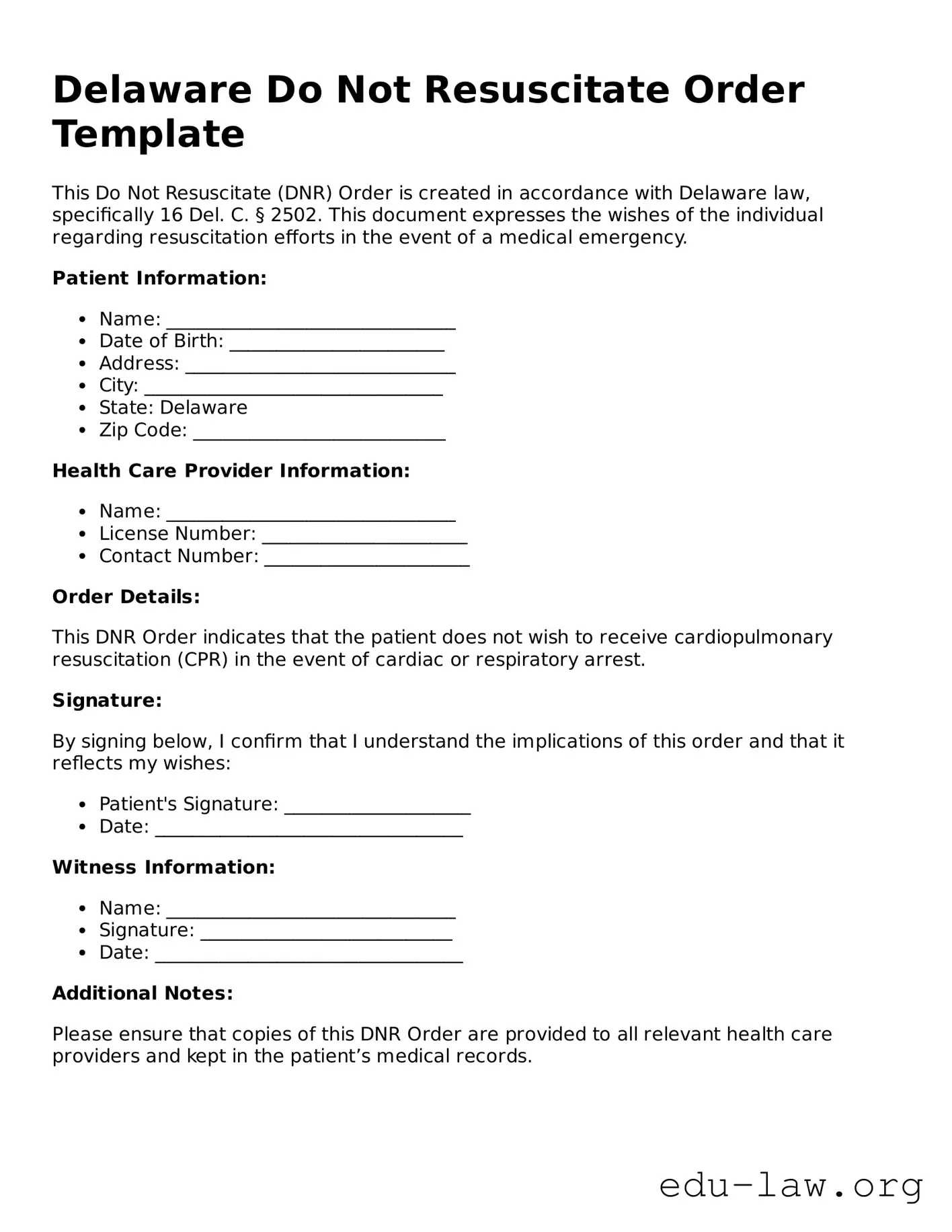
The Delaware Do Not Resuscitate (DNR) Order form serves as a crucial document for individuals who wish to express their preferences regarding medical treatment in the event of a life-threatening emergency. This form allows patients to communicate their desire not to receive cardiopulmonary resuscitation (CPR) or other life-sustaining measures if their heart stops beating or if they stop breathing. It is designed for use by adults who are capable of making informed decisions about their healthcare. The DNR form must be completed and signed by the patient or their authorized representative, and it typically requires the signature of a physician to ensure that the order is valid and recognized by emergency medical personnel. Importantly, the document is intended to provide clarity and guidance to healthcare providers, family members, and emergency responders, ensuring that the individual's wishes are respected during critical moments. Additionally, the DNR Order form is part of a broader conversation about advance care planning, which encompasses various legal documents that outline a person's healthcare preferences. Understanding the implications and requirements of the DNR form is essential for anyone considering this option, as it plays a significant role in end-of-life care decisions.
Delaware Do Not Resuscitate Order Template
This Do Not Resuscitate (DNR) Order is created in accordance with Delaware law, specifically 16 Del. C. § 2502. This document expresses the wishes of the individual regarding resuscitation efforts in the event of a medical emergency.
Patient Information:
Health Care Provider Information:
Order Details:
This DNR Order indicates that the patient does not wish to receive cardiopulmonary resuscitation (CPR) in the event of cardiac or respiratory arrest.
Signature:
By signing below, I confirm that I understand the implications of this order and that it reflects my wishes:
Witness Information:
Additional Notes:
Please ensure that copies of this DNR Order are provided to all relevant health care providers and kept in the patient’s medical records.
| Fact Name | Details |
|---|---|
| Governing Law | The Delaware Do Not Resuscitate Order is governed by Title 16, Chapter 2503 of the Delaware Code. |
| Purpose | This form is intended to communicate a person's wishes regarding resuscitation efforts in case of a medical emergency. |
| Eligibility | Any adult who is capable of making healthcare decisions can complete the Do Not Resuscitate Order. |
| Signature Requirement | The form must be signed by the individual or their legal representative to be valid. |
| Healthcare Provider's Role | A healthcare provider must sign the order to confirm that they understand the patient's wishes. |
| Form Availability | The Do Not Resuscitate Order form can be obtained from healthcare facilities or the Delaware Division of Public Health. |
| Revocation | A person can revoke the Do Not Resuscitate Order at any time, verbally or in writing. |
| Emergency Medical Services | Emergency medical personnel are required to honor a valid Do Not Resuscitate Order in the field. |
Filling out the Delaware Do Not Resuscitate Order form is an important step in expressing your healthcare preferences. After completing the form, it will be essential to share it with your healthcare providers and keep copies in accessible locations to ensure your wishes are honored in a medical emergency.
What is a Do Not Resuscitate (DNR) Order in Delaware?
A Do Not Resuscitate Order is a legal document that allows a person to refuse certain life-saving medical treatments, specifically cardiopulmonary resuscitation (CPR), in the event of a medical emergency. In Delaware, this order is designed for individuals who have a terminal illness or are in a state where they do not wish to receive aggressive life-sustaining treatment. It ensures that medical personnel respect the individual's wishes regarding resuscitation efforts.
How do I obtain a DNR Order in Delaware?
To obtain a DNR Order in Delaware, you must first have a conversation with your healthcare provider. They can help you understand the implications of a DNR and determine if it aligns with your healthcare goals. Once you and your healthcare provider agree on the decision, they will complete the DNR Order form, which you will need to sign. It's essential to keep copies of the signed form in accessible locations, such as with your medical records or with a trusted family member.
Will my DNR Order be honored in all medical settings?
Yes, a properly executed DNR Order in Delaware should be honored in all medical settings, including hospitals, nursing homes, and emergency medical services. However, it's crucial to ensure that the order is easily accessible and that medical personnel are aware of its existence. You may want to carry a wallet card or wear a medical alert bracelet indicating your DNR status. This can help ensure that your wishes are respected in an emergency situation.
Can I change or revoke my DNR Order?
Absolutely. You have the right to change or revoke your DNR Order at any time. If you decide to do so, it’s important to inform your healthcare provider and complete a new form if necessary. You should also ensure that any copies of the old DNR Order are destroyed or marked as revoked to avoid confusion. Keeping open communication with your healthcare team about your wishes is essential for ensuring that your current preferences are understood and followed.
Failing to complete all required sections of the form. Each part of the Delaware Do Not Resuscitate Order form must be filled out completely to ensure that the document is valid and enforceable.
Not having the form signed by a licensed physician. A signature from a qualified healthcare provider is essential for the order to be recognized by medical personnel.
Using outdated versions of the form. It is important to ensure that the most current version of the Delaware Do Not Resuscitate Order form is used, as regulations may change.
Neglecting to discuss the order with family members or caregivers. Open communication about the intentions behind the order can help prevent confusion and ensure that everyone involved understands the individual's wishes.
When dealing with end-of-life care, individuals and families often utilize various documents alongside the Delaware Do Not Resuscitate (DNR) Order form. These documents help ensure that a person's medical preferences are clearly understood and honored. Here are some commonly used forms and documents:
These documents work together to create a comprehensive plan for medical care and decision-making. By understanding and utilizing them, individuals can ensure that their healthcare wishes are respected, providing peace of mind for both themselves and their loved ones.
The Delaware Do Not Resuscitate (DNR) Order form shares similarities with a living will. A living will is a legal document that outlines an individual’s preferences regarding medical treatment in situations where they cannot communicate their wishes. Like the DNR, a living will can specify the types of medical interventions a person does or does not want, particularly in end-of-life scenarios. Both documents serve to ensure that a person's healthcare choices are respected, allowing individuals to maintain control over their medical care even when they are unable to express their desires verbally.
Another document akin to the DNR is a healthcare power of attorney. This legal instrument designates a trusted individual to make healthcare decisions on behalf of someone who is incapacitated. While the DNR specifically addresses resuscitation efforts, a healthcare power of attorney can encompass a broader range of medical decisions. Both documents emphasize the importance of personal autonomy in healthcare and provide a mechanism for individuals to communicate their preferences in advance, ensuring that their values and wishes are honored during critical moments.
A physician’s orders for life-sustaining treatment (POLST) form is also similar to the DNR Order form. The POLST is designed for patients with serious illnesses or those who are near the end of life. It translates a patient’s treatment preferences into actionable medical orders, which healthcare providers must follow. Like the DNR, the POLST allows individuals to specify their wishes regarding resuscitation and other life-sustaining measures. This document is particularly useful for ensuring that a patient’s preferences are clear and can be easily communicated across different healthcare settings.
The advance directive shares common ground with the DNR Order form as well. An advance directive is a broader category that includes both living wills and healthcare powers of attorney. It allows individuals to outline their healthcare preferences and appoint a representative to make decisions on their behalf. Similar to the DNR, advance directives are crucial for ensuring that an individual’s wishes regarding medical treatment are honored, especially in situations where they may not be able to voice those wishes themselves.
Lastly, the do-not-hospitalize (DNH) order is another document that parallels the DNR. A DNH order is specifically designed to prevent hospital admissions for patients who wish to remain in their current care setting, often due to terminal illness or advanced age. While the DNR focuses on resuscitation efforts, the DNH emphasizes the overall approach to care and the patient’s desire to avoid hospitalization. Both documents reflect a commitment to honoring the patient's preferences and ensuring that their end-of-life care aligns with their values and desires.
When filling out the Delaware Do Not Resuscitate Order form, it’s important to follow certain guidelines. Here are some things you should and shouldn’t do:
Taking these steps can help ensure that your wishes are respected in a medical emergency.
When it comes to the Delaware Do Not Resuscitate (DNR) Order form, there are several misconceptions that can lead to confusion. Here are six common misunderstandings:
This is not true. A DNR order specifically addresses resuscitation efforts in the event of cardiac arrest. Other medical treatments, such as pain management or medications, can still be provided.
A DNR order can be appropriate for anyone who wishes to avoid resuscitation in specific circumstances, not just those who are terminally ill.
This is incorrect. Individuals can revoke or modify their DNR orders at any time, as long as they are mentally competent to do so.
Emergency responders will still provide necessary medical care up until the point of resuscitation. A DNR order only applies to resuscitation efforts.
While a physician's signature is typically required, the DNR order can also be valid if it meets specific criteria set by Delaware law.
DNR orders may not be recognized in all settings, such as in hospitals or during certain medical procedures. It’s important to communicate your wishes clearly to all healthcare providers.
Understanding these misconceptions can help individuals make informed decisions regarding their healthcare preferences and ensure their wishes are respected.
The Delaware Do Not Resuscitate (DNR) Order form is an important legal document for individuals who wish to express their preferences regarding resuscitation efforts in the event of a medical emergency. Below are key takeaways regarding the use of this form.