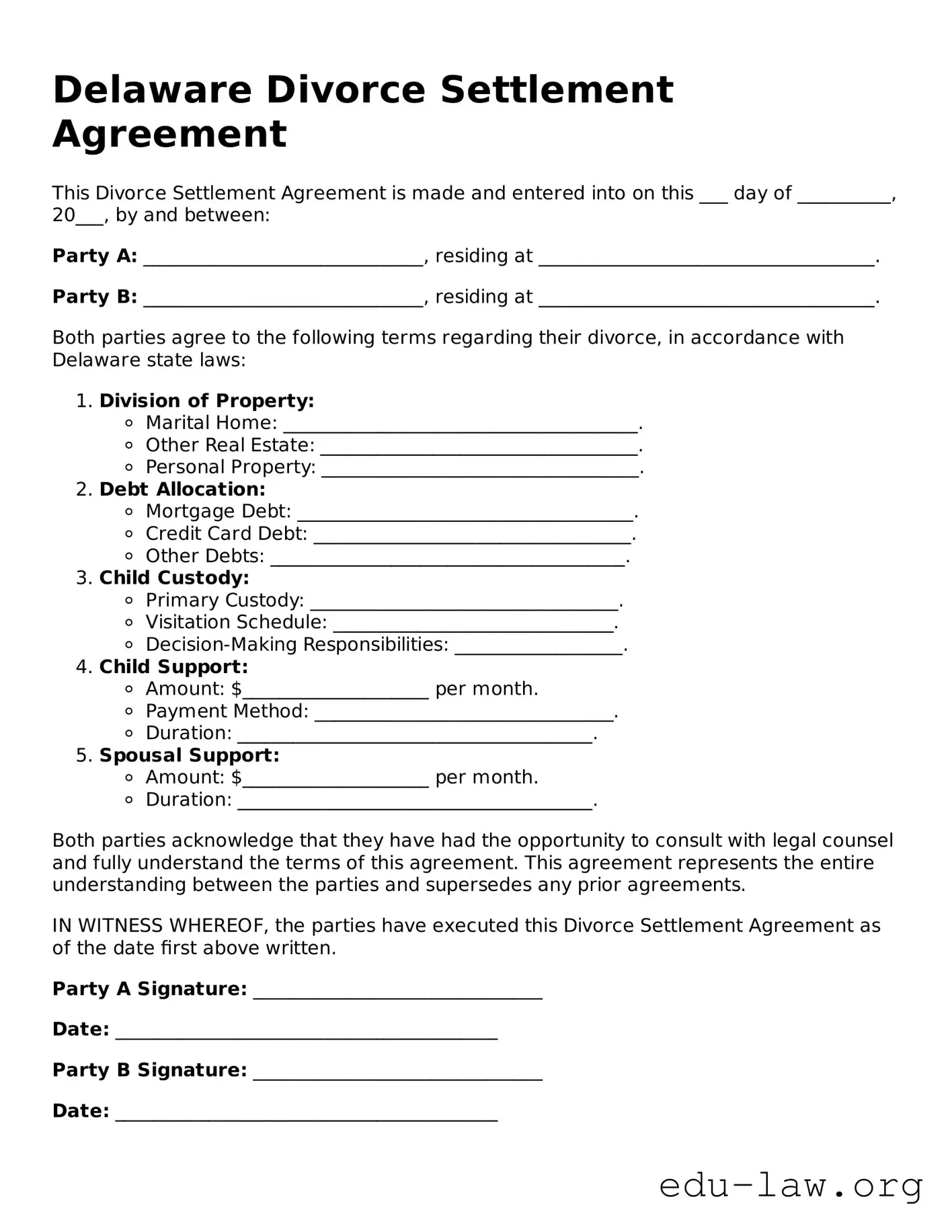
When navigating the complexities of divorce, one of the most crucial documents involved is the Delaware Divorce Settlement Agreement form. This form serves as a comprehensive outline of the terms and conditions agreed upon by both parties, addressing key aspects such as the division of assets and debts, child custody arrangements, visitation schedules, and spousal support. It is designed to ensure that both individuals have a clear understanding of their rights and responsibilities post-divorce. In addition to these critical components, the agreement also outlines how any future disputes will be resolved, providing a framework for cooperation and communication. Completing this form accurately is essential, as it not only reflects the mutual consent of both parties but also becomes a binding legal document once approved by the court. By understanding the major elements of this agreement, individuals can better prepare themselves for the emotional and financial implications of divorce, ultimately leading to a more amicable resolution.
Delaware Divorce Settlement Agreement
This Divorce Settlement Agreement is made and entered into on this ___ day of __________, 20___, by and between:
Party A: ______________________________, residing at ____________________________________.
Party B: ______________________________, residing at ____________________________________.
Both parties agree to the following terms regarding their divorce, in accordance with Delaware state laws:
Both parties acknowledge that they have had the opportunity to consult with legal counsel and fully understand the terms of this agreement. This agreement represents the entire understanding between the parties and supersedes any prior agreements.
IN WITNESS WHEREOF, the parties have executed this Divorce Settlement Agreement as of the date first above written.
Party A Signature: _______________________________
Date: _________________________________________
Party B Signature: _______________________________
Date: _________________________________________
| Fact Name | Details |
|---|---|
| Governing Law | The Delaware Divorce Settlement Agreement is governed by Title 13 of the Delaware Code, specifically relating to family law. |
| Purpose | This form is used to outline the terms of a divorce settlement between spouses, including asset division, child custody, and support agreements. |
| Filing Requirements | The completed agreement must be filed with the Family Court in the county where the divorce is initiated. |
| Mutual Agreement | Both parties must agree to the terms outlined in the settlement for it to be valid and enforceable. |
| Modification | Once signed and approved by the court, the agreement can only be modified through a new court order. |
| Legal Representation | While not required, it is highly recommended that each party consults with an attorney before signing the agreement to ensure their rights are protected. |
After obtaining the Delaware Divorce Settlement Agreement form, the next step involves carefully filling it out with accurate and relevant information. This form will facilitate the resolution of various issues related to the divorce, including property division, child custody, and support arrangements.
What is a Delaware Divorce Settlement Agreement?
A Delaware Divorce Settlement Agreement is a legal document that outlines the terms and conditions agreed upon by both spouses during the divorce process. This agreement covers various aspects such as property division, alimony, child custody, and child support. It serves as a binding contract once signed by both parties and approved by the court.
Why is a Divorce Settlement Agreement important?
This agreement is crucial as it helps to clarify the rights and responsibilities of each spouse after the divorce. It aims to prevent future disputes by ensuring that both parties have a mutual understanding of the settlement terms. Additionally, having a formal agreement can expedite the divorce process and provide peace of mind for both parties involved.
What should be included in the Divorce Settlement Agreement?
Key elements typically included in a Divorce Settlement Agreement are the division of marital property, arrangements for child custody and visitation, child support obligations, and spousal support terms. It may also address debts and any other relevant financial matters. Each agreement should be tailored to the specific needs of the family involved.
Can the Divorce Settlement Agreement be modified after it is signed?
Yes, the Divorce Settlement Agreement can be modified after it is signed, but only under certain circumstances. Both parties must agree to the changes, and the modifications must be documented and submitted to the court for approval. This is especially common in matters involving child custody or support as circumstances can change over time.
How do I create a Divorce Settlement Agreement?
Creating a Divorce Settlement Agreement involves discussing and negotiating the terms with your spouse. It is advisable to consider consulting with a legal professional to ensure that your rights are protected. Once both parties reach an agreement, it should be drafted in writing, reviewed, and signed before being submitted to the court.
Is legal representation necessary when drafting a Divorce Settlement Agreement?
While legal representation is not strictly necessary, it is highly recommended. An attorney can provide valuable guidance, ensure that the agreement is fair, and help navigate any complex issues that may arise. Having legal advice can also help prevent future disputes and ensure that the agreement complies with Delaware law.
What happens if we cannot reach an agreement?
If both parties cannot reach an agreement, the divorce may proceed to court. A judge will then make decisions regarding the division of assets, child custody, and support based on the evidence presented. This process can be lengthy and costly, making it beneficial to try to resolve disputes amicably before resorting to litigation.
Where do I file the Divorce Settlement Agreement in Delaware?
The Divorce Settlement Agreement must be filed with the Family Court in the county where either spouse resides. It is essential to follow the specific filing procedures outlined by the court. Proper filing ensures that the agreement is recognized and enforceable under Delaware law.
Inadequate Disclosure of Assets: One common mistake is failing to fully disclose all assets and liabilities. When parties do not provide a complete picture of their financial situation, it can lead to future disputes and complications.
Ignoring Child Support Guidelines: Many individuals overlook the child support guidelines established by Delaware law. It’s crucial to calculate support obligations accurately to ensure fairness and compliance.
Vague Language: Using ambiguous terms can create confusion. Clear and precise language is essential to avoid misinterpretations that could arise later.
Neglecting to Address Future Changes: Some people fail to consider how life changes, such as job loss or relocation, might affect the agreement. Including provisions for future modifications can safeguard against unexpected circumstances.
Not Consulting a Legal Professional: Attempting to navigate the process without legal guidance can lead to oversights. Consulting with a legal expert can provide clarity and ensure that all necessary elements are included.
Forgetting to Review the Agreement: Once the form is filled out, some individuals neglect to review it thoroughly. A careful review can catch errors and ensure that all parties are in agreement before submission.
When navigating the process of divorce in Delaware, several documents often accompany the Divorce Settlement Agreement. Each of these forms plays a vital role in ensuring that the divorce proceedings are handled smoothly and that both parties' rights and responsibilities are clearly defined. Below are some key documents you may encounter.
Understanding these documents can significantly ease the divorce process. Each form serves a specific purpose, contributing to a fair and organized resolution. Being prepared with the necessary paperwork can help individuals focus on moving forward with their lives.
The Delaware Child Support Agreement is similar to the Divorce Settlement Agreement in that both documents aim to address the financial responsibilities of parents after separation or divorce. The Child Support Agreement specifically outlines the amount of financial support one parent will provide to the other for the upbringing of their children. Like the Divorce Settlement Agreement, it must be mutually agreed upon by both parties and can be enforced by the court. Both documents play a crucial role in ensuring that the needs of children are met while minimizing conflict between parents.
The Parenting Plan is another document that shares similarities with the Divorce Settlement Agreement. This plan details how parents will share responsibilities and make decisions regarding their children after a divorce. It covers aspects such as custody arrangements, visitation schedules, and communication methods between parents. Like the Divorce Settlement Agreement, the Parenting Plan requires cooperation and agreement from both parties, aiming to provide a stable environment for children during and after the divorce process.
The Property Settlement Agreement is closely related to the Divorce Settlement Agreement, as both deal with the division of assets and liabilities during a divorce. This document specifically outlines how marital property will be divided between the spouses, including real estate, bank accounts, and debts. Both agreements serve to clarify financial arrangements and help prevent disputes in the future. They ensure that both parties have a clear understanding of their rights and responsibilities regarding property after the divorce.
The Alimony Agreement is another document that aligns with the Divorce Settlement Agreement, focusing on financial support. This agreement specifies whether one spouse will provide financial assistance to the other after the divorce, including the amount and duration of support. Similar to the Divorce Settlement Agreement, the Alimony Agreement must be agreed upon by both parties and can be incorporated into the final divorce decree. It aims to provide financial stability for the lower-earning spouse during the transition to post-marital life.
Lastly, the Separation Agreement bears similarities to the Divorce Settlement Agreement, as it is often used when couples decide to live apart but are not yet divorced. This document outlines the terms of the separation, including child custody, support, and property division. Like the Divorce Settlement Agreement, it requires both parties to come to a mutual understanding and agreement on various issues. This agreement can later serve as a foundation for the divorce settlement, making the transition smoother when the couple decides to finalize their divorce.
When filling out the Delaware Divorce Settlement Agreement form, it is essential to approach the task with care. Here are some important guidelines to consider:
Following these guidelines can help facilitate a smoother experience when completing the Divorce Settlement Agreement form in Delaware.
When navigating the Delaware Divorce Settlement Agreement form, several misconceptions can lead to confusion. Understanding the truth behind these myths is essential for a smooth divorce process. Here are five common misconceptions:
Addressing these misconceptions can help individuals approach the divorce process with clarity and confidence. It is vital to seek accurate information and, if necessary, professional guidance to navigate the complexities of divorce in Delaware.
When filling out and using the Delaware Divorce Settlement Agreement form, there are several important points to keep in mind. Understanding these key takeaways can help ensure a smoother process.
By following these key points, you can navigate the process more effectively and work towards a resolution that meets the needs of all parties involved.