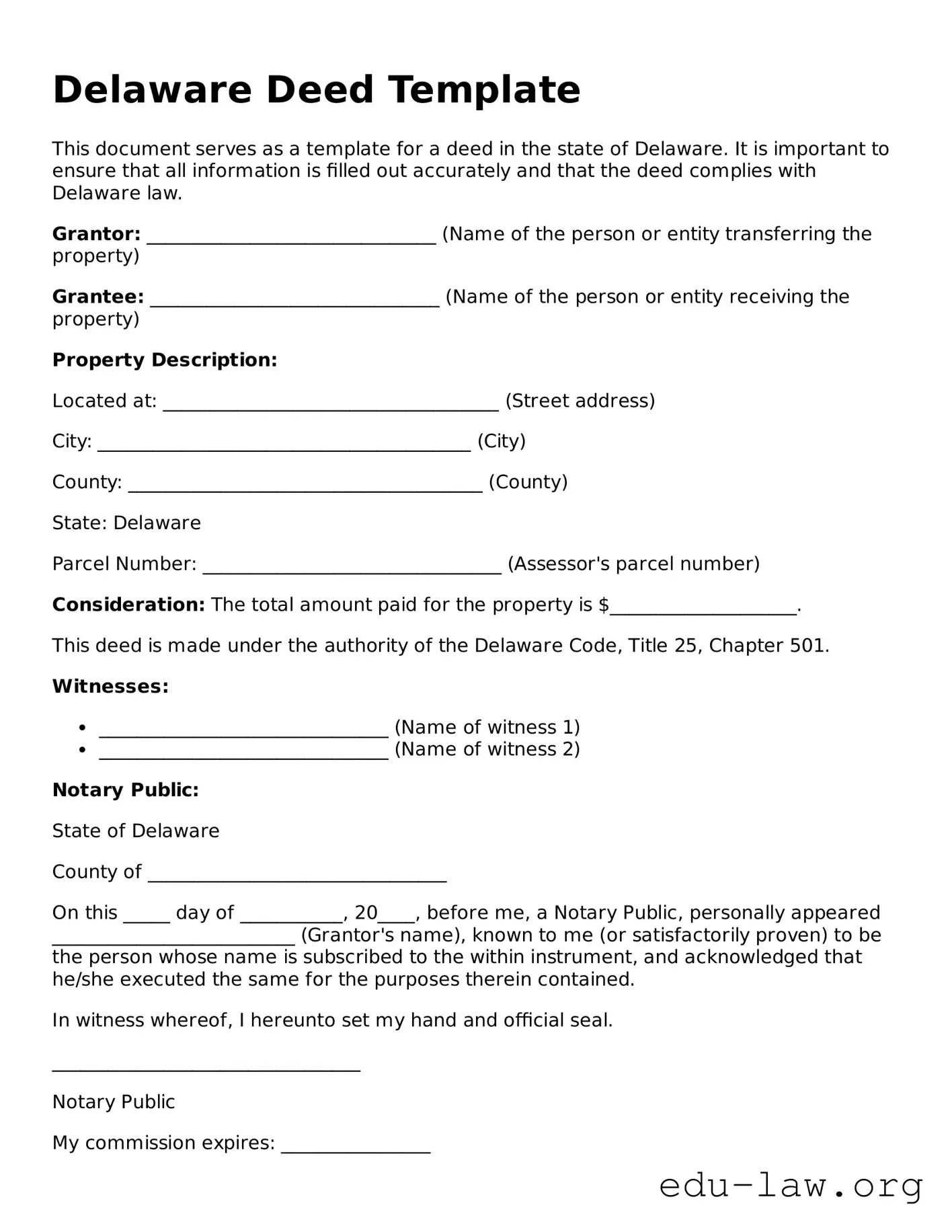
When navigating the complexities of real estate transactions in Delaware, understanding the Delaware Deed form is essential. This legal document serves as a crucial instrument for transferring property ownership, ensuring that the rights of both the seller and the buyer are clearly defined and protected. The form typically includes vital information such as the names of the parties involved, a detailed description of the property being transferred, and the terms of the transfer. Additionally, it often requires signatures from both parties, along with witnesses or a notary, to validate the transaction. The Delaware Deed form may also specify any conditions or covenants associated with the property, providing clarity on what the new owner can and cannot do with the land. Whether you are a seasoned investor or a first-time homebuyer, familiarity with this document can significantly streamline the process of property acquisition in Delaware.
Delaware Deed Template
This document serves as a template for a deed in the state of Delaware. It is important to ensure that all information is filled out accurately and that the deed complies with Delaware law.
Grantor: _______________________________ (Name of the person or entity transferring the property)
Grantee: _______________________________ (Name of the person or entity receiving the property)
Property Description:
Located at: ____________________________________ (Street address)
City: ________________________________________ (City)
County: ______________________________________ (County)
State: Delaware
Parcel Number: ________________________________ (Assessor's parcel number)
Consideration: The total amount paid for the property is $____________________.
This deed is made under the authority of the Delaware Code, Title 25, Chapter 501.
Witnesses:
Notary Public:
State of Delaware
County of ________________________________
On this _____ day of ___________, 20____, before me, a Notary Public, personally appeared __________________________ (Grantor's name), known to me (or satisfactorily proven) to be the person whose name is subscribed to the within instrument, and acknowledged that he/she executed the same for the purposes therein contained.
In witness whereof, I hereunto set my hand and official seal.
_________________________________
Notary Public
My commission expires: ________________
| Fact Name | Description |
|---|---|
| Governing Law | The Delaware Deed form is governed by the Delaware Code, Title 25, Chapter 501. |
| Types of Deeds | Delaware recognizes various types of deeds, including warranty deeds, quitclaim deeds, and special purpose deeds. |
| Required Information | Essential details must be included, such as the names of the grantor and grantee, property description, and the date of execution. |
| Notarization | The Delaware Deed must be signed in the presence of a notary public to be considered valid. |
| Filing Requirements | After execution, the deed should be recorded with the appropriate county recorder's office to ensure public notice. |
After completing the Delaware Deed form, it will need to be submitted for recording with the appropriate county office. Ensure that all necessary information is accurate and complete to avoid delays in processing.
What is a Delaware Deed form?
A Delaware Deed form is a legal document used to transfer ownership of real estate from one party to another within the state of Delaware. This form captures essential details about the property, including its legal description, the names of the parties involved, and any conditions or terms associated with the transfer. It serves as proof of ownership once properly executed and recorded with the appropriate county office.
What types of deeds are available in Delaware?
Delaware offers several types of deeds, each serving different purposes. The most common include the General Warranty Deed, which provides the highest level of protection to the buyer, ensuring that the seller has clear title to the property. The Special Warranty Deed offers limited guarantees, covering only the period during which the seller owned the property. There are also Quitclaim Deeds, which transfer whatever interest the seller has without any warranties. Understanding the differences is crucial for making an informed decision.
How do I fill out a Delaware Deed form?
Filling out a Delaware Deed form requires careful attention to detail. Start by entering the names of the grantor (the person transferring the property) and the grantee (the person receiving the property). Next, include a clear legal description of the property, which can typically be found in previous deeds or property tax records. Be sure to specify the type of deed you are using. Finally, both parties must sign the document, and it should be notarized to validate the transaction.
Do I need to record the Delaware Deed form?
Yes, recording the Delaware Deed form is essential. Once the deed is signed and notarized, it must be filed with the Recorder of Deeds in the county where the property is located. Recording the deed provides public notice of the transfer and protects the rights of the new owner. It also helps prevent future disputes regarding property ownership. Failing to record the deed may lead to complications down the line.
Are there any fees associated with filing a Delaware Deed form?
Yes, there are fees associated with filing a Delaware Deed form. These fees can vary depending on the county and the type of deed being recorded. Typically, there is a nominal fee for the recording process, as well as potential additional costs for any necessary certifications or copies. It’s advisable to check with the local Recorder of Deeds office for the most accurate and current fee schedule.
Incorrect Names: Ensure that the names of all parties involved are spelled correctly and match their legal identification. Any discrepancies can lead to delays or complications.
Missing Signatures: All required signatures must be present. If a signature is missing, the deed may not be valid.
Improper Notarization: The deed must be notarized correctly. Failing to have a notary public witness the signing can invalidate the document.
Incorrect Legal Description: The property’s legal description should be accurate and detailed. Errors in this section can create confusion regarding the property boundaries.
Failure to Include the Date: Not dating the document can lead to questions about when the transfer took place. Always include the date of execution.
Omitting the Consideration: The deed should state the consideration, or payment, involved in the transfer. Leaving this blank may raise legal issues later.
Incorrect Property Type: Clearly indicate whether the property is residential, commercial, or otherwise. Misidentifying the property type can complicate future transactions.
Inadequate Witnesses: Some deeds require witnesses. Check local requirements to ensure that the deed is properly witnessed, if necessary.
Not Filing the Deed: After completion, the deed must be filed with the appropriate county office. Failing to do so can result in a lack of public record for the transaction.
When dealing with property transactions in Delaware, several forms and documents often accompany the Delaware Deed form. Each of these documents plays a vital role in ensuring that the transfer of property is conducted smoothly and legally. Below is a list of commonly used documents that may be required in conjunction with the Delaware Deed form.
Each of these documents serves an important function in the property transfer process. Together, they help protect the interests of all parties involved and facilitate a successful transaction. Understanding these forms can alleviate some of the stress associated with real estate dealings.
The Delaware Deed form shares similarities with the Warranty Deed. A Warranty Deed guarantees that the seller holds clear title to the property and has the right to sell it. This document also provides a warranty that the property is free from any encumbrances, ensuring the buyer has legal protection against future claims. In both forms, the transfer of ownership is clearly documented, making them reliable for both parties involved.
Another similar document is the Quitclaim Deed. Unlike a Warranty Deed, a Quitclaim Deed transfers whatever interest the seller may have in the property without any guarantees. While it may not provide the same level of protection, it is often used in situations such as divorce or transferring property between family members. Both forms serve to legally transfer ownership, but the level of assurance differs significantly.
The Special Purpose Deed is also comparable to the Delaware Deed form. This type of deed is used for specific transactions, such as transferring property into a trust or for estate planning purposes. Like the Delaware Deed, it must be executed correctly to ensure the transfer is legally binding. Both documents require the signature of the grantor and may necessitate notarization.
The Bargain and Sale Deed is another document that bears resemblance to the Delaware Deed. This deed implies that the seller has the right to sell the property but does not provide any warranties against defects in title. While it is less protective than a Warranty Deed, it is often utilized in real estate transactions where the buyer is aware of potential risks. Both deeds facilitate the transfer of property ownership, albeit with different levels of assurance.
The Grant Deed is similar as well, as it conveys ownership of real property and includes certain implied warranties. The seller guarantees that they have not sold the property to anyone else and that the property is free from undisclosed encumbrances. Both the Grant Deed and the Delaware Deed form serve to document the transfer of property, ensuring that ownership is clear and recognized.
The Deed of Trust is another document that aligns with the Delaware Deed form. While it serves a different purpose—acting as a security for a loan—it still involves the transfer of property interest. The borrower conveys the property to a trustee, who holds it until the loan is paid off. Both documents require precise execution and can significantly impact ownership rights.
The Executor’s Deed is also comparable to the Delaware Deed. This deed is used to transfer property from a deceased person's estate to heirs or beneficiaries. It is executed by the executor of the estate and must comply with specific legal requirements. Both forms are essential in confirming the transfer of property ownership, though the Executor’s Deed is tied to the probate process.
The Mineral Deed is another document that shares similarities with the Delaware Deed form. This deed specifically transfers rights to minerals beneath the surface of the property. While it may not transfer the surface rights, it is essential for those involved in mining or drilling activities. Both documents legally transfer interests in property, though they may pertain to different aspects of ownership.
Finally, the Leasehold Deed can be compared to the Delaware Deed form in that it grants rights to use and occupy a property for a specified period. While it does not convey ownership outright, it establishes a legal relationship between the lessor and lessee. Both forms require clear documentation to protect the rights of the parties involved.
When filling out the Delaware Deed form, it’s essential to ensure that the information is accurate and complete. Below is a list of things to do and avoid during this process.
Misconception 1: The Delaware Deed form is only for transferring residential property.
This is not true. The Delaware Deed form can be used for various types of property, including commercial real estate and vacant land. It is a versatile document that accommodates different property types, ensuring that all transactions are legally recognized.
Misconception 2: A notary public is not necessary for a Delaware Deed to be valid.
In fact, a notary public is essential for validating the deed. The signatures of the parties involved must be notarized to ensure that the document holds up in court. Without proper notarization, the deed may be deemed invalid.
Misconception 3: The Delaware Deed form does not require any specific information about the property.
This is incorrect. The form requires detailed information about the property, including its legal description, the names of the grantor and grantee, and any encumbrances. Failing to include this information could lead to complications in the transfer process.
Misconception 4: Once a Delaware Deed is filed, it cannot be changed or revoked.
This is misleading. While a filed deed is generally considered final, it can be amended or revoked under certain circumstances. If a mistake is discovered or if the parties agree to change the terms, a corrective deed can be filed to address these issues.
Filling out and using the Delaware Deed form can be straightforward if you keep a few key points in mind. Here are some important takeaways to consider:
By following these takeaways, you can navigate the process of completing and using the Delaware Deed form with greater confidence.