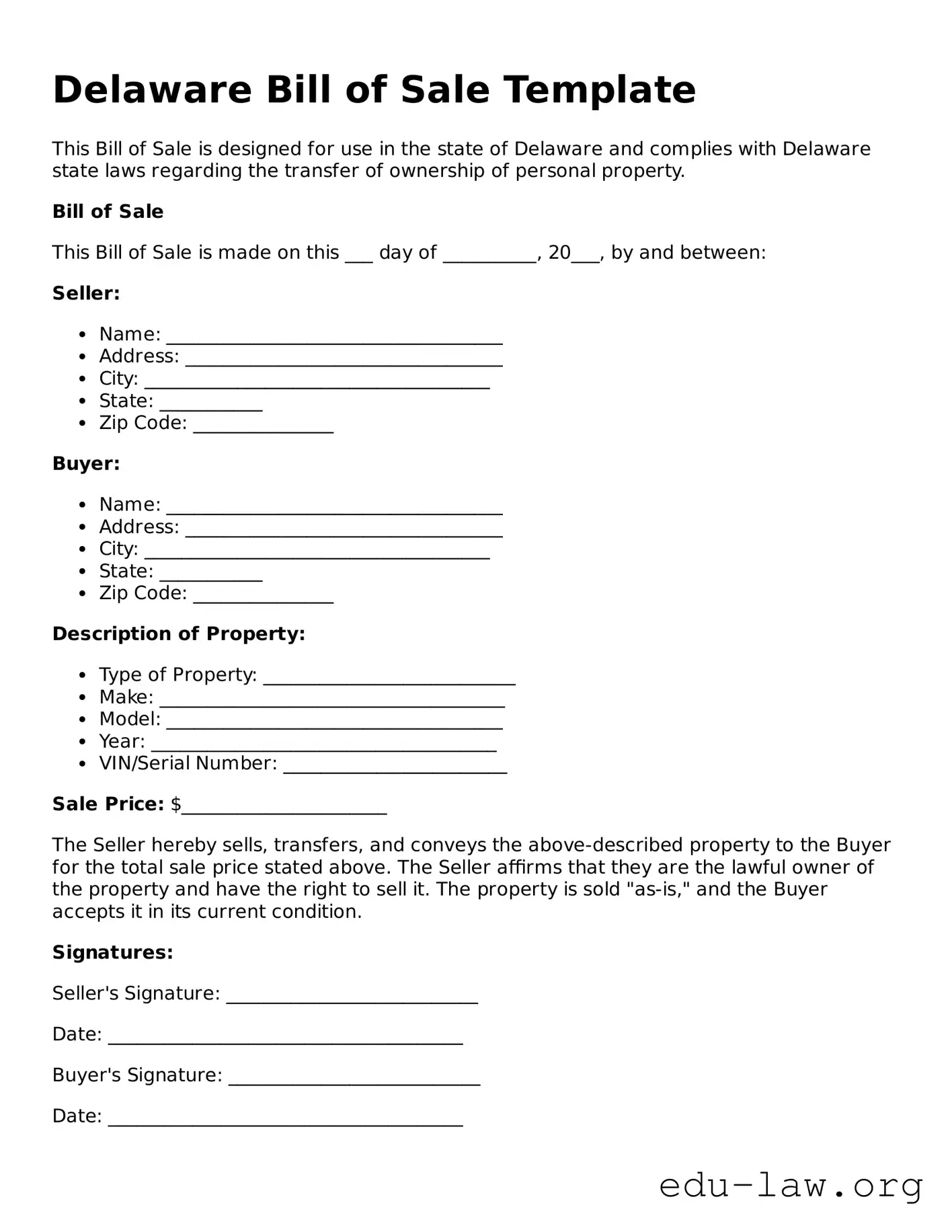
The Delaware Bill of Sale form serves as a vital document in the transfer of ownership for various types of personal property, including vehicles, boats, and equipment. This form not only provides a record of the transaction but also protects both the buyer and seller by outlining key details such as the description of the item, the purchase price, and the date of the sale. In Delaware, having a properly completed Bill of Sale is essential for registering the item with the appropriate state authorities, particularly in the case of vehicles. It can also serve as proof of ownership in disputes or for insurance purposes. By including the names and addresses of both parties, along with their signatures, the form establishes a clear agreement that can be referenced in the future. Understanding the components of the Delaware Bill of Sale is crucial for anyone involved in buying or selling personal property in the state.
Delaware Bill of Sale Template
This Bill of Sale is designed for use in the state of Delaware and complies with Delaware state laws regarding the transfer of ownership of personal property.
Bill of Sale
This Bill of Sale is made on this ___ day of __________, 20___, by and between:
Seller:
Buyer:
Description of Property:
Sale Price: $______________________
The Seller hereby sells, transfers, and conveys the above-described property to the Buyer for the total sale price stated above. The Seller affirms that they are the lawful owner of the property and have the right to sell it. The property is sold "as-is," and the Buyer accepts it in its current condition.
Signatures:
Seller's Signature: ___________________________
Date: ______________________________________
Buyer's Signature: ___________________________
Date: ______________________________________
This document serves as a legal record of the transaction and should be kept by both parties for their records.
| Fact Name | Description |
|---|---|
| Purpose | The Delaware Bill of Sale is used to document the transfer of ownership of personal property from one party to another. |
| Governing Law | This form is governed by the Delaware Uniform Commercial Code (UCC), specifically Title 6, Chapter 2. |
| Types of Property | The form can be used for various types of personal property, including vehicles, equipment, and other tangible items. |
| Notarization | While notarization is not required, it is recommended to enhance the document's credibility. |
| Information Required | Essential details include the names and addresses of both the buyer and seller, a description of the item, and the sale price. |
| Use in Vehicle Sales | The Bill of Sale is particularly important for vehicle transactions, as it may be required for registration and title transfer. |
| Record Keeping | Both parties should retain a copy of the completed Bill of Sale for their records, as it serves as proof of the transaction. |
| Legal Protection | A properly completed Bill of Sale can provide legal protection for both the buyer and seller in case of disputes. |
Once you have the Delaware Bill of Sale form in front of you, it's time to fill it out accurately. This document is essential for transferring ownership of personal property, and completing it correctly will help ensure a smooth transaction.
After completing these steps, the Bill of Sale will be ready for use. Keep a copy for your records, as it serves as proof of the transaction.
What is a Delaware Bill of Sale form?
A Delaware Bill of Sale form is a legal document that records the transfer of ownership of personal property from one party to another. This form serves as proof of the transaction and outlines details such as the buyer, seller, item description, and sale price.
When do I need a Bill of Sale in Delaware?
You typically need a Bill of Sale when you buy or sell personal property, such as vehicles, boats, or equipment. It is particularly important for high-value items, as it provides legal protection for both the buyer and seller by documenting the transaction.
Is a Bill of Sale required by law in Delaware?
While a Bill of Sale is not legally required for all transactions in Delaware, it is highly recommended. For certain items, such as vehicles, a Bill of Sale may be necessary to complete the registration process with the Delaware Division of Motor Vehicles.
What information should be included in the Bill of Sale?
The Bill of Sale should include the names and addresses of both the buyer and seller, a detailed description of the item being sold, the sale price, and the date of the transaction. It is also wise to include signatures from both parties to validate the agreement.
Can I create my own Bill of Sale?
Yes, you can create your own Bill of Sale. Ensure that it contains all necessary information and is clear and concise. Many templates are available online, but customizing one to fit your specific transaction can be beneficial.
Does a Bill of Sale need to be notarized in Delaware?
A Bill of Sale does not need to be notarized to be legally binding in Delaware. However, having it notarized can add an extra layer of authenticity and may be required by some parties or institutions, such as banks or the DMV.
What should I do if the seller does not provide a Bill of Sale?
If the seller does not provide a Bill of Sale, you can request one. If they refuse, consider documenting the transaction yourself. Take photos of the item, keep records of any communication, and ask for a written confirmation of the sale. This documentation can help protect your interests.
Where can I find a Delaware Bill of Sale template?
You can find Delaware Bill of Sale templates online through legal websites, government resources, or document preparation services. Ensure that the template you choose complies with Delaware laws and meets your specific needs.
Not including all required information. The Bill of Sale must have complete details about the buyer, seller, and the item being sold.
Failing to provide accurate descriptions. The item should be described clearly, including its make, model, year, and condition.
Omitting the date of the transaction. The date is essential for record-keeping and legal purposes.
Not signing the document. Both the buyer and seller must sign the Bill of Sale for it to be valid.
Using incorrect or outdated forms. Ensure that the latest version of the Delaware Bill of Sale form is used.
Forgetting to include payment details. It is important to specify the payment method and amount.
Not providing identification information. Including driver's license numbers or other ID details can help verify the identities of both parties.
Neglecting to make copies. Both parties should retain a copy of the signed Bill of Sale for their records.
Failing to check for typos or errors. Mistakes in names, addresses, or other critical information can lead to disputes.
Not understanding the implications of the sale. Both parties should be aware of their rights and responsibilities once the Bill of Sale is signed.
The Delaware Bill of Sale is an important document for transferring ownership of personal property. However, several other forms and documents are often used in conjunction with it to ensure a smooth transaction. Here are some common forms that may accompany the Bill of Sale:
Each of these documents plays a vital role in the sale process, providing clarity and protection for both the buyer and seller. By utilizing these forms alongside the Delaware Bill of Sale, individuals can navigate their transactions with confidence.
The Vehicle Bill of Sale is a document used when transferring ownership of a vehicle. Like the Delaware Bill of Sale, it serves as proof of the transaction between the buyer and the seller. This document typically includes details such as the vehicle identification number (VIN), make, model, and year, along with the names and addresses of both parties. Both documents require signatures to validate the sale.
The Personal Property Bill of Sale is similar in that it documents the sale of personal items, such as furniture or electronics. This form outlines the specifics of the items sold, including descriptions and any relevant serial numbers. It protects both the buyer and seller by providing a record of the transaction, just like the Delaware Bill of Sale does for various types of property.
The Firearm Bill of Sale is necessary when buying or selling firearms. This document includes details about the firearm, such as make, model, and serial number. Similar to the Delaware Bill of Sale, it serves as a legal record of the transaction and can help ensure compliance with state and federal laws regarding firearm ownership.
The Motorcycle Bill of Sale is used specifically for the sale of motorcycles. This document captures essential information, including the motorcycle's VIN, make, model, and year. Like the Delaware Bill of Sale, it provides a formal record of the transaction, which can be important for registration and title transfer purposes.
The Business Bill of Sale is relevant when transferring ownership of a business or its assets. This document details the assets being sold, including equipment, inventory, and any intellectual property. Both the Business Bill of Sale and the Delaware Bill of Sale create a clear record of the transaction, protecting the interests of both the buyer and seller.
The RV Bill of Sale is specifically designed for the sale of recreational vehicles. This document includes information such as the RV's VIN, make, model, and year. Similar to the Delaware Bill of Sale, it provides a legal framework for the transfer of ownership and can be used for registration and title purposes.
The Lease Termination Agreement is a document that outlines the end of a lease agreement. While it serves a different purpose than the Delaware Bill of Sale, both documents formalize a transaction or agreement between parties. The Lease Termination Agreement specifies the terms under which the lease is concluded, protecting the rights of both the landlord and tenant.
The Equipment Bill of Sale is used when selling or buying equipment, such as machinery or tools. This document details the equipment being sold, including make, model, and condition. Like the Delaware Bill of Sale, it provides a legal record of the transaction, ensuring that both parties understand the terms and conditions of the sale.
The Gift Bill of Sale can be used when transferring ownership of an item as a gift. While it may not involve a monetary exchange, this document still serves as proof of the transfer. Similar to the Delaware Bill of Sale, it can help clarify ownership and protect both parties in case of disputes.
When filling out the Delaware Bill of Sale form, it’s important to follow certain guidelines to ensure that the document is valid and effective. Here are some things you should and shouldn’t do:
By adhering to these guidelines, you can ensure that your Bill of Sale is properly executed and serves its intended purpose.
Many people have misunderstandings about the Delaware Bill of Sale form. Here are some common misconceptions:
While many associate the Bill of Sale with vehicle transactions, it can also be used for other items, such as furniture, electronics, or even livestock.
Although not always mandatory, having a Bill of Sale can protect both the buyer and seller by providing proof of the transaction.
Both the buyer and seller should sign the Bill of Sale to validate the agreement and ensure mutual consent.
In Delaware, notarization is not required for a Bill of Sale. However, having it notarized can add an extra layer of security.
A Bill of Sale is more detailed than a simple receipt. It includes information about the item, the parties involved, and the terms of the sale.
It is best to complete the Bill of Sale at the time of the transaction. This ensures that all details are accurate and agreed upon.
Both parties should keep a copy of the Bill of Sale for their records. This can be useful for future reference or in case of disputes.
While there are templates available, the Bill of Sale can be customized to fit the specific needs of the transaction.
Businesses also use Bills of Sale for transactions. They serve as proof of sale and can help in tracking inventory.
When dealing with the Delaware Bill of Sale form, understanding its key components and proper usage is essential. Here are some important takeaways to keep in mind:
By following these guidelines, you can ensure that your Bill of Sale is properly completed and serves its intended purpose effectively.