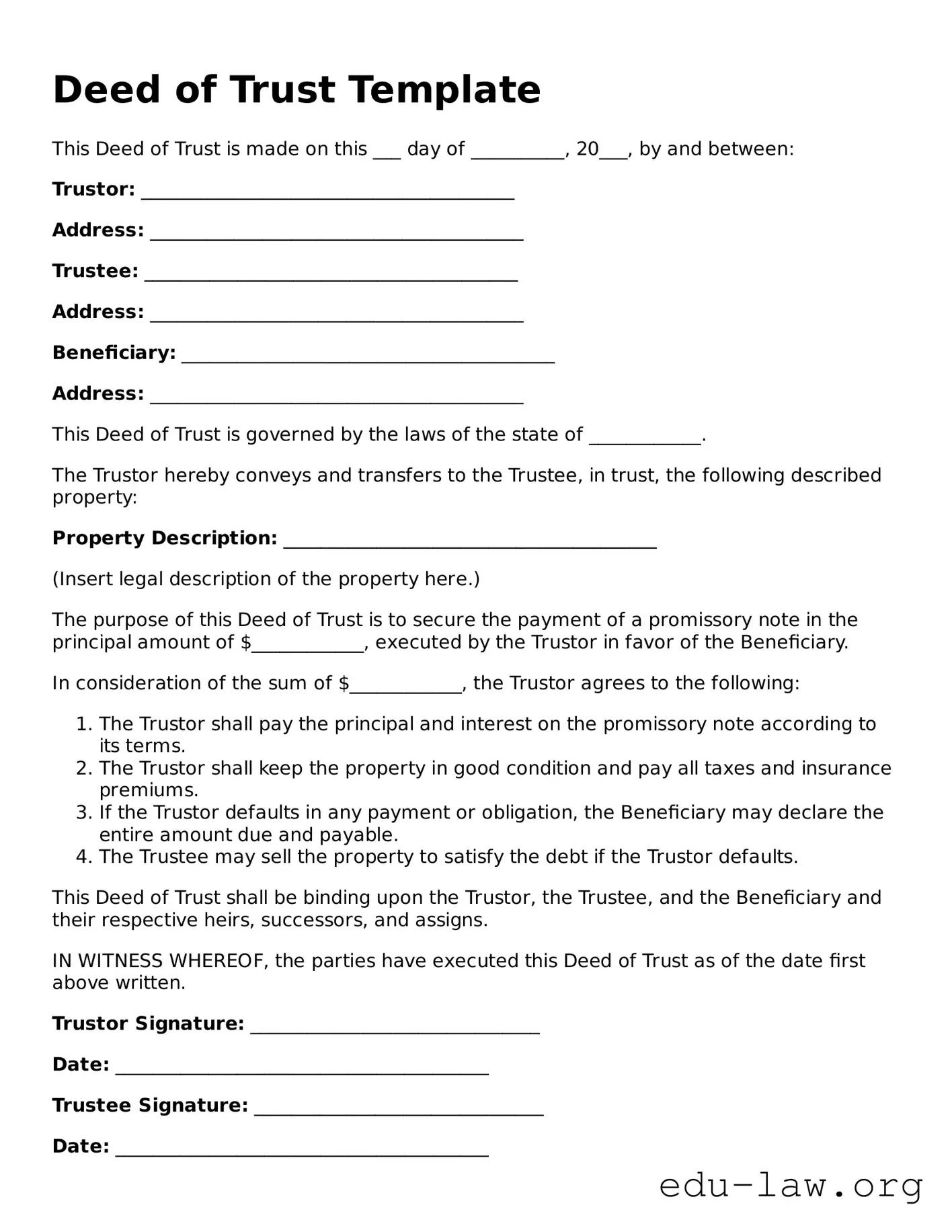
The Deed of Trust form plays a crucial role in real estate transactions, particularly in securing loans. This legal document involves three key parties: the borrower, the lender, and a neutral third party known as the trustee. When a borrower takes out a mortgage, they sign the Deed of Trust to give the lender a security interest in the property. This means that if the borrower fails to repay the loan, the lender can initiate a foreclosure process to recover the owed amount. Unlike a traditional mortgage, the Deed of Trust allows for a more streamlined foreclosure process, which can benefit lenders and streamline the resolution for all parties involved. Additionally, the form outlines the specific terms of the loan, including the amount borrowed, the interest rate, and the repayment schedule. Understanding the Deed of Trust is essential for anyone involved in real estate, whether you are a buyer, seller, or investor, as it ensures that the rights and responsibilities of each party are clearly defined and legally enforceable.
Deed of Trust Template
This Deed of Trust is made on this ___ day of __________, 20___, by and between:
Trustor: ________________________________________
Address: ________________________________________
Trustee: ________________________________________
Address: ________________________________________
Beneficiary: ________________________________________
Address: ________________________________________
This Deed of Trust is governed by the laws of the state of ____________.
The Trustor hereby conveys and transfers to the Trustee, in trust, the following described property:
Property Description: ________________________________________
(Insert legal description of the property here.)
The purpose of this Deed of Trust is to secure the payment of a promissory note in the principal amount of $____________, executed by the Trustor in favor of the Beneficiary.
In consideration of the sum of $____________, the Trustor agrees to the following:
This Deed of Trust shall be binding upon the Trustor, the Trustee, and the Beneficiary and their respective heirs, successors, and assigns.
IN WITNESS WHEREOF, the parties have executed this Deed of Trust as of the date first above written.
Trustor Signature: _______________________________
Date: ________________________________________
Trustee Signature: _______________________________
Date: ________________________________________
Beneficiary Signature: _______________________________
Date: ________________________________________
| Fact Name | Description |
|---|---|
| Definition | A Deed of Trust is a legal document that secures a loan by transferring the property title to a trustee until the loan is paid off. |
| Parties Involved | Typically, there are three parties: the borrower (trustor), the lender (beneficiary), and the trustee who holds the title. |
| State-Specific Forms | Each state may have its own version of the Deed of Trust, governed by local laws. For example, in California, it is governed by California Civil Code Section 2920. |
| Foreclosure Process | In most states, a Deed of Trust allows for a non-judicial foreclosure process, which can be quicker than judicial foreclosure. |
| Power of Sale Clause | Many Deeds of Trust include a power of sale clause, allowing the trustee to sell the property if the borrower defaults. |
| Recording Requirement | To be enforceable against third parties, a Deed of Trust must be recorded with the appropriate local government office. |
After obtaining the Deed of Trust form, you will need to complete it accurately to ensure it meets all necessary requirements. Follow these steps carefully to fill out the form correctly.
Once the form is filled out and signed, it will need to be recorded with the appropriate local government office. This step ensures that the Deed of Trust is legally recognized and enforceable.
What is a Deed of Trust?
A Deed of Trust is a legal document that secures a loan by transferring the title of a property to a third party, known as a trustee. This arrangement involves three parties: the borrower (trustor), the lender (beneficiary), and the trustee. The borrower receives the funds necessary to purchase a property, while the trustee holds the title until the loan is paid off. If the borrower defaults, the trustee has the authority to sell the property to recover the lender's investment.
How does a Deed of Trust differ from a mortgage?
While both a Deed of Trust and a mortgage serve the same purpose of securing a loan, they differ in their structure and the parties involved. A mortgage typically involves two parties: the borrower and the lender. In contrast, a Deed of Trust introduces a third party, the trustee, who holds the title to the property. This additional layer can simplify the foreclosure process. In many states, a Deed of Trust allows for a non-judicial foreclosure, which can be faster and less costly than the judicial foreclosure process often required with a mortgage.
What are the key components of a Deed of Trust?
A Deed of Trust includes several important elements. First, it identifies the parties involved: the borrower, the lender, and the trustee. Next, it describes the property being secured, including its legal description. The document outlines the terms of the loan, such as the amount borrowed, interest rate, and repayment schedule. Additionally, it specifies the rights and responsibilities of each party, including what happens in the event of default. Finally, the Deed of Trust must be signed and notarized to be legally binding.
What happens if the borrower defaults on the loan?
If the borrower defaults on the loan, the trustee has the authority to initiate the foreclosure process. In states that utilize a Deed of Trust, this process can be non-judicial, meaning it does not require court intervention. The trustee will typically send a notice of default to the borrower, allowing them a specified period to cure the default. If the borrower fails to do so, the trustee can proceed with a public auction of the property. The proceeds from the sale are used to pay off the outstanding loan balance, with any remaining funds going to the borrower.
Can a Deed of Trust be modified after it is signed?
Yes, a Deed of Trust can be modified, but this typically requires the consent of all parties involved. If the borrower and lender agree to change the terms—such as the interest rate or repayment schedule—they can execute a modification agreement. This document must be signed and notarized, similar to the original Deed of Trust. It's important to note that any changes made should be carefully documented to ensure clarity and legal enforceability.
Not including the correct names of all parties involved. Ensure that the names of the borrower, lender, and trustee are accurately listed.
Failing to provide a complete property description. A precise description helps avoid confusion and potential disputes later.
Omitting the loan amount. This figure is crucial for understanding the financial obligation being secured.
Not signing the document in the appropriate places. All required signatures must be present for the deed to be valid.
Neglecting to have the document notarized. A notary public’s signature lends credibility and legality to the deed.
Using outdated or incorrect forms. Always ensure you are using the most current version of the Deed of Trust form.
Failing to check state-specific requirements. Different states may have unique rules regarding Deeds of Trust.
Not keeping copies of the completed document. Retaining copies is important for your records and future reference.
Ignoring the need for additional documentation. Sometimes, other forms or disclosures may be required to accompany the Deed of Trust.
A Deed of Trust is a crucial document in real estate transactions, particularly when securing a loan. It establishes the relationship between the borrower, lender, and a third party known as the trustee. Alongside the Deed of Trust, several other forms and documents are commonly utilized to ensure a smooth transaction and protect the interests of all parties involved. Here’s a list of some key documents often associated with a Deed of Trust:
Understanding these documents is essential for anyone involved in a real estate transaction. Each plays a vital role in ensuring that the loan process is clear, secure, and legally binding. Being informed about these forms can help borrowers and lenders navigate the complexities of property financing more effectively.
A Mortgage is perhaps the most similar document to a Deed of Trust. Both serve as security for a loan, allowing the lender to take possession of the property if the borrower defaults. However, in a Mortgage, the borrower retains ownership and has a direct relationship with the lender. In contrast, a Deed of Trust involves a third party, known as a trustee, who holds the title until the loan is repaid. This difference can affect the foreclosure process, with Mortgages typically requiring court involvement, while Deeds of Trust can allow for a quicker, non-judicial foreclosure process.
A Promissory Note is another document closely related to a Deed of Trust. The Promissory Note outlines the borrower's promise to repay the loan, detailing the amount borrowed, interest rate, and repayment terms. While the Deed of Trust secures the loan by tying it to the property, the Promissory Note serves as the borrower's formal agreement to repay. Together, these documents create a comprehensive framework for the loan transaction.
An Assignment of Mortgage is similar in that it pertains to the transfer of rights associated with a loan. This document allows a lender to transfer their interest in the mortgage to another party. While a Deed of Trust is often used for new loans, an Assignment of Mortgage is relevant when existing loans change hands. Both documents ensure that the new lender can enforce the terms of the loan, whether it is secured by a mortgage or a deed of trust.
When filling out a Deed of Trust form, attention to detail is crucial. Here are some important dos and don'ts to consider:
Following these guidelines can help ensure that the Deed of Trust is processed smoothly and correctly.
Understanding the Deed of Trust form can be challenging, and several misconceptions often arise. Here are five common misunderstandings:
This is not entirely accurate. While both serve to secure a loan, a Deed of Trust involves three parties: the borrower, the lender, and a third-party trustee. In contrast, a mortgage typically involves only two parties: the borrower and the lender.
Many believe that once a Deed of Trust is executed, it is set in stone. However, it is possible to amend the terms under certain conditions, often requiring the consent of all parties involved.
This is misleading. A Deed of Trust secures a loan by placing a lien on the property, but it does not transfer ownership. The borrower retains ownership rights unless they default on the loan.
This misconception overlooks other potential lenders. Private individuals, credit unions, and other financial institutions can also provide loans secured by a Deed of Trust.
This is not true. Deeds of Trust can be used for various types of properties, including commercial real estate and land, depending on the agreement between the parties involved.
By clearing up these misconceptions, individuals can better navigate the complexities of real estate transactions and understand their rights and responsibilities.
When dealing with a Deed of Trust, understanding its purpose and the process of filling it out is crucial. Here are some key takeaways to consider:
Filling out a Deed of Trust correctly is vital for protecting the interests of all parties involved. Taking the time to understand each aspect can prevent complications down the road.