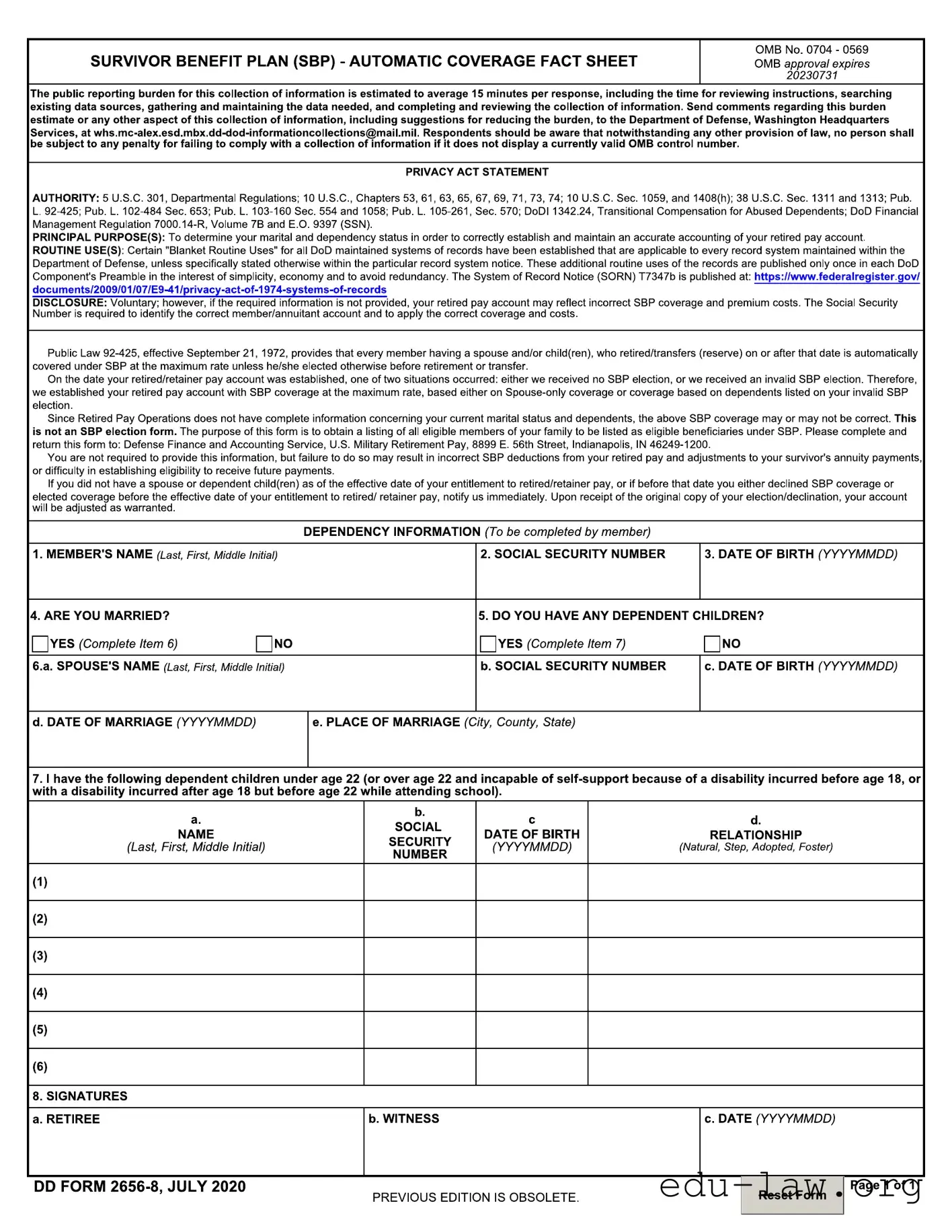
The DD Form 2656-8, also known as the Survivor Benefit Plan (SBP) Automatic Coverage Fact Sheet, plays a crucial role in ensuring that military retirees and their families are adequately protected under the Survivor Benefit Plan. This form is primarily used to gather essential information regarding a retiree's marital and dependency status. By collecting this information, the Department of Defense can accurately establish and maintain a retiree's pay account, which is vital for determining survivor benefits. The form is not an election form; rather, it serves to list eligible beneficiaries, which may include spouses and dependent children, for potential SBP coverage. It is important to note that if the necessary information is not provided, retirees may face incorrect deductions from their pay or complications in securing future payments for their survivors. Additionally, the form includes a privacy statement and outlines the legal authority under which the information is collected, ensuring that respondents understand their rights and responsibilities. Completing the DD Form 2656-8 accurately and promptly is essential for retirees who wish to ensure their loved ones are protected in the event of their passing.
| Fact Name | Details |
|---|---|
| Form Purpose | The DD Form 2656-8 is used to establish and maintain accurate accounting of retired pay accounts by collecting information about marital and dependency status. |
| OMB Approval | This form has OMB approval (OMB No. 0704-0569), which expires on July 31, 2023. |
| Privacy Act Statement | Information collected under this form is governed by various laws, including 5 U.S.C. 301 and 10 U.S.C. Chapters 53, 61, and 63, among others. |
| Voluntary Disclosure | Providing information is voluntary; however, failure to do so may result in incorrect deductions from retired pay and issues with survivor annuity payments. |
| Automatic Coverage | Members with a spouse and/or children who retire on or after September 21, 1972, are automatically covered under the Survivor Benefit Plan (SBP) unless they elect otherwise. |
| Dependency Information | Members must provide details about their spouse and dependent children, including names, Social Security numbers, and dates of birth. |
| Submission Address | Completed forms should be sent to the Defense Finance and Accounting Service, U.S. Military Retirement Pay, at 8899 E. 56th Street, Indianapolis, IN 46249-1200. |
Completing the DD Form 2656-8 is an important step to ensure your Survivor Benefit Plan (SBP) coverage accurately reflects your current family situation. Follow these steps carefully to provide the necessary information.
After completing these steps, ensure you keep a copy for your records. Submitting the form will help in establishing accurate SBP coverage for your loved ones. If you have questions or need assistance, consider reaching out to a legal or financial advisor familiar with military benefits.
What is the purpose of the DD Form 2656-8?
The DD Form 2656-8 is used to gather information about a member's marital and dependency status. This information is essential for accurately establishing and maintaining a retired pay account. The form helps ensure that the Survivor Benefit Plan (SBP) coverage is correctly assigned, which is crucial for determining premium costs and eligibility for survivor benefits.
Who is required to complete the DD Form 2656-8?
What happens if I do not complete the DD Form 2656-8?
If the DD Form 2656-8 is not completed and submitted, your retired pay account may reflect incorrect SBP coverage. This could result in higher or lower premium costs and may affect the survivor’s annuity payments. Inaccuracies in the information provided can also complicate future eligibility for benefits. Therefore, it is important to provide the required information to avoid these issues.
How do I submit the DD Form 2656-8?
The completed form should be sent to the Defense Finance and Accounting Service at the address specified on the form. The address is: U.S. Military Retirement Pay, 8899 E. 56th Street, Indianapolis, IN 46249-1200. Ensure that all required information is filled out accurately to facilitate processing.
Inaccurate Personal Information: Many individuals fail to provide accurate names, Social Security Numbers, or dates of birth. This can lead to significant delays in processing.
Missing Signatures: Some people neglect to sign the form. Without a signature, the form is considered incomplete and cannot be processed.
Incorrect Marital Status: Not indicating whether they are married or not can cause confusion. It is essential to answer this question correctly to determine eligibility for benefits.
Omitting Dependent Information: Failing to list dependent children or providing incorrect details about them can result in inaccurate benefit calculations.
Incorrect Dates: Providing wrong dates for marriage or children's birth can lead to complications in verifying eligibility.
Inadequate Documentation: Some individuals do not include necessary supporting documents, which may be required for verification purposes.
Not Following Instructions: Ignoring the instructions provided on the form can lead to incomplete submissions. It is crucial to read all guidelines carefully.
Failure to Update Information: Individuals sometimes forget to update their marital status or dependent information after significant life events, such as marriage or the birth of a child.
Submitting the Form to the Wrong Address: Some people send the completed form to an incorrect address, delaying the processing of their benefits.
Not Keeping Copies: Failing to retain a copy of the submitted form can lead to issues if there are questions or disputes regarding the information provided.
The DD Form 2656-8 is essential for establishing automatic coverage under the Survivor Benefit Plan (SBP). However, several other forms and documents are often used in conjunction with it to ensure accurate processing and compliance. Here’s a brief overview of these related documents.
Each of these documents plays a vital role in the administration of benefits under the SBP. Ensuring that all necessary forms are completed accurately can help prevent delays and ensure that beneficiaries receive the support they need.
The DD Form 2656-8, which pertains to the Survivor Benefit Plan (SBP), shares similarities with the DD Form 214. The DD Form 214 serves as a certificate of release or discharge from active duty and is essential for veterans seeking benefits. Both forms require detailed personal information, such as the service member's name, Social Security number, and marital status. While the DD Form 214 provides a snapshot of a veteran's military service, the DD Form 2656-8 focuses on the survivor benefits available to the member's family. Completing both forms accurately is crucial for ensuring that veterans and their dependents receive the benefits they are entitled to.
Another document similar to the DD Form 2656-8 is the VA Form 21-526EZ, which is used to apply for disability compensation and related benefits from the Department of Veterans Affairs. Like the DD Form 2656-8, this form requires the applicant to disclose personal and family information to determine eligibility for benefits. Both forms emphasize the importance of accurate information to ensure that the correct benefits are provided. While the DD Form 2656-8 is specifically about survivor benefits, the VA Form 21-526EZ focuses on disability compensation, highlighting different aspects of support available to veterans.
The SBP Election form is another document that bears resemblance to the DD Form 2656-8. This form allows service members to elect or decline participation in the SBP. Both documents require detailed information about the member's marital status and dependents to establish the correct coverage. The primary difference lies in the SBP Election form's role in allowing a member to make choices regarding their benefits, while the DD Form 2656-8 is more about confirming existing coverage and beneficiary information.
Similarly, the DD Form 1172-2 is used to apply for a Uniformed Services Identification Card and to enroll eligible family members in the Defense Enrollment Eligibility Reporting System (DEERS). Both forms necessitate accurate personal and family information, ensuring that dependents are recognized and can access military benefits. While the DD Form 2656-8 focuses on survivor benefits, the DD Form 1172-2 is more about identification and enrollment, yet both serve to protect the rights of military families.
The Form 10-10EZ from the Department of Veterans Affairs is also comparable to the DD Form 2656-8. This application for health benefits requires applicants to provide personal and family information to establish eligibility for VA health care. Both forms underscore the importance of accurate data to ensure that veterans and their families receive the appropriate benefits. While the DD Form 2656-8 is centered on survivor benefits, the Form 10-10EZ focuses on health care access, reflecting different facets of support available to veterans and their families.
Another document that parallels the DD Form 2656-8 is the DD Form 2870, which is used to authorize the release of medical information. This form also requires personal information to ensure that the correct individual is granting access to medical records. Both forms emphasize the importance of consent and accurate information in managing benefits and services for military families. While the DD Form 2656-8 is focused on survivor benefits, the DD Form 2870 is concerned with medical privacy, yet both are essential for the proper administration of benefits.
Lastly, the Form SF-2809 is used for health benefits enrollment under the Federal Employees Health Benefits Program. This form requires similar personal and family information to determine eligibility for health benefits. Like the DD Form 2656-8, it aims to ensure that dependents are covered under the appropriate health plan. While the focus of the SF-2809 is on health insurance, both documents reflect the critical need for accurate information in managing benefits for military and federal employees and their families.
When filling out the DD 2656-8 form, attention to detail is crucial. Here are ten important do's and don'ts to guide you through the process.
Following these guidelines will help ensure that your form is completed correctly, reducing the risk of complications in your Survivor Benefit Plan coverage.
Understanding the DD Form 2656-8 can be challenging. Here are some common misconceptions about this important form:
By addressing these misconceptions, you can better understand the purpose and importance of the DD Form 2656-8 in managing your survivor benefits.
Filling out the DD 2656-8 form is an important step for military retirees to ensure proper survivor benefits. Here are some key takeaways to keep in mind:
By keeping these points in mind, you can ensure that your benefits are set up correctly and that your loved ones are protected.