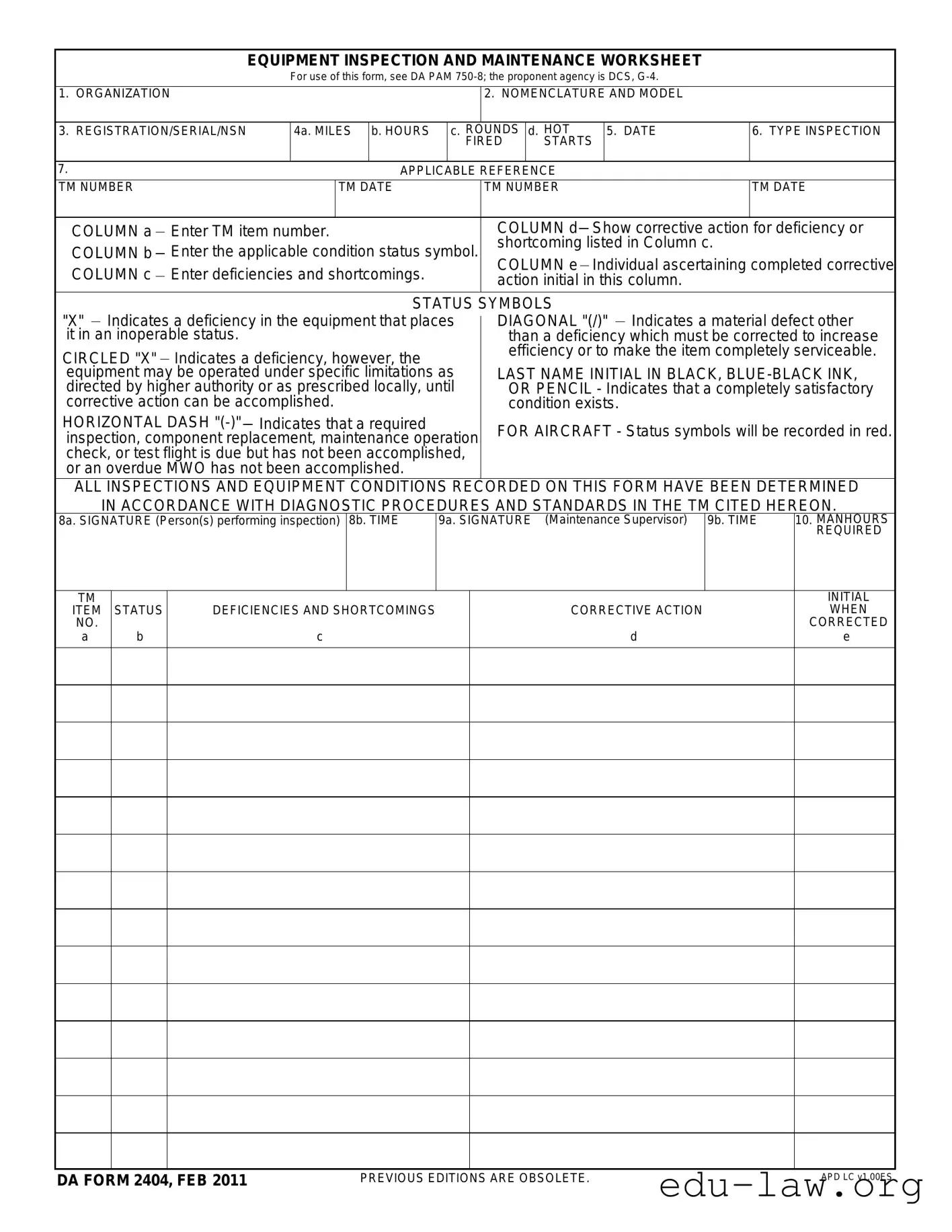
The DA 5988 E form serves as a crucial tool for maintaining the operational readiness of military equipment, particularly aircraft. This form is designed to document the status of equipment inspections and maintenance activities, ensuring that all deficiencies and shortcomings are properly recorded and addressed. Key sections of the form include the organization name, equipment nomenclature and model, and various metrics such as miles, hours, and fired rounds. Each entry is accompanied by specific status symbols that convey the condition of the equipment, ranging from operational to inoperable. For instance, an "X" indicates a significant deficiency, while a diagonal line suggests a material defect that requires correction. The form also emphasizes the importance of corrective actions, requiring personnel to detail what steps were taken to resolve issues. Signatures from both the inspector and the maintenance supervisor are necessary to validate the inspection process, underscoring accountability within the maintenance workflow. By following the guidelines set forth in DA PAM 750-8, the DA 5988 E form helps ensure that military equipment remains safe and effective, ultimately supporting mission success.
EQUIPMENT INSPECTION AND MAINTENANCE WORKSHEET
For use of this form, see DA PAM
|
1. ORGANIZATION |
|
|
|
|
|
2. NOMENCLATURE AND MODEL |
|
||||||||||||||
|
|
|
|
|
|
|
|
|
|
|
|
|
|
|
|
|
|
|
|
|
|
|
|
3. REGISTRATION/SERIAL/NSN |
4a. MILES |
b. HOURS |
c. FIREDROUNDS |
d. STARTSHOT |
5. DATE |
6. TYPE INSPECTION |
|||||||||||||||
|
|
|
|
|
|
|
|
|
|
|
|
|
|
|
|
|
|
|
|
|
|
|
7. |
|
|
|
|
|
|
|
|
|
APPLICABLE REFERENCE |
|
|
|
|
||||||||
|
TM NUMBER |
|
|
TM DATE |
TM NUMBER |
|
|
|
TM DATE |
|||||||||||||
|
|
|
|
|
|
|
|
|
|
|
|
|
|
|
|
|
||||||
|
COLUMN a |
|
Enter TM item number. |
COLUMN d |
|
Show corrective action for deficiency or |
||||||||||||||||
|
|
|||||||||||||||||||||
|
|
|
|
|||||||||||||||||||
|
COLUMN b |
|
|
|
|
Enter the applicable condition status symbol. |
shortcoming listed in Column c. |
|
||||||||||||||
|
|
|
COLUMN e |
|
|
Individual ascertaining completed corrective |
||||||||||||||||
|
COLUMN c |
|
|
Enter deficiencies and shortcomings. |
|
|
||||||||||||||||
|
|
|
|
|
||||||||||||||||||
|
|
action initial in this column. |
|
|||||||||||||||||||
|
|
|
||||||||||||||||||||
|
|
|
|
|
|
|
|
|
|
|
|
|
|
|||||||||
|
|
|
|
|
|
|
|
|
|
|
STATUS SYMBOLS |
|
|
|
|
|||||||
|
"X" |
|
Indicates a deficiency in the equipment that places |
DIAGONAL "(/)" |
|
Indicates a material defect other |
||||||||||||||||
|
|
|
||||||||||||||||||||
|
it in an inoperable status. |
|
|
|
|
than a deficiency which must be corrected to increase |
||||||||||||||||
|
CIRCLED "X" |
|
|
|
Indicates a deficiency, however, the |
efficiency or to make the item completely serviceable. |
||||||||||||||||
|
|
|
||||||||||||||||||||
|
equipment may be operated under specific limitations as |
LAST NAME INITIAL IN BLACK, |
||||||||||||||||||||
|
directed by higher authority or as prescribed locally, until |
OR PENCIL - Indicates that a completely satisfactory |
||||||||||||||||||||
|
corrective action can be accomplished. |
condition exists. |
|
|||||||||||||||||||
HORIZONTAL DASH
ALL INSPECTIONS AND EQUIPMENT CONDITIONS RECORDED ON THIS FORM HAVE BEEN DETERMINED IN ACCORDANCE WITH DIAGNOSTIC PROCEDURES AND STANDARDS IN THE TM CITED HEREON.
8a. SIGNATURE (Person(s) performing inspection) 8b. TIME 9a. SIGNATURE (Maintenance Supervisor) 9b. TIME 10. MANHOURS REQUIRED
TM |
|
|
|
INITIAL |
ITEM |
STATUS |
DEFICIENCIES AND SHORTCOMINGS |
CORRECTIVE ACTION |
WHEN |
NO. |
|
|
|
CORRECTED |
a |
b |
c |
d |
e |
DA FORM 2404, FEB 2011 |
PREVIOUS EDITIONS ARE OBSOLETE. |
APD LC v1.00ES |
|
|
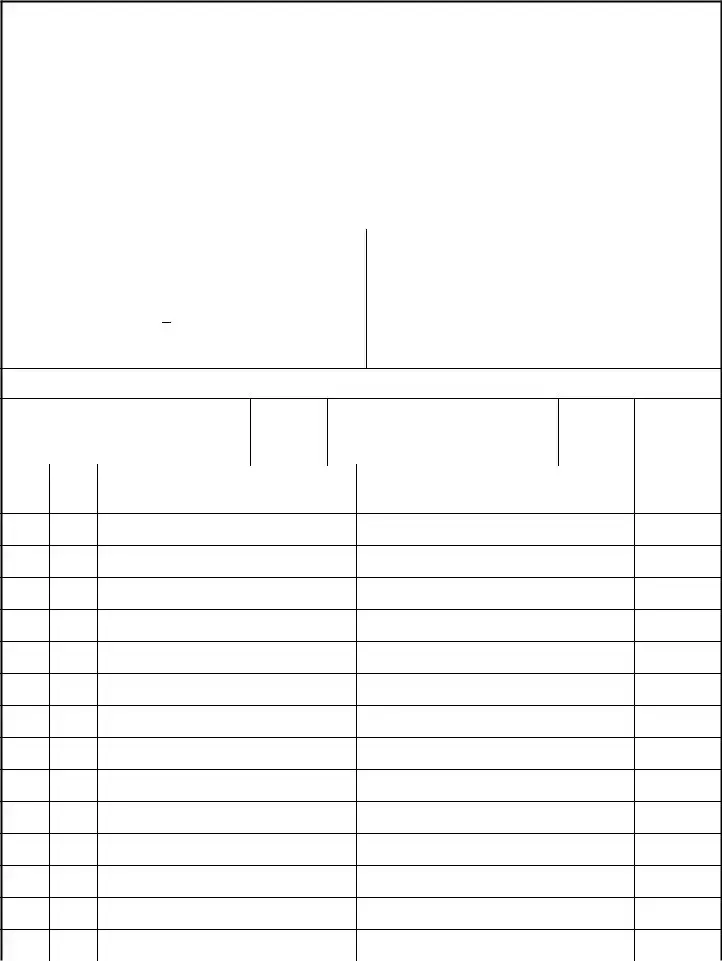
TM |
STATUS |
ITEM |
|
NO. |
b |
a |
DEFICIENCIES AND SHORTCOMINGS
c
CORRECTIVE ACTION
d
INITIAL
WHEN
CORRECTED e
DA FORM 2404, FEB 2011
APD LC v1.00ES
| Fact Name | Description |
|---|---|
| Form Purpose | The DA 5988 E form is used for documenting aircraft equipment inspection and maintenance activities. |
| Governing Regulation | This form is governed by DA PAM 750-8, which provides guidance on maintenance management. |
| Status Symbols | Status symbols are recorded in red to indicate the condition of the equipment being inspected. |
| Inspection Details | Sections of the form include organization, nomenclature, model, and various inspection metrics such as miles and hours. |
| Corrective Actions | Column d specifies the corrective action needed for deficiencies listed in Column c. |
| Signature Requirements | Signatures of both the person performing the inspection and the maintenance supervisor are required to validate the form. |
| Obsolescence Notice | The form indicates that previous editions are obsolete, ensuring the use of the most current version. |
Filling out the DA 5988 E form is essential for maintaining accurate records of equipment inspections and maintenance. This form helps ensure that all necessary information is documented properly, allowing for efficient tracking of equipment status and any required corrective actions.
What is the DA 5988 E form used for?
The DA 5988 E form is primarily utilized as an equipment inspection and maintenance worksheet. It is designed to help organizations document the status of equipment, including aircraft, by recording any deficiencies, maintenance actions, and inspections performed. This form ensures that all necessary information is systematically captured, facilitating effective maintenance and operational readiness.
Who is responsible for filling out the DA 5988 E form?
The responsibility for completing the DA 5988 E form typically falls on the personnel conducting the inspections. This includes individuals who are trained to assess the condition of the equipment. Additionally, a maintenance supervisor must review and sign off on the form to confirm that the inspection has been carried out correctly and that any noted deficiencies are addressed.
What information is required on the DA 5988 E form?
Several key pieces of information must be included on the DA 5988 E form. This includes the organization’s name, the nomenclature and model of the equipment, registration or serial numbers, and details about the inspection type. Furthermore, it captures the date of inspection, the status of the equipment, deficiencies identified, and corrective actions taken.
What do the status symbols on the DA 5988 E form signify?
Status symbols are critical for understanding the condition of the equipment. An "X" indicates a deficiency that makes the equipment inoperable. A diagonal line "(/)" signifies a material defect that needs correction to improve efficiency. A circled "X" means there is a deficiency, but the equipment can still operate under specific limitations. Lastly, a horizontal dash "(-)" shows that a required inspection or maintenance task is overdue.
How should deficiencies be documented on the DA 5988 E form?
Deficiencies should be documented in the designated column of the DA 5988 E form. Each deficiency or shortcoming must be clearly described, allowing for an accurate understanding of the issues present. It is crucial that this information is detailed enough to inform maintenance personnel about the specific corrective actions needed.
What is the significance of the corrective action section on the form?
The corrective action section is vital for tracking how deficiencies are resolved. It allows personnel to note what actions were taken to correct the identified issues. This not only helps in maintaining a history of maintenance activities but also ensures accountability and thoroughness in addressing equipment problems.
What does it mean if a deficiency is marked with a circled "X"?
A circled "X" indicates that while there is a deficiency, the equipment can still be operated under specific limitations. These limitations are usually dictated by higher authority or local directives. It is essential for operators to be aware of these limitations to ensure safety and compliance until the deficiency is fully addressed.
How often should the DA 5988 E form be filled out?
The DA 5988 E form should be filled out whenever an inspection is performed. This includes routine checks, as well as when any issues are identified during operation. Regular documentation helps maintain an accurate record of the equipment's condition and ensures timely maintenance actions are taken.
Can the DA 5988 E form be used for all types of equipment?
While the DA 5988 E form is primarily designed for aircraft, it can also be adapted for use with other types of equipment within military operations. However, it is essential to follow any specific guidelines or instructions relevant to the particular type of equipment being inspected to ensure compliance with applicable standards.
What should be done if a deficiency is identified on the DA 5988 E form?
If a deficiency is identified, it must be documented on the form, and appropriate corrective actions should be initiated. The maintenance supervisor should be notified immediately, and the necessary repairs or inspections should be scheduled. Following up on these actions is crucial to restore the equipment to a fully operational status.
Inaccurate Information: Providing incorrect details in fields such as organization, nomenclature, or registration can lead to significant issues. Ensure that all information is double-checked for accuracy.
Improper Use of Status Symbols: Misunderstanding or misapplying the status symbols can create confusion. Familiarize yourself with what each symbol means to avoid errors.
Neglecting to Document Deficiencies: Failing to enter deficiencies and shortcomings in Column c can result in incomplete records. Every issue must be documented to ensure proper maintenance.
Missing Signatures: Not obtaining the necessary signatures from the person performing the inspection and the maintenance supervisor can invalidate the form. Ensure all required signatures are present.
Incorrect Initials for Corrective Action: The individual who completes the corrective action must initial in Column e. Missing or incorrect initials can lead to accountability issues.
Failure to Update Inspection Dates: Dates must be recorded accurately. An outdated inspection date can lead to compliance issues and safety risks.
The DA Form 5988-E is an essential document for recording the status of equipment, particularly for aircraft. It serves as an inspection and maintenance worksheet, ensuring that all necessary information about the equipment's condition is documented accurately. Alongside this form, several other documents are commonly used to facilitate effective maintenance and inspection processes. Below is a list of these documents, each serving a specific purpose.
Each of these documents plays a vital role in the overall maintenance and accountability of military equipment. Proper use of these forms not only enhances operational readiness but also ensures compliance with military regulations. Understanding their purpose and how they interconnect is crucial for effective equipment management.
The DA Form 2404 is an Equipment Inspection and Maintenance Worksheet that serves a similar purpose to the DA 5988 E form. Both forms are used to document the condition and maintenance of military equipment. The DA 2404 allows personnel to record deficiencies and required corrective actions, just like the DA 5988 E. The format includes sections for signatures and timestamps, ensuring accountability for inspections and maintenance actions. This form also uses symbols to indicate the status of equipment, providing a clear visual representation of any issues that need attention.
The DA Form 2407, known as the Maintenance Request, is another document that parallels the DA 5988 E. This form is used to request maintenance for equipment that requires repair. While the DA 5988 E focuses on inspection and status, the DA 2407 is specifically designed to initiate corrective actions. Both forms require detailed information about the equipment and the nature of the issues, ensuring that maintenance personnel have the necessary information to address concerns effectively.
The DA Form 5987 E, or the Vehicle Inspection and Maintenance Worksheet, shares similarities with the DA 5988 E in that it is used for documenting the condition and maintenance of vehicles. This form includes sections for recording inspection results, deficiencies, and corrective actions. Like the DA 5988 E, it employs status symbols to communicate the operational readiness of vehicles, making it easier for personnel to understand the equipment's condition at a glance.
The DA Form 2405 is another related document, known as the Equipment Transfer and Acceptance Form. This form is used when equipment is transferred from one unit to another. While the DA 5988 E focuses on inspection and maintenance, the DA 2405 ensures that the receiving unit is aware of any existing deficiencies or maintenance requirements. Both forms emphasize accountability and documentation, helping to maintain the integrity of military equipment across units.
The DA Form 3151 is the Equipment Receipt, which is similar to the DA 5988 E in that it documents the acceptance of equipment. This form records the condition of the equipment at the time of receipt, ensuring that any existing issues are noted and addressed. Like the DA 5988 E, the DA 3151 plays a crucial role in maintaining accurate records and accountability within military operations.
The DA Form 2406, known as the Maintenance Management Work Order, serves a similar function to the DA 5988 E by documenting maintenance actions taken on equipment. This form is used to track work orders and ensure that all maintenance tasks are completed as required. Both forms require detailed information about the equipment and the actions taken, fostering effective communication among maintenance personnel.
The DA Form 5988 is an earlier version of the DA 5988 E and serves a similar purpose in documenting equipment status and maintenance needs. While the DA 5988 E has updated features and improved clarity, both forms are designed to ensure that military equipment is properly inspected and maintained. The evolution from the DA 5988 to the DA 5988 E reflects ongoing efforts to enhance documentation practices within military operations.
The DA Form 2403, known as the Equipment Maintenance Record, is another document that parallels the DA 5988 E. This form is used to maintain a detailed history of maintenance actions performed on equipment. While the DA 5988 E focuses on current inspection results, the DA 2403 provides a comprehensive overview of the equipment's maintenance history, ensuring that all actions are recorded for future reference.
Finally, the DA Form 7500 is the Maintenance Management Control Record, which shares similarities with the DA 5988 E in that it tracks maintenance activities and equipment status. This form is used to ensure that all maintenance tasks are completed in a timely manner and that equipment remains operational. Both forms emphasize the importance of maintaining accurate records to support effective equipment management within military units.
When filling out the DA 5988 E form, it is essential to follow certain guidelines to ensure accuracy and compliance. Here are ten things to do and avoid:
Understanding the DA 5988 E form is essential for effective equipment inspection and maintenance. However, several misconceptions can lead to confusion. Here’s a breakdown of ten common misunderstandings:
By addressing these misconceptions, users can better understand the purpose and proper use of the DA 5988 E form, leading to improved maintenance practices.
Filling out the DA 5988 E form is essential for effective equipment inspection and maintenance. Here are some key takeaways to ensure proper usage:
By following these guidelines, you can enhance the efficiency and effectiveness of the inspection and maintenance process.