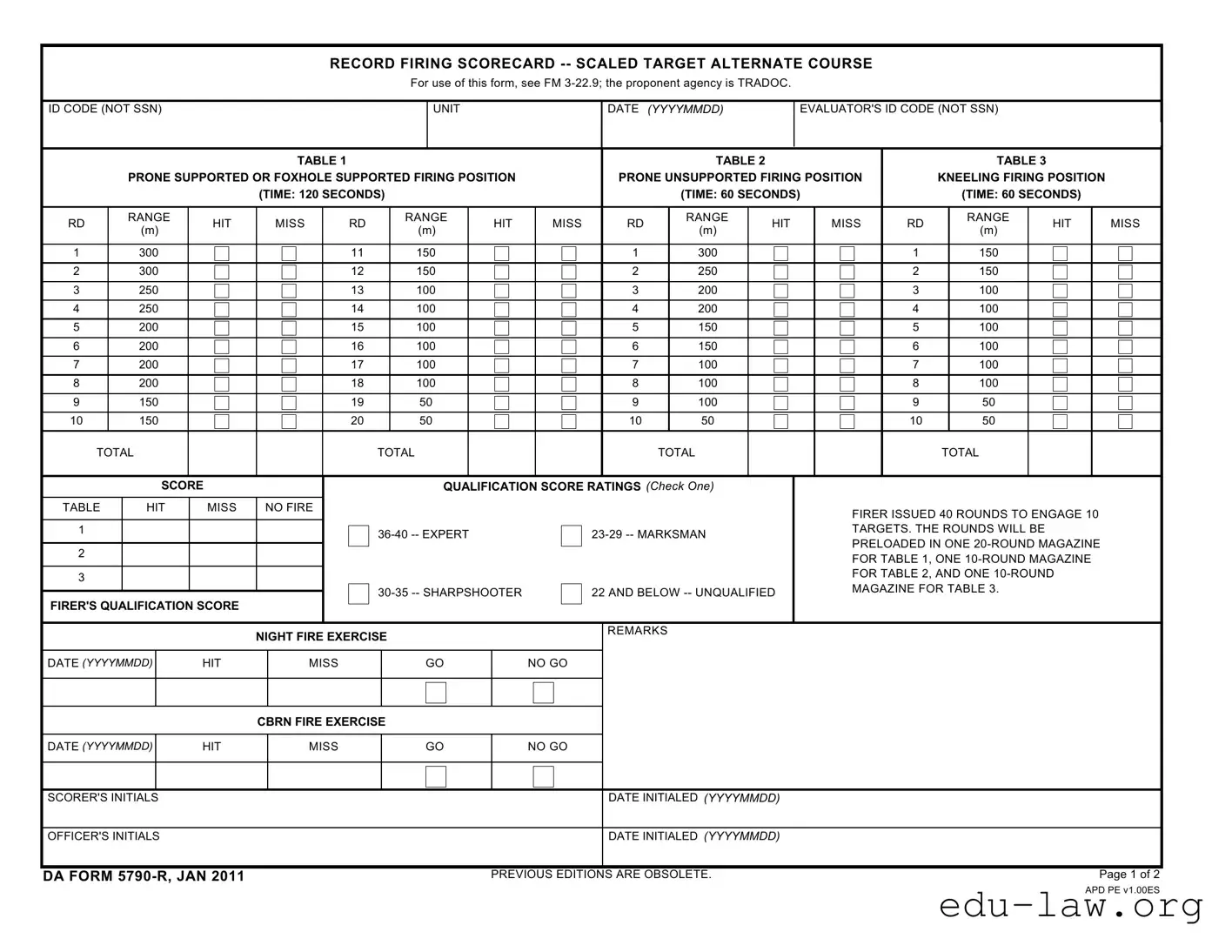
The DA 5790 R form serves as a critical tool for scoring record fire qualifications using an alternate course when standard ranges are unavailable. This scorecard is designed specifically for the 25-meter scaled silhouette target, allowing evaluators to track the performance of firers across three distinct firing tables. Each table presents unique challenges, such as the prone supported position, prone unsupported position, and kneeling position, with varying time limits and scoring criteria. The form captures essential data, including the unit, date, and evaluator’s ID, while also detailing the number of hits and misses at different ranges. With a total of 40 rounds issued, the scoring system awards points based on the accuracy of each shot fired at designated targets. The structured approach ensures that firers engage targets in a systematic manner, promoting consistency and fairness in the qualification process. Additionally, the DA 5790 R form includes provisions for night fire and chemical, biological, radiological, and nuclear (CBRN) exercises, making it a versatile document for comprehensive training evaluations.
RECORD FIRING SCORECARD
For use of this form, see FM
ID CODE (NOT SSN) |
UNIT |
DATE (YYYYMMDD) |
|
EVALUATOR'S ID CODE (NOT SSN) |
|
|
|
|
|
|
|
|
|
|
|
|
|
|
|
|
|
|
|
TABLE 1 |
|
|
|
|
|
|
|
|
|
|
|
TABLE 2 |
|
|
|
|
|
TABLE 3 |
|
|
|
|||
|
|
PRONE SUPPORTED OR FOXHOLE SUPPORTED FIRING POSITION |
|
|
|
PRONE UNSUPPORTED FIRING POSITION |
|
KNEELING FIRING POSITION |
|
|||||||||||||||||||||
|
|
|
|
|
(TIME: 120 SECONDS) |
|
|
|
|
|
|
(TIME: 60 SECONDS) |
|
|
|
(TIME: 60 SECONDS) |
|
|||||||||||||
|
|
|
|
|
|
|
|
|
|
|
|
|
|
|
|
|
|
|
|
|
|
|
|
|
|
|
|
|
|
|
RD |
|
RANGE |
HIT |
|
MISS |
|
RD |
|
|
RANGE |
|
HIT |
|
MISS |
|
RD |
|
RANGE |
|
HIT |
MISS |
RD |
|
RANGE |
|
HIT |
|
MISS |
||
|
(m) |
|
|
|
|
(m) |
|
|
|
|
(m) |
|
|
(m) |
|
|
||||||||||||||
|
|
|
|
|
|
|
|
|
|
|
|
|
|
|
|
|
|
|
|
|
|
|
|
|
|
|||||
|
|
|
|
|
|
|
|
|
|
|
|
|
|
|
|
|
|
|
|
|
|
|
|
|
|
|
|
|
||
1 |
300 |
|
|
|
|
11 |
|
|
150 |
|
|
|
|
1 |
|
300 |
|
|
|
|
1 |
|
150 |
|
|
|
|
|||
|
|
|
|
|
|
|
|
|
|
|
|
|
|
|
|
|
|
|
|
|
|
|
|
|
|
|
|
|
|
|
2 |
300 |
|
|
|
|
12 |
|
|
150 |
|
|
|
|
2 |
|
250 |
|
|
|
|
2 |
|
150 |
|
|
|
|
|||
|
|
|
|
|
|
|
|
|
|
|
|
|
|
|
|
|
|
|
|
|
|
|
|
|
|
|
|
|
|
|
3 |
250 |
|
|
|
|
13 |
|
|
100 |
|
|
|
|
3 |
|
200 |
|
|
|
|
3 |
|
100 |
|
|
|
|
|||
|
|
|
|
|
|
|
|
|
|
|
|
|
|
|
|
|
|
|
|
|
|
|
|
|
|
|
|
|
|
|
4 |
250 |
|
|
|
|
14 |
|
|
100 |
|
|
|
|
4 |
|
200 |
|
|
|
|
4 |
|
100 |
|
|
|
|
|||
|
|
|
|
|
|
|
|
|
|
|
|
|
|
|
|
|
|
|
|
|
|
|
|
|
|
|
|
|
|
|
5 |
200 |
|
|
|
|
15 |
|
|
100 |
|
|
|
|
5 |
|
150 |
|
|
|
|
5 |
|
100 |
|
|
|
|
|||
|
|
|
|
|
|
|
|
|
|
|
|
|
|
|
|
|
|
|
|
|
|
|
|
|
|
|
|
|
|
|
6 |
200 |
|
|
|
|
16 |
|
|
100 |
|
|
|
|
6 |
|
150 |
|
|
|
|
6 |
|
100 |
|
|
|
|
|||
|
|
|
|
|
|
|
|
|
|
|
|
|
|
|
|
|
|
|
|
|
|
|
|
|
|
|
|
|
|
|
7 |
200 |
|
|
|
|
17 |
|
|
100 |
|
|
|
|
7 |
|
100 |
|
|
|
|
7 |
|
100 |
|
|
|
|
|||
|
|
|
|
|
|
|
|
|
|
|
|
|
|
|
|
|
|
|
|
|
|
|
|
|
|
|
|
|
|
|
8 |
200 |
|
|
|
|
18 |
|
|
100 |
|
|
|
|
8 |
|
100 |
|
|
|
|
8 |
|
100 |
|
|
|
|
|||
|
|
|
|
|
|
|
|
|
|
|
|
|
|
|
|
|
|
|
|
|
|
|
|
|
|
|
|
|
|
|
9 |
150 |
|
|
|
|
19 |
|
|
50 |
|
|
|
|
9 |
|
100 |
|
|
|
|
9 |
|
50 |
|
|
|
|
|||
|
|
|
|
|
|
|
|
|
|
|
|
|
|
|
|
|
|
|
|
|
|
|
|
|
|
|
|
|
|
|
10 |
150 |
|
|
|
|
20 |
|
|
50 |
|
|
|
|
10 |
|
50 |
|
|
|
|
10 |
|
50 |
|
|
|
|
|||
|
|
|
|
|
|
|
|
|
|
|
|
|
|
|
|
|
|
|
|
|
|
|
|
|
|
|
|
|
|
|
TOTAL |
|
|
|
|
|
TOTAL |
|
|
|
|
|
|
TOTAL |
|
|
|
|
|
TOTAL |
|
|
|
|
|||||||
|
|
|
|
|
|
|
|
|
|
|
|
|
|
|
|
|
|
|
|
|
|
|
|
|
|
|
|
|||
|
|
|
SCORE |
|
|
|
|
|
|
QUALIFICATION SCORE RATINGS (CHECK ONE) |
|
|
|
|
|
|
|
|
|
|
||||||||||
|
|
|
|
|
|
|
|
|
|
|
|
|
|
|
|
|
|
|
|
|
|
|
|
|
|
|
|
|
||
TABLE |
|
HIT |
MISS |
NO FIRE |
|
|
|
|
|
|
|
|
|
|
|
|
|
|
|
|
FIRER ISSUED 40 ROUNDS TO ENGAGE 10 |
|
||||||||
|
|
|
|
|
|
|
|
|
|
|
|
|
|
|
|
|
|
|
|
|
|
|
|
|||||||
1 |
|
|
|
|
|
|
|
|
|
|
|
|
|
TARGETS. THE ROUNDS WILL BE |
|
|
|
|||||||||||||
|
|
|
|
|
|
|
|
|
|
|
|
|
|
PRELOADED IN ONE |
|
|||||||||||||||
2 |
|
|
|
|
|
|
|
|
|
|
|
|
|
|
|
|
|
|
|
|
|
|
|
|||||||
|
|
|
|
|
|
|
|
|
|
|
|
|
|
|
|
|
|
|
|
|
|
FOR TABLE 1, ONE |
|
|||||||
|
|
|
|
|
|
|
|
|
|
|
|
|
|
|
|
|
|
|
|
|
|
|
|
|||||||
3 |
|
|
|
|
|
|
|
|
|
|
|
|
|
|
|
|
|
|
|
|
|
|
FOR TABLE 2, AND ONE |
|
||||||
|
|
|
|
|
|
|
|
|
|
|
|
|
|
|
|
|
|
|
|
|
|
|
|
|
|
|
|
|
|
|
|
|
|
|
|
|
|
|
|
|
|
22 AND BELOW |
|
MAGAZINE FOR TABLE 3. |
|
|
|
||||||||||||||
|
|
|
|
|
|
|
|
|
|
|
|
|
|
|
||||||||||||||||
|
|
|
|
|
|
|
|
|
|
|
|
|
|
|
|
|
|
|
|
|||||||||||
FIRER'S QUALIFICATION SCORE |
|
|
|
|
|
|
|
|
|
|
|
|
|
|
|
|
|
|
|
|
|
|
|
|
|
|
||||
|
|
|
|
|
|
|
|
|
|
|
|
|
|
|
|
|
|
|
|
|
|
|
|
|
|
|
|
|||
|
|
|
|
|
NIGHT FIRE EXERCISE |
|
|
|
|
REMARKS |
|
|
|
|
|
|
|
|
|
|
||||||||||
|
|
|
|
|
|
|
|
|
|
|
|
|
|
|
|
|
|
|
|
|
|
|
||||||||
|
|
|
|
|
|
|
|
|
|
|
|
|
|
|
|
|
|
|
|
|
|
|
|
|
|
|
|
|||
DATE (YYYYMMDD) |
|
HIT |
|
MISS |
|
|
|
GO |
|
NO GO |
|
|
|
|
|
|
|
|
|
|
|
|
|
|
|
|||||
|
|
|
|
|
|
|
|
|
|
|
|
|
|
|
|
|
|
|
|
|
|
|
|
|
|
|
||||
|
|
|
|
|
|
|
|
|
|
|
|
|
|
|
|
|
|
|
|
|
|
|
|
|
|
|
||||
|
|
|
|
|
CBRN FIRE EXERCISE |
|
|
|
|
|
|
|
|
|
|
|
|
|
|
|
|
|
|
|||||||
|
|
|
|
|
|
|
|
|
|
|
|
|
|
|
|
|
|
|
|
|
|
|
|
|
|
|
|
|||
DATE (YYYYMMDD) |
|
HIT |
|
MISS |
|
|
|
GO |
|
NO GO |
|
|
|
|
|
|
|
|
|
|
|
|
|
|
|
|||||
|
|
|
|
|
|
|
|
|
|
|
|
|
|
|
|
|
|
|
|
|
|
|
|
|
|
|
|
|
|
|
|
|
|
|
|
|
|
|
|
|
|
|
|
|
|
|
|
|
|
|
|
|
|
|
|
|
|
|
|
|
|
SCORER'S INITIALS
DATE INITIALED (YYYYMMDD)
OFFICER'S INITIALS
DATE INITIALED (YYYYMMDD)
DA FORM |
PREVIOUS EDITIONS ARE OBSOLETE. |
Page 1 of 2 |
APD PE v1.00ES
This scorecard is used to score alternate course record fire qualification when the
NOTE: If zeroing/grouping exercises are not performed on the day of record fire, six rounds of training/sustainment ammunition will be fired for
CONDUCT OF FIRE
Alternate course qualification firers will have one
Though the time between each firing position is not specified, enough time should be allotted to allow the firer to clear his weapon, quickly change firing positions, and reload before beginning the next firing table. The range RSO ensures that enough time is given between each change in firing position to facilitate the timely flow of the record fire qualification table.
(1)Table
The firer is given one
(2) Table 2
The firer is given one
(3) Table 3
The firer is given one
SCORING
The same target sheet is used for every
DA FORM |
Page 2 of 2 |
APD PE v1.00ES
| Fact Name | Description |
|---|---|
| Form Purpose | The DA 5790 R form is used to record firing scores for alternate course qualifications when standard ranges are not available. |
| Governing Agency | This form is governed by the Training and Doctrine Command (TRADOC) of the U.S. Army. |
| Target Type | The qualification uses a 25-meter scaled silhouette target, identified by the National Stock Number (NSN) 6920-01-167-1398. |
| Qualification Tables | There are three tables in the qualification: Table 1 (Prone Supported or Foxhole Supported), Table 2 (Prone Unsupported), and Table 3 (Kneeling). |
| Magazine Distribution | Firing involves one 20-round magazine for Table 1 and two 10-round magazines for Tables 2 and 3. |
| Time Limits | Firing must be completed within specific time limits: 120 seconds for Table 1, and 60 seconds for Tables 2 and 3. |
| Scoring Method | Each hit on the silhouette counts towards the total score, with a maximum of 40 hits possible across all tables. |
| Engagement Order | Firing should follow a left-to-right and nearest-to-farthest engagement order for effective scoring. |
| Zeroing Requirement | Before qualification, six rounds of training ammunition must be fired for zero confirmation if zeroing/grouping exercises are not conducted. |
| Previous Editions | The current version of the DA 5790 R form is from January 2011, and previous editions are considered obsolete. |
Completing the DA Form 5790-R is essential for documenting firing scores during qualification exercises. Following these steps will help ensure that all necessary information is accurately recorded.
What is the DA Form 5790-R used for?
The DA Form 5790-R, also known as the Record Firing Scorecard for Scaled Target Alternate Course, is utilized to score alternate course record fire qualifications. This form is specifically designed for situations when standard record fire and known distance ranges are not available. It helps in tracking a firer's performance during various firing positions and conditions.
What are the different tables included in the DA Form 5790-R?
The form consists of three main tables that assess a firer's shooting skills from different positions. Table 1 focuses on the Prone Supported or Foxhole Supported Firing Position, allowing for two rounds per silhouette. Table 2 evaluates the Prone Unsupported Firing Position, with one round per silhouette. Lastly, Table 3 assesses the Kneeling Firing Position, where firers engage silhouettes with varying rounds based on distance.
How is scoring conducted on the DA Form 5790-R?
Scoring is based on the number of hits within or touching the silhouette targets. A maximum of 40 hits can be achieved, with different scoring rules for various distances. For instance, firers can score up to 5 hits for targets at 50 and 100 meters, while only 1 hit is allowed for targets at 150 meters. Each table has specific rules regarding how many rounds can be fired and how hits are counted.
What should a firer do before beginning the qualification course?
Before starting the qualification course, if zeroing or grouping exercises have not been conducted, the firer must fire six rounds of training ammunition for 25-meter zero confirmation. This step is crucial for ensuring accuracy during the qualification.
What is the time limit for each firing table on the DA Form 5790-R?
Each firing table has a designated time limit. For Table 1, the firer has 120 seconds to complete their shots. Table 2 must be completed within 60 seconds, and Table 3 also has a time limit of 60 seconds. It is important for firers to manage their time effectively to ensure they can engage all targets within the allotted time.
How should firers engage the targets during the qualification?
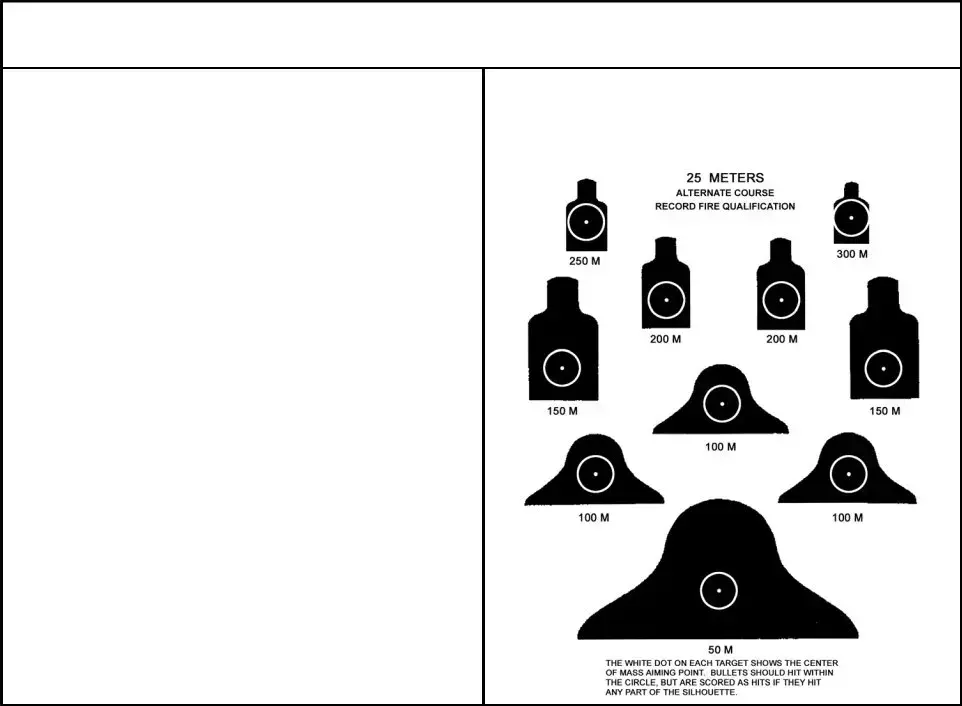
Firers are advised to engage targets in a specific order: from left to right and nearest to farthest. This structured approach helps in maintaining focus and ensuring that each target is engaged according to the established guidelines. The recommended order is 50m, 100m left, 100m center, 100m right, followed by targets at 150m, 200m, 250m, and finally 300m.
What happens if a firer does not qualify?
If a firer does not meet the qualification standards, they are considered unqualified. The form allows for a clear record of performance, and additional training may be required to improve skills before retesting. Continuous practice and adherence to guidelines can help firers achieve better results in future qualifications.
When filling out the DA 5790 R form, individuals often encounter several common mistakes that can lead to inaccuracies or delays in processing. Here’s a detailed list of ten such errors:
By being aware of these common pitfalls, individuals can improve their accuracy when completing the DA 5790 R form, ensuring a smoother qualification process.
The DA Form 5790 R is a critical document used to record firing scores during qualification exercises. It is often accompanied by several other forms and documents that support the qualification process. Below is a list of these forms, along with brief descriptions of each.
These forms work together to provide a complete picture of a soldier's qualifications, fitness, and overall readiness for service. Each document plays a specific role in maintaining standards within the military framework.
The DA Form 5790-R is similar to the DA Form 5500, which is used for body composition assessment. Both forms require precise data entry to ensure accurate results. The DA Form 5500 tracks measurements to evaluate whether an individual meets the Army's height and weight standards. Similarly, the DA Form 5790-R captures firing scores to determine a soldier's marksmanship qualification. Each form serves a critical purpose in assessing readiness and compliance with military standards.
Another document that resembles the DA Form 5790-R is the DA Form 705, which is used for the Army Physical Fitness Test (APFT). The DA Form 705 records an individual's performance in physical fitness assessments. Like the DA Form 5790-R, it requires specific metrics to be filled out, such as scores for push-ups, sit-ups, and a timed run. Both forms are essential for evaluating soldier readiness and ensuring that personnel meet the required standards for their respective areas.
The DA Form 2-1 is another document that shares similarities with the DA Form 5790-R. This form serves as a personnel record for soldiers and includes various details about their military career. While the DA Form 5790-R focuses on marksmanship qualifications, the DA Form 2-1 compiles a soldier's training, assignments, and performance evaluations. Both documents are vital for tracking a soldier's progress and qualifications throughout their military career.
Additionally, the DA Form 4187 is relevant, as it is used for personnel actions such as requests for training or changes in duty status. Both forms require detailed information and signatures from evaluators to validate the content. The DA Form 5790-R documents firing qualifications, while the DA Form 4187 facilitates administrative changes in a soldier's record. Each plays a role in maintaining accurate military documentation.
Similar to the DA Form 5790-R is the DA Form 5501, which is another body composition assessment tool. This form is specifically for males and requires similar data collection as the DA Form 5500. Both forms are used to ensure soldiers meet health and fitness standards, highlighting the importance of physical readiness in the military. Each document contributes to the overall evaluation of soldier capabilities.
The DA Form 2627, which is used for non-judicial punishment, also bears resemblance to the DA Form 5790-R. While the former addresses disciplinary actions, both forms require thorough documentation and signatures from commanding officers. The DA Form 5790-R assesses marksmanship qualifications, while the DA Form 2627 ensures accountability and adherence to military regulations. Each form is crucial in maintaining order and discipline within the ranks.
The DA Form 1059 is another comparable document, as it is used to record academic evaluations for soldiers attending military schools. Both the DA Form 5790-R and DA Form 1059 require detailed scoring and feedback. The DA Form 1059 assesses a soldier's educational achievements, while the DA Form 5790-R evaluates marksmanship skills. Both forms are integral to a soldier's professional development and career progression.
The DA Form 638 is similar in that it is used for recommending soldiers for awards and decorations. Both forms require specific details and justifications to support the evaluation process. While the DA Form 5790-R focuses on firing qualifications, the DA Form 638 documents achievements and contributions to the unit. Each form plays a role in recognizing and validating soldier accomplishments.
Lastly, the DA Form 31 is relevant as it is used for requesting leave. Both forms require careful completion and approval from superiors. The DA Form 5790-R assesses marksmanship qualifications, while the DA Form 31 manages soldiers' time away from duty. Each form is essential for maintaining operational readiness and ensuring that personnel fulfill their responsibilities.
When filling out the DA 5790 R form, certain practices can help ensure accuracy and compliance. Here are five key dos and don'ts:
By adhering to these guidelines, you can streamline the process and enhance the accuracy of your record firing scorecard.
Here are eight common misconceptions about the DA 5790 R form, along with clarifications for each:
This form is used by all levels of shooters, not just experts. It is designed to evaluate and record firing scores for various skill levels.
The DA 5790 R is specifically for alternate courses when standard record fire and known distance ranges are unavailable. It provides flexibility in training.
FIRERS must engage targets from left to right and nearest to farthest, following a specific sequence. This ensures a structured approach to the qualification.
Each table has its own scoring rules. For example, Table 1 allows for 2 hits per silhouette, while Table 2 allows only 1 hit per silhouette.
Each table has a strict time limit. For instance, Table 1 must be completed in 120 seconds, and Table 2 in 60 seconds.
The number of rounds varies by table. For example, Table 1 uses a 20-round magazine, while Tables 2 and 3 use 10-round magazines.
Zeroing is crucial. If zeroing/grouping exercises are not performed on the day of record fire, six rounds of training ammunition must be fired for zero confirmation.
This form is current and remains an essential tool for scoring firing qualifications. Previous editions are obsolete.
Filling out and using the DA 5790 R form effectively is crucial for accurate record-keeping in firing qualifications. Here are key takeaways to consider: