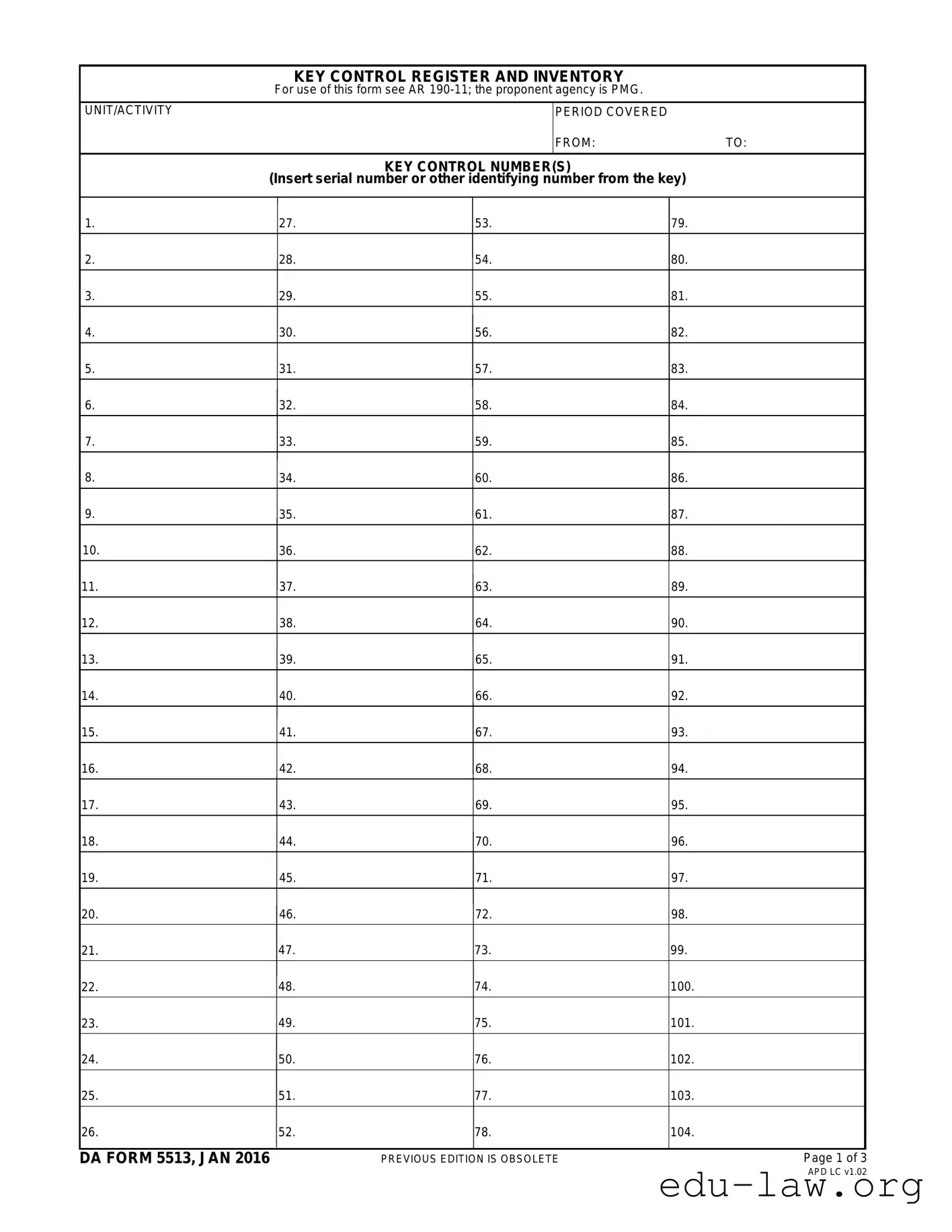
The DA 5513 form plays a crucial role in maintaining security and accountability within military operations. Designed as a Key Control Register and Inventory, this form helps units track the issuance and return of keys, ensuring that access to sensitive areas is well-managed. It covers a specified period, allowing for organized record-keeping that is essential for operational integrity. Each key is assigned a unique control number, which aids in identifying and managing access points effectively. The form includes sections for documenting the issuance of keys, including details such as the date and time keys are issued, who issued them, and to whom they were given. Additionally, it provides space for recording the return of keys, thus creating a comprehensive inventory that can be reviewed during joint or semiannual audits. By using the DA 5513, military personnel can enhance their key management practices, ultimately contributing to the overall security of their installations.

|
|
KEY CONTROL REGISTER AND INVENTORY |
|
||
|
For use of this form see AR |
|
|||
UNIT/ACTIVITY |
|
|
|
PERIOD COVERED |
|
|
|
|
|
FROM: |
TO: |
|
|
|
KEY CONTROL NUMBER(S) |
|
|
(Insert serial number or other identifying number from the key) |
|||||
|
|
|
|
|
|
1. |
27. |
53. |
|
79. |
|
|
|
|
|
|
|
2. |
28. |
54. |
|
80. |
|
3. |
29. |
55. |
|
81. |
|
4. |
30. |
56. |
|
82. |
|
5. |
31. |
57. |
|
83. |
|
|
|
|
|
|
|
6. |
32. |
58. |
|
84. |
|
|
|
|
|
|
|
7. |
33. |
59. |
|
85. |
|
8. |
34. |
60. |
|
86. |
|
9. |
35. |
61. |
|
87. |
|
10. |
36. |
62. |
|
88. |
|
11. |
|
37. |
63. |
|
89. |
12. |
|
38. |
64. |
|
90. |
13. |
|
39. |
65. |
|
91. |
14. |
|
40. |
66. |
|
92. |
15. |
|
41. |
67. |
|
93. |
16. |
|
42. |
68. |
|
94. |
17. |
|
43. |
69. |
|
95. |
18. |
|
44. |
70. |
|
96. |
19. |
|
45. |
71. |
|
97. |
20. |
|
46. |
72. |
|
98. |
21. |
47. |
73. |
|
99. |
|
22. |
48. |
74. |
|
100. |
|
23. |
49. |
75. |
|
101. |
|
24. |
50. |
76. |
|
102. |
|
25. |
51. |
77. |
|
103. |
|
|
|
|
|
|
|
26. |
52. |
78. |
|
104. |
|
|
|
|
|
|
|
DA FORM 5513, JAN 2016 |
|
|
PREVIOUS EDITION IS OBSOLETE |
Page 1 of 3 |
|
APD LC v1.02
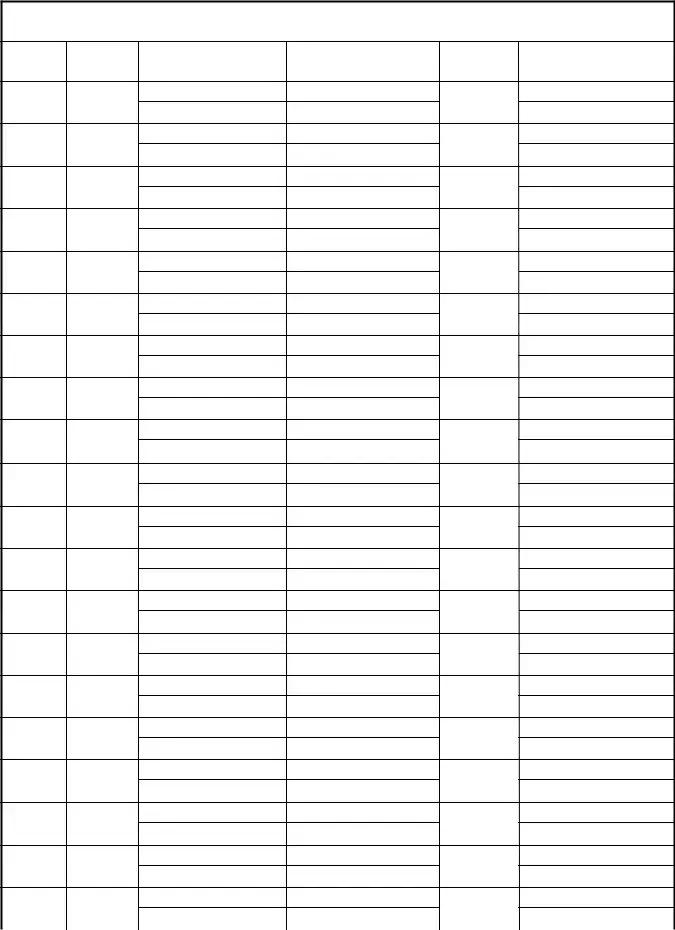
KEY ISSUE AND TURN IN
(Continued)
KEY
NUMBER
ISSUED
(Date/Time)
ISSUED BY
(Printed Name/Signature)
ISSUED TO
(Printed Name/Signature)
TURNED IN |
RECEIVED BY |
(Date/Time) |
(Printed Name/Signature) |
DA FORM 5513, JAN 2016 |
PREVIOUS EDITION IS OBSOLETE |
Page 2 of 3 |
APD LC v1.02
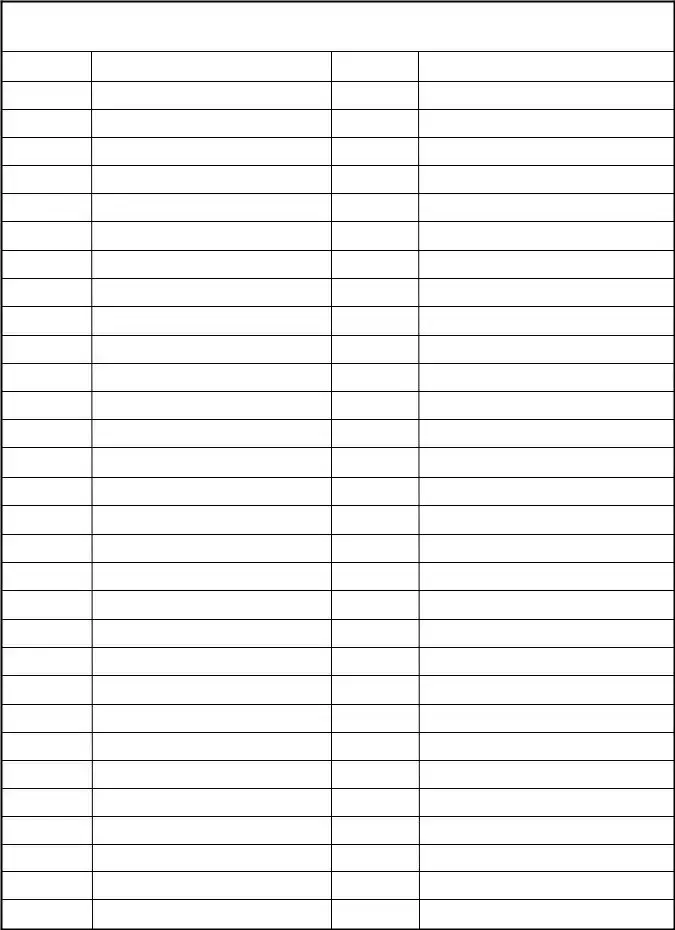
INVENTORIES (JOINT/SEMIANNUAL)
DATE |
PRINTED NAME/SIGNATURE |
DATE |
PRINTED NAME/SIGNATURE |
DA FORM 5513, JAN 2016 |
PREVIOUS EDITION IS OBSOLETE |
Page 3 of 3 |
APD LC v1.02
| Fact Name | Fact Details |
|---|---|
| Purpose | The DA Form 5513 serves as a key control register and inventory form, ensuring proper tracking and management of keys within military units. |
| Governing Regulation | This form is governed by Army Regulation (AR) 190-11, which outlines the security of arms, ammunition, and explosives. |
| Frequency of Use | Units are required to use this form periodically, specifically during joint or semiannual inventories. |
| Key Control Numbers | The form includes spaces for up to 104 key control numbers, allowing for comprehensive inventory management. |
| Issued By | Each key issued must be documented with the name and signature of the person who issued it, ensuring accountability. |
| Returned Keys | When keys are returned, the form requires the signature of the individual receiving them, maintaining a clear chain of custody. |
| Record Keeping | Records of key issuance and returns are essential for maintaining security and must be kept up to date. |
| Previous Editions | The current edition of the DA Form 5513 was updated in January 2016, and earlier versions are now considered obsolete. |
| Importance of Accuracy | Accurate completion of this form is crucial for ensuring the security of facilities and equipment within military operations. |
Completing the DA 5513 form is essential for maintaining accurate records of key control and inventory management. The following steps will guide you through the process of filling out this form correctly.
Once you have completed these steps, review the form for accuracy and ensure all required signatures are present. This will help maintain compliance with key control regulations.
What is the DA 5513 form used for?
The DA 5513 form is used as a Key Control Register and Inventory. It helps military units keep track of key issuance and returns, ensuring proper accountability and security for keys within an organization.
Who is responsible for filling out the DA 5513 form?
The responsibility for completing the DA 5513 form typically falls on personnel assigned to key control duties within a unit. This includes documenting key issuance, returns, and conducting inventories as required by regulations.
What information is required on the DA 5513 form?
The form requires several key pieces of information, including the unit or activity name, the period covered, and specific key control numbers. Additionally, it captures details about who issued and returned the keys, along with the dates and signatures of the individuals involved.
How often should the DA 5513 form be updated?
The DA 5513 form should be updated every time keys are issued or returned. Regular inventories, typically conducted semiannually or as specified by your unit's policies, should also be documented on this form to maintain accurate records.
What happens if a key is lost or not returned?
If a key is lost or not returned, it is crucial to report the incident immediately. The unit must follow established protocols for lost keys, which may include notifying security personnel and taking steps to rekey locks if necessary. Documentation of the loss should also be noted on the DA 5513 form.
Can the DA 5513 form be completed electronically?
Yes, the DA 5513 form can be completed electronically if your unit has the necessary systems in place. However, it is important to ensure that all signatures and required information are properly captured, whether using a digital format or a printed copy.
Is there a specific format for the key control numbers on the DA 5513 form?
Yes, key control numbers should be entered in a clear and consistent format. This may include serial numbers or other identifying numbers associated with the keys. Proper documentation ensures that keys can be easily tracked and accounted for.
What should be done with the DA 5513 form after it is completed?
Once the DA 5513 form is completed, it should be securely stored as part of the unit's records. Access to these records should be restricted to authorized personnel to maintain confidentiality and security regarding key control.
Where can I find the DA 5513 form?
The DA 5513 form can typically be found on official military websites or through your unit's administrative office. It is important to ensure you are using the most current version of the form, as previous editions may be obsolete.
When filling out the DA 5513 form, individuals often make several common mistakes. Here’s a list of eight frequent errors to avoid:
Leaving out essential details, such as the unit/activity or the period covered, can lead to confusion and delays.
Double-check the key control numbers. Mistakes in these numbers can result in inventory discrepancies.
Ensure that all required signatures are included. Missing signatures can invalidate the form.
Using incorrect or inconsistent dates for issuance and receipt can complicate tracking and accountability.
Always print names clearly. Illegible handwriting can lead to misunderstandings about who is responsible for the keys.
Not updating the form when key control numbers change can lead to outdated records.
When conducting inventories, ensure that the dates are consistent across all entries. Discrepancies can raise red flags.
Using an outdated version of the form can result in missing important updates or changes in procedures.
By being mindful of these common pitfalls, you can ensure that the DA 5513 form is completed accurately and efficiently.
The DA 5513 form, known as the Key Control Register and Inventory, is essential for tracking the issuance and return of keys within military units. To ensure comprehensive key management, several other forms and documents are often utilized in conjunction with the DA 5513. Below is a list of these related documents, each serving a specific purpose in the key control process.
Utilizing these forms alongside the DA 5513 enhances the effectiveness of key management and property accountability within military operations. Each document plays a vital role in ensuring that assets are properly tracked and maintained, fostering a culture of responsibility and security.
The DA Form 2062, also known as the Hand Receipt, serves a similar purpose to the DA 5513 form. Both documents track the issuance and return of property, ensuring accountability. The DA 2062 is typically used for individual items or equipment, whereas the DA 5513 focuses on key control. Each form requires signatures from both the issuer and the recipient, reinforcing responsibility for the items listed.
The DA Form 3749, or Equipment Receipt, is another document that parallels the DA 5513. It is used for the issuance and return of specific equipment. Like the DA 5513, the DA 3749 captures essential details such as the date of issue and the signatures of the parties involved. This form helps maintain a clear record of who has possession of the equipment, which is crucial for inventory management.
The DA Form 7000, known as the Request for Transfer of Property, also shares similarities with the DA 5513. This form is used when property is being transferred between units or individuals. Both documents require detailed information about the items being transferred and the signatures of the involved parties. They ensure that property accountability is maintained throughout the transfer process.
The DA Form 2404, which is used for equipment inspection and maintenance, has some overlap with the DA 5513. While the primary focus of the DA 2404 is on the condition of equipment, it also includes information about the equipment’s accountability. Both forms require documentation of the individuals involved, ensuring that everyone is aware of their responsibilities regarding the equipment or keys in question.
Lastly, the DA Form 3161, or Request for Issue or Turn-In, is similar to the DA 5513 in that it documents the issuance and return of items. This form is often used for temporary issues and provides a record of transactions. Like the DA 5513, it requires signatures from both the issuer and the recipient, helping to maintain accountability and transparency in the handling of property.
When filling out the DA 5513 form, attention to detail is crucial. Here are some important dos and don'ts to consider:
By following these guidelines, you can help ensure that your DA 5513 form is completed correctly and efficiently, facilitating a smoother process for all parties involved.
The DA Form 5513 is essential for key control and inventory management in military settings. However, several misconceptions exist about its purpose and use. Here are eight common misunderstandings:
Understanding these misconceptions can lead to better compliance and management of key control processes within military units.
When filling out and using the DA 5513 form, it is essential to follow certain guidelines to ensure accuracy and compliance. Here are some key takeaways to keep in mind:
By following these takeaways, you can effectively manage key control and inventory, ensuring that all procedures are adhered to with care and diligence.