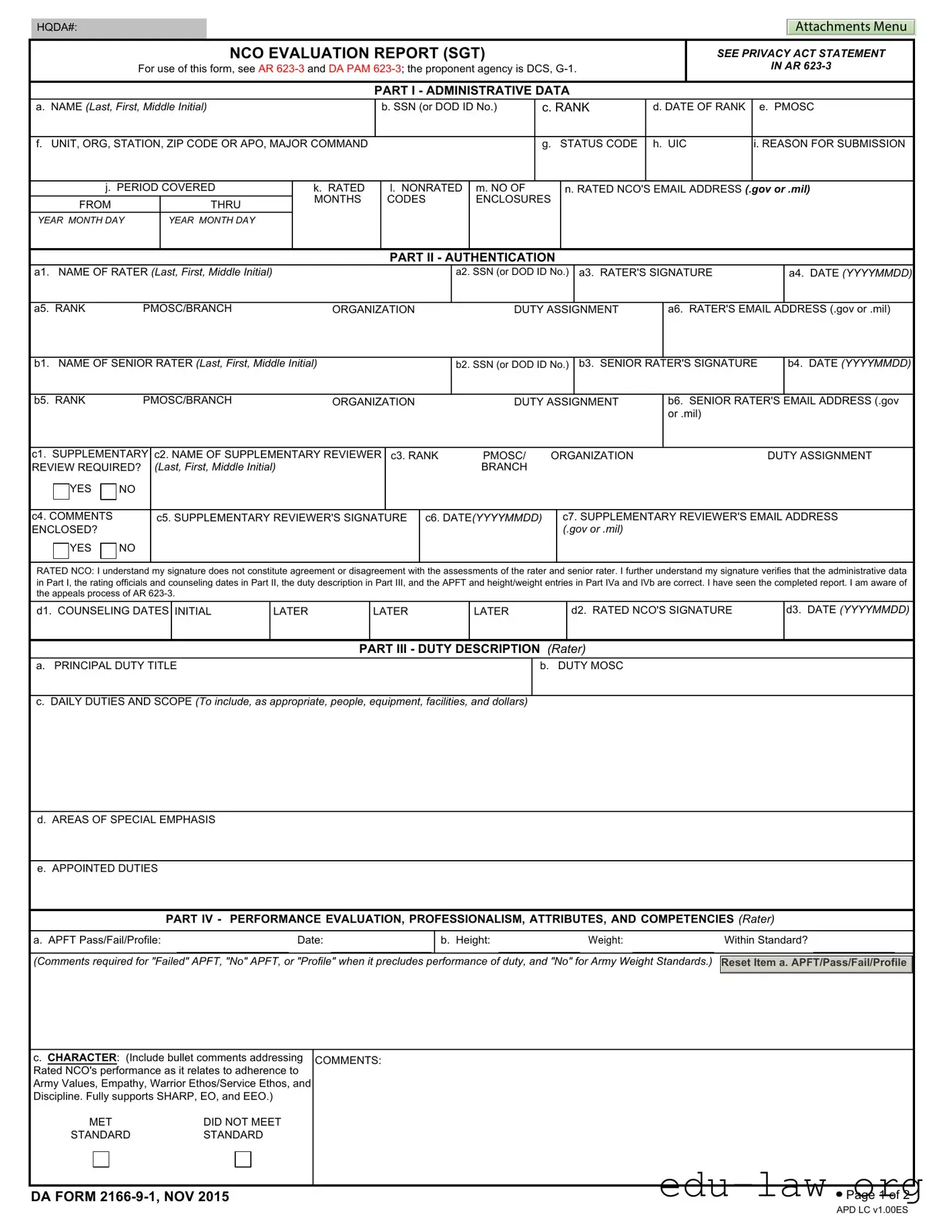
The DA 2166-9-1 form is an essential tool for evaluating non-commissioned officers (NCOs) in the U.S. Army. It serves as the NCO Evaluation Report specifically for the rank of Sergeant. This form captures important information about the rated NCO, including their name, Social Security Number, rank, and unit details. The evaluation process is structured in several parts, beginning with administrative data and moving through authentication, duty descriptions, and performance evaluations. Each section requires input from both the rater and senior rater, ensuring a comprehensive assessment of the NCO's performance and potential. The form also emphasizes the importance of counseling dates and includes a section for the rated NCO to acknowledge their understanding of the report. Key performance attributes such as character, presence, intellect, leadership, development, and achievement are evaluated, providing a holistic view of the NCO's capabilities. This structured approach not only helps in recognizing outstanding performance but also identifies areas for improvement, ultimately contributing to the professional growth of Army personnel.
HQDA#: |
Attachments Menu |
NCO EVALUATION REPORT (SGT)
For use of this form, see AR
SEE PRIVACY ACT STATEMENT
IN AR
PART I
a.NAME (Last, First, Middle Initial)
b. SSN (or DOD ID No.)
c. RANK
d. DATE OF RANK
e. PMOSC
f. UNIT, ORG, STATION, ZIP CODE OR APO, MAJOR COMMAND
g. STATUS CODE
h. UIC
i. REASON FOR SUBMISSION
j. PERIOD COVERED
FROMTHRU
YEAR MONTH DAY |
YEAR MONTH DAY |
k.RATED MONTHS
l.NONRATED CODES
m. NO OF ENCLOSURES
n. RATED NCO'S EMAIL ADDRESS (.gov or .mil)
PART II
a1. NAME OF RATER (Last, First, Middle Initial)
a2. SSN (or DOD ID No.)
a3. RATER'S SIGNATURE
a4. DATE (YYYYMMDD)
a5. RANK |
PMOSC/BRANCH |
ORGANIZATION |
DUTY ASSIGNMENT
a6. RATER'S EMAIL ADDRESS (.gov or .mil)
b1. NAME OF SENIOR RATER (Last, First, Middle Initial)
b2. SSN (or DOD ID No.)
b3. SENIOR RATER'S SIGNATURE
b4. DATE (YYYYMMDD)
b5. RANK |
PMOSC/BRANCH |
ORGANIZATION |
DUTY ASSIGNMENT |
b6. SENIOR RATER'S EMAIL ADDRESS (.gov or .mil)
c1. SUPPLEMENTARY |
c2. NAME OF SUPPLEMENTARY REVIEWER |
c3. RANK |
PMOSC/ |
ORGANIZATION |
DUTY ASSIGNMENT |
|||
REVIEW REQUIRED? |
(Last, First, Middle Initial) |
|
|
BRANCH |
|
|
|
|
YES |
NO |
|
|
|
|
|
|
|
|
|
|
|
|
|
|
||
c4. COMMENTS |
|
c5. SUPPLEMENTARY REVIEWER'S SIGNATURE |
c6. DATE(YYYYMMDD) |
|
c7. SUPPLEMENTARY REVIEWER'S EMAIL ADDRESS |
|||
ENCLOSED? |
|
|
|
|
|
|
(.gov or .mil) |
|
YES |
NO |
|
|
|
|
|
|
|
|
|
|
|
|
|
|
|
|
RATED NCO: I understand my signature does not constitute agreement or disagreement with the assessments of the rater and senior rater. I further understand my signature verifies that the administrative data in Part I, the rating officials and counseling dates in Part II, the duty description in Part III, and the APFT and height/weight entries in Part IVa and IVb are correct. I have seen the completed report. I am aware of the appeals process of AR
d1. COUNSELING DATES INITIAL
LATER
LATER
LATER
d2. RATED NCO'S SIGNATURE
d3. DATE (YYYYMMDD)
PART III
a. PRINCIPAL DUTY TITLE
b. DUTY MOSC
c.DAILY DUTIES AND SCOPE (To include, as appropriate, people, equipment, facilities, and dollars)
d.AREAS OF SPECIAL EMPHASIS
e.APPOINTED DUTIES
PART IV
a. APFT Pass/Fail/Profile: |
Date: |
b. Height: |
Weight: |
Within Standard? |
(Comments required for "Failed" APFT, "No" APFT, or "Profile" when it precludes performance of duty, and "No" for Army Weight Standards.) Reset Item a. APFT/Pass/Fail/Profile
c.CHARACTER: (Include bullet comments addressing Rated NCO's performance as it relates to adherence to Army Values, Empathy, Warrior Ethos/Service Ethos, and Discipline. Fully supports SHARP, EO, and EEO.)
MET |
DID NOT MEET |
STANDARD |
STANDARD |
COMMENTS:
DA FORM |
Page 1 of 2 |
APD LC v1.00ES
RATED NCO'S NAME (Last, First, Middle Initial) |
SSN (or DOD ID No.) |
THRU DATE |
|
|
|
PART IV
d. PRESENCE: (Military and professional |
COMMENTS: |
|
bearing, Fitness, Confidence, Resilience.) |
|
|
MET |
DID NOT MEET |
|
STANDARD |
STANDARD |
|
e. INTELLECT: (Mental agility, Sound judgment, COMMENTS: |
|
Innovation, Interpersonal tact, Expertise.) |
|
MET |
DID NOT MEET |
STANDARD |
STANDARD |
f. LEADS: (Leads others, Builds trust, Extends COMMENTS: |
|
influence beyond the chain of command, Leads by |
|
example Communicates.) |
|
MET |
DID NOT MEET |
STANDARD |
STANDARD |
g. DEVELOPS: (Creates a positive command/ COMMENTS: |
|
workplace environment, Fosters esprit de corps, |
|
Prepares self, Develops others, Stewards the |
|
profession.) |
|
MET |
DID NOT MEET |
STANDARD |
STANDARD |
|
|
h. ACHIEVES: (Gets results.) |
COMMENTS: |
MET |
DID NOT MEET |
STANDARD |
STANDARD |
|
|
|
|
|
|
RATER OVERALL PERFORMANCE |
|
i. I currently rate |
NCOs in this grade. |
|
|||||
COMMENTS: |
|
|
|
|
|
|
|
|
|
|
|
|
|
|
|
|
|
|
|
|
|
PART V |
|
a. Select one box representing Rated |
b. COMMENTS: |
|
|||||
NCO’s potential compared to others in the |
|
|
|||||
same grade whom you have rated in your |
|
|
|||||
career. I currently senior rate |
|
|
|||||
NCOs in this grade. |
|
|
|
|
|
|
|
|
|
|
|
|
|
||
MOST QUALIFIED |
|
|
|
|
|
|
|
HIGHLY QUALIFIED |
|
|
|||||
QUALIFIED |
|
|
|
|
|
|
|
NOT QUALIFIED |
|
|
|
|
|
|
|
|
|
|
|||||
c. List two successive assignments and one broadening assignment |
|
||||||
Successive Assignment: |
1) |
|
|
2) |
Broadening Assignment: |
||
|
|
|
|||||
DA FORM |
|
Page 2 of 2 |
|||||
|
|
|
|
|
|
|
APD PE v1.00ES |
| Fact Name | Description |
|---|---|
| Form Purpose | The DA 2166-9-1 form is used for the NCO Evaluation Report for Sergeants. |
| Governing Law | This form is governed by AR 623-3 and DA PAM 623-3. |
| Privacy Act Statement | Users must refer to the Privacy Act Statement as outlined in AR 623-3. |
| Submission Requirements | Submission includes detailed administrative data, performance evaluation, and signatures from rater and senior rater. |
Completing the DA Form 2166-9-1 is an essential task for evaluating non-commissioned officers. After filling out the form, it will need to be submitted to the appropriate personnel for review. Ensure that all information is accurate and complete to avoid delays in processing.
What is the purpose of the DA 2166 9 1 form?
The DA 2166 9 1 form is used for evaluating Non-Commissioned Officers (NCOs) at the rank of Sergeant. It serves as an official record of an NCO's performance, professionalism, and potential for future assignments. This evaluation helps in making informed decisions regarding promotions, assignments, and overall career development within the Army.
Who needs to complete the DA 2166 9 1 form?
The form must be completed by the rater, senior rater, and the rated NCO. The rater assesses the NCO's performance and provides feedback. The senior rater reviews the evaluation and offers insights into the NCO's potential. The rated NCO is required to sign the form, acknowledging that they have seen the completed report and understand the evaluation process.
What information is required on the DA 2166 9 1 form?
Key information includes the NCO's name, Social Security Number (or DOD ID), rank, and unit details. The form also requires the period covered by the evaluation, the names and signatures of the rater and senior rater, and performance metrics such as the Army Physical Fitness Test (APFT) results. Additionally, the rater must provide comments on various attributes, including character, presence, intellect, leadership, development, and achievements.
How does the evaluation process work?
The evaluation process begins with the rater filling out the form based on their observations of the NCO's performance. After the rater completes their assessment, the senior rater reviews it and adds their own evaluation of the NCO's potential. The rated NCO then reviews the completed form, signs it, and can provide comments or feedback. This entire process ensures a comprehensive evaluation that reflects the NCO's contributions and areas for improvement.
Incomplete or Incorrect Personal Information: One common mistake is failing to provide complete and accurate personal details in Part I. This includes the name, Social Security Number (SSN), rank, and unit information. Missing or incorrect data can delay processing and create complications.
Failure to Verify Counseling Dates: Many individuals overlook the importance of verifying counseling dates in Part II. Accurate dates are crucial as they confirm that the rated NCO has received the necessary feedback and support. Missing or incorrect dates can lead to misunderstandings about performance evaluations.
Neglecting to Include Required Signatures: Some people forget to obtain the necessary signatures from the rater, senior rater, and supplementary reviewer. Each signature is a vital part of the evaluation process, ensuring accountability and transparency. Without these signatures, the form may be deemed incomplete.
Inadequate Performance Comments: Providing insufficient or vague comments in the performance evaluation sections can hinder a complete understanding of the rated NCO's capabilities. Specific examples and detailed observations are essential for a fair assessment. Failing to include these can diminish the effectiveness of the evaluation.
The DA Form 2166-9-1 is a crucial document in the evaluation process for Non-Commissioned Officers (NCOs) in the U.S. Army. Alongside this form, several other documents and forms are commonly utilized to ensure a comprehensive evaluation and record-keeping process. Each of these documents serves a specific purpose, contributing to the overall assessment of an NCO's performance and potential.
These documents collectively enhance the evaluation process for NCOs, providing a well-rounded view of an individual's capabilities, performance, and potential for future leadership roles. Proper use of these forms ensures that evaluations are thorough, transparent, and conducive to the professional growth of soldiers in the Army.
The DA Form 2166-9-1 is similar to the DA Form 67-9, which is the Company Grade Plate Evaluation Report. Both forms serve as evaluation tools for military personnel, focusing on performance and potential. The DA Form 67-9 is used for officers in the company grade, while the 2166-9-1 specifically targets non-commissioned officers (NCOs). Each form requires details about the individual’s duties, achievements, and areas of improvement, ensuring a comprehensive assessment of their capabilities and contributions to the Army.
Another comparable document is the DA Form 1059, the Service School Academic Evaluation Report. This form evaluates the academic performance of military personnel who attend training courses. Like the 2166-9-1, it emphasizes the importance of assessment in professional development. Both documents require signatures from raters and senior raters, highlighting the collaborative nature of evaluations within the military structure.
The DA Form 4856, also known as the Developmental Counseling Form, shares similarities with the DA Form 2166-9-1 in that both are used to document and communicate performance. The 4856 is typically used for counseling sessions to address specific performance issues or goals, while the 2166-9-1 provides a broader overview of an NCO’s performance over time. Both forms facilitate feedback and encourage professional growth within the ranks.
Additionally, the DA Form 7000, the Financial Liability Investigation of Property Loss, can be seen as similar in its evaluative nature, though it focuses on financial accountability rather than performance. Both forms require detailed reporting and signatures, ensuring that all involved parties acknowledge the findings. They both emphasize the importance of documentation in maintaining standards within the military.
The DA Form 7570, which is the Army Physical Fitness Test Scorecard, also relates to the DA Form 2166-9-1 by assessing physical performance. The 2166-9-1 includes a section on physical fitness, making it essential for evaluating an NCO's overall readiness. Both forms highlight the significance of physical conditioning in military service and require accurate reporting of results.
The DA Form 2166-9-2, the NCO Evaluation Report for SFC and above, is another document that aligns with the 2166-9-1. While the latter is for SGTs, the 2166-9-2 covers higher-ranking NCOs. Both forms assess leadership abilities, performance, and potential, ensuring that evaluations are consistent across different ranks within the NCO structure.
Similarly, the DA Form 2823, the Sworn Statement, can be compared to the DA Form 2166-9-1 in terms of documentation. While the 2823 is used to gather factual accounts for investigations, both forms require careful attention to detail and accuracy. They play crucial roles in maintaining accountability and transparency within military operations.
Lastly, the DA Form 4856-1, the NCOER Counseling Checklist, complements the 2166-9-1 by providing a structured approach to performance counseling. Both documents aim to enhance communication between NCOs and their leaders. They help establish clear expectations and track progress, contributing to the overall development of military personnel.
When filling out the DA 2166-9-1 form, there are important guidelines to follow. Here’s a list of things you should and shouldn't do:
Following these guidelines will help ensure your form is completed correctly and efficiently.
Understanding the DA 2166-9-1 form is crucial for service members, but several misconceptions can lead to confusion. Here are five common misunderstandings about this evaluation report form:
Many believe that the DA 2166-9-1 is used solely to document poor performance. In reality, it is designed to provide a comprehensive evaluation of an NCO's performance, highlighting both strengths and areas for improvement.
Some think that signing the form means the rated NCO agrees with everything written in the evaluation. However, the signature merely verifies that the administrative data is correct and that the NCO has seen the completed report.
There is a belief that once the form is submitted, it is no longer relevant. In truth, the evaluations can impact future assignments, promotions, and career progression, making them important long after submission.
Some individuals assume that only the rater's input matters. However, the senior rater also plays a significant role in assessing the NCO's potential and overall performance, adding another layer of evaluation.
Many think that the form can be filled out in any manner. In fact, specific guidelines dictate how to complete the form, ensuring that evaluations are consistent and thorough. Adhering to these guidelines is essential for clarity and accuracy.
Filling out and using the DA 2166-9-1 form requires attention to detail and adherence to specific guidelines. Here are key takeaways regarding this process: