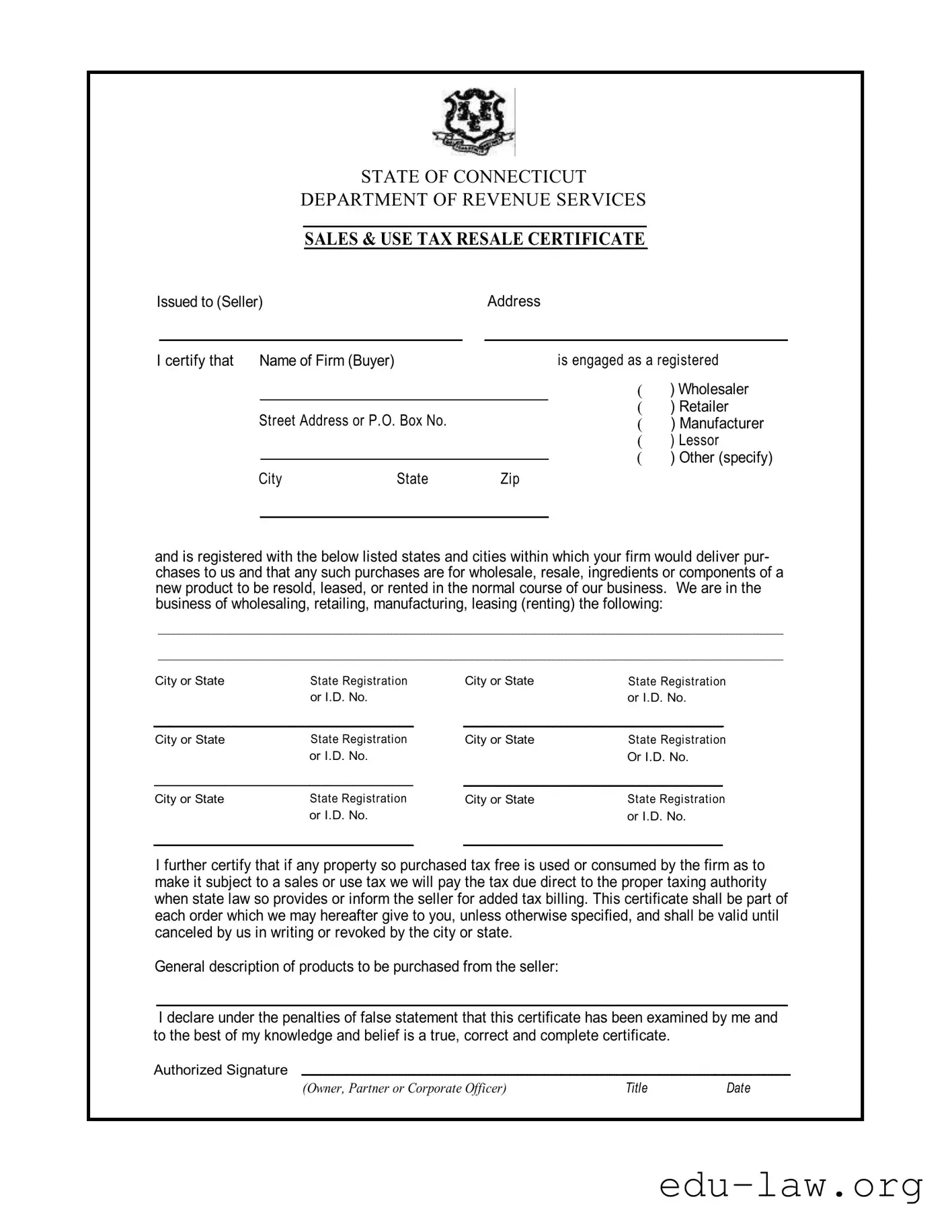
The Connecticut Resale Certificate form serves a critical role in the state's sales and use tax system, allowing businesses to purchase goods without paying sales tax, provided those goods are intended for resale. This form is issued to sellers by buyers, who must certify their status as wholesalers, retailers, manufacturers, lessors, or other specified entities. It requires detailed information, including the names and addresses of both the buyer and seller, as well as the buyer's registration numbers with various states and cities. The form also stipulates that the purchases made are for wholesale, resale, or as components of new products intended for resale or rental. Importantly, the buyer must acknowledge their responsibility to pay any applicable sales or use tax if the purchased items are used in a manner that triggers tax obligations. The certificate remains valid until it is canceled in writing or revoked by the appropriate authority. A general description of the products to be purchased must also be provided, ensuring clarity in the transaction. The form concludes with a declaration, emphasizing the buyer's commitment to honesty and accuracy, which is crucial in maintaining compliance with state tax laws.
STATE OF CONNECTICUT
DEPARTMENT OF REVENUE SERVICES
SALES & USE TAX RESALE CERTIFICATE
Issued to (Seller) |
|
|
Address |
|
||||
|
|
|
|
|
|
|
|
|
I certify that |
Name of Firm (Buyer) |
|
|
|
is engaged as a registered |
|||
|
|
|
|
|
|
|
( |
) Wholesaler |
|
|
Street Address or P.O. Box No. |
( |
) Retailer |
||||
|
|
( |
) Manufacturer |
|||||
|
|
|
|
|
|
( |
) Lessor |
|
|
|
|
|
|
|
|
( |
) Other (specify) |
|
|
|
|
State |
|
|||
|
|
City |
Zip |
|
||||
|
|
|
|
|
|
|
|
|
and is registered with the below listed states and cities within which your firm would deliver pur- chases to us and that any such purchases are for wholesale, resale, ingredients or components of a new product to be resold, leased, or rented in the normal course of our business. We are in the business of wholesaling, retailing, manufacturing, leasing (renting) the following:
City or State |
State Registration |
|
or I.D. No. |
City or State |
State Registration |
|
or I.D. No. |
City or State |
State Registration |
|
or I.D. No. |
City or State |
State Registration |
|
or I.D. No. |
City or State |
State Registration |
|
Or I.D. No. |
City or State |
State Registration |
|
or I.D. No. |
I further certify that if any property so purchased tax free is used or consumed by the firm as to make it subject to a sales or use tax we will pay the tax due direct to the proper taxing authority when state law so provides or inform the seller for added tax billing. This certificate shall be part of each order which we may hereafter give to you, unless otherwise specified, and shall be valid until canceled by us in writing or revoked by the city or state.
General description of products to be purchased from the seller:
I declare under the penalties of false statement that this certificate has been examined by me and to the best of my knowledge and belief is a true, correct and complete certificate.
Authorized Signature
(Owner, Partner or Corporate Officer) |
TITLE |
DATE |
| Fact Name | Description |
|---|---|
| Purpose | The Connecticut Resale Certificate allows businesses to purchase items tax-free for resale, leasing, or manufacturing. |
| Eligibility | Only registered wholesalers, retailers, manufacturers, lessors, or other specified businesses can use this certificate. |
| Tax Responsibility | If items purchased tax-free are used for personal use, the buyer must pay the sales tax directly to the state. |
| Validity | This certificate remains valid until it is canceled in writing or revoked by the state or city. |
| Required Information | Buyers must provide their business name, address, and registration details to complete the certificate. |
| Governing Law | The use of this form is governed by Connecticut state tax laws, specifically the Sales and Use Tax regulations. |
Filling out the Connecticut Resale Certificate form is a straightforward process that requires specific information about your business and its tax registration. Once completed, this form allows you to make tax-exempt purchases for resale. Here’s how to fill it out step by step.
What is a Connecticut Resale Certificate?
The Connecticut Resale Certificate is a document that allows businesses to purchase goods without paying sales tax. This form is typically used by wholesalers, retailers, manufacturers, and lessors who intend to resell the items they purchase. By providing this certificate to a seller, the buyer certifies that the goods are for resale or will be used as components in products that will be sold.
Who can use the Connecticut Resale Certificate?
Any business engaged in wholesaling, retailing, manufacturing, or leasing can use the Connecticut Resale Certificate. The buyer must be registered with the appropriate state or local tax authorities and must use the purchased items in the normal course of their business operations.
How do I fill out the Connecticut Resale Certificate?
To complete the certificate, you need to provide your business name, address, and the type of business you operate (wholesaler, retailer, etc.). You must also list the states where you are registered and the relevant registration or ID numbers. Additionally, a description of the products you intend to purchase should be included. Finally, an authorized person must sign the document.
Is there a specific format for the Connecticut Resale Certificate?
While the Connecticut Department of Revenue Services provides a standard form, you can also create your own version as long as it includes all the required information. Ensure that your certificate meets the state’s guidelines to avoid any issues with tax compliance.
Do I need to renew the Connecticut Resale Certificate?
The certificate remains valid until it is canceled in writing by the buyer or revoked by the state or city. However, it is advisable to review and update the information periodically, especially if there are changes in your business structure or tax registration.
What happens if I misuse the Connecticut Resale Certificate?
If a business uses the resale certificate incorrectly—such as purchasing items for personal use rather than for resale—it may face penalties. This could include back taxes owed, interest, and potential fines. It is crucial to ensure that the items purchased with the certificate are truly for resale or business purposes.
Can I use the Connecticut Resale Certificate in other states?
The Connecticut Resale Certificate is only valid in Connecticut. If you conduct business in other states, you will need to check their specific regulations and obtain the appropriate resale certificates for those jurisdictions. Each state has its own rules regarding sales tax and resale exemptions.
What should I do if I lose my Connecticut Resale Certificate?
If you lose your resale certificate, you should complete a new one and provide it to your suppliers. It is also a good idea to keep a copy of all resale certificates for your records, as you may need to present them for tax audits or compliance checks.
How long should I keep records related to the Connecticut Resale Certificate?
It is recommended to keep records related to the resale certificate for at least three to four years. This includes copies of the certificate, purchase invoices, and any correspondence with tax authorities. Maintaining these records can help protect your business in the event of an audit.
Who should I contact for more information about the Connecticut Resale Certificate?
For additional questions or guidance, you can contact the Connecticut Department of Revenue Services. Their website offers resources and contact information to help clarify any uncertainties regarding sales tax and resale certificates.
Incomplete Seller Information: Failing to provide the full name and address of the seller can lead to confusion and complications in the transaction.
Incorrect Buyer Classification: Selecting the wrong classification (wholesaler, retailer, manufacturer, etc.) may result in improper tax treatment.
Missing State Registration Numbers: Not listing all relevant state registration or identification numbers can invalidate the certificate.
Vague Product Descriptions: Providing a general or unclear description of the products being purchased may raise questions during audits.
Failure to Sign: Omitting the signature of an authorized person can render the certificate ineffective.
Incorrect Date: Not dating the certificate can create ambiguity regarding its validity period.
Ignoring Tax Responsibilities: Not acknowledging the obligation to pay sales tax if the purchased items are used for non-resale purposes can lead to penalties.
Not Specifying Cancellation Terms: Failing to mention how the certificate can be canceled may lead to misunderstandings between buyer and seller.
Using Outdated Forms: Submitting an outdated version of the resale certificate can cause delays or rejections.
Neglecting to Keep Copies: Not retaining a copy of the completed certificate for your records can complicate future transactions or audits.
The Connecticut Resale Certificate is a crucial document for businesses engaged in buying goods for resale. It helps ensure that sales tax is not charged on items intended for resale. Along with this certificate, several other forms and documents are often used to facilitate transactions and maintain compliance with tax regulations. Below is a list of these commonly associated documents.
These documents work together to ensure smooth transactions and compliance with tax laws. Understanding each one can help businesses operate more effectively and avoid potential legal issues.
The Sales Tax Exemption Certificate is a document that allows buyers to purchase goods without paying sales tax, similar to the Ct Resale Certificate. This certificate is typically used by organizations that qualify for tax-exempt status, such as non-profits or government entities. It serves to confirm that the purchases made are for exempt purposes, just as the Ct Resale Certificate verifies that items are intended for resale or use in manufacturing. Both documents require the buyer to provide information about their business and the intended use of the items purchased.
The Purchase Order (PO) is another document that shares similarities with the Ct Resale Certificate. A purchase order is an official request from a buyer to a seller to provide goods or services at specified prices and terms. While the Ct Resale Certificate focuses on tax exemption for resale purposes, the PO outlines the details of the transaction, including quantities and delivery dates. Both documents facilitate clear communication between the buyer and seller, ensuring that expectations are understood and met.
The Certificate of Authority is a document that grants a business the right to operate within a certain jurisdiction. Similar to the Ct Resale Certificate, it confirms the legitimacy of a business's operations. While the Ct Resale Certificate is specifically related to sales tax exemptions for resale, the Certificate of Authority is broader, encompassing various legal permissions required for a business to function. Both documents serve to establish the credibility of the business involved in the transaction.
The Business License is a document that permits a company to conduct business legally within a specific area. Like the Ct Resale Certificate, it is essential for compliance with local regulations. The business license indicates that the company has met all necessary legal requirements to operate, while the Ct Resale Certificate ensures that tax obligations are appropriately managed for resale transactions. Both documents are vital for maintaining lawful business practices.
The 1099 Form is a tax document used to report income received by independent contractors or freelancers. While this form is not directly related to sales tax, it shares a connection with the Ct Resale Certificate in the context of tax compliance. The 1099 Form provides necessary information for tax reporting, similar to how the Ct Resale Certificate helps manage tax obligations for resale purchases. Both documents play a role in ensuring that businesses adhere to tax laws and regulations.
Finally, the W-9 Form is a request for taxpayer identification number and certification. This form is used by businesses to collect information from independent contractors for tax purposes. Like the Ct Resale Certificate, the W-9 Form is crucial for ensuring compliance with tax regulations. While the Ct Resale Certificate focuses on sales tax exemptions, the W-9 Form is essential for reporting income to the IRS. Both documents are integral to the financial and tax responsibilities of businesses.
When filling out the Connecticut Resale Certificate form, it’s important to follow certain guidelines to ensure accuracy and compliance. Here’s a list of things you should and shouldn’t do:
By following these tips, you can help ensure that your use of the Connecticut Resale Certificate is compliant and effective.
Understanding the Connecticut Resale Certificate can be tricky. Here are some common misconceptions that often lead to confusion:
By clearing up these misconceptions, businesses can navigate the resale certificate process more effectively and ensure compliance with state tax laws.
Understanding the Connecticut Resale Certificate form is crucial for businesses engaged in wholesale or retail activities. Here are some key takeaways to keep in mind:
By keeping these points in mind, businesses can navigate the use of the Connecticut Resale Certificate effectively and ensure compliance with state tax regulations.