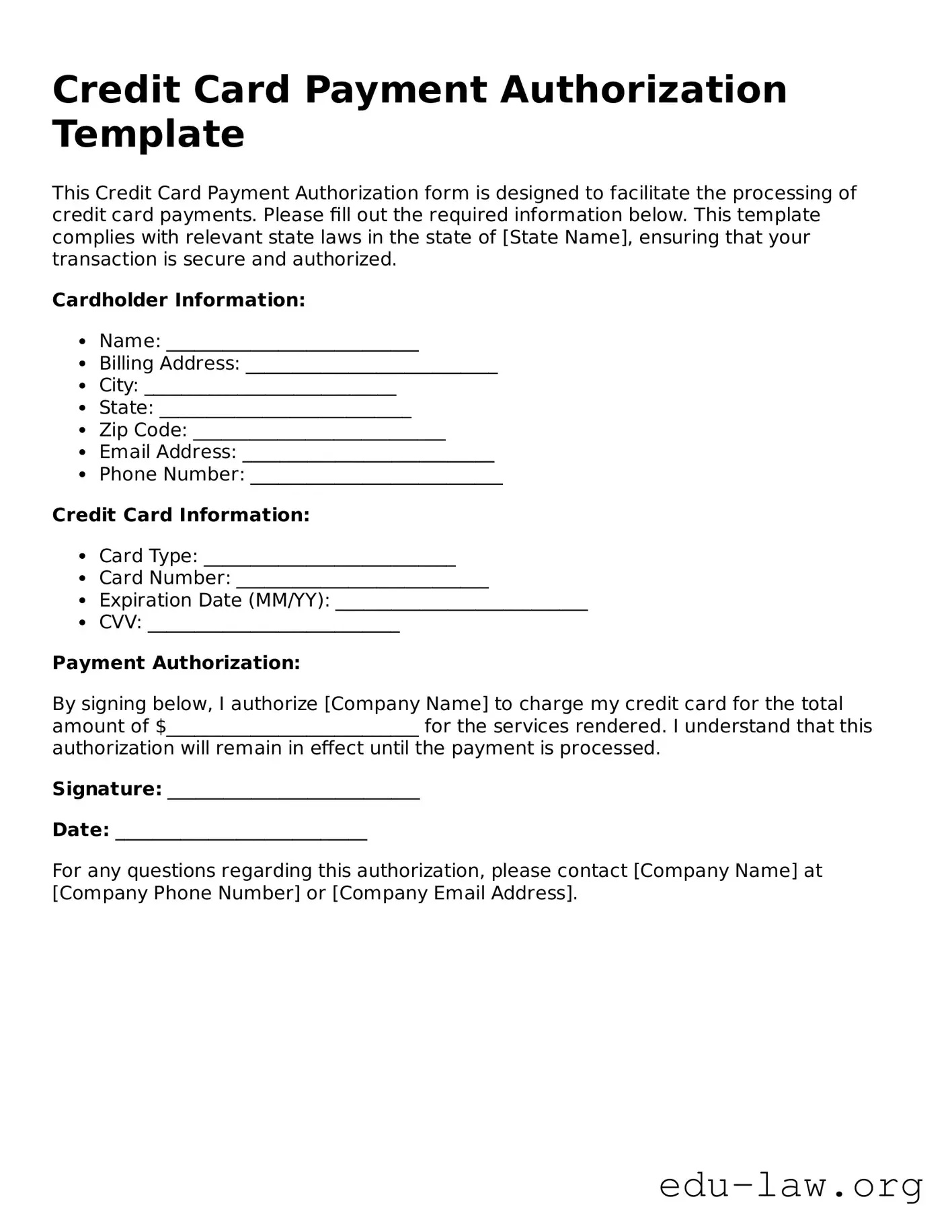
The Credit Card Payment Authorization form is an essential tool for businesses and consumers alike, facilitating secure transactions while providing peace of mind. This form typically includes key details such as the cardholder's name, card number, expiration date, and the amount to be charged. It may also require the cardholder's signature, indicating consent for the transaction. By using this form, businesses can ensure they have the necessary authorization to process payments, reducing the risk of fraud and chargebacks. Additionally, the form often outlines the terms of the transaction, ensuring that both parties understand their rights and responsibilities. Overall, the Credit Card Payment Authorization form serves as a crucial safeguard in the payment process, promoting transparency and trust between consumers and merchants.
Credit Card Payment Authorization Template
This Credit Card Payment Authorization form is designed to facilitate the processing of credit card payments. Please fill out the required information below. This template complies with relevant state laws in the state of [State Name], ensuring that your transaction is secure and authorized.
Cardholder Information:
Credit Card Information:
Payment Authorization:
By signing below, I authorize [Company Name] to charge my credit card for the total amount of $___________________________ for the services rendered. I understand that this authorization will remain in effect until the payment is processed.
Signature: ___________________________
Date: ___________________________
For any questions regarding this authorization, please contact [Company Name] at [Company Phone Number] or [Company Email Address].
| Fact Name | Description |
|---|---|
| Purpose | The Credit Card Payment Authorization form is used to obtain permission from a cardholder to charge their credit card for a specific amount. |
| Cardholder Information | This form typically requires the cardholder's name, billing address, and contact information for verification purposes. |
| Payment Details | It includes fields for the credit card number, expiration date, and security code to ensure accurate processing of the transaction. |
| Authorization Signature | The cardholder must provide a signature, indicating consent for the transaction and acknowledging the terms of the payment. |
| Revocation Rights | Cardholders have the right to revoke authorization at any time, which should be clearly stated on the form. |
| State-Specific Laws | In California, for instance, the form is governed by the California Civil Code Section 1747.08 regarding credit card transactions. |
| Data Security | Organizations must handle the information securely to protect the cardholder's sensitive data from unauthorized access. |
| Record Keeping | It is important to keep a copy of the signed form for record-keeping and to resolve any potential disputes. |
| Usage Limitations | The authorization is typically limited to a specific transaction amount and may not be used for recurring charges unless explicitly stated. |
Completing the Credit Card Payment Authorization form is a straightforward process. Once you have filled out the form correctly, it will be submitted for processing. This allows for efficient handling of your payment and ensures that your information is secure.
After completing these steps, review the form to ensure all information is correct before submitting it for processing.
What is a Credit Card Payment Authorization form?
A Credit Card Payment Authorization form is a document that allows a business or service provider to charge a specified amount to a customer's credit card. This form ensures that the customer gives explicit permission for the transaction, helping to protect both parties in the process.
Why do I need to fill out this form?
Filling out the Credit Card Payment Authorization form is essential for several reasons. It provides a clear record of your consent for the transaction. Additionally, it helps safeguard against unauthorized charges, ensuring that your financial information is handled responsibly.
What information is required on the form?
The form typically requires your name, billing address, credit card number, expiration date, and the amount to be charged. Some forms may also ask for your signature to confirm your authorization. Providing accurate information is crucial to avoid any processing issues.
Is my personal information secure when I submit this form?
Yes, reputable businesses take your privacy seriously. They should use secure methods to process your information. Look for secure payment gateways and ensure that the company has a privacy policy in place to protect your data.
Can I revoke my authorization after submitting the form?
Yes, you can revoke your authorization. However, it is important to do so in writing and to notify the business as soon as possible. Keep in mind that revoking authorization may affect any ongoing services or transactions associated with the payment.
What should I do if I notice an unauthorized charge?
If you see an unauthorized charge on your credit card statement, contact your credit card issuer immediately. They can help you dispute the charge and may provide guidance on how to proceed. It is also advisable to inform the business involved to resolve the issue directly.
How long does it take for the payment to be processed?
The processing time can vary depending on the business and the payment method used. Generally, transactions are processed within a few business days. If you have concerns about the timing, reach out to the business for clarification.
Can I use this form for recurring payments?
Yes, the Credit Card Payment Authorization form can be used for recurring payments, provided that it explicitly states the frequency and amount of the charges. Ensure that you understand the terms before authorizing recurring transactions to avoid unexpected charges.
Failing to provide complete personal information. This includes your name, address, and contact details.
Not including the correct credit card number. Double-check for accuracy to avoid payment delays.
Leaving out the expiration date of the credit card. Ensure this is filled in to validate the card.
Neglecting to sign the form. A signature is often required for authorization.
Using an expired credit card. Always check the card's validity before submission.
Not providing the CVV code. This three-digit number is crucial for processing payments securely.
Failing to read the terms and conditions. Understanding what you are agreeing to is essential.
Submitting the form without reviewing it. A quick review can catch mistakes before they become issues.
Not providing a valid email address for confirmation. This can lead to missed communications.
Ignoring the contact information for questions. If you have doubts, reach out for clarification.
The Credit Card Payment Authorization form is a vital document for businesses that require authorization from customers to charge their credit cards. However, several other forms and documents often accompany this authorization to ensure a smooth transaction process and to maintain compliance with various regulations. Below is a list of some commonly used documents.
Incorporating these documents alongside the Credit Card Payment Authorization form enhances the overall transaction process. Each document plays a specific role in ensuring transparency, compliance, and customer satisfaction.
The Credit Card Payment Authorization form shares similarities with a Direct Debit Authorization form. Both documents authorize a financial institution or service provider to withdraw funds from an account. In the case of the Direct Debit Authorization, the focus is on bank accounts rather than credit cards. This document requires the account holder's consent to allow recurring payments, mirroring the consent aspect of the credit card authorization.
Another document that resembles the Credit Card Payment Authorization form is the ACH Authorization form. Like the credit card form, the ACH Authorization allows for electronic payments to be deducted from a bank account. It provides the payer with a way to authorize transactions, ensuring that funds are transferred securely and with permission, similar to how a credit card form operates.
The Payment Plan Agreement also has similarities. This document outlines the terms under which payments will be made over time. It often includes details about the payment amounts and schedule, much like a credit card authorization form which specifies the payment details for a one-time or recurring charge. Both documents aim to establish clear expectations between the payer and the payee.
A Lease Agreement can be compared to the Credit Card Payment Authorization form in that both require a signature to confirm consent for payment obligations. In a lease agreement, tenants agree to pay rent, while in the credit card form, the cardholder agrees to allow charges. Both documents serve to protect the interests of the parties involved by clarifying payment responsibilities.
The Subscription Agreement is another document that shares common ground. This form allows individuals to agree to recurring payments for services or products. Similar to the credit card authorization, it requires the subscriber’s consent to process payments regularly. Both documents facilitate ongoing transactions based on the agreement of the parties.
In addition, the Invoice Approval form is akin to the Credit Card Payment Authorization form. An invoice approval confirms that a payer agrees to the charges listed on the invoice. This form often precedes a payment, ensuring that the payer acknowledges the amount due, much like the authorization form confirms the cardholder’s consent to a charge.
The Service Agreement also has parallels with the Credit Card Payment Authorization form. This document outlines the terms of service and payment obligations between a service provider and a client. It typically includes payment terms and conditions, similar to how a credit card authorization specifies the payment amount and frequency.
Lastly, the Purchase Order can be likened to the Credit Card Payment Authorization form. A purchase order is a document that confirms a buyer’s intent to purchase goods or services. It typically includes payment details and terms, establishing a mutual understanding of the transaction, much like the credit card authorization form does for credit transactions.
When filling out the Credit Card Payment Authorization form, it is essential to follow certain guidelines to ensure accuracy and security. Below is a list of things you should and shouldn't do.
By adhering to these guidelines, you can help protect your financial information and ensure a smooth transaction process.
Understanding the Credit Card Payment Authorization form is essential for both consumers and businesses. However, several misconceptions can lead to confusion. Here are seven common misunderstandings:
This is not true. The Credit Card Payment Authorization form can be used for in-person transactions as well, particularly when a business needs to keep a record of the authorization.
While the form provides authorization, it does not guarantee that the payment will be processed. Issues such as insufficient funds or credit limits can still prevent the transaction.
Although the form serves as a record of authorization, it does not inherently protect against fraudulent charges. Consumers should still monitor their statements and report any unauthorized transactions.
Different businesses may have their own versions of the Credit Card Payment Authorization form, tailored to their specific needs and compliance requirements.
This form can also be used for debit cards. It applies to any card that requires authorization for payment.
Consumers can revoke authorization, but they must do so in writing and follow the business's specific procedures to ensure the revocation is honored.
While the enforceability can depend on various factors, a properly executed Credit Card Payment Authorization form can be legally binding in many circumstances.
Being aware of these misconceptions can help consumers make informed decisions and protect their financial interests.
Filling out and using a Credit Card Payment Authorization form can be straightforward if you keep a few key points in mind. Here are some essential takeaways to help you navigate the process effectively:
By keeping these takeaways in mind, you can confidently fill out and use the Credit Card Payment Authorization form, ensuring a smooth transaction experience.