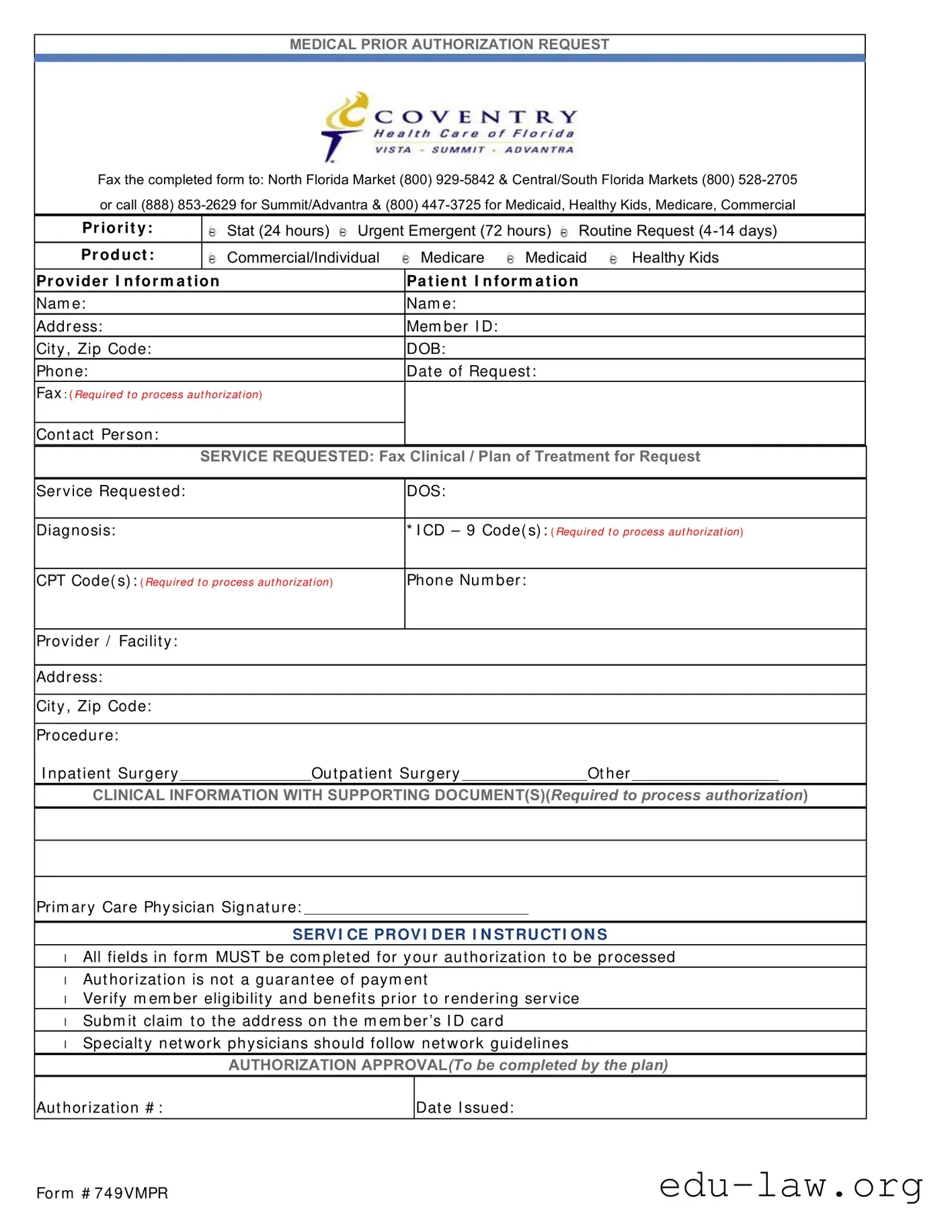
The Coventry Prior Authorization form serves as a crucial tool in the healthcare process, ensuring that necessary medical services are approved before they are rendered. This form is designed to streamline communication between healthcare providers and insurance companies, facilitating timely access to care for patients. It requires essential information such as the patient's name, member ID, and date of birth, alongside details about the requested service, including the diagnosis and relevant procedure codes. Providers must also submit supporting clinical documentation to substantiate the request. Various priority levels for authorization are indicated, ranging from urgent to routine, each with specific timeframes for processing. It is important to note that completing the form does not guarantee payment, and verification of member eligibility and benefits is advised before services are delivered. Adhering to the guidelines laid out in the form is essential for a smooth authorization process, ensuring that patients receive the care they need in a timely manner.
MEDICAL PRIOR AUTHORIZATION REQUEST
Fax the completed form to: North Florida Market (800)
Pr io r i t y : |
cef |
Stat (24 hours) cef Urgent Emergent (72 hours) cef Routine Request |
|||
Pr od u ct : |
cef |
Commercial/Individual |
fec Medicare cef Medicaid |
cef Healthy Kids |
|
Pr ov i d e r I n f o r m a t io n |
|
Pa t ie n t I n f or m a t io n |
|
||
Nam e: |
|
|
Nam e: |
|
|
Addr ess: |
|
|
Mem ber I D: |
|
|
Cit y , Zip Code: |
|
|
DOB: |
|
|
Phon e: |
|
|
Dat e of Request : |
|
|
Fax : ( Requ ir ed t o pr ocess aut hor izat ion ) |
|
|
|
||
Cont act Per son : |
|
|
|
|
|
|
SERVICE REQUESTED: Fax Clinical / Plan of Treatment for Request |
||||
Ser vice Request ed: |
|
|
DOS: |
|
|
Diagnosis: |
|
|
* I CD – 9 Code( s) : ( Requ ir ed t o pr ocess aut hor izat ion ) |
||
CPT Code( s) : ( Requ ir ed t o pr ocess aut hor izat ion ) |
Phon e Nu m ber : |
|
|||
Provider / Facilit y : |
|
|
|
|
|
Addr ess: |
|
|
|
|
|
Cit y , Zip Code: |
|
|
|
|
|
Procedu re: |
|
|
|
|
|
I npat ient Sur gery |
|
Ou t pat ient Sur gery |
|
Ot her |
|
CLINICAL INFORMATION WITH SUPPORTING DOCUMENT(S)(Required to process authorization)
Prim ar y Care Phy sician Sign at u re:
|
|
SERV I CE PR OV I D ER I N ST RU CT I O N S |
l |
All fields in form MUST be com plet ed f or y ou r au t horizat ion t o be pr ocessed |
|
l |
Aut hor izat ion is not a guar an t ee of paym ent |
|
l |
Ver if y m em ber eligibilit y an d benef it s pr ior t o r ender in g ser vice |
|
l |
Subm it claim t o t he addr ess on t h e m em ber ’s I D car d |
|
l |
Specialt y n et w or k ph ysicians should f ollow net w or k guidelines |
|
|
|
AUTHORIZATION APPROVAL(To be completed by the plan) |
Aut hor izat ion # : |
Dat e I ssued: |
|
For m # 74 9VMPR
| Fact Name | Description |
|---|---|
| Submission Methods | The completed Coventry Prior Authorization form can be faxed to specific numbers based on the market: North Florida Market (800) 929-5842 and Central/South Florida Markets (800) 528-2705. |
| Contact Information | For inquiries, individuals can call (888) 853-2629 for Summit/Advantra or (800) 447-3725 for Medicaid, Healthy Kids, and Medicare. |
| Priority Levels | Requests can be categorized as: Stat (24 hours), Urgent Emergent (72 hours), or Routine Request (4-14 days). |
| Product Types | The form accommodates various product types, including Commercial/Individual, Medicare, Medicaid, and Healthy Kids. |
| Required Information | Essential information includes patient details such as name, address, member ID, date of birth, and phone number. |
| Service Request Details | Providers must include the service requested, date of service (DOS), diagnosis, ICD-9 codes, and CPT codes. |
| Clinical Documentation | Supporting clinical information and documents are required to process the authorization. |
| Authorization Disclaimer | Authorization does not guarantee payment. Providers must verify member eligibility and benefits prior to rendering services. |
| Provider Instructions | All fields in the form must be completed for authorization to be processed, and specialty network physicians should follow network guidelines. |
Filling out the Coventry Prior Authorization form is essential for obtaining approval for medical services. After completing the form, it must be faxed to the appropriate number based on your market. Ensure all required information is accurate and complete to avoid delays in processing.
What is the Coventry Prior Authorization form used for?
The Coventry Prior Authorization form is a document required to obtain approval for certain medical services or treatments before they are provided. This process helps ensure that the requested services are medically necessary and covered under the patient's health plan. It is essential for both providers and patients to understand that prior authorization does not guarantee payment; it simply allows the provider to proceed with the service after receiving approval from the insurance company.
How do I submit the Coventry Prior Authorization form?
You can submit the completed form by faxing it to the appropriate number based on your location. For the North Florida Market, use (800) 929-5842. For Central and South Florida Markets, fax to (800) 528-2705. If you prefer to speak directly with a representative, you can call (888) 853-2629 for Summit/Advantra or (800) 447-3725 for Medicaid, Healthy Kids, and Medicare inquiries.
What information is required to complete the form?
To properly complete the Coventry Prior Authorization form, you must provide detailed information about both the patient and the provider. This includes the patient's name, address, member ID, date of birth, and phone number. Additionally, you will need to include the provider's information, the service requested, diagnosis codes (ICD-9), and procedure codes (CPT). Ensure that all fields are filled out accurately to avoid delays in processing.
What are the different types of requests for prior authorization?
The form allows for different types of requests based on the urgency of the service needed. You can indicate whether the request is urgent (to be processed within 72 hours), routine (which may take 4 to 14 days), or a stat request (to be processed within 24 hours). Selecting the correct priority helps the insurance company address your request in a timely manner.
What should I do if my authorization is denied?
If your prior authorization request is denied, you will typically receive a notification explaining the reason for the denial. It is important to review this information carefully. You can appeal the decision by providing additional documentation or clarification regarding the medical necessity of the requested service. The appeal process varies by insurance plan, so it’s advisable to follow the specific guidelines provided in the denial notice.
Is prior authorization required for all medical services?
No, prior authorization is not required for all medical services. It generally applies to specific treatments, procedures, or medications that are deemed high-cost or high-risk. To determine whether a service requires prior authorization, check with the insurance company or review the patient’s health plan benefits. It’s always best to verify eligibility and coverage before proceeding with any treatment.
Can I get help filling out the form?
Failing to complete all required fields. Each section of the Coventry Prior Authorization form must be filled out completely to avoid delays.
Not providing accurate patient information. Mistakes in the patient's name, date of birth, or member ID can lead to processing issues.
Submitting the form without the necessary supporting documents. Clinical information and treatment plans are essential for authorization.
Neglecting to verify member eligibility before submitting the request. This step is crucial to ensure that the services are covered.
Choosing the incorrect priority for the request. Understanding the urgency of the service is vital for proper processing timelines.
Not including the correct diagnosis and procedure codes. Accurate ICD-9 and CPT codes are required to process the authorization.
Forgetting to provide a contact person’s information. This is important for follow-up questions or clarifications.
Ignoring the instructions for specialty network physicians. Following network guidelines is essential for authorization approval.
Failing to submit the form to the correct fax number. Each market has a designated fax number, and sending it to the wrong one can cause delays.
The Coventry Prior Authorization form is a crucial document used to obtain approval for specific medical services or treatments. However, it is often accompanied by several other forms and documents that help facilitate the authorization process. Below is a list of common documents that may be required alongside the Coventry Prior Authorization form.
Gathering these documents ensures a smoother authorization process and increases the likelihood of approval. Each document plays a vital role in providing the insurance provider with the necessary information to make an informed decision about the requested service.
The Coventry Prior Authorization form shares similarities with the UnitedHealthcare Prior Authorization form. Both documents require detailed patient and provider information, including names, addresses, and contact numbers. Each form also necessitates the submission of specific clinical information and supporting documentation to process the authorization request. The urgency of the request can vary, with options for urgent or routine requests, similar to the categorizations found in the UnitedHealthcare form.
Another comparable document is the Aetna Prior Authorization form. Like the Coventry form, it requires comprehensive patient details, including the member ID and date of birth. Both forms emphasize the need for a clinical rationale for the requested service, necessitating the inclusion of relevant diagnosis and procedure codes. Additionally, both documents inform providers that authorization does not guarantee payment, highlighting the importance of verifying member eligibility beforehand.
The Cigna Prior Authorization form is also similar in structure and purpose. It requires the same essential information about the patient and provider. Both forms ask for diagnosis and procedure codes, ensuring that the request is supported by adequate clinical documentation. Cigna’s form, like Coventry’s, outlines the need for urgent or routine processing, making it clear how quickly the request needs to be addressed.
The Blue Cross Blue Shield (BCBS) Prior Authorization form exhibits similar features as well. It includes sections for patient and provider information, along with a requirement for clinical documentation. Both forms emphasize the importance of completing all fields to avoid delays in processing. Furthermore, BCBS also specifies that authorization does not guarantee payment, aligning with the messaging found in the Coventry form.
The Humana Prior Authorization form mirrors the Coventry form in its layout and required information. Both documents necessitate the submission of clinical details, including diagnosis and procedure codes. The urgency of the request is categorized in a similar manner, allowing providers to specify whether the request is routine, urgent, or emergent. This consistency helps streamline the authorization process across different insurance providers.
The Medicare Prior Authorization form also shares key similarities with the Coventry form. It requires detailed patient information, including member ID and date of birth, just as the Coventry form does. Both documents demand supporting clinical information to justify the service request. Moreover, they both highlight the need to verify eligibility before rendering services, ensuring that providers understand the importance of this step.
The Medicaid Prior Authorization form exhibits similar characteristics as well. It requires comprehensive patient and provider information, along with clinical details to support the authorization request. Both forms emphasize that the authorization process is not a guarantee of payment, which is crucial for providers to understand when planning patient care. Additionally, the forms both allow for categorizing the urgency of the request, which helps prioritize processing.
Finally, the Tricare Prior Authorization form shares common elements with the Coventry form. It requires essential information about the patient and provider, including contact details and member ID. Both documents necessitate the inclusion of diagnosis and procedure codes, ensuring that the request is adequately supported. Furthermore, both forms instruct providers to verify eligibility before services are rendered, emphasizing the importance of this step in the authorization process.
When filling out the Coventry Prior Authorization form, attention to detail is crucial. Here are five important dos and don'ts to keep in mind:
By adhering to these guidelines, you can help ensure a smoother authorization process and avoid common pitfalls. Remember, thoroughness and accuracy are your best allies in navigating the complexities of medical authorization requests.
Misconceptions about the Coventry Prior Authorization form can lead to confusion among healthcare providers and patients. Here are ten common misconceptions explained:
When filling out and using the Coventry Prior Authorization form, consider the following key takeaways: