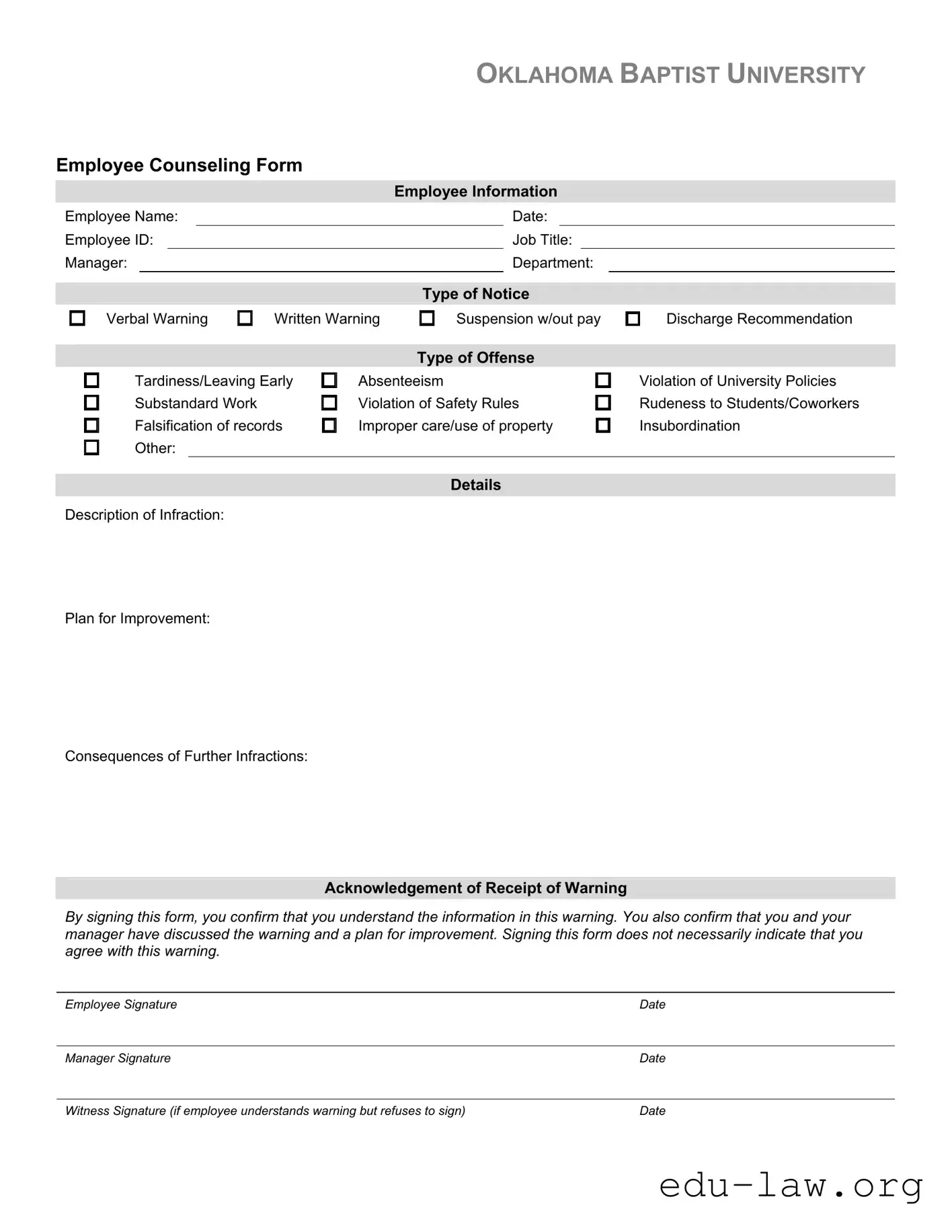
The Employee Counseling Form is a crucial document used by Oklahoma Baptist University to address and document various employee performance issues. This form serves multiple purposes, including providing a structured approach to handling disciplinary matters and fostering communication between employees and management. It includes essential employee information such as name, date, employee ID, job title, and department, which helps in tracking the case effectively. The form categorizes the type of notice being issued—whether a verbal warning, written warning, suspension without pay, or discharge recommendation. It also outlines the nature of the offense, ranging from tardiness and absenteeism to more serious violations like insubordination and falsification of records. A detailed description of the infraction is required, alongside a plan for improvement and the potential consequences of further infractions. Importantly, the form includes a section for the employee to acknowledge receipt of the warning, ensuring that they understand the contents and implications of the discussion held with their manager. By signing the form, employees confirm that they have been informed of the warning and the plan for improvement, although this does not necessarily indicate agreement with the warning itself.
OKLAHOMA BAPTIST UNIVERSITY
Employee Counseling Form
|
|
Employee Information |
|
Employee Name: |
|
Date: |
|
Employee ID: |
|
|
Job Title: |
Manager:Department:
Type of Notice
Verbal Warning |
Written Warning |
Suspension w/out pay |
Discharge Recommendation
Type of Offense
Tardiness/Leaving Early |
Absenteeism |
Substandard Work |
Violation of Safety Rules |
Violation of University Policies
Rudeness to Students/Coworkers
Falsification of records |
Improper care/use of property |
Insubordination |
Other:
Details
Description of Infraction:
Plan for Improvement:
Consequences of Further Infractions:
Acknowledgement of Receipt of Warning
By signing this form, you confirm that you understand the information in this warning. You also confirm that you and your manager have discussed the warning and a plan for improvement. Signing this form does not necessarily indicate that you agree with this warning.
Employee Signature |
Date |
|
|
Manager Signature |
Date |
|
|
Witness Signature (if employee understands warning but refuses to sign) |
Date |
| Fact Name | Description |
|---|---|
| Form Purpose | The Employee Counseling Form is used to document issues related to employee performance or behavior. |
| Types of Notices | It includes various types of notices such as verbal warnings, written warnings, suspensions without pay, and discharge recommendations. |
| Types of Offenses | Common offenses listed include tardiness, absenteeism, substandard work, and violation of university policies. |
| Plan for Improvement | The form requires a description of the infraction and outlines a plan for improvement to help the employee address the issue. |
| Governing Law | This form is governed by Oklahoma state employment laws, which focus on fair treatment and due process in employee discipline. |
Completing the Counseling form is an important step in addressing workplace issues. Ensure that all required information is accurately filled out to facilitate a clear understanding of the situation and the necessary actions moving forward.
What is the purpose of the Employee Counseling Form?
The Employee Counseling Form is designed to document instances of employee misconduct or performance issues. It serves as a formal record that outlines the nature of the infraction, the plan for improvement, and the potential consequences of further violations. This documentation helps ensure clarity and accountability for both the employee and management.
What types of offenses can be reported on this form?
The form allows for various types of offenses to be reported, including tardiness, absenteeism, substandard work, violations of safety rules, and rudeness to students or coworkers. Other offenses, such as falsification of records and insubordination, can also be included. This comprehensive list helps managers address a wide range of issues that may arise in the workplace.
What information is required from the employee on the form?
Employees must provide their name, date, employee ID, job title, department, and manager's name. Additionally, they need to specify the type of notice being issued, describe the infraction in detail, and outline a plan for improvement. This information is crucial for creating a complete record of the situation.
What happens after the form is completed?
Once the form is completed, it is reviewed by both the employee and the manager. They will discuss the contents of the form, including the plan for improvement and the consequences of further infractions. After this discussion, both parties must sign the form to acknowledge their understanding of the warning and the steps moving forward.
What does it mean to sign the form?
By signing the Employee Counseling Form, the employee confirms that they understand the information presented in the warning. It is important to note that signing does not necessarily indicate agreement with the warning; rather, it signifies that the employee has been made aware of the issues discussed and the expectations for improvement.
Is a witness signature required on the form?
A witness signature is only required if the employee understands the warning but refuses to sign the form. This signature serves as additional verification that the employee has been informed of the warning and its implications, even in the absence of their agreement.
How does the form contribute to employee development?
The Employee Counseling Form plays a significant role in employee development by clearly outlining areas needing improvement and providing a structured plan to address these issues. This proactive approach encourages employees to take responsibility for their performance and fosters a culture of accountability and growth within the organization.
Not filling in all required fields: It's crucial to complete every section of the form. Missing information can lead to delays or misunderstandings.
Using unclear language: When describing the infraction, be specific. Vague descriptions can create confusion about what occurred.
Failing to sign: Remember to sign the form. A signature indicates that you acknowledge the discussion and the contents of the warning.
Ignoring the plan for improvement: Take the time to outline a clear plan for improvement. This shows commitment to change and helps clarify expectations.
Not discussing with the manager: Ensure you have a conversation with your manager about the warning. This dialogue is essential for understanding the situation.
Overlooking the consequences: Be aware of the consequences of further infractions. Understanding these can help you avoid future issues.
Neglecting to provide details: When listing the details of the infraction, include all relevant facts. This helps create a complete picture of the situation.
Misunderstanding the acknowledgment: Signing the form does not mean you agree with the warning. It's important to understand this distinction.
Not keeping a copy: After completing the form, make sure to keep a copy for your records. This can be helpful for future reference.
Failing to follow up: After submitting the form, follow up with your manager. This shows that you are proactive about your improvement.
Alongside the Employee Counseling Form, several other documents are commonly utilized in the employee management process. Each of these forms serves a distinct purpose in maintaining clear communication and documentation regarding employee performance and behavior.
Utilizing these forms in conjunction with the Employee Counseling Form helps create a comprehensive approach to employee management. Each document plays a vital role in fostering a transparent and fair workplace environment.
The Employee Performance Review form shares similarities with the Counseling form in that both documents aim to evaluate an employee's performance and behavior in the workplace. The Performance Review typically includes sections for feedback on job duties, strengths, and areas for improvement. Like the Counseling form, it often requires signatures to acknowledge that the employee has received and understood the feedback provided. Both documents serve as essential tools for managers to communicate expectations and help employees grow in their roles.
The Disciplinary Action Notice is another document akin to the Counseling form. This notice outlines specific violations of company policy and the corresponding disciplinary measures. It serves as a formal record of the infractions, similar to how the Counseling form documents the details of an employee's behavior that needs correction. Both documents emphasize the importance of clear communication between management and employees regarding unacceptable conduct and the potential consequences of continued issues.
The Incident Report is similar to the Counseling form in that it records specific occurrences that may affect an employee's standing within the organization. This document typically details the nature of the incident, the parties involved, and any witnesses. Like the Counseling form, it aims to ensure that all relevant information is documented for future reference, particularly when addressing employee behavior or performance issues.
The Employee Warning Notice is closely related to the Counseling form, as it serves as a formal warning to an employee about their conduct or performance. This document outlines the specific issues at hand and the necessary steps for improvement. Both the Warning Notice and the Counseling form require the employee's acknowledgment, reinforcing the importance of understanding the situation and the expectations moving forward.
The Exit Interview form can be compared to the Counseling form in that both documents facilitate communication about an employee's experience within the organization. While the Counseling form addresses ongoing issues, the Exit Interview gathers feedback on what led to an employee's departure. Both forms aim to improve workplace conditions and provide insights for management regarding employee satisfaction and retention.
The Performance Improvement Plan (PIP) is another document that aligns with the Counseling form. A PIP outlines specific performance issues and the steps an employee must take to improve. Similar to the Counseling form, it includes timelines and measurable goals to track progress. Both documents highlight the organization's commitment to employee development and provide a structured approach to resolving performance-related concerns.
The Grievance Form shares characteristics with the Counseling form, as both are used to address workplace issues. While the Counseling form focuses on employee behavior and performance, the Grievance Form allows employees to formally report concerns or complaints about workplace conditions or treatment. Both documents ensure that employees have a channel to voice their concerns and seek resolution through documented processes.
The Attendance Record is another document that bears resemblance to the Counseling form, as it tracks an employee's attendance and punctuality. If an employee has frequent tardiness or absenteeism, the Counseling form may be utilized to address these issues formally. Both documents serve to hold employees accountable for their attendance and emphasize the importance of reliability in the workplace.
The Acknowledgment of Receipt form is similar to the Counseling form in that it confirms an employee's understanding of policies or warnings provided by management. This document is often signed by the employee to indicate they have received and understood the information. Like the Counseling form, it reinforces the importance of communication between employees and management regarding expectations and responsibilities.
Lastly, the Training Completion Certificate can be compared to the Counseling form, as both documents serve as records of an employee's progress and development. The Training Completion Certificate acknowledges that an employee has successfully completed a training program, while the Counseling form documents an employee's journey toward improvement in specific areas. Both emphasize the organization's commitment to employee growth and development.
When filling out the Oklahoma Baptist University Employee Counseling Form, it is essential to approach the task with care. Here are some important dos and don’ts to keep in mind:
Misconceptions about the Counseling form can lead to confusion and misunderstandings. Here are five common misconceptions:
When filling out and using the Counselling form, keep the following key takeaways in mind: