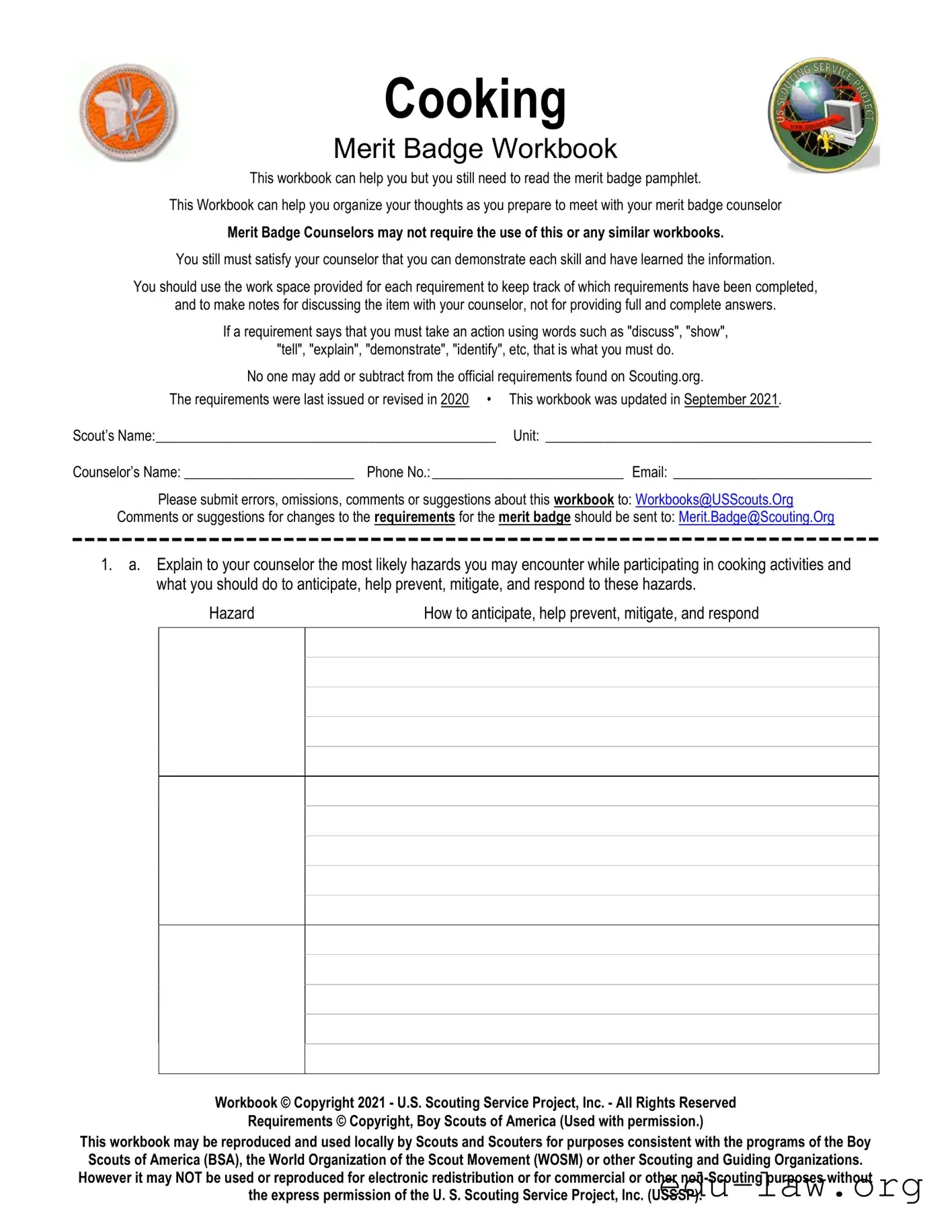
The Cooking Badge form serves as an essential tool for Scouts embarking on their culinary journey. Designed to complement the merit badge pamphlet, this workbook helps Scouts organize their thoughts and prepare for discussions with their merit badge counselor. While the form offers structured space to track completed requirements and jot down notes, it is important to remember that it is not a substitute for demonstrating the necessary skills or knowledge. Each requirement prompts Scouts to engage actively with their counselor, whether by discussing safety hazards, demonstrating first aid for cooking-related injuries, or explaining proper food storage techniques. The form also emphasizes the importance of understanding food allergies and reading food labels, ensuring that Scouts are well-equipped to handle various cooking challenges. With the last update issued in 2021, the workbook remains a valuable resource, guiding Scouts through the requirements laid out by the Boy Scouts of America while encouraging personal responsibility and safety in the kitchen.

Cooking
Merit Badge Workbook
This workbook can help you but you still need to read the merit badge pamphlet.
This Workbook can help you organize your thoughts as you prepare to meet with your merit badge counselor
Merit Badge Counselors may not require the use of this or any similar workbooks.
You still must satisfy your counselor that you can demonstrate each skill and have learned the information.
You should use the work space provided for each requirement to keep track of which requirements have been completed,
and to make notes for discussing the item with your counselor, not for providing full and complete answers.
If a requirement says that you must take an action using words such as "discuss", "show",
"tell", "explain", "demonstrate", "identify", etc, that is what you must do.
No one may add or subtract from the official requirements found on Scouting.org.
The requirements were last issued or revised in 2020 • |
This workbook was updated in September 2021. |
Scout’s Name:________________________________________________ |
Unit: ______________________________________________ |
Counselor’s Name: ________________________ Phone No.: ___________________________ Email: ____________________________
Please submit errors, omissions, comments or suggestions about this workbook to: [email protected]
Comments or suggestions for changes to the requirements for the merit badge should be sent to: [email protected]
1.a. Explain to your counselor the most likely hazards you may encounter while participating in cooking activities and what you should do to anticipate, help prevent, mitigate, and respond to these hazards.
Hazard |
How to anticipate, help prevent, mitigate, and respond |
Workbook © Copyright 2021 - U.S. Scouting Service Project, Inc. - All Rights Reserved
Requirements © Copyright, Boy Scouts of America (Used with permission.)
This workbook may be reproduced and used locally by Scouts and Scouters for purposes consistent with the programs of the Boy Scouts of America (BSA), the World Organization of the Scout Movement (WOSM) or other Scouting and Guiding Organizations.
However it may NOT be used or reproduced for electronic redistribution or for commercial or other
the express permission of the U. S. Scouting Service Project, Inc. (USSSP).
Cooking |
Scout's Name: ________________________ |
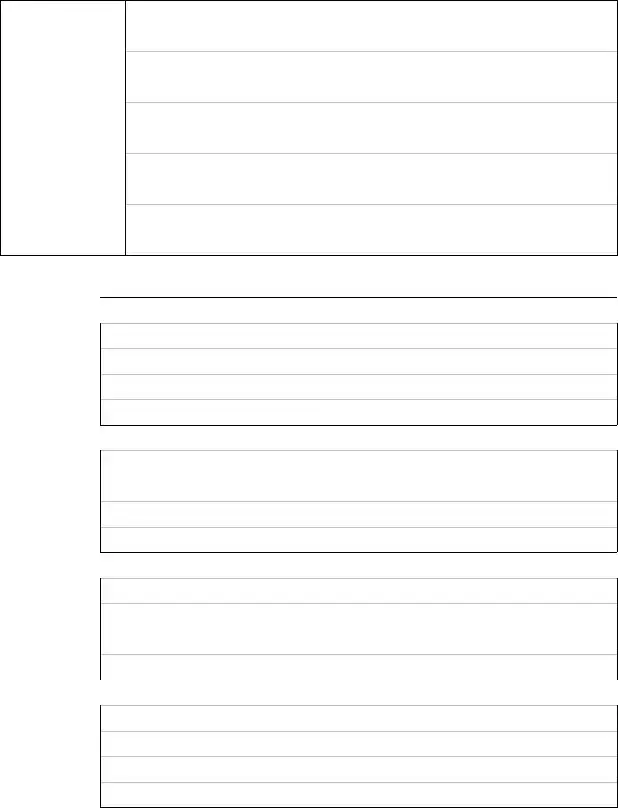
b.Show that you know first aid for and how to prevent injuries or illnesses that could occur while preparing meals and eating, including burns and scalds, cuts, choking, and allergic reactions.
Burns and scalds
Cuts
Choking
Allergic reactions
Cooking - Merit Badge Workbook |
Page. 2 of 33 |
Cooking |
Scout's Name: ________________________ |
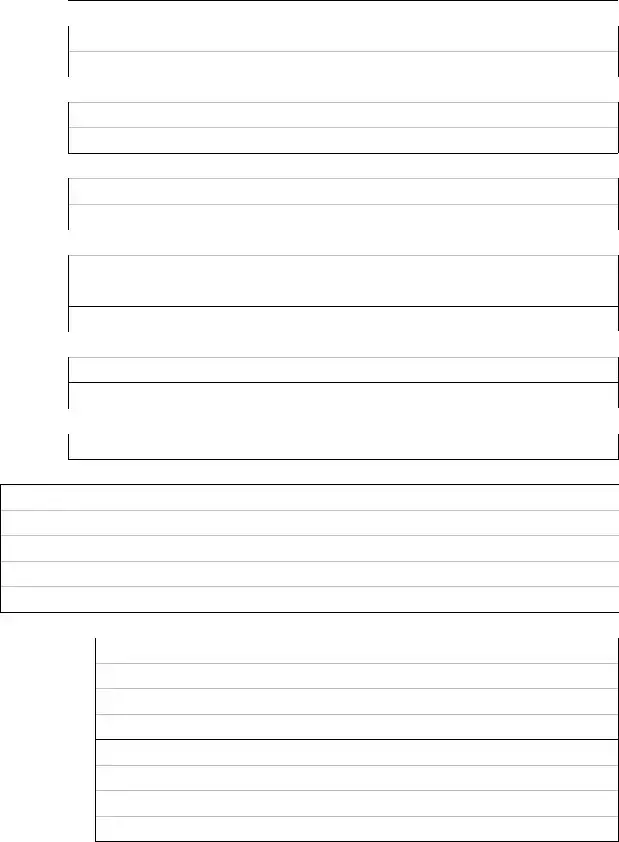
c.Describe how meat, fish, chicken, eggs, dairy products, and fresh vegetables should be stored, transported, and properly prepared for cooking.
Meat Fish Chicken Eggs
Dairy
Products
Fresh
Vegetables Explain how to prevent
d. Discuss with your counselor food allergies, food intolerance, and
Cooking - Merit Badge Workbook |
Page 3 of 33 |
Cooking |
Scout's Name: ________________________ |
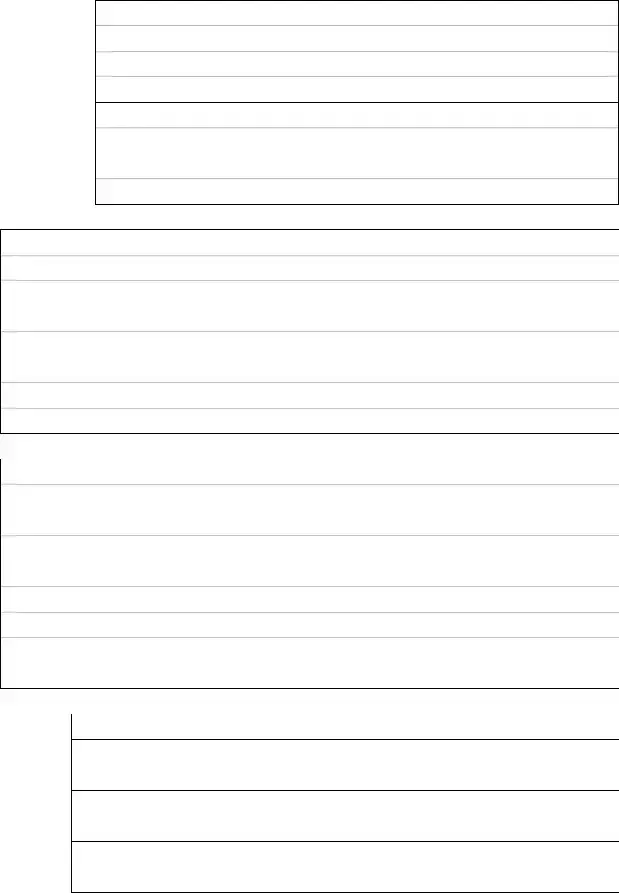
Food intolerance
Explain why someone who handles or prepares food needs to be aware of these concerns.
e. Discuss with your counselor why reading food labels is important.
Explain how to identify common allergens such as peanuts, tree nuts, milk, eggs, wheat, soy, and shellfish.
Peanuts Tree nuts Milk Eggs Wheat Soy Shellfish
Cooking - Merit Badge Workbook |
Page 4 of 33 |
Cooking |
Scout's Name: ________________________ |
2.Nutrition. Do the following:
a.Using the MyPlate food guide or the current USDA nutrition model, give five examples for EACH of the following food groups, the recommended number of daily servings, and the recommended serving size:
Example |
Daily servings |
Serving Size |
1. Fruits
2.Vegetables
3. Grains
4. Proteins
5. Dairy
b. Explain why you should limit your intake of oils and sugars.
Cooking - Merit Badge Workbook |
Page 5 of 33 |
Cooking |
Scout's Name: ________________________ |
c. |
Determine your daily level of activity and your caloric need based on your activity level. |
Then, based on the MyPlate food guide, discuss with your counselor an appropriate meal plan for yourself for one day.
d.Discuss your current eating habits with your counselor and what you can do to eat healthier, based on the MyPlate food guide.
Cooking - Merit Badge Workbook |
Page 6 of 33 |

Cooking |
Scout's Name: ________________________ |
e.Discuss the following food label terms: calorie, fat, saturated fat, trans fat, cholesterol, sodium, carbohydrate, dietary fiber, sugar, protein.
Calorie
Fat
Saturated fat
Trans fat
Cholesterol
Sodium
Carbohydrate
Dietary fiber
Sugar
Protein
Cooking - Merit Badge Workbook |
Page 7 of 33 |
Cooking |
Scout's Name: ________________________ |
|
Explain how to calculate total carbohydrates and nutritional values for two servings, based on the serving size |
|
specified on the label. |
3.Cooking Basics. Do the following:
a.Discuss EACH of the following cooking methods. For each one, describe the equipment needed, how temperature control is maintained, and name at least one food that can be cooked using that method: baking, boiling, broiling, pan frying, simmering, steaming, microwaving, grilling, foil cooking, and use of a Dutch oven.
Method |
Food |
Equipment needed |
How is food cooked and temperature maintained? |
Baking |
|
|
|
Boiling
Broiling
Cooking - Merit Badge Workbook |
Page 8 of 33 |

Cooking |
Scout's Name: ________________________ |
Pan frying
Simmering
Steaming
Microwaving
Grilling
Foil cooking
Use of a Dutch oven
Cooking - Merit Badge Workbook |
Page 9 of 33 |
Cooking |
Scout's Name: ________________________ |
b. |
Discuss the benefits of using a camp stove on an outing vs. a charcoal or wood fire. |
c.Describe for your counselor how to manage your time when preparing a meal so components for each course are ready to serve at the correct time.
Note: The meals prepared for Cooking merit badge requirements 4, 5, and 6 will count only toward fulfilling those requirements and will not count toward rank advancement or other merit badges. Meals prepared for rank advancement or other merit badges may not count toward the Cooking merit badge. You must not repeat any menus for meals actually prepared or cooked in requirements 4, 5, and 6.
Cooking - Merit Badge Workbook |
Page 10 of 33 |
| Fact Name | Description |
|---|---|
| Purpose | The Cooking Merit Badge Workbook helps Scouts organize their thoughts and prepare for discussions with their merit badge counselors. |
| Requirements | Scouts must demonstrate skills and knowledge to their counselors, who may not require the use of this workbook. |
| Hazard Awareness | Scouts must explain potential hazards in cooking and how to prevent or respond to them, including burns and cuts. |
| Food Safety | The workbook emphasizes proper storage and preparation of various food items to prevent cross-contamination. |
| Nutrition Education | Scouts learn about nutrition through the MyPlate food guide, including serving sizes and daily recommendations. |
| Updates | This workbook was updated in September 2021, while the official requirements were last revised in 2020. |
Filling out the Cooking Badge form is an important step in your journey to earning the badge. This process involves gathering necessary information and demonstrating your understanding of cooking safety, nutrition, and food handling. Follow these steps to complete the form effectively.
What is the purpose of the Cooking Badge form?
The Cooking Badge form is designed to help Scouts organize their thoughts and prepare for discussions with their merit badge counselor. It serves as a guide to track completed requirements and make notes for conversations about cooking skills and safety.
Do I have to use the Cooking Badge form to earn the merit badge?
No, the use of this workbook is not mandatory. Merit Badge Counselors may choose not to require it. However, it can be a useful tool for Scouts to ensure they cover all necessary topics and requirements.
What should I do if I find errors in the Cooking Badge form?
If you notice any errors, omissions, or have suggestions for improvements, you can send your feedback to [email protected]. Your input can help enhance the workbook for future users.
What are the main topics covered in the Cooking Badge form?
The Cooking Badge form covers various topics, including safety hazards in cooking, first aid for common cooking injuries, proper food storage and preparation techniques, food allergies, and nutrition guidelines. Each section provides specific requirements for Scouts to fulfill.
How can I demonstrate my understanding of food safety?
You can demonstrate your understanding of food safety by discussing with your counselor the various hazards that may occur while cooking. This includes explaining how to anticipate, prevent, and respond to these hazards. Additionally, showing knowledge of first aid for injuries related to cooking is essential.
Why is it important to read food labels?
Reading food labels is crucial for understanding the ingredients and nutritional content of food products. It helps identify common allergens, such as peanuts, tree nuts, and dairy, which is vital for preventing allergic reactions. Awareness of food labels also aids in making healthier dietary choices.
What should I know about food allergies and food intolerance?
Food allergies and intolerances can cause serious health issues. It's important to discuss these topics with your counselor, including the symptoms and management strategies. Understanding these concerns is essential for anyone who handles or prepares food to ensure safety for themselves and others.
What is the MyPlate food guide, and how is it used in the Cooking Badge form?
The MyPlate food guide is a visual representation of the recommended food groups and portions for a balanced diet. In the Cooking Badge form, Scouts are required to provide examples of foods from each group, the recommended daily servings, and serving sizes, promoting awareness of nutrition.
How can I track my progress while using the Cooking Badge form?
The Cooking Badge form includes designated spaces for Scouts to note which requirements have been completed. Use these spaces to keep track of your progress and jot down notes for discussion with your counselor, ensuring a thorough understanding of each requirement.
Incomplete Information: Many individuals forget to fill in their personal details, such as Scout's name, unit, and counselor's information. Without this basic information, the form may be considered invalid.
Neglecting to Read the Pamphlet: Some people skip reading the merit badge pamphlet. This pamphlet contains essential information that aids in understanding the requirements and skills needed.
Using Workbooks Incorrectly: A common mistake is treating the workbook as a place for complete answers rather than a tool for organizing thoughts. The workbook should be used to track progress and make notes for discussions.
Ignoring Requirement Language: Failing to pay attention to action words like "discuss," "show," or "demonstrate" can lead to incomplete submissions. Each requirement specifies what is expected, and these verbs guide the actions needed.
Modifying Official Requirements: Some individuals mistakenly believe they can add or change requirements. It is crucial to adhere strictly to the official requirements outlined on Scouting.org.
Omitting Hazards Discussion: Not adequately explaining potential hazards in cooking activities is a frequent error. This section is vital for demonstrating understanding and preparedness.
Failing to Address Food Safety: When discussing food allergies and cross-contamination, individuals often overlook the importance of food safety practices. This discussion is essential for ensuring safe cooking.
Ignoring Nutritional Guidelines: Some people do not provide sufficient examples or explanations related to nutrition, such as the MyPlate food guide. This section requires detailed responses to meet the requirements.
The Cooking Badge form is an essential document for Scouts working on their cooking merit badge. Along with this form, several other documents and forms are often utilized to enhance the learning experience and ensure that all requirements are met. Below is a list of these additional forms and documents.
These documents work together to support Scouts in their journey to earn the Cooking Badge. Each one plays a role in promoting safety, knowledge, and skill development in cooking activities.
The Cooking Badge form is similar to the First Aid Merit Badge Workbook. Both documents guide participants in preparing for discussions with their counselors. They include sections for tracking completed requirements and taking notes. Additionally, they emphasize the importance of demonstrating skills and knowledge, ensuring that Scouts are well-prepared to address safety and health concerns associated with their activities.
Another comparable document is the Camping Merit Badge Workbook. This workbook also provides a structured format for Scouts to organize their thoughts and experiences. Like the Cooking Badge form, it requires Scouts to demonstrate specific skills and knowledge before meeting with their counselor. Both workbooks encourage Scouts to reflect on safety and preparedness in the context of their respective activities.
The Swimming Merit Badge Workbook shares similarities with the Cooking Badge form in that both require participants to discuss safety measures and potential hazards. Each workbook includes sections for Scouts to make notes and track progress on requirements. This format helps Scouts prepare for their counselor meetings by ensuring they understand the risks associated with their activities.
Similarly, the Environmental Science Merit Badge Workbook offers a structured approach to learning about safety and responsibility in nature. Both documents encourage Scouts to engage with their counselors through discussion and demonstration. They emphasize the importance of understanding hazards, whether in cooking or environmental activities, fostering a sense of awareness and responsibility.
The Personal Fitness Merit Badge Workbook is another document that mirrors the Cooking Badge form. Both workbooks guide participants in tracking their progress and preparing for discussions with their counselors. They focus on the importance of health and safety, encouraging Scouts to demonstrate their understanding of physical well-being and the precautions necessary to maintain it.
The Family Life Merit Badge Workbook is similar in that it provides a framework for Scouts to engage in discussions about responsibilities and safety within the home. Like the Cooking Badge form, it includes sections for note-taking and tracking progress. Both workbooks emphasize the importance of communication and understanding potential hazards in everyday situations.
The Emergency Preparedness Merit Badge Workbook also aligns with the Cooking Badge form. Both documents require Scouts to identify and discuss potential hazards related to their activities. They provide structured spaces for tracking requirements and encourage participants to demonstrate their knowledge and skills, ensuring they are prepared for emergencies.
In addition, the Citizenship in the Community Merit Badge Workbook shares a similar format. Both workbooks guide Scouts in organizing their thoughts and preparing for discussions with counselors. They emphasize the importance of understanding community responsibilities and safety, fostering a sense of civic duty and awareness of potential hazards.
The Hiking Merit Badge Workbook is another document that reflects the structure of the Cooking Badge form. Both require participants to track their progress and prepare for discussions about safety and preparedness. They emphasize the importance of understanding the risks associated with outdoor activities and encourage Scouts to demonstrate their knowledge of safe practices.
Lastly, the Gardening Merit Badge Workbook shares similarities with the Cooking Badge form. Both documents provide a structured approach to learning and tracking progress. They encourage Scouts to discuss safety and health concerns related to their activities, fostering a sense of responsibility and awareness in both cooking and gardening practices.
When filling out the Cooking Badge form, it’s essential to follow certain guidelines to ensure clarity and accuracy. Below is a list of things you should and shouldn't do:
Misconceptions about the Cooking Badge form can lead to confusion. Here are nine common misunderstandings:
Understanding these misconceptions will help you navigate the Cooking Badge process more effectively.
When filling out the Cooking Badge form, here are some key takeaways to keep in mind: