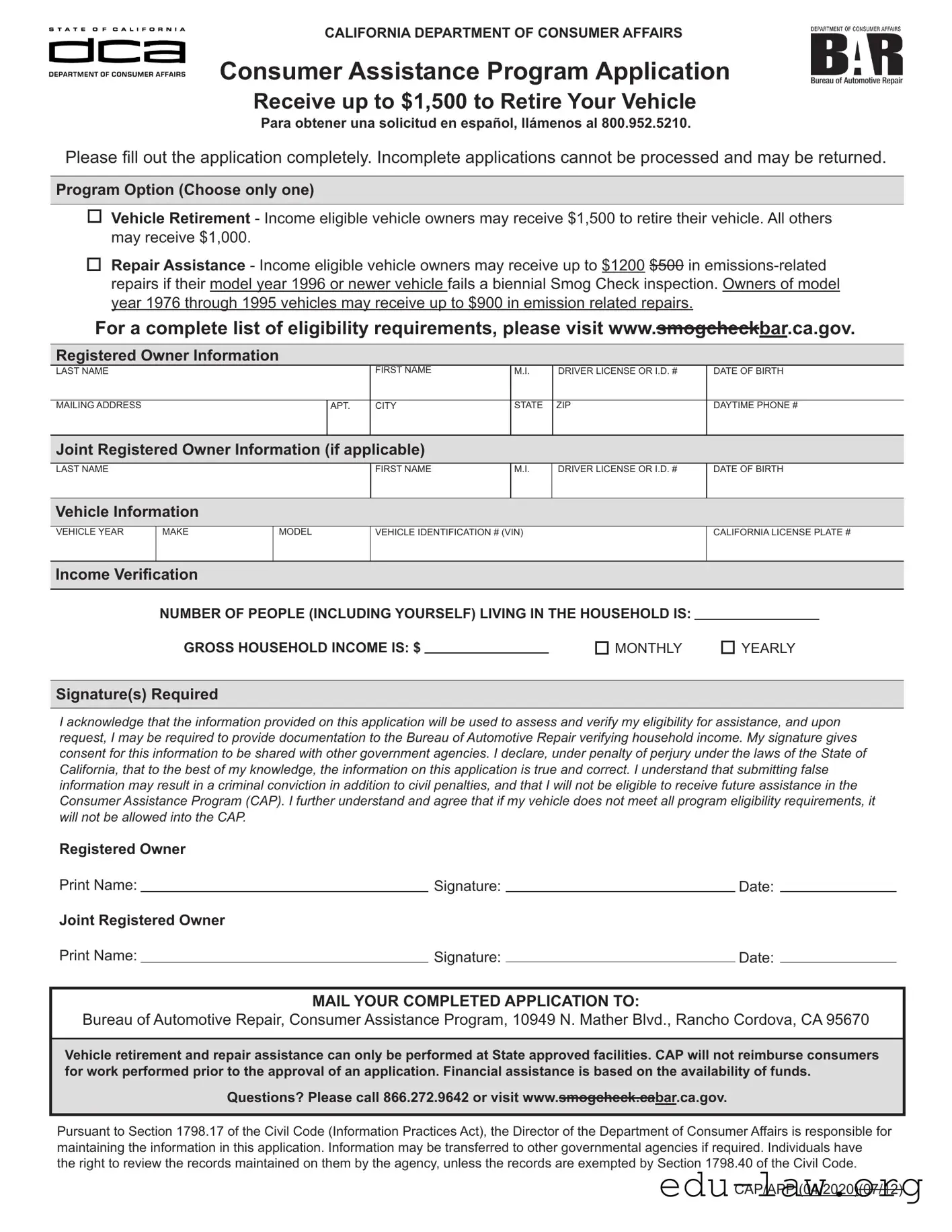
The Consumer Assistance Program Application form serves as a critical gateway for California vehicle owners seeking financial support to retire or repair their vehicles. This program offers two main options: vehicle retirement and repair assistance, each designed to address specific needs. Eligible vehicle owners can receive up to $1,500 for retiring their vehicles, while those opting for repair assistance may access funds for emissions-related repairs, contingent on their vehicle's model year and income status. To ensure the application process runs smoothly, it is essential that applicants complete the form in its entirety; incomplete submissions will be returned, delaying potential assistance. The form requires detailed information about the registered owner, including personal identification and household income, which must be verified. Acknowledgment of the accuracy of the provided information is mandatory, as is the understanding of the consequences of submitting false information. Additionally, applicants must be aware that assistance is contingent on the availability of funds and that all work must be performed at state-approved facilities. For further inquiries or to obtain assistance in Spanish, applicants can contact the program directly. Completing this application is not merely a bureaucratic step; it is a vital action that can lead to significant financial relief for eligible vehicle owners in California.
CALIFORNIA DEPARTMENT OF CONSUMER AFFAIRS
Consumer Assistance Program Application
Receive up to $1,500 to Retire Your Vehicle
Para obtener una solicitud en español, llámenos al 800.952.5210.
Please fill out the application completely. Incomplete applications cannot be processed and may be returned.
Program Option (Choose only one)
Vehicle Retirement - Income eligible vehicle owners may receive $1,500 to retire their vehicle. All others may receive $1,000.
Repair Assistance - Income eligible vehicle owners may receive up to $1200 $500 in
For a complete list of eligibility requirements, please visit www.smogcheckbar.ca.gov.
Registered Owner Information
LAST NAME
MAILING ADDRESS
FIRST NAME
APT. CITY
M.I.
STATE
DRIVER LICENSE OR I.D. #
ZIP
DATE OF BIRTH
DAYTIME PHONE #
Joint Registered Owner Information (if applicable)
LAST NAME
FIRST NAME
M.I.
DRIVER LICENSE OR I.D. #
DATE OF BIRTH
Vehicle Information
VEHICLE YEAR
MAKE
MODEL
VEHICLE IDENTIFICATION # (VIN)
CALIFORNIA LICENSE PLATE #
Income Verification
NUMBER OF PEOPLE (INCLUDING YOURSELF) LIVING IN THE HOUSEHOLD IS:
GROSS HOUSEHOLD INCOME IS: $ |
|
MONTHLY |
YEARLY |
|
Signature(s) Required
I acknowledge that the information provided on this application will be used to assess and verify my eligibility for assistance, and upon request, I may be required to provide documentation to the Bureau of Automotive Repair verifying household income. My signature gives consent for this information to be shared with other government agencies. I declare, under penalty of perjury under the laws of the State of California, that to the best of my knowledge, the information on this application is true and correct. I understand that submitting false information may result in a criminal conviction in addition to civil penalties, and that I will not be eligible to receive future assistance in the Consumer Assistance Program (CAP). I further understand and agree that if my vehicle does not meet all program eligibility requirements, it will not be allowed into the CAP.
Registered Owner |
|
|
|
|
Print Name: |
|
Signature: |
|
Date: |
Joint Registered Owner |
|
|
|
|
Print Name: |
|
Signature: |
|
Date: |
|
|
|||
MAIL YOUR COMPLETED APPLICATION TO:
Bureau of Automotive Repair, Consumer Assistance Program, 10949 N. Mather Blvd., Rancho Cordova, CA 95670
Vehicle retirement and repair assistance can only be performed at State approved facilities. CAP will not reimburse consumers for work performed prior to the approval of an application. Financial assistance is based on the availability of funds.
Questions? Please call 866.272.9642 or visit www.smogcheck.cabar.ca.gov.
Pursuant to Section 1798.17 of the Civil Code (Information Practices Act), the Director of the Department of Consumer Affairs is responsible for maintaining the information in this application. Information may be transferred to other governmental agencies if required. Individuals have the right to review the records maintained on them by the agency, unless the records are exempted by Section 1798.40 of the Civil Code.
CAP/APP (04/2020)(07/12)
| Fact Name | Description |
|---|---|
| Program Purpose | The Consumer Assistance Program provides financial assistance to eligible vehicle owners for vehicle retirement or repair, helping to reduce emissions and improve air quality. |
| Financial Assistance Amounts | Eligible vehicle owners can receive up to $1,500 for vehicle retirement. For repair assistance, income-eligible owners may receive up to $1,200 for emissions-related repairs. |
| Eligibility Criteria | Eligibility is determined by income levels and vehicle model year. Specific requirements can be found at www.smogcheckbar.ca.gov. |
| Application Completeness | It is crucial to fill out the application completely. Incomplete applications may be returned and cannot be processed. |
| Signature Requirement | Applicants must sign the form, acknowledging the accuracy of the information provided and consenting to share it with other government agencies. |
| Mailing Instructions | Completed applications should be mailed to the Bureau of Automotive Repair at the specified address in Rancho Cordova, CA. |
| Governing Law | This program is governed by the California Civil Code, specifically Section 1798.17, which relates to the maintenance of personal information. |
After completing the Consumer Assistance Program Application form, you will submit it to the Bureau of Automotive Repair for processing. They will review your application to determine your eligibility for vehicle retirement or repair assistance. Make sure all information is accurate and complete to avoid delays.
What is the Consumer Assistance Program and how can I benefit from it?
The Consumer Assistance Program (CAP) is designed to help California residents with financial assistance for vehicle retirement or emissions-related repairs. Eligible vehicle owners can receive up to $1,500 to retire their vehicle. If you qualify based on your income, you may receive the full amount. For those who need repair assistance, income-eligible owners can receive up to $1,200 for emissions-related repairs if their vehicle is from model year 1996 or newer. If your vehicle is older, from model year 1976 to 1995, you can receive up to $900. This program aims to improve air quality and reduce pollution by encouraging the retirement of older vehicles and supporting repairs on those that can still be used.
What are the eligibility requirements for the program?
To qualify for the Consumer Assistance Program, you must meet specific income guidelines based on the number of people living in your household. Additionally, your vehicle must meet certain criteria, such as being registered in California and passing a smog check inspection if you are applying for repair assistance. It is important to choose only one option when filling out the application: either vehicle retirement or repair assistance. For detailed eligibility requirements, you can visit the website www.smogcheckbar.ca.gov. It is crucial to ensure that all information provided in the application is accurate and complete, as incomplete applications may be returned and delay your assistance.
How do I complete the application form correctly?
Completing the application form accurately is essential for processing your request. Start by filling out all required fields, including your personal information, vehicle details, and income verification. Make sure to select only one program option: either vehicle retirement or repair assistance. Double-check that all information is correct, as any discrepancies may lead to delays or denial of your application. Once you have filled out the application completely, sign it to acknowledge that the information provided is true and correct. Finally, mail your completed application to the address specified in the form. If you have any questions during the process, you can reach out to the program's helpline for assistance.
What happens after I submit my application?
After submitting your application, it will be reviewed by the Bureau of Automotive Repair. They will assess your eligibility based on the information you provided. If your application is approved, you will receive instructions on how to proceed with vehicle retirement or repair assistance. It’s important to note that financial assistance is subject to the availability of funds. You will not be reimbursed for any work done before your application is approved. If additional information or documentation is needed, the Bureau may contact you. Keeping your contact information updated is crucial to ensure a smooth communication process.
Leaving the application incomplete: Many applicants fail to fill out all required sections, which can lead to delays or outright rejection of the application.
Choosing more than one program option: Applicants often mistakenly select multiple options for assistance, but only one choice is permitted. This can result in confusion and processing issues.
Incorrect income reporting: Some individuals misreport their gross household income, either by providing incorrect figures or by misunderstanding the income verification requirements.
Omitting joint owner information: If applicable, failure to include details about a joint registered owner can complicate the application process.
Not providing a valid vehicle identification number (VIN): Applicants sometimes neglect to include the VIN, which is crucial for verifying vehicle eligibility.
Ignoring signature requirements: Some applicants forget to sign the application, which is necessary for processing and may lead to rejection.
Submitting the application to the wrong address: Misaddressing the application can result in delays. It is important to ensure that the application is sent to the correct Bureau of Automotive Repair address.
Failing to read program eligibility requirements: Not reviewing the eligibility criteria thoroughly can lead to applying for assistance when not qualified, wasting time and effort.
Submitting false information: Providing inaccurate or misleading information can have serious consequences, including criminal charges and disqualification from future assistance.
The Consumer Assistance Program (CAP) Application is just one part of the process for obtaining vehicle retirement or repair assistance. Along with this application, several other forms and documents may be necessary to ensure eligibility and facilitate the application process. Below is a list of commonly required documents.
Gathering these documents along with the CAP Application can streamline the process and increase the chances of receiving assistance. Ensuring that all required information is complete and accurate will help avoid delays in processing your application.
The Consumer Assistance Program Application form shares similarities with the Supplemental Nutrition Assistance Program (SNAP) application. Both documents require applicants to provide detailed personal information, including household income and the number of individuals living in the household. This information is crucial for determining eligibility for assistance. Just as SNAP aims to support low-income families with food benefits, the Consumer Assistance Program seeks to help eligible vehicle owners by offering financial aid for vehicle retirement or repairs. Both forms emphasize the importance of completeness, as incomplete applications can lead to delays or denials of assistance.
Another document that resembles the Consumer Assistance Program Application is the Low-Income Home Energy Assistance Program (LIHEAP) application. Similar to the Consumer Assistance Program, LIHEAP assists eligible low-income households by providing financial aid for energy bills. Applicants must disclose their income levels and household size, which helps determine the amount of assistance they may receive. Both applications also require signatures that affirm the accuracy of the information provided, reinforcing the importance of honesty in the application process. This requirement serves to protect the integrity of the programs and ensures that assistance is directed to those who truly qualify.
The application for the Women, Infants, and Children (WIC) program also bears resemblance to the Consumer Assistance Program Application. WIC provides nutritional support to low-income pregnant women, new mothers, and young children. Like the Consumer Assistance Program, the WIC application requires detailed demographic and income information to assess eligibility. Both forms include a declaration of truthfulness, where applicants must affirm that the information they provide is accurate and complete. This shared focus on verifying eligibility underscores the programs' commitment to serving those in need while maintaining accountability and transparency.
Lastly, the Medicaid application shares key features with the Consumer Assistance Program Application. Medicaid provides health coverage to low-income individuals and families, and its application process involves similar steps, including the submission of personal and financial information. Both applications aim to evaluate the applicant's eligibility based on income and household composition. Furthermore, both documents necessitate a signature that confirms the applicant's understanding of the consequences of providing false information. This requirement is essential for ensuring that resources are allocated appropriately and that assistance reaches those who qualify.
When filling out the Consumer Assistance Program Application form, it's important to follow certain guidelines to ensure your application is processed smoothly. Below is a list of things you should and shouldn't do.
Many individuals believe that they can submit the application even if it is incomplete. However, incomplete applications cannot be processed and will be returned. It is essential to fill out every section of the form accurately.
Some applicants think that everyone will receive the same amount of assistance. In reality, income-eligible vehicle owners can receive up to $1,500 for vehicle retirement, while others may only qualify for $1,000. Different amounts are also available for repair assistance based on vehicle age and income eligibility.
There is a common belief that consumers can be reimbursed for repairs made prior to the approval of their application. This is incorrect. Assistance can only be provided for work performed at state-approved facilities after the application has been approved.
Some applicants assume that they do not need to verify their income. In fact, income verification is a critical part of the application process. Applicants may be required to provide documentation to confirm their household income.
Many people think they can apply without having their vehicle information ready. However, the application requires specific details about the vehicle, including its year, make, model, and VIN. This information is essential for determining eligibility.
There is a misconception that financial assistance is always available. However, assistance is contingent upon the availability of funds. It is important to apply as soon as possible to avoid missing out on potential assistance.
Filling out the Consumer Assistance Program Application form can seem daunting, but understanding the key points can simplify the process. Here are ten important takeaways to keep in mind:
By keeping these points in mind, you can navigate the application process more effectively and increase your chances of receiving the assistance you need.