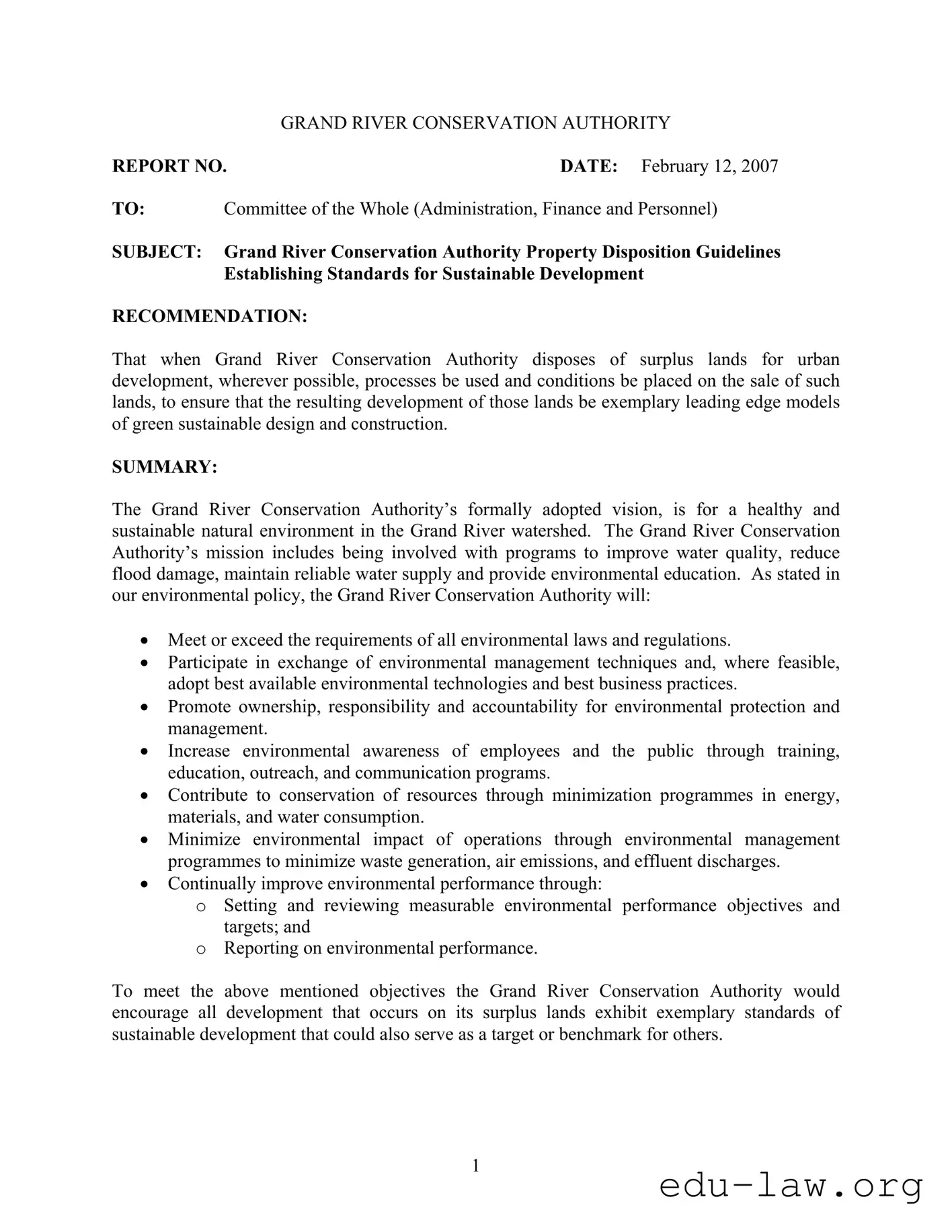
The Conservation Authority Report form serves as a crucial tool for guiding the sustainable development of surplus lands owned by the Grand River Conservation Authority (GRCA). This report outlines the authority's commitment to environmental responsibility while providing clear recommendations for the disposition of these lands. It emphasizes the importance of using innovative processes and placing specific conditions on land sales to ensure that new developments set a high standard for green design and construction. The GRCA aims to create a healthy and sustainable natural environment in the Grand River watershed, aligning its mission with the principles of sustainable development. The report highlights various strategies, such as adopting best practices in environmental management and promoting community awareness, to enhance overall ecological performance. Additionally, it discusses the financial implications of implementing sustainable practices, noting that while upfront costs may be slightly higher, long-term savings and potential grants can offset these expenses. By fostering collaboration with municipalities and integrating sustainable practices from the planning stages, the GRCA aims to lead by example and encourage responsible urban growth in the region.
GRAND RIVER CONSERVATION AUTHORITY
REPORT NO. |
DATE: February 12, 2007 |
TO: Committee of the Whole (Administration, Finance and Personnel)
SUBJECT: Grand River Conservation Authority Property Disposition Guidelines Establishing Standards for Sustainable Development
RECOMMENDATION:
That when Grand River Conservation Authority disposes of surplus lands for urban development, wherever possible, processes be used and conditions be placed on the sale of such lands, to ensure that the resulting development of those lands be exemplary leading edge models of green sustainable design and construction.
SUMMARY:
The Grand River Conservation Authority’s formally adopted vision, is for a healthy and sustainable natural environment in the Grand River watershed. The Grand River Conservation Authority’s mission includes being involved with programs to improve water quality, reduce flood damage, maintain reliable water supply and provide environmental education. As stated in our environmental policy, the Grand River Conservation Authority will:
•Meet or exceed the requirements of all environmental laws and regulations.
•Participate in exchange of environmental management techniques and, where feasible, adopt best available environmental technologies and best business practices.
•Promote ownership, responsibility and accountability for environmental protection and management.
•Increase environmental awareness of employees and the public through training, education, outreach, and communication programs.
•Contribute to conservation of resources through minimization programmes in energy, materials, and water consumption.
•Minimize environmental impact of operations through environmental management programmes to minimize waste generation, air emissions, and effluent discharges.
•Continually improve environmental performance through:
OSetting and reviewing measurable environmental performance objectives and targets; and
OReporting on environmental performance.
To meet the above mentioned objectives the Grand River Conservation Authority would encourage all development that occurs on its surplus lands exhibit exemplary standards of sustainable development that could also serve as a target or benchmark for others.
1
REPORT:
The Grand River Conservation Authority owns approximately 50,000 acres of land in the Grand River watershed. From time to time small parcels of these lands which do not perform a significant environmental, educational or recreational purpose may be considered surplus to the needs of the organization.
Revenue from the disposition of surplus Grand River Conservation Authority lands must be placed in a special reserve fund, which is only available for Capital Projects that meet the criteria set out by the “Policies and Procedures for the Treatment of Conservation Authority Generated Revenue” (MNR, June 1997). These reserve funds are generally used for land acquisitions that meet the goals of the Grand River Conservation Authority’s approved land acquisition policy.
Municipalities in the watershed are at various stages in the move toward implementation of sustainable development policies. As an environmental agency with the aforementioned policies, it is imperative that the Grand River Conservation Authority ensure that it promotes environmental responsibility to its utmost ability.
As an agency that also has regulatory responsibilities, we need to lead by example, if we are to credibly encourage positive change in the behaviour and practices of others, when it comes to the form and function of urban growth.
There are disposition methods available that will allow us to ensure minimum property development standards for the planning and development of surplus property. We can ensure, through the use of “expressions of interest” and “requests for proposals”, (with specific conditions), that only those organizations willing and able to design and build to these standards have the opportunity to acquire our surplus lands.
The “Policies and Procedures for Disposition of Conservation Authority Property” (MNR, June 1997) require that open and transparent disposition processes be utilized.
Some of the environmental technologies that a developer may propose in response to a Request For Proposal could include:
•Opportunities for district / alternate energy systems.
•Solar orientation, passive and active solar systems, wind, vegetation and landform techniques.
•Ground source heating on an individual or communal scale.
•“Leed Certified” Buildings.
•Rainwater and grey water recycling systems.
•Planting Programmes.
•Minimize impervious surfaces.
•Leading edge storm water techniques.
•Meeting or exceeding the 2012 building code standards for energy efficiency starting now.
•Emissions reductions – “0” footprint.
2
•Renewable energy opportunities such as
•Maximize use of recycled materials.
•
•Setting overall development performance targets such as:
O% reduction in household water requirements.
O% reduction in household discharge flows (sanitary / storm).
O% reduction in household solid waste.
O% reduction in household energy use (aim for European standard).
O% reduction in household greenhouse gas emissions
The Grand River Conservation Authority has the ability to ensure through the municipal planning approval process, that the form and configuration of land use provides for the most opportune type of sustainable development. Implementing architectural design and mechanical systems is only one way to achieve improved performance targets. To be able to achieve the most impact, the form of urban development needs to be considered very early in the planning process. Innovative planning from day one will allow for planning to be holistic, system based, and integrated, as opposed to addressing opportunities on a case by case basis. Some technologies such as district energy systems, communal and more efficient ground source heating systems, and building massing opportunities which take advantage of solar orientation can only be properly incorporated when the intent is included from the outset.
The GRCA can enlist the services of leaders in these fields with our selected planning consultants, to ensure that these developments are successful.
Municipalities are starting to promote and demand that these issues be considered. Helping to reduce the “peak” energy requirements of a municipality assists society by reducing the need for new electrical infrastructure, and its resulting environmental impacts.
With the adoption of the motion in this report, staff will be able to share our organizational objectives with municipal staff involved with processing our land development initiatives. Approvals and decisions would come from the shared understanding of common goals. Reduced consumption and discharges will also assist municipalities in reaching population and sustainability targets contained in the Provincial “Places to Grow” policy.
The adoption of this position by Grand River Conservation Authority will help the development application process, and provide assurances to Municipal Councils, staff, and the public, about what they can expect from land development applications that involve Grand River Conservation Authority lands.
3
FINANCIAL IMPLICATION:
Placing conditions on property for sale may impact the potential selling price by a small amount.
The cost of development of this type is projected to cost between 5 & 10% more than traditional development. It is reasonable to conclude that one third of these additional costs associated with development of this type can be absorbed in market pricing, and two thirds offset by avoiding long term energy supply costs. (Payback over time).
By being at the leading edge of this initiative, grants may also be available to pilot some of these concepts, from organizations such as NRCAN, F.C.M., and A.M.O., to name a few!
OTHER DEPARTMENT CONSIDERATIONS:
All departments are in support of this initiative.
Prepared by: |
Approved by: |
__________________________________ |
___________________________________ |
Tom Smith |
Keith Murch |
Manager of Property |
Assistant C.A.O. / |
4
| Fact Name | Details |
|---|---|
| Report Date | The report was dated February 12, 2007. |
| Governing Law | The report is governed by the "Policies and Procedures for the Treatment of Conservation Authority Generated Revenue" (MNR, June 1997). |
| Environmental Commitment | The Grand River Conservation Authority aims to meet or exceed all environmental laws and regulations. |
| Land Ownership | The Grand River Conservation Authority owns approximately 50,000 acres of land in the Grand River watershed. |
| Disposal Process | Open and transparent processes are required for the disposition of surplus property, as per the MNR guidelines. |
| Financial Implications | Development costs may be 5-10% higher than traditional methods, but long-term energy savings can offset these costs. |
Filling out the Conservation Authority Report form is essential for documenting the process of land disposition and ensuring compliance with established guidelines. Once the form is completed, it will be submitted to the appropriate committee for review and action.
What is the purpose of the Conservation Authority Report form?
The Conservation Authority Report form serves to outline the Grand River Conservation Authority's guidelines and recommendations regarding the disposition of surplus lands. This report emphasizes the importance of sustainable development practices when these lands are sold for urban development. It aims to ensure that any resulting projects are models of green design and construction, aligning with the Authority's mission to promote environmental responsibility and sustainability within the Grand River watershed.
How does the Grand River Conservation Authority ensure sustainable development on surplus lands?
The Grand River Conservation Authority employs various methods to promote sustainable development. When disposing of surplus lands, the Authority utilizes processes such as “expressions of interest” and “requests for proposals.” These methods allow the Authority to set specific conditions that developers must meet, ensuring that only those committed to sustainable practices can acquire the lands. Additionally, the Authority encourages the use of innovative environmental technologies and design strategies that minimize environmental impact and promote energy efficiency.
What are the financial implications of placing conditions on the sale of surplus lands?
Placing conditions on the sale of surplus lands may slightly affect the potential selling price, as the cost of developing these properties is estimated to be 5 to 10 percent higher than traditional development. However, it is believed that a portion of these additional costs can be absorbed by the market, while the long-term savings from reduced energy supply costs can offset the remaining expenses. By leading in sustainable development initiatives, the Authority may also attract grants to support innovative projects.
Why is it important for the Grand River Conservation Authority to lead by example in sustainable development?
Leading by example is crucial for the Grand River Conservation Authority as it enhances credibility when advocating for sustainable practices among municipalities and developers. By adopting exemplary standards for their own land development initiatives, the Authority can effectively influence positive changes in urban growth and environmental management. This proactive approach not only aligns with the Authority's mission but also supports broader community goals for sustainability and responsible resource management.
Inaccurate Information: Providing incorrect details about the property can lead to delays. Ensure all data is accurate and up-to-date.
Missing Signatures: Forgetting to sign the form is a common oversight. Always double-check that all required signatures are included.
Failure to Attach Supporting Documents: Not including necessary documents can stall the process. Make sure to attach all required paperwork.
Ignoring Guidelines: Each form has specific instructions. Not following these guidelines can result in rejection.
Incomplete Sections: Leaving sections blank or partially filled out is a frequent mistake. Take the time to complete every part of the form.
Incorrect Formatting: Using the wrong format for dates, numbers, or addresses can confuse reviewers. Stick to the specified formats.
Not Proofreading: Typos and grammatical errors can undermine credibility. Always review your form before submission.
Missing Deadlines: Submitting the form after the deadline can lead to rejection. Keep track of all important dates.
Assuming Knowledge: Don’t assume that reviewers know everything about your project. Provide clear explanations and context where needed.
The Conservation Authority Report form serves as a crucial document in the context of land management and environmental sustainability. Alongside this form, several other documents and forms play a significant role in facilitating effective communication and decision-making within the framework of property disposition and sustainable development. Below is a list of these related forms and documents, each with a brief description of its purpose and relevance.
Each of these documents complements the Conservation Authority Report form by ensuring a comprehensive approach to land management and sustainable development. Together, they create a framework that not only promotes responsible stewardship of the environment but also engages the community and stakeholders in meaningful ways.
The Environmental Impact Assessment (EIA) document serves a similar purpose to the Conservation Authority Report form by evaluating the potential environmental effects of proposed projects. Both documents aim to ensure that development is conducted in an environmentally responsible manner. An EIA assesses how a project may affect the surrounding environment, including air and water quality, wildlife, and vegetation. Like the Conservation Authority Report, it emphasizes the importance of sustainable practices and compliance with environmental regulations. Both documents aim to promote awareness and accountability in environmental management, ensuring that development aligns with broader conservation goals.
The Land Use Plan is another document that parallels the Conservation Authority Report. It outlines the strategic vision for land development and use within a specific area. Both documents share a commitment to sustainable development principles. The Land Use Plan provides a framework for decision-making regarding land use, while the Conservation Authority Report focuses specifically on the disposition of surplus lands. Each document serves to guide stakeholders in making informed choices that consider environmental impacts and community needs, reinforcing the importance of planning in achieving sustainable outcomes.
The Zoning By-law is similar to the Conservation Authority Report in that it regulates land use and development within a municipality. Both documents establish standards and guidelines to ensure that development is consistent with community goals. The Zoning By-law specifies how land can be used, while the Conservation Authority Report emphasizes the need for sustainable development practices when disposing of surplus lands. Both documents work together to ensure that development aligns with environmental stewardship and community values.
The Development Agreement is another related document, as it outlines the terms and conditions under which a development project can proceed. Similar to the Conservation Authority Report, it may include provisions for environmental protection and sustainable practices. Both documents aim to establish clear expectations for developers, ensuring that projects contribute positively to the community and environment. The Development Agreement serves as a binding contract that reinforces the goals set forth in the Conservation Authority Report regarding responsible land use.
The Site Plan Approval document shares similarities with the Conservation Authority Report by detailing the specific design and layout of a proposed development. Both documents emphasize the importance of sustainable practices and compliance with environmental standards. The Site Plan Approval process ensures that developments are designed with consideration for their environmental impact, mirroring the Conservation Authority's focus on promoting exemplary standards of sustainability in land development. Each document plays a critical role in guiding the planning and execution of development projects.
The Environmental Management Plan (EMP) is akin to the Conservation Authority Report in its focus on managing environmental impacts during development. Both documents advocate for proactive measures to minimize negative effects on the environment. An EMP outlines strategies for pollution prevention, resource conservation, and compliance with environmental regulations, much like the guidelines provided in the Conservation Authority Report. Both documents aim to promote responsible development practices that protect natural resources and enhance sustainability.
Finally, the Sustainability Report is comparable to the Conservation Authority Report as it evaluates the environmental performance of projects and initiatives. Both documents emphasize the importance of measuring and reporting on sustainability efforts. The Sustainability Report typically includes metrics related to energy use, waste management, and resource conservation, while the Conservation Authority Report focuses on setting performance targets for land development. Each document aims to enhance transparency and accountability in environmental stewardship, encouraging continuous improvement in sustainable practices.
When filling out the Conservation Authority Report form, it's essential to approach the task with care. Here’s a list of things you should and shouldn't do:
By following these guidelines, you can ensure a smoother experience when completing the Conservation Authority Report form. Remember, clarity and accuracy are your best allies in this process!
Misconceptions can often cloud understanding of important documents like the Conservation Authority Report form. Here are five common misconceptions along with clarifications:
This is not accurate. While the report discusses the disposition of surplus lands, it emphasizes sustainable development practices and environmental responsibility as key components of any land sale.
In reality, the GRCA is committed to improving environmental performance. The report outlines various strategies to ensure that any development on surplus lands meets high environmental standards.
Not all surplus lands are up for sale. The GRCA only considers lands that do not serve significant environmental, educational, or recreational purposes for potential disposition.
The guidelines outlined in the report are not optional. They establish minimum standards that developers must adhere to when proposing projects on GRCA lands.
On the contrary, the report highlights the importance of aligning land development with community sustainability goals. It encourages collaboration with municipalities to ensure that developments meet both environmental and community standards.
Filling out and using the Conservation Authority Report form is a crucial step for ensuring sustainable development in the Grand River watershed. Here are some key takeaways to consider: