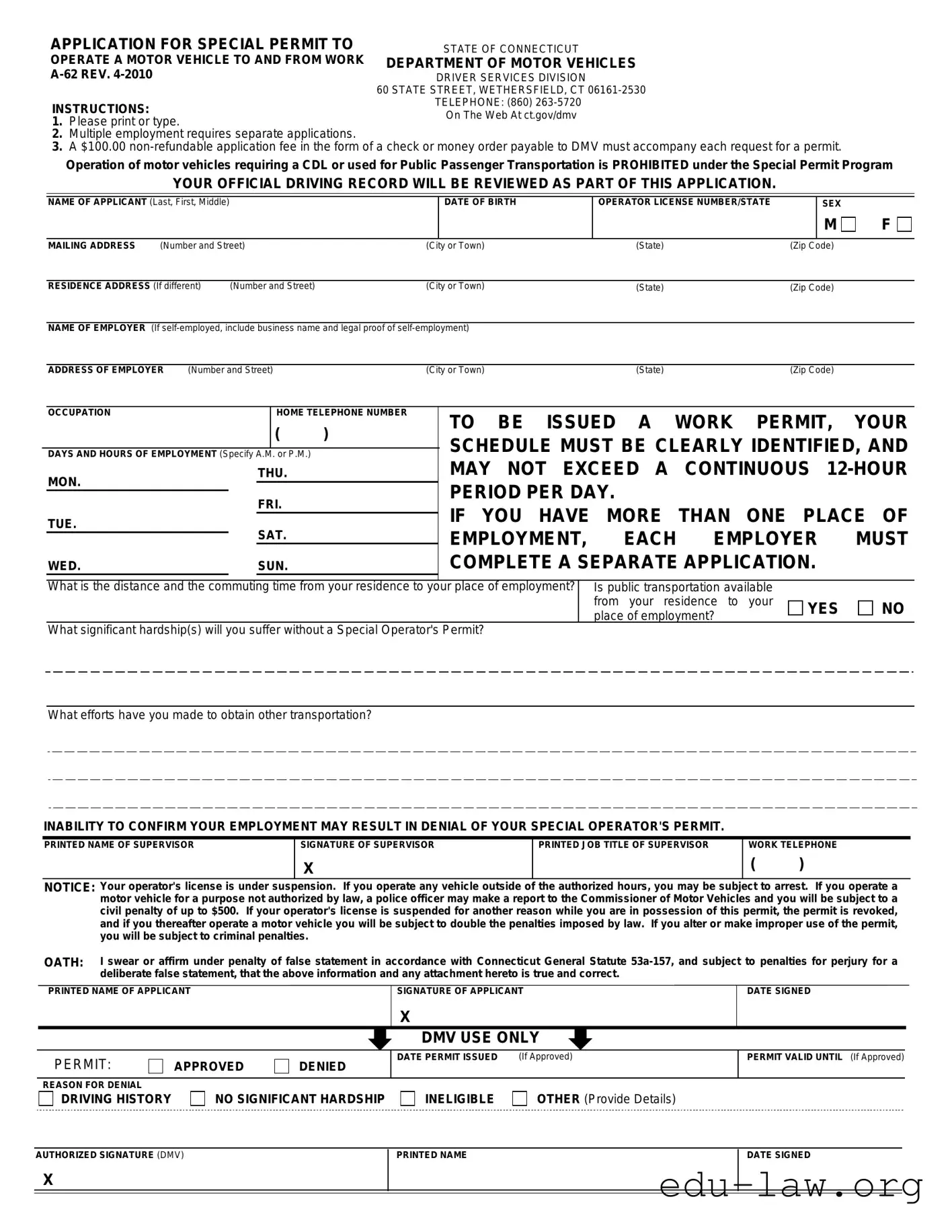
The Connecticut A 62 form serves as a crucial tool for individuals seeking to obtain a special permit that allows them to operate a motor vehicle specifically for commuting to and from work. This application is particularly relevant for those whose driving privileges have been suspended, providing a pathway to maintain employment despite transportation challenges. To initiate the process, applicants must complete the form with accurate personal details, including their name, date of birth, and operator license number. Additionally, the form requires information about the applicant's employer, occupation, and work schedule, ensuring that the commuting hours are clearly defined and do not exceed a continuous 12-hour period per day. A non-refundable fee of $100 must accompany each application, and it is essential to note that multiple employment situations necessitate separate applications. Furthermore, the form emphasizes the importance of verifying employment, as failure to do so may result in denial of the permit. It also outlines the restrictions associated with the permit, such as prohibiting the operation of vehicles requiring a Commercial Driver’s License (CDL) or those used for public passenger transportation. Understanding the nuances of the A 62 form is vital for those facing hardships due to license suspensions, as it represents not just a legal document, but a lifeline to employment and independence.
APPLICATION FOR SPECIAL PERMIT TO
OPERATE A MOTOR VEHICLE TO AND FROM WORK
INSTRUCTIONS:
1. Please print or type.
2. Multiple employment requires separate applications.
3. A $100.00
Operation of motor vehicles requiring a CDL or used for Public Passenger Transportation is PROHIBITED under the Special Permit Program
YOUR OFFICIAL DRIVING RECORD WILL BE REVIEWED AS PART OF THIS APPLICATION.
NAME OF APPLICANT (Last, First, Middle)
DATE OF BIRTH
OPERATOR LICENSE NUMBER/STATE
SEX
M
F
MAILING ADDRESS |
(Number and Street) |
(City or Town) |
(State) |
(Zip Code) |
|
|
|
|
|
|
|
RESIDENCE ADDRESS (If different) |
(Number and Street) |
(City or Town) |
(State) |
(Zip Code) |
|
NAME OF EMPLOYER (If
ADDRESS OF EMPLOYER |
(Number and Street) |
(City or Town) |
(State) |
(Zip Code) |
OCCUPATION |
HOME TELEPHONE NUMBER |
( )
DAYS AND HOURS OF EMPLOYMENT (Specify A.M. or P.M.)
TO BE ISSUED A WORK PERMIT, YOUR SCHEDULE MUST BE CLEARLY IDENTIFIED, AND
MON.
TUE.
THU.
FRI.
SAT.
MAY NOT EXCEED A CONTINUOUS
IF YOU HAVE MORE THAN ONE PLACE OF
EMPLOYMENT, EACH EMPLOYER MUST
WED.SUN.
COMPLETE A SEPARATE APPLICATION.
What is the distance and the commuting time from your residence to your place of employment? |
Is public transportation available |
|
|
|
from your residence to your |
YES |
NO |
|
place of employment? |
||
|
|
|
|
What significant hardship(s) will you suffer without a Special Operator's Permit? |
|
|
|
What efforts have you made to obtain other transportation?
INABILITY TO CONFIRM YOUR EMPLOYMENT MAY RESULT IN DENIAL OF YOUR SPECIAL OPERATOR'S PERMIT.
PRINTED NAME OF SUPERVISOR
SIGNATURE OF SUPERVISOR
X
PRINTED JOB TITLE OF SUPERVISOR
WORK TELEPHONE
( )
NOTICE:
OATH:
Your operator's license is under suspension. If you operate any vehicle outside of the authorized hours, you may be subject to arrest. If you operate a motor vehicle for a purpose not authorized by law, a police officer may make a report to the Commissioner of Motor Vehicles and you will be subject to a civil penalty of up to $500. If your operator's license is suspended for another reason while you are in possession of this permit, the permit is revoked, and if you thereafter operate a motor vehicle you will be subject to double the penalties imposed by law. If you alter or make improper use of the permit, you will be subject to criminal penalties.
I swear or affirm under penalty of false statement in accordance with Connecticut General Statute
PRINTED NAME OF APPLICANT |
SIGNATURE OF APPLICANT |
DATE SIGNED |
X
DMV USE ONLY
PERMIT:
APPROVED
DENIED
DATE PERMIT ISSUED |
(If Approved) |
PERMIT VALID UNTIL (If Approved)
REASON FOR DENIAL
DRIVING HISTORY
NO SIGNIFICANT HARDSHIP
INELIGIBLE
OTHER (Provide Details)
AUTHORIZED SIGNATURE (DMV)
X
PRINTED NAME
DATE SIGNED
| Fact Name | Details |
|---|---|
| Form Purpose | The A-62 form is an application for a special permit to operate a motor vehicle to and from work in Connecticut. |
| Governing Law | This form is governed by Connecticut General Statutes related to motor vehicle operation and permits. |
| Application Fee | A non-refundable application fee of $100 must accompany each request for a permit. |
| Eligibility | Applicants must have a suspended operator's license to be eligible for the special permit. |
| Employment Verification | Inability to confirm employment may result in denial of the special operator's permit. |
| Transportation Restrictions | Operation of vehicles requiring a CDL or used for public passenger transportation is prohibited under this program. |
| Hours of Operation | Work schedules must not exceed a continuous 12-hour period per day. |
| Consequences of Misuse | Improper use of the permit may lead to criminal penalties and civil fines of up to $500. |
Filling out the Connecticut A 62 form is a straightforward process. This application allows individuals with a suspended operator's license to request a special permit for commuting to work. Below are the steps to complete the form accurately.
What is the Connecticut A 62 form used for?
The Connecticut A 62 form is an application for a special permit that allows individuals with suspended driver’s licenses to operate a motor vehicle specifically to and from work. This form is essential for those who face significant hardships due to their inability to drive legally. It is important to note that the permit is not applicable for vehicles requiring a Commercial Driver's License (CDL) or those used for public passenger transportation.
What are the eligibility requirements for obtaining a special permit?
To be eligible for the special permit, applicants must demonstrate a significant hardship that would result from not being able to drive to work. This includes providing details about their commuting distance and time. Additionally, applicants must confirm their employment status, which may require a supervisor’s signature. It is also necessary for the applicant to have a valid reason for needing the permit, as the application will be reviewed in conjunction with their driving record.
What information is required on the A 62 form?
The A 62 form requires several key pieces of information. Applicants must provide their personal details, including name, date of birth, and driver’s license number. Employment information is also necessary, including the name and address of the employer, occupation, and work schedule. Furthermore, applicants must indicate the commuting distance and whether public transportation is available. A detailed account of hardships faced without the permit must also be included.
Is there a fee associated with the A 62 application?
Yes, there is a non-refundable application fee of $100. This fee must be submitted in the form of a check or money order made payable to the Connecticut Department of Motor Vehicles (DMV). Each application for a permit requires this fee, which is necessary for processing the request.
What happens if the application is denied?
If the application for the special permit is denied, the applicant will receive a notification stating the reason for the denial. Common reasons include a lack of significant hardship or ineligibility based on the applicant's driving history. Understanding the specific reason for denial is crucial, as it may provide insights into what can be improved for a potential future application.
What are the consequences of misusing the special permit?
Misuse of the special permit can lead to severe penalties. If an individual operates a vehicle outside of the authorized hours or for unauthorized purposes, they may face arrest. Additionally, if the permit is used improperly or altered, criminal penalties may apply. It is vital for permit holders to adhere strictly to the regulations outlined in the permit to avoid legal repercussions.
Failing to print or type the information clearly. Handwritten applications can lead to misunderstandings and errors.
Not providing separate applications for multiple employments. Each job requires its own form to be processed correctly.
Overlooking the $100.00 application fee. This fee must be included with the application; otherwise, it will not be processed.
Neglecting to specify days and hours of employment clearly. The schedule must be detailed to ensure compliance with permit regulations.
Not indicating public transportation availability. This information is crucial for assessing the need for a special permit.
Failing to provide significant hardship details. Applicants must explain why they need the special operator's permit.
Not including proof of employment. Inability to confirm employment can lead to denial of the permit.
Leaving out the supervisor's information. A printed name, signature, and contact number are required for verification.
Ignoring the oath and affirmation section. Providing false information can result in serious legal consequences.
Not signing and dating the application. An unsigned form is considered incomplete and will not be processed.
The Connecticut A 62 form is essential for individuals seeking a special permit to operate a motor vehicle for work purposes while their regular driver's license is suspended. Several other forms and documents often accompany this application to ensure a comprehensive review process. Below is a list of these documents, each playing a crucial role in the application procedure.
Each of these documents serves to provide the Connecticut Department of Motor Vehicles with a clear understanding of the applicant's situation. Properly preparing and submitting these forms can significantly influence the outcome of the A 62 application process.
The Connecticut A-62 form is similar to the Application for a Restricted License. Both documents serve to provide individuals with limited driving privileges under specific circumstances, particularly when their regular driver's license has been suspended. The restricted license application requires detailed information about the applicant's employment and commuting needs, just like the A-62. Each application emphasizes the importance of demonstrating a significant hardship without driving privileges.
Another comparable document is the Application for a Hardship License. This form is designed for individuals who need to drive for essential activities, such as work or medical appointments. Similar to the A-62, applicants must show proof of employment and outline the hardships they would face without the ability to drive. Both forms require a clear explanation of the necessity for driving and may involve a review of the applicant's driving record.
The Application for a Temporary License is also akin to the A-62 form. This document allows individuals to obtain a temporary driving permit while their license is being reinstated. Like the A-62, it requires the applicant to provide personal information, proof of identity, and details about their driving history. Both applications are intended to ensure that individuals can maintain mobility during a suspension period, albeit for different reasons.
Additionally, the Application for a Work Permit is relevant. This form is specifically for individuals who need to drive for work-related purposes while their driving privileges are restricted. The A-62 and work permit application both require details about the applicant's employment, including the name of the employer and work hours. Both documents aim to facilitate the applicant's ability to fulfill job responsibilities despite a suspended license.
The Application for a Medical Permit is another document that shares similarities with the A-62 form. This application allows individuals to drive for medical appointments or to obtain necessary medical care. Like the A-62, it requires a demonstration of need and hardship. Both forms ensure that the applicant's circumstances warrant the need for limited driving privileges during a suspension.
The Application for a Student Permit also parallels the A-62 form. This document is for students who need to drive to school or educational programs while their license is suspended. Both applications require the applicant to outline their educational commitments and the necessity of driving to fulfill those commitments. They emphasize the importance of education and the need for transportation to support it.
The Application for a Provisional License is another document that shares a purpose with the A-62. This form allows individuals, often new drivers or those with restricted licenses, to drive under certain conditions. Similar to the A-62, it requires a clear outline of driving restrictions and circumstances under which the individual may operate a vehicle. Both forms are designed to provide a pathway to regain driving privileges while ensuring safety on the road.
Lastly, the Application for a Commercial Driving Permit bears resemblance to the A-62 form. This application is for individuals seeking to drive commercial vehicles under specific conditions, often during a suspension period. Both documents require the applicant to provide extensive information about their employment and driving history. They ensure that individuals can continue to work in their chosen field while adhering to legal restrictions.
When filling out the Connecticut A-62 form, it is important to be thorough and accurate. Here are some dos and don’ts to keep in mind:
Understanding the Connecticut A 62 form can be challenging, and misconceptions often lead to confusion. Here are six common misunderstandings regarding this special permit application:
By clarifying these misconceptions, individuals can better navigate the application process and understand the limitations and requirements associated with the Connecticut A 62 form.
When filling out the Connecticut A 62 form, consider the following key takeaways: