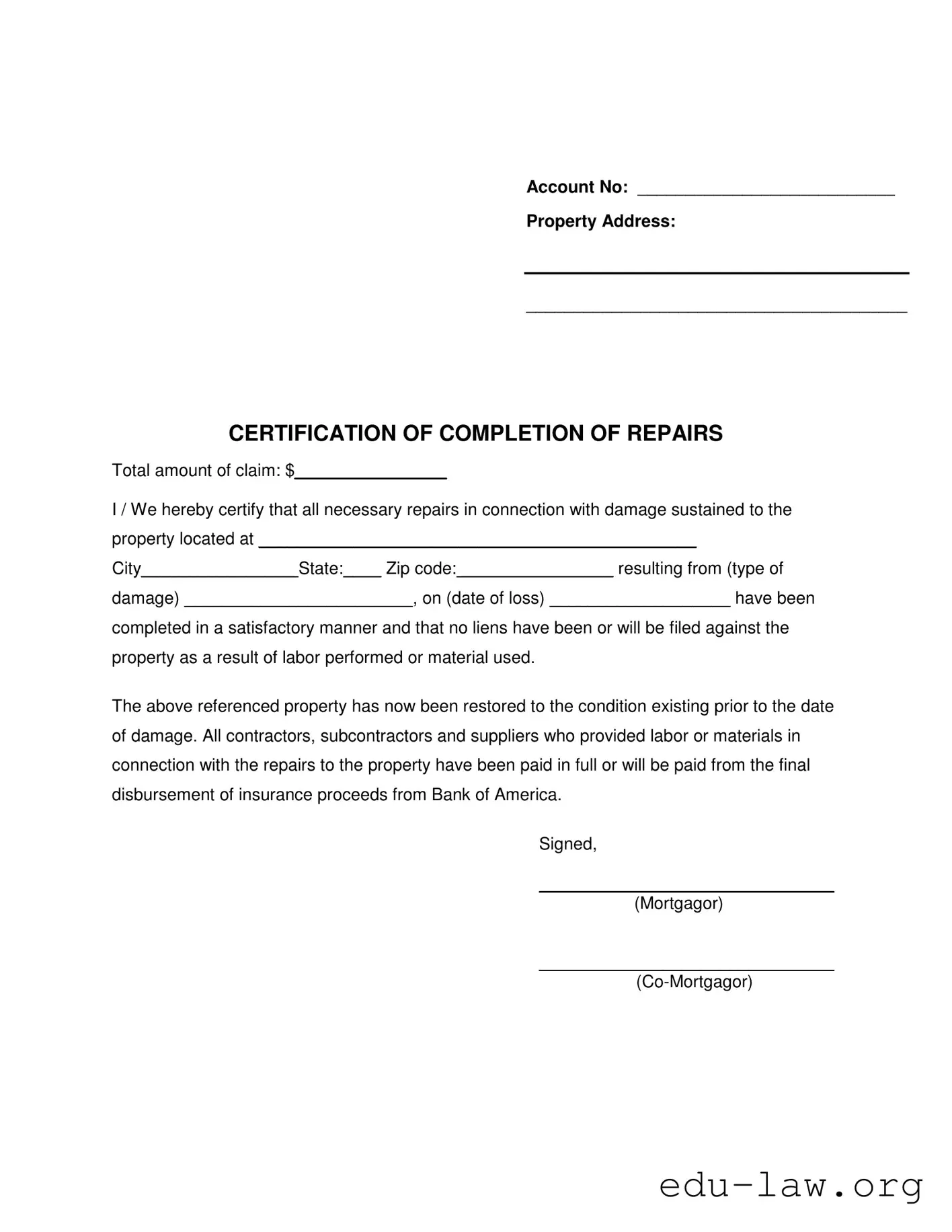
The Completion Repairs form plays a crucial role in the process of property damage claims, particularly in the context of insurance. This form serves as a certification that all necessary repairs have been satisfactorily completed following damage to a property. It includes essential details such as the account number, property address, total claim amount, and the nature of the damage incurred. By signing this document, the property owner affirms that no liens have been filed against the property as a result of the repair work, ensuring that all contractors, subcontractors, and suppliers have been compensated for their services. Furthermore, the form confirms that the property has been restored to its original condition prior to the damage, providing peace of mind to both the property owner and the insurance provider. This documentation not only facilitates the final disbursement of insurance proceeds but also establishes a clear record of compliance with all obligations related to the repair process.

Account No: ___________________________
Property Address:
________________________________________
CERTIFICATION OF COMPLETION OF REPAIRS
Total amount of claim: $________________
I / We hereby certify that all necessary repairs in connection with damage sustained to the property located at ______________________________________________
City________________ State:____ Zip code: ________________ resulting from (type of
damage) ________________________, on (date of loss) ___________________ have been
completed in a satisfactory manner and that no liens have been or will be filed against the property as a result of labor performed or material used.
The above referenced property has now been restored to the condition existing prior to the date of damage. All contractors, subcontractors and suppliers who provided labor or materials in connection with the repairs to the property have been paid in full or will be paid from the final disbursement of insurance proceeds from Bank of America.
Signed,
_______________________________
(Mortgagor)
_______________________________
| Fact Name | Description |
|---|---|
| Purpose | The Completion Repairs form certifies that all necessary repairs to a property have been completed following damage. |
| Claim Amount | The form requires the total amount of the claim to be specified, ensuring clarity on the financial aspect of the repairs. |
| Certification Requirement | Homeowners must certify that repairs were completed satisfactorily and that no liens will be filed against the property. |
| Restoration Condition | The property must be restored to its condition prior to the damage for the certification to be valid. |
| Payment of Contractors | All contractors and suppliers involved in the repairs must be paid in full or will be paid from insurance proceeds. |
| Signatures Required | The form must be signed by the mortgagor and co-mortgagor, indicating their agreement to the terms stated. |
| State-Specific Forms | Some states may have specific forms or additional requirements governed by local laws related to property repairs and liens. |
| Governing Laws | In states like California, Civil Code Section 8416 governs the completion of repairs and lien waivers, while Florida follows Chapter 713 of the Florida Statutes. |
After you have gathered all the necessary information, you are ready to complete the Completion Repairs form. This document is essential for confirming that repairs have been finalized and that all parties involved have been compensated. Follow these steps to fill out the form accurately.
What is the Completion Repairs form used for?
The Completion Repairs form is a document that certifies that all necessary repairs have been completed on a property following damage. This form is often required by insurance companies or lenders to confirm that the property has been restored to its original condition before the damage occurred.
Who needs to fill out the Completion Repairs form?
The form needs to be filled out by the property owner, also known as the mortgagor. If there is a co-mortgagor, they must also sign the form. This ensures that all parties involved in the property are aware of the repairs and agree to the certification.
What information is required on the form?
You will need to provide several key details, including the account number, property address, total amount of the claim, type of damage, and the date of loss. Additionally, you must certify that all necessary repairs have been completed and that no liens will be filed against the property.
What does it mean to certify the completion of repairs?
By certifying the completion of repairs, you are confirming that all work has been done satisfactorily. This means that the property has been restored to its condition before the damage. It also implies that all contractors and suppliers have been paid for their services.
What happens if the repairs are not completed?
If the repairs are not completed, you should not sign the Completion Repairs form. Doing so could lead to legal issues, including potential claims of fraud. It’s essential to ensure that all repairs are finished before certifying completion.
Can I submit the form without paying all contractors?
No, you cannot submit the form unless all contractors, subcontractors, and suppliers have been paid in full. This is a critical part of the certification process. If you plan to pay them from the insurance proceeds, you must clearly indicate that in the form.
What should I do if I have questions while filling out the form?
If you have questions while completing the form, it’s best to consult with a legal expert or a representative from your insurance company. They can provide guidance specific to your situation and ensure that you complete the form correctly.
Is there a deadline for submitting the Completion Repairs form?
When filling out the Completion Repairs form, it is important to pay attention to detail. Mistakes can lead to delays in processing claims or even denials. Below is a list of common errors that people often make:
Omitting the account number or property address can create confusion and hinder the processing of your claim.
Providing an incorrect or incomplete property address may result in complications. Ensure that the address matches official documents.
Not clearly stating the type of damage can lead to misunderstandings. Be specific about what caused the damage.
Leaving the date of loss blank is a common mistake. This date is crucial for verifying the claim.
Errors in the certification statement can invalidate the form. Double-check that all required statements are accurately filled out.
Failing to disclose any existing or potential liens against the property can lead to legal issues. Be transparent about any liens.
Not confirming that all contractors and suppliers have been paid can jeopardize your claim. Ensure all payments are settled.
Missing or incorrect signatures from the mortgagor or co-mortgagor can render the form invalid. Verify that all required signatures are present.
Failing to keep a copy of the completed form for personal records can be a significant oversight. Always retain a copy for your files.
By avoiding these common mistakes, you can help ensure a smoother process for your claim. Attention to detail is key in completing the Completion Repairs form accurately.
The Completion Repairs form is an essential document used in property damage claims. It certifies that repairs have been completed satisfactorily and outlines the financial aspects related to those repairs. Several other forms and documents are often utilized alongside this form to ensure a comprehensive and organized claims process. Below is a list of these documents, each described briefly.
Each of these documents plays a vital role in the claims process, ensuring that all aspects of the repair and reimbursement are documented and verified. Properly managing these forms can facilitate a smoother experience when dealing with insurance claims related to property damage.
The Completion Repairs form is similar to a Certificate of Completion. Both documents serve as proof that specific work has been finished. A Certificate of Completion typically indicates that a construction project or renovation has met all requirements and standards. It assures stakeholders that the project is complete and ready for use. This document often includes details about inspections and approvals, making it essential for finalizing construction projects.
Another document that shares similarities is the Final Inspection Report. This report is generated after a property has undergone repairs or renovations. It details the results of a thorough inspection conducted by a qualified professional. Like the Completion Repairs form, it confirms that all necessary work has been completed satisfactorily. This document can be crucial for homeowners seeking to ensure that repairs meet local building codes and safety standards.
The Affidavit of Completion is also comparable. This legal document is signed by a contractor or property owner, affirming that all work has been completed according to the agreed terms. It often includes information about payments made to subcontractors and suppliers. Similar to the Completion Repairs form, it serves to protect all parties involved by ensuring that no outstanding claims or liens exist against the property.
A Warranty of Work is another related document. This warranty guarantees that the completed repairs will be free from defects for a specified period. It provides assurance to the property owner that any issues arising from the work performed will be addressed by the contractor. Like the Completion Repairs form, it emphasizes the completion of work and the commitment to quality and satisfaction.
Lastly, the Release of Lien is a document that is often associated with the Completion Repairs form. This document is issued by contractors or suppliers, confirming that they have been paid for their services and materials. It protects the property owner from potential claims against the property. Similar to the Completion Repairs form, the Release of Lien ensures that all financial obligations related to the repairs have been satisfied, preventing future disputes.
When filling out the Completion Repairs form, attention to detail is crucial. Here are four important guidelines to follow:
Following these guidelines will help ensure that your submission is handled efficiently and that your claim is processed without unnecessary complications.
Misconceptions about the Completion Repairs form can lead to confusion. Here are eight common misunderstandings, along with clarifications:
Filling out the Completion Repairs form is an important step in the claims process. Here are some key takeaways to help you navigate this form effectively:
By keeping these key points in mind, you can fill out the Completion Repairs form accurately and efficiently, helping to expedite your claim process.