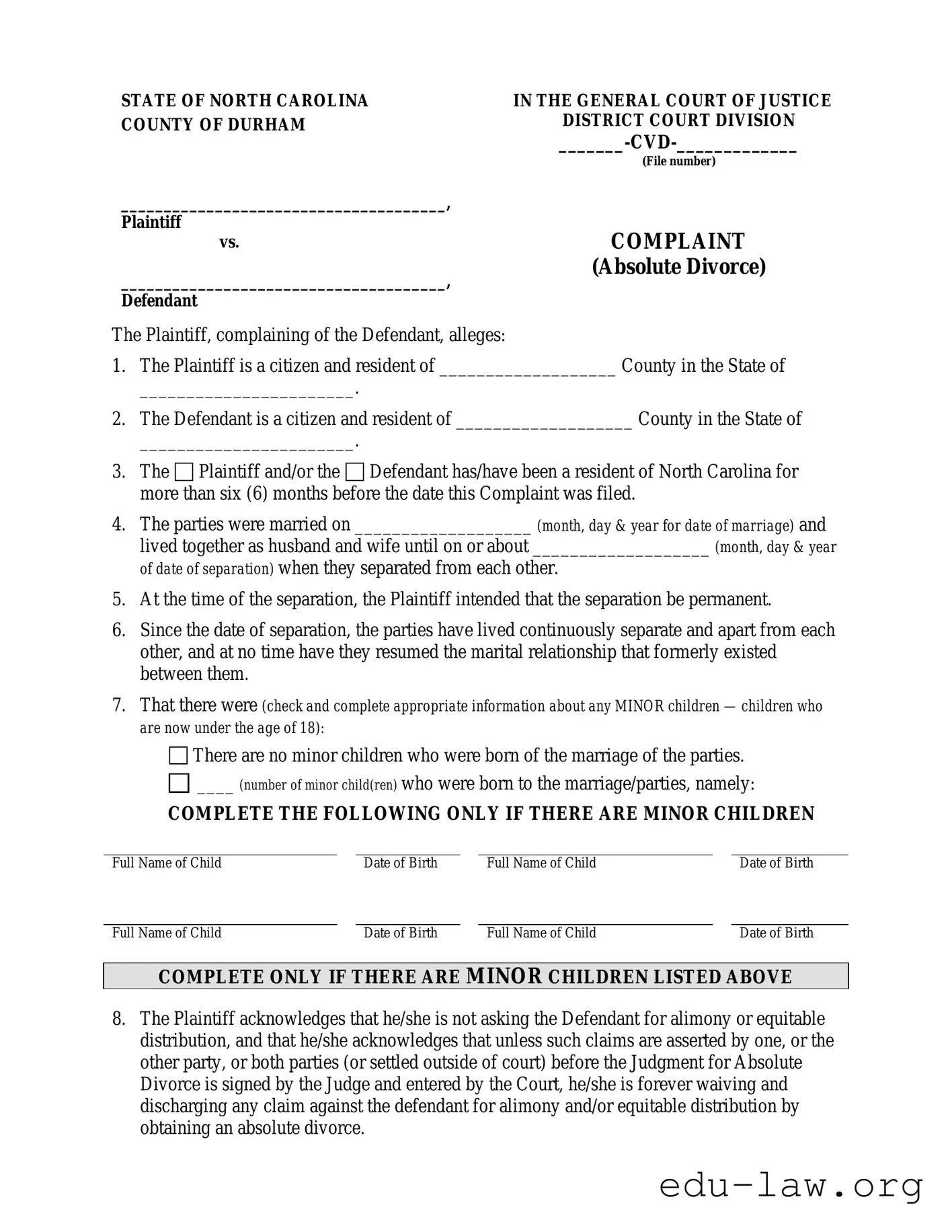
Filing for divorce can be an emotional and complex process, but understanding the necessary paperwork can ease some of the burden. In North Carolina, the Complaint Divorce form is a crucial document that initiates the legal proceedings for an absolute divorce. This form requires the plaintiff to provide essential information, including the names and residences of both parties, the duration of their marriage, and the date of separation. It also addresses any minor children involved, ensuring their welfare is considered. The plaintiff must affirm that they do not seek alimony or property distribution unless previously agreed upon, which can simplify the proceedings. Additionally, the form allows for the request to resume a maiden name if desired. By clearly outlining these details, the Complaint Divorce form serves as a foundational step in dissolving the marital bonds, enabling both parties to move forward with their lives.

STATE OF NORTH CAROLINA |
IN THE GENERAL COURT OF JUSTICE |
COUNTY OF DURHAM |
DISTRICT COURT DIVISION |
|
|
|
(File number) |
______________________________________,
Plaintiff
vs.
______________________________________,
Defendant
COMPLAINT
(Absolute Divorce)
The Plaintiff, complaining of the Defendant, alleges:
1.The Plaintiff is a citizen and resident of ___________________ County in the State of
_______________________.
2.The Defendant is a citizen and resident of ___________________ County in the State of
_______________________.
3.The Plaintiff and/or the Defendant has/have been a resident of North Carolina for more than six (6) months before the date this Complaint was filed.
4.The parties were married on ___________________ (month, day & year for date of marriage) and lived together as husband and wife until on or about ___________________ (month, day & year of date of separation) when they separated from each other.
5.At the time of the separation, the Plaintiff intended that the separation be permanent.
6.Since the date of separation, the parties have lived continuously separate and apart from each other, and at no time have they resumed the marital relationship that formerly existed between them.
7.That there were (check and complete appropriate information about any MINOR children — children who
are now under the age of 18):
There are no minor children who were born of the marriage of the parties.
____ (number of minor child(ren) who were born to the marriage/parties, namely:
COMPLETE THE FOLLOWING ONLY IF THERE ARE MINOR CHILDREN
Full Name of Child |
Date of Birth |
Full Name of Child |
Date of Birth |
Full Name of Child |
Date of Birth |
Full Name of Child |
Date of Birth |
COMPLETE ONLY IF THERE ARE MINOR CHILDREN LISTED ABOVE
8.The Plaintiff acknowledges that he/she is not asking the Defendant for alimony or equitable distribution, and that he/she acknowledges that unless such claims are asserted by one, or the other party, or both parties (or settled outside of court) before the Judgment for Absolute Divorce is signed by the Judge and entered by the Court, he/she is forever waiving and discharging any claim against the defendant for alimony and/or equitable distribution by obtaining an absolute divorce.

9. (check if applicable) That the Plaintiff and Defendant executed an agreement settling property and other issues on _____________. (attach a copy of the agreement)
10. (check if applicable) That the Plaintiff be allowed to resume the use of her maiden name, to wit: __________________________ (print maiden name).
WHEREFORE, the Plaintiff respectfully requests the following:
1.That the bonds of matrimony which have existed between the parties will be dissolved and that he/she be granted an absolute divorce from the Defendant.
2.The Plaintiff respectfully requests that the Separation and Property Settlement Agreement executed by the parties on ______________ be incorporated herein.
This the _____ day of _________________, 20_____ (month and year).
________________________________________
(Plaintiff’s full
_____________________________________________________
(Complete street/mailing address of Plaintiff)
________________________________________
________________________________________
(City, State, Zip Code for Plaintiff)
________________________________________
(Plaintiff’s Telephone number)
VERIFICATION
(Must be signed in front of a Notary Public)
I, ______________________________________ (Print Your Name), being first duly sworn,
deposes and says that I am the Plaintiff herein, that I have read the foregoing Complaint for Absolute Divorce and know the statements therein to be true of my own personal knowledge, except as to those matters alleged upon information and belief, and as to those matters, I believe them to be true.
This _____ day of _____________, 20____ (month and year).
__________________________________________________
(Plaintiff’s
Subscribed and affirmed before me this ____ day
of ________________, 20____.
____________________________
Notary Public
My Commission expires: ______________
| Fact Name | Description |
|---|---|
| Governing Law | The Complaint Divorce NC form is governed by North Carolina General Statutes, specifically Chapter 50. |
| Residency Requirement | The Plaintiff and/or Defendant must have been a resident of North Carolina for at least six months prior to filing. |
| Separation Duration | The parties must have lived continuously separate and apart since their date of separation. |
| Minor Children | If there are minor children involved, specific information about each child must be provided in the form. |
| Alimony Waiver | The Plaintiff acknowledges that they are not requesting alimony or equitable distribution, waiving such claims unless asserted before the divorce judgment. |
| Maiden Name Restoration | The Plaintiff may request to resume their maiden name as part of the divorce proceedings. |
Filling out the Complaint Divorce NC form is a necessary step in initiating a divorce proceeding in North Carolina. After completing the form, it will need to be filed with the appropriate court. Ensure all information is accurate and complete to avoid delays in the process.
What is the purpose of the Complaint Divorce NC form?
The Complaint Divorce NC form is a legal document used to initiate the process of obtaining an absolute divorce in North Carolina. It outlines the details of the marriage, the separation, and any relevant information regarding children or property. This form serves as the official request to the court for the dissolution of the marriage, allowing the plaintiff to present their case for divorce.
Who can file the Complaint Divorce NC form?
Any individual who meets the residency requirements of North Carolina can file this form. Specifically, either the plaintiff or the defendant must have been a resident of the state for at least six months prior to filing. The plaintiff must also be able to provide information about the marriage, separation, and any children involved.
What information must be included in the form?
The form requires specific information, including the names and addresses of both parties, the date of marriage, the date of separation, and details about any minor children. If applicable, the plaintiff must also indicate whether they are seeking alimony or property distribution. Additionally, if there is an agreement regarding property or other issues, that information should be included as well.
What happens if there are minor children involved?
If the parties have minor children, the form requires the plaintiff to provide the names and birthdates of those children. It is important to note that any claims related to child custody or support may need to be addressed separately in court. The Complaint Divorce NC form itself primarily focuses on the divorce proceedings.
Is it necessary to have legal representation when filing this form?
While it is not mandatory to have legal representation when filing the Complaint Divorce NC form, it is highly recommended. Navigating divorce proceedings can be complex, especially when issues like custody, support, and property division are involved. An attorney can provide guidance, ensure that the form is completed correctly, and represent the interests of the plaintiff in court.
What should I do after filing the Complaint Divorce NC form?
After filing the Complaint Divorce NC form, the plaintiff must serve the defendant with a copy of the complaint and a summons. This informs the defendant of the divorce proceedings and gives them the opportunity to respond. Following this, the court will schedule a hearing to review the case, at which point the plaintiff may need to present evidence or testimony to support their request for divorce.
Failing to provide complete and accurate information about residency. It's crucial to specify the county and state for both the Plaintiff and Defendant.
Not confirming the duration of residency in North Carolina. Ensure that the requirement of being a resident for more than six months is met.
Overlooking the date of marriage and separation. These dates are essential for the court to understand the timeline of the relationship.
Neglecting to indicate the intention for a permanent separation. This is a key element in establishing grounds for divorce.
Forgetting to check the box regarding minor children. If there are children involved, this section must be completed accurately.
Failing to provide the full names and birth dates of any minor children. This information is vital for the court's records.
Not acknowledging alimony or equitable distribution claims. It's important to state clearly that you are waiving these claims if applicable.
Forgetting to attach any agreements made regarding property and other issues. If there is an agreement, it must be included with the complaint.
Neglecting to request the resumption of a maiden name if desired. This request should be clearly stated if applicable.
Not signing the verification in front of a Notary Public. This step is essential to validate the document.
When filing for a divorce in North Carolina, several additional forms and documents may be necessary to complete the process effectively. These documents help clarify various aspects of the divorce, such as child custody, financial arrangements, and the legal status of the marriage. Below is a list of commonly used forms alongside the Complaint Divorce NC form.
Understanding these forms can help streamline the divorce process and ensure that all necessary legal requirements are met. Each document plays a crucial role in protecting the rights and interests of both parties involved.
The Complaint Divorce NC form shares similarities with the Petition for Divorce. Both documents initiate the divorce process, outlining the grounds for the divorce and the details of the marriage. They require the identification of the parties involved and often include information about residency and separation dates. Additionally, both forms may address issues related to minor children and property settlements, although the specific requirements can vary by state.
Another document similar to the Complaint Divorce NC form is the Separation Agreement. This agreement outlines the terms under which the parties will live separately, addressing issues such as child custody, support, and property division. While the Complaint focuses on the divorce itself, the Separation Agreement serves as a precursor, detailing the arrangements made prior to the divorce filing. Both documents may be filed in court and can influence the final divorce decree.
The Motion for Temporary Orders is also comparable. This document is filed to request immediate relief regarding child custody, support, or property issues while the divorce is pending. Like the Complaint Divorce NC form, it requires specific information about the parties and their situation. Both documents aim to clarify the rights and responsibilities of each party during the divorce process.
The Affidavit of Service is another related document. It serves as proof that the Complaint Divorce NC form has been properly delivered to the other party. This affidavit includes details about how and when the documents were served. Both documents are essential for ensuring that the legal process is followed correctly and that both parties are aware of the proceedings.
The Financial Affidavit is similar in that it provides a detailed overview of each party's financial situation. This document is often required in divorce cases to assess support obligations and property division. While the Complaint Divorce NC form outlines the divorce itself, the Financial Affidavit supports the claims made regarding alimony or asset distribution.
The Child Custody Agreement is another document that may be filed alongside the Complaint Divorce NC form if minor children are involved. This agreement outlines the parenting plan and custody arrangements. Both documents emphasize the welfare of the children and aim to establish clear guidelines for co-parenting after the divorce.
Lastly, the Judgment of Absolute Divorce is closely related. This document is the final order issued by the court, officially ending the marriage. It incorporates the details from the Complaint Divorce NC form, including any agreements made regarding children or property. Both documents are integral to the divorce process, marking the transition from married to single status.
When filling out the Complaint Divorce NC form, there are important steps to follow to ensure accuracy and compliance with legal requirements. Here is a list of things you should and shouldn't do:
By following these guidelines, you can help ensure that your Complaint Divorce NC form is properly completed and submitted.
Misconceptions about the Complaint Divorce NC form can lead to confusion during the divorce process. Here are ten common misconceptions clarified:
Filling out the Complaint Divorce NC form can seem daunting, but understanding its key components can make the process smoother. Here are some essential takeaways to keep in mind:
By keeping these points in mind, you can approach the Complaint Divorce NC form with confidence. Each step you take is a move towards a new chapter in your life.