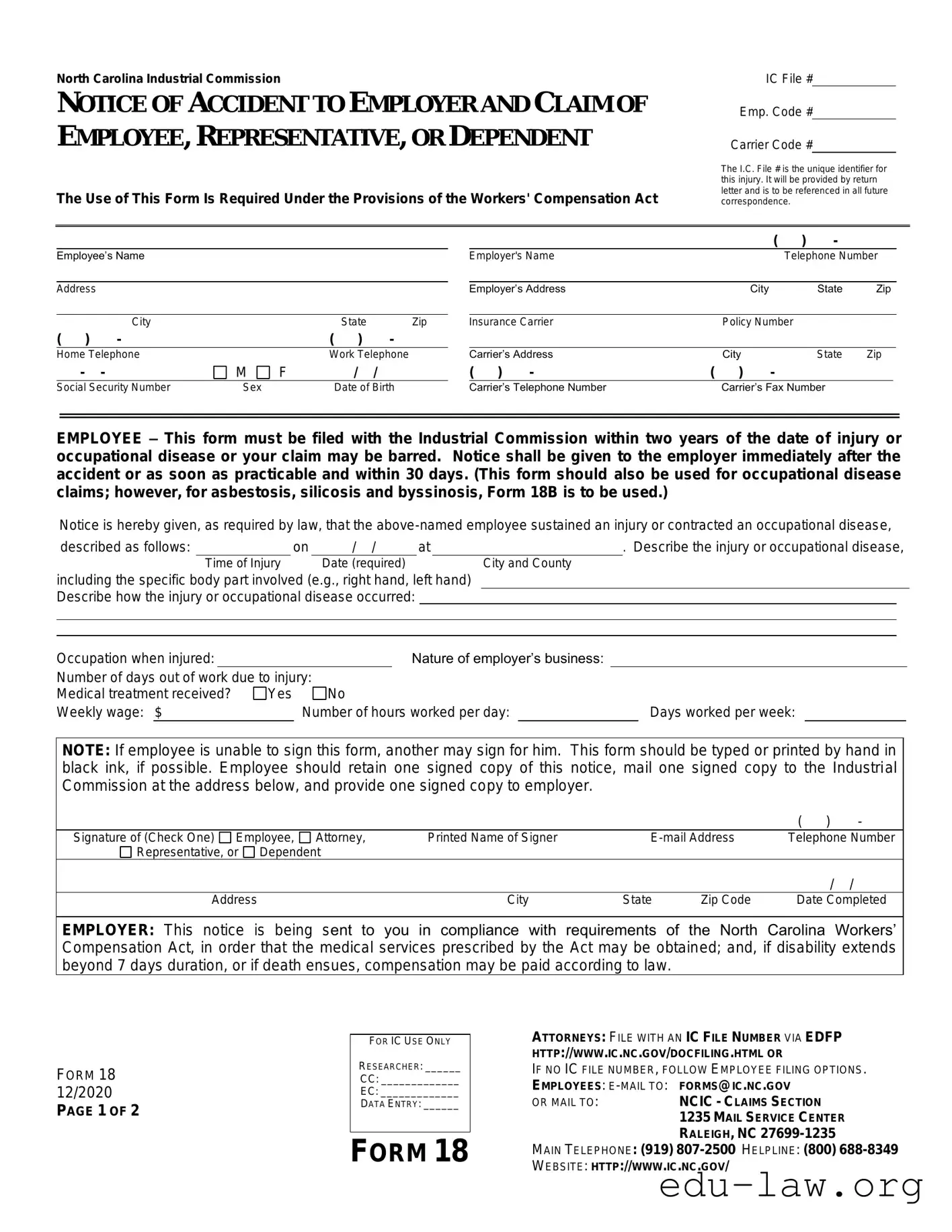
The Commission 18 form is a crucial document for employees in North Carolina who have sustained an injury or developed an occupational disease while on the job. This form serves multiple purposes: it notifies the employer of the incident and establishes a legal claim for compensation if filed within two years of the injury date. Employees must submit the completed form to the North Carolina Industrial Commission and provide a copy to their employer within 30 days of the accident. The form requires essential information, including the employee's personal details, a description of the injury, and specifics about the employer and insurance carrier. Additionally, it outlines the necessary steps for filing, such as retaining copies for personal records and ensuring that all required information is accurately filled out. If the employee is unable to sign the form, a representative may do so on their behalf. Understanding the importance of the Commission 18 form is vital, as it not only initiates the claims process but also ensures that employees receive the medical services and compensation they are entitled to under the Workers' Compensation Act.
North Carolina Industrial Commission |
IC File # |
NOTICE OF ACCIDENT TO EMPLOYER AND CLAIM OF EMPLOYEE, REPRESENTATIVE, OR DEPENDENT
The Use of This Form Is Required Under the Provisions of the Workers' Compensation Act
Emp. Code #
Carrier Code #
The I.C. File # is the unique identifier for this injury. It will be provided by return letter and is to be referenced in all future correspondence.
( ) -
Employee’s Name
Address
|
|
City |
|
|
State |
Zip |
( |
) |
- |
|
( |
) |
- |
Home Telephone |
|
Work Telephone |
||||
|
- |
- |
M |
F |
/ |
/ |
Social Security Number |
Sex |
|
Date of Birth |
|||
Employer's Name |
|
|
Telephone Number |
||||
|
|
|
|
|
|
||
Employer’s Address |
|
City |
State |
Zip |
|||
|
|
|
|
|
|||
Insurance Carrier |
|
Policy Number |
|
|
|||
|
|
|
|
|
|
||
Carrier’s Address |
|
City |
State |
Zip |
|||
( |
) |
- |
( |
) |
- |
|
|
Carrier’s Telephone Number |
|
Carrier’s Fax Number |
|
|
|||
EMPLOYEE – This form must be filed with the Industrial Commission within two years of the date of injury or occupational disease or your claim may be barred. Notice shall be given to the employer immediately after the accident or as soon as practicable and within 30 days. (This form should also be used for occupational disease claims; however, for asbestosis, silicosis and byssinosis, Form 18B is to be used.)
Notice is hereby given, as required by law, that the
described as follows: |
|
|
on |
|
/ / |
|
|
at |
|
. Describe the injury or occupational disease, |
||||||||||
|
|
Time of Injury |
|
|
Date (required) |
|
|
|
|
City and County |
|
|
|
|
|
|||||
including the specific body part involved (e.g., right hand, left hand) |
|
|
|
|
|
|
||||||||||||||
Describe how the injury or occupational disease occurred: |
|
|
|
|
|
|
||||||||||||||
|
|
|
|
|
|
|
|
|
|
|
|
|
|
|
|
|
||||
|
|
|
|
|
|
|
|
|
|
|
|
|
|
|
|
|
||||
Occupation when injured: |
|
|
|
|
|
|
Nature of employer’s business: |
|
|
|
|
|
|
|||||||
Number of days out of work due to injury: |
|
|
|
|
|
|
|
|
|
|
|
|
|
|
||||||
Medical treatment received? |
Yes |
|
|
No |
|
|
|
|
|
|
|
|
|
|
|
|
||||
Weekly wage: $ |
|
Number of hours worked per day: |
|
Days worked per week: |
||||||||||||||||
|
|
|
|
|
|
|
|
|
|
|
|
|
|
|
|
|
|
|
|
|
NOTE: If employee is unable to sign this form, another may sign for him. This form should be typed or printed by hand in black ink, if possible. Employee should retain one signed copy of this notice, mail one signed copy to the Industrial Commission at the address below, and provide one signed copy to employer.
|
|
|
|
|
|
|
( |
) |
- |
Signature of (Check One) |
Employee, |
Attorney, |
Printed Name of Signer |
Telephone Number |
|||||
Representative, or |
Dependent |
|
|
|
|
|
|
||
|
|
|
|
|
|
|
|
/ |
/ |
Address |
|
|
City |
State |
Zip Code |
Date Completed |
|||
EMPLOYER: This notice is being sent to you in compliance with requirements of the North Carolina Workers’ Compensation Act, in order that the medical services prescribed by the Act may be obtained; and, if disability extends beyond 7 days duration, or if death ensues, compensation may be paid according to law.
FORM 18 12/2020
PAGE 1 OF 2
FOR IC USE ONLY
RESEARCHER: ______
CC:_____________
EC: _____________
DATA ENTRY: ______
FORM 18
ATTORNEYS: FILE WITH AN IC FILE NUMBER VIA EDFP
HTTP://WWW.IC.NC.GOV/DOCFILING.HTML OR
IF NO IC FILE NUMBER, FOLLOW EMPLOYEE FILING OPTIONS.
EMPLOYEES: |
FORMS@IC.NC.GOV |
OR MAIL TO: |
NCIC - CLAIMS SECTION |
|
1235 MAIL SERVICE CENTER |
|
RALEIGH, NC |
MAIN TELEPHONE: (919)
WEBSITE: HTTP://WWW.IC.NC.GOV/

GENERAL INFORMATION ON THE FORM 18
1.What does a Form 18 do?
A Form 18 establishes a legal claim of injury on your behalf if filed within two years of the date of injury or occupational disease, and gives the required written notice to the employer if a copy is submitted to the employer within 30 days of the injury. The employer is required by law to file a Form 19 if the employee misses more than one day of work due to the injury or if the medical bills exceed $4,000.00. However, the employer’s filing of a Form 19 does not satisfy the employee’s obligation to file a claim. In order to ensure the employee’s rights are protected, the employee must file a Form 18 even though the employer may be paying compensation or the Industrial Commission may have opened a file for the injury.
2.To whom should the Form 18 be sent?
The original Form 18 should be submitted to the Industrial Commission. The injured worker should keep one copy for his or her records and one copy should be submitted to the employer at the time of the injury.
3.What numbers do I write in the upper right corner?
You do not need to fill in the spaces on the upper right corner of the Form 18. If you know that your employer has already filed a report of injury, (Form 19) and you know what your I.C. (Industrial Commission), File Number is, you may write the number in the “I.C. File No.” space. If you do not already have an I.C. File Number, the Industrial Commission will assign one upon receipt of the Form 18. The other two spaces “Emp. Code No.” and “Carrier Code No.” are for internal use only.
4.What if I do not know who my employer’s insurance carrier is?
If you do not know who the employer’s insurance carrier is you may either ask your employer for the information, call the Industrial Commission’s Claims Administration Section at (800)
5.When listing the number of days out of work, do I count partial days?
Yes, you include partial as well as whole calendar days not worked. However, the days do not need to be consecutive.
6.What happens after I file the Form 18?
The Industrial Commission will mail an acknowledgement letter to you after your Form 18 is processed. Processing time varies according to current workload. The Industrial Commission will mail a copy of the acknowledgement letter to the employer or its workers’ compensation insurance carrier asking them to contact you and inform you if compensation will be paid to you voluntarily.
| Fact Name | Description |
|---|---|
| Purpose of Form 18 | This form establishes a legal claim for injury and provides required notice to the employer. |
| Filing Deadline | The form must be filed within two years of the injury date or occupational disease. |
| Notice to Employer | Notice must be given to the employer immediately after the accident or within 30 days. |
| Employer's Obligations | If the employee misses more than one day of work, the employer must file a Form 19. |
| Submission Process | The original Form 18 goes to the Industrial Commission, with copies kept by the employee and sent to the employer. |
| Contact Information | For assistance, employees can call the Industrial Commission's helpline at (800) 688-8349. |
Completing the Commission 18 form is an important step in reporting a workplace injury or occupational disease. After submitting the form, the Industrial Commission will process it and send you an acknowledgment letter. This letter confirms that your claim has been received and outlines the next steps. It is crucial to ensure that all information is accurate and complete to avoid delays in processing.
1. What does a Form 18 do?
A Form 18 establishes a legal claim of injury on your behalf if it is filed within two years of the date of injury or occupational disease. It also provides the required written notice to the employer when a copy is submitted within 30 days of the injury. If an employee misses more than one day of work due to the injury, or if medical bills exceed $4,000, the employer is required to file a Form 19. However, the employer's filing does not satisfy the employee's obligation to file a claim. To protect your rights, it is essential to file a Form 18, even if the employer is paying compensation or the Industrial Commission has opened a file for the injury.
2. To whom should the Form 18 be sent?
The original Form 18 should be submitted to the Industrial Commission. It is important for the injured worker to keep one copy for personal records. Additionally, one copy should be provided to the employer at the time of the injury.
3. What numbers do I write in the upper right corner?
You do not need to fill in the spaces in the upper right corner of the Form 18. If you know your employer has already filed a report of injury (Form 19) and you have the I.C. (Industrial Commission) File Number, you may write that number in the “I.C. File No.” space. If you do not have an I.C. File Number, the Industrial Commission will assign one upon receipt of the Form 18. The “Emp. Code No.” and “Carrier Code No.” spaces are for internal use only.
4. What if I do not know who my employer’s insurance carrier is?
If you are unsure of your employer's insurance carrier, you can ask your employer directly for the information. Alternatively, you can call the Industrial Commission’s Claims Administration Section at (800) 688-8349 and press “1” after the prompt. If you prefer, you may also leave the line blank on the form.
5. When listing the number of days out of work, do I count partial days?
Yes, you should include both partial and whole calendar days that were not worked. It is not necessary for these days to be consecutive.
6. What happens after I file the Form 18?
After filing the Form 18, the Industrial Commission will send you an acknowledgment letter once your form is processed. The time it takes to process varies based on the current workload. Additionally, the Commission will mail a copy of the acknowledgment letter to your employer or its workers’ compensation insurance carrier, requesting them to contact you regarding whether compensation will be paid voluntarily.
Not filing within the required time frame: One of the most critical mistakes is failing to submit the Commission 18 form within two years of the injury or occupational disease. Delays can bar your claim entirely.
Inaccurate personal information: Providing incorrect details, such as your name, address, or Social Security Number, can lead to processing delays or complications in your claim.
Omitting the description of the injury: Failing to clearly describe the injury or occupational disease can hinder your claim. Be specific about the body part affected and how the injury occurred.
Not notifying the employer: It’s essential to inform your employer about the injury immediately or as soon as practicable. Not doing so can jeopardize your claim.
Forgetting to include medical treatment details: If you received medical treatment, be sure to indicate this on the form. Missing this information can create confusion about your claim.
Neglecting to sign the form: Ensure that the form is signed by you or an authorized representative. An unsigned form will not be accepted.
Failing to keep copies: Always retain a signed copy of the form for your records. This can serve as proof of your submission and help track your claim.
Ignoring the submission process: Make sure to send the form to the correct address. If unsure, consult the guidelines provided on the form or contact the Industrial Commission.
When navigating the workers' compensation process in North Carolina, several forms and documents accompany the Commission 18 form. Understanding these additional documents is essential for ensuring that all necessary information is submitted correctly and timely. Here’s a brief overview of five important forms often used alongside the Commission 18.
Each of these forms plays a crucial role in the workers' compensation process. It is vital to complete and submit them accurately to avoid delays or complications in receiving benefits. Ensure that all forms are filled out completely and submitted within the required timeframes to protect your rights and streamline the claims process.
The Commission 18 form bears similarities to the First Report of Injury form, often used in various states. Both documents serve as initial notifications to employers and insurance carriers about workplace injuries. They require essential details such as the employee’s information, the nature of the injury, and the circumstances surrounding it. The First Report of Injury typically must be filed promptly after an incident, similar to the Commission 18, ensuring that the employer is aware of the situation and can take appropriate action.
Another document akin to the Commission 18 is the Employee's Claim for Compensation form. This form is used by employees to formally claim benefits following a workplace injury. Like the Commission 18, it requires detailed information about the injury, including dates and circumstances. Both forms emphasize the importance of timely submission to protect the employee's rights and ensure that claims are processed efficiently.
The Notice of Injury form is also comparable to the Commission 18. This document is designed to inform employers about an employee's injury and initiate the claims process. It typically includes similar fields for employee and employer information, as well as specifics regarding the incident. Both forms aim to provide necessary details to facilitate communication between the employee and employer, ensuring compliance with legal requirements.
The Workers' Compensation Claim form shares a close relationship with the Commission 18. This form is often used to initiate a claim for benefits after an injury occurs. It requires comprehensive information about the incident and the injured party, paralleling the information requested on the Commission 18. Both documents are critical in establishing the basis for compensation and ensuring that the injured worker receives the necessary support.
Similar to the Commission 18, the Occupational Disease Claim form is used to report illnesses resulting from workplace conditions. This form captures the specifics of the disease, the work environment, and the employee’s medical history. Both documents are essential for establishing a claim, ensuring that employees can seek compensation for health issues related to their employment.
The Form 19, or Employer’s Report of Injury, is another document that aligns with the Commission 18. This form is submitted by employers to report an injury to the Industrial Commission. While the Commission 18 focuses on the employee's perspective, the Form 19 provides the employer's account of the incident. Both forms are necessary for a comprehensive understanding of the injury and facilitate communication between all parties involved.
The Claim for Benefits form is also similar to the Commission 18. This form is used by employees to request specific benefits after a workplace injury. It requires the same type of information regarding the injury and the employee’s work situation. Both documents are crucial for ensuring that injured workers can access the benefits they need to recover and return to work.
The Medical Report form is relevant in the context of the Commission 18 as well. This document provides detailed medical information regarding the employee’s injury or illness. While the Commission 18 serves as a notification and claim initiation, the Medical Report complements it by offering the necessary medical evidence to support the claim. Both documents work together to establish the legitimacy of the injury and the need for compensation.
Lastly, the Release of Information form can be compared to the Commission 18. This form allows healthcare providers to share medical records with the employer or insurance carrier. While the Commission 18 initiates the claim process, the Release of Information form ensures that all relevant medical information is accessible to facilitate the claims process. Both documents are essential in maintaining transparency and ensuring that injured employees receive appropriate care and compensation.
When filling out the Commission 18 form, consider the following do's and don'ts:
There are several misconceptions about the Commission 18 form that can lead to confusion for employees filing claims. Here are six common misunderstandings:
Understanding these misconceptions can help employees navigate the workers' compensation process more effectively.
Key Takeaways for Filling Out and Using the Commission 18 Form: