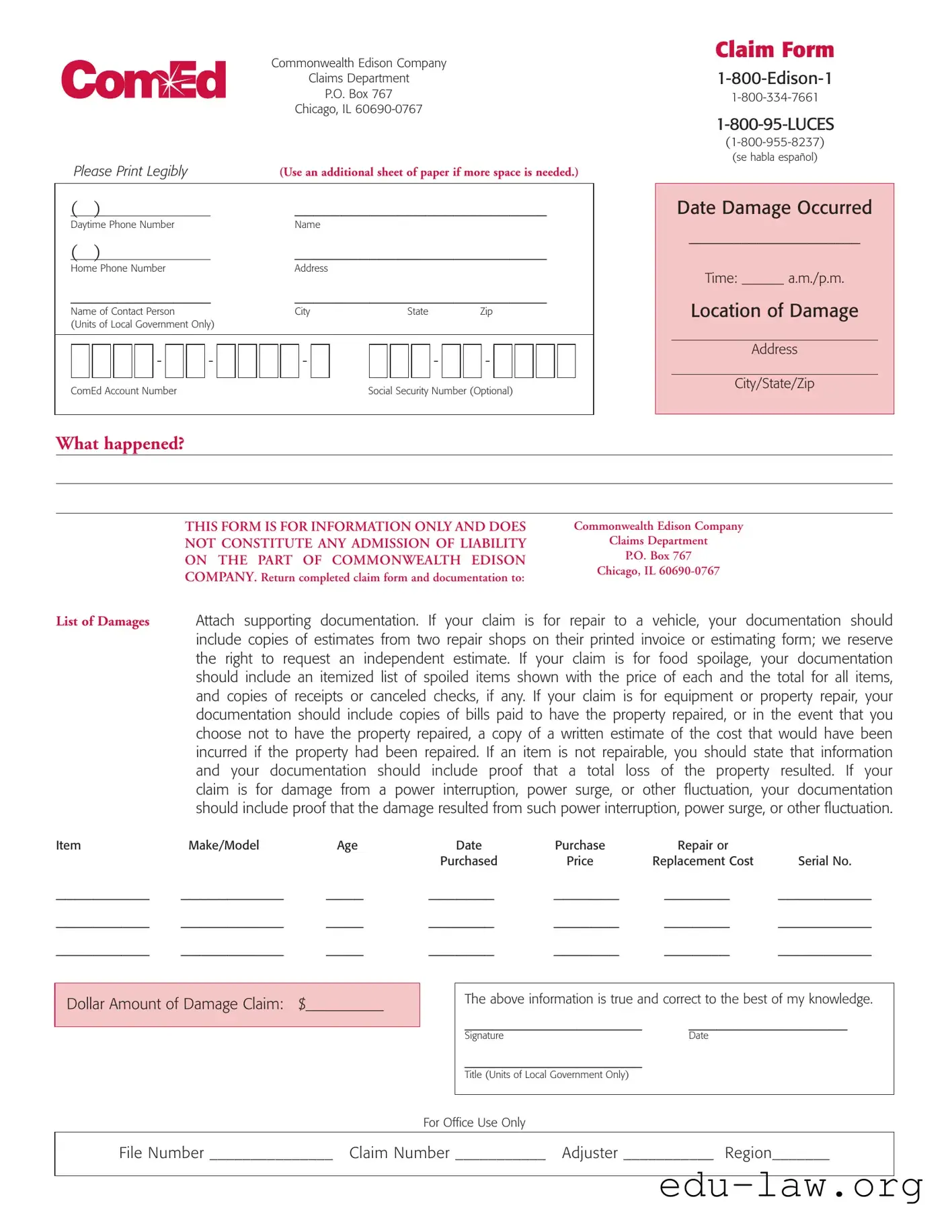
The ComEd 1800 form is an essential tool for customers of Commonwealth Edison Company seeking to file claims for various types of damages related to power interruptions or fluctuations. This form serves as a structured way to document incidents, ensuring that all necessary information is captured for a thorough investigation. Customers are prompted to provide details such as their contact information, the date and time of the damage occurrence, and a description of what happened. Additionally, the form requires documentation to substantiate the claim, which can include repair estimates, receipts, and itemized lists of damaged items. It is important to note that while this form initiates the claims process, it does not imply any admission of liability on the part of ComEd. The claims department will review submissions carefully, and customers may need to retain damaged items for inspection during the investigation. Understanding the requirements and structure of the ComEd 1800 form can help streamline the claims process and facilitate a quicker resolution for those affected by power-related issues.
|
|
|
|
Commonwealth Edison Company |
|
|
|
|
|
|
Claims Department |
|
|
|
|
|
|
P.O. Box 767 |
|
|
|
|
|
|
Chicago, IL |
|
|
|
Please Print Legibly |
(Use an additional sheet of paper if more space is needed.) |
||||
|
|
|
|
|
||
|
( |
) |
|
___________________________ |
||
|
Daytime Phone Number |
Name |
|
|
||
|
( |
) |
|
___________________________ |
||
|
Home Phone Number |
Address |
|
|
||
|
_______________ |
___________________________ |
||||
|
Name of Contact Person |
City |
State |
Zip |
||
(Units of Local Government Only)
|
|
|
|
- |
|
|
- |
|
|
|
|
- |
|
|
|
|
|
- |
|
|
- |
|
|
|
|
|
|
|
|
|
|
|
|
|
|
|
|
|
|
|
|
|
|
|
|
|
|
ComEd Account Number |
|
|
|
|
|
|
|
|
Social Security Number (Optional) |
|
|||||||||||||
What happened?
Claim Form
(se habla
Date Damage Occurred
____________________
Time: ______ a.m./p.m.
Location of Damage
Address
City/State/Zip
THIS FORM IS FOR INFORMATION ONLY AND DOES NOT CONSTITUTE ANY ADMISSION OF LIABILITY ON THE PART OF COMMONWEALTH EDISON COMPANY. Return completed claim form and documentation to:
Commonwealth Edison Company
Claims Department
P.O. Box 767
Chicago, IL
List of DamagesAttach supporting documentation. If your claim is for repair to a vehicle, your documentation should include copies of estimates from two repair shops on their printed invoice or estimating form; we reserve the right to request an independent estimate. If your claim is for food spoilage, your documentation should include an itemized list of spoiled items shown with the price of each and the total for all items, and copies of receipts or canceled checks, if any. If your claim is for equipment or property repair, your documentation should include copies of bills paid to have the property repaired, or in the event that you choose not to have the property repaired, a copy of a written estimate of the cost that would have been incurred if the property had been repaired. If an item is not repairable, you should state that information and your documentation should include proof that a total loss of the property resulted. If your claim is for damage from a power interruption, power surge, or other fluctuation, your documentation should include proof that the damage resulted from such power interruption, power surge, or other fluctuation.
ItemMake/ModelAge
__________ ___________ ____
__________ ___________ ____
__________ ___________ ____
Dollar Amount of Damage Claim: $__________
Date |
Purchase |
Repair or |
|
Purchased |
Price |
Replacement Cost |
Serial No. |
_______ |
_______ |
_______ |
__________ |
_______ |
_______ |
_______ |
__________ |
_______ |
_______ |
_______ |
__________ |
The above information is true and correct to the best of my knowledge.
___________________ _________________
SignatureDate
___________________
Title (Units of Local Government Only)
For Office Use Only
File Number _______________ Claim Number ___________ Adjuster ___________ Region_______

Dear ComEd Customer:
Please complete and return this form so we can investigate your claim*. THIS FORM IS FOR INFORMATION ONLY AND DOES NOT CONSTITUTE ANY ADMISSION OF LIABILITY ON THE PART OF COMMONWEALTH EDISON COMPANY. Be as accurate and complete as possible, and attach any documentation that you have to support your claim and the damage amount. If you need additional space, use a separate piece of paper. We will conduct an impartial investigation and render a decision as quickly as possible. Please note that our investigation may include field inspections to verify damages claimed and to obtain such other proof as required by the circumstances of the case. We may need to examine damaged items while conducting our investigation, so please do not dispose of them (except spoiled food) until we have authorized you to do so. We will notify you when we reach a decision on your claim. If you choose not to accept our proposed resolution of your claim, you may pursue a complaint with the Illinois Commerce Commission.
Damages resulting from storms, wind, ice, accidents beyond our control, vandalism, tree or wildlife contact, equipment failure, scheduled outages or normal operating procedures will not be reimbursed except possibly under Section
Section
Vehicle Damage. If your claim is for repair to a vehicle, your supporting documentation should include copies of estimates from two repair shops on their printed invoice or estimating form; we reserve the right to request an independent estimate.
Food Spoilage. If your claim is for food spoilage, your supporting documentation should include an itemized list of spoiled items shown with the price of each and total for all items, and copies of receipts or canceled checks, if any.
Equipment or Property Damage. If your claim is for equipment or property repair, your supporting documentation should include copies of bills paid to have the property repaired, or in the event that you choose not to have the property repaired, a copy of a written estimate of the cost that would have been incurred if the property had been repaired. If an item is not repairable, you should state that information and your supporting documentation should include proof that a total loss of the property resulted.
*Units of Local Government Only: To make a claim for reimbursement for emergency and contingency expenses under Section
When completed, return the ComEd copy and supporting documentation to:
Commonwealth Edison Company
Claims Department
P.O. Box 767
Chicago, IL
| Fact Name | Description |
|---|---|
| Purpose | The ComEd 1800 form is used to file claims for damages related to power interruptions or fluctuations caused by Commonwealth Edison Company. |
| Eligibility | Customers, including units of local government, can submit claims for actual damages or reimbursement for emergency expenses under specific conditions outlined in the Illinois Public Utilities Act. |
| Documentation Requirements | Claimants must attach supporting documentation, which varies based on the type of damage, such as repair estimates for vehicles or itemized lists for food spoilage. |
| Governing Law | This form is governed by Section 16-125(e) and (f) of the Illinois Public Utilities Act (220 ILCS 5/16-125(e) & (f)). |
| Submission Instructions | Completed forms and documentation should be sent to the ComEd Claims Department at P.O. Box 767, Chicago, IL 60690-0767. |
Completing the ComEd 1800 form is a crucial step in the claims process. By providing accurate and detailed information, you ensure that your claim is investigated thoroughly. After submitting the form, ComEd will review your claim and may conduct inspections to verify the damages. It is important to keep any damaged items until the investigation is complete, except for spoiled food.
What is the ComEd 1800 form used for?
The ComEd 1800 form is designed for customers to file claims related to damages caused by power interruptions, surges, or other fluctuations in service. This form allows you to document the incident, provide details about the damages, and submit supporting documentation to help ComEd investigate your claim.
How do I fill out the ComEd 1800 form?
To fill out the ComEd 1800 form, start by printing legibly. Provide your contact information, including daytime and home phone numbers. Describe what happened, including the date and time of the damage, and the location. You will also need to list the damages and attach any supporting documentation. If you need more space, feel free to use an additional sheet of paper.
What kind of documentation do I need to submit with my claim?
Documentation is crucial for supporting your claim. If your claim involves vehicle damage, include estimates from two repair shops. For food spoilage, provide an itemized list of spoiled items along with receipts. If you are claiming property damage, include bills from repairs or estimates for potential repairs. Make sure to gather all relevant documents to strengthen your case.
What happens after I submit the ComEd 1800 form?
Once you submit the form, ComEd will conduct an impartial investigation of your claim. This may include field inspections to verify the damages. They will notify you of their decision as soon as possible. It’s important to keep any damaged items until you receive authorization to dispose of them, except for spoiled food.
Can I file a claim for damages caused by a power outage?
Yes, you can file a claim for damages caused by a power outage, power surge, or other fluctuations. However, be aware that certain conditions apply. For example, claims may be considered under specific sections of the Illinois Public Utilities Act if the outage affected a large number of customers and met certain criteria. ComEd may not be liable for damages caused by circumstances beyond their control.
What if I disagree with ComEd's decision on my claim?
If you disagree with the resolution proposed by ComEd, you have the option to pursue a complaint with the Illinois Commerce Commission. They can help you address your concerns and ensure that your claim is reviewed fairly.
Is there a deadline for submitting the ComEd 1800 form?
While the specific deadline may vary, it is generally advisable to submit your claim as soon as possible after the incident occurs. Prompt submission helps ensure that your claim can be investigated and processed efficiently. Always check for any specific timelines mentioned in the instructions provided with the form.
Illegible handwriting: Filling out the form in a messy or hard-to-read way can cause delays. Make sure to print legibly.
Missing contact information: Forgetting to include a daytime or home phone number can hinder communication. Always provide at least one phone number.
Not including supporting documentation: Claims without the necessary proof, like receipts or estimates, may be rejected. Attach all relevant documents to support your claim.
Incorrect account information: Double-check your ComEd account number. An error here can lead to processing issues.
Leaving out the date and time: Not specifying when the damage occurred can create confusion. Always fill in the date and time accurately.
Not detailing the damage: Failing to clearly describe what happened can result in misunderstandings. Be as specific as possible about the nature of the damage.
Ignoring the itemized list requirement: If your claim involves spoiled food or damaged items, you need to provide a detailed list. Don’t skip this step.
Not signing and dating the form: Forgetting to sign and date can lead to delays. Ensure you complete this final step before submission.
When filing a claim with Commonwealth Edison Company using the ComEd 1800 form, there are several other forms and documents that may be necessary to support your claim. These documents help provide additional information and evidence related to the damages incurred. Below is a list of commonly used forms and documents that can accompany the ComEd 1800 form.
Gathering the necessary documentation can streamline the claims process and help ensure a fair evaluation of your situation. Always keep copies of all submitted forms and documents for your records.
The ComEd 1800 form is similar to a standard insurance claim form. Both documents serve the purpose of collecting information about damages incurred by an individual. They typically require personal details, a description of the incident, and supporting documentation to substantiate the claim. Insurance claim forms often include sections for policy numbers and specific types of coverage, which may not be present in the ComEd form. However, both forms aim to facilitate the claims process by gathering necessary information to evaluate the validity of the claim.
Another document similar to the ComEd 1800 form is a vehicle accident report form. This form is used to document details of an automobile accident, including the parties involved, damage to vehicles, and any injuries sustained. Like the ComEd form, it requires accurate information about the incident, including date, time, and location. Both forms also emphasize the importance of supporting documentation, such as photographs or police reports, to validate the claims being made.
A third comparable document is a property damage claim form used in landlord-tenant disputes. This form allows tenants to report damage to rental properties and request repairs or reimbursement. Similar to the ComEd form, it asks for detailed descriptions of the damage, the circumstances surrounding it, and any supporting evidence. Both documents aim to ensure that claims are processed fairly and efficiently, although the specific context of property damage claims may differ from utility-related claims.
The fourth document is a food spoilage claim form, often used in the context of homeowners' insurance. This form is designed for individuals to report losses due to spoiled food items, typically as a result of power outages. It requires an itemized list of spoiled items along with their purchase prices, mirroring the ComEd form's request for detailed documentation of damages. Both forms focus on the need for thorough evidence to support the claim being made.
A fifth document similar to the ComEd 1800 form is a business interruption claim form. Businesses use this form to report losses incurred due to disruptions in operations, such as power outages or natural disasters. Both forms require detailed information about the incident, including dates and descriptions of the impact on operations or property. They also emphasize the importance of providing supporting documentation to substantiate the claims being made.
The sixth document is a warranty claim form. When a product fails to meet the terms of its warranty, consumers can submit this form to request repairs or replacements. The information required is similar to that of the ComEd form, as it often includes details about the product, the nature of the defect, and supporting documentation like receipts. Both forms aim to facilitate the resolution of claims based on the specific circumstances surrounding the issue.
A seventh document is a flood damage claim form. Homeowners affected by flooding can use this form to request assistance or reimbursement for damages. Similar to the ComEd form, it requires information about the incident, a detailed list of damages, and supporting documentation. Both forms are structured to ensure that claims are handled efficiently and that necessary evidence is provided to support the claim.
The eighth document is a construction defect claim form. This form allows property owners to report issues related to construction work that did not meet standards. Both the construction defect claim form and the ComEd form require detailed descriptions of the issues, the circumstances leading to the claim, and supporting evidence. They share a common goal of ensuring that claims are properly documented and assessed.
Lastly, a ninth document that resembles the ComEd 1800 form is a theft claim form. Individuals who have experienced theft can use this form to report stolen items and seek reimbursement. Like the ComEd form, it requires personal information, a description of the incident, and documentation to support the claim. Both forms are designed to assist in the claims process by gathering necessary information for evaluation.
When filling out the ComEd 1800 form, it's essential to approach the process carefully to ensure your claim is processed smoothly. Here’s a list of things you should and shouldn’t do:
Understanding the ComEd 1800 form can be crucial for those seeking to file a claim for damages. However, several misconceptions often arise. Here are four common misunderstandings:
By understanding these misconceptions, claimants can better navigate the process and improve their chances of a successful outcome.
Filing a claim using the ComEd 1800 form can seem daunting, but understanding the process can make it easier. Here are some key takeaways to help you navigate the form effectively:
By keeping these points in mind, you can ensure that your claim is processed smoothly and efficiently. Good luck!