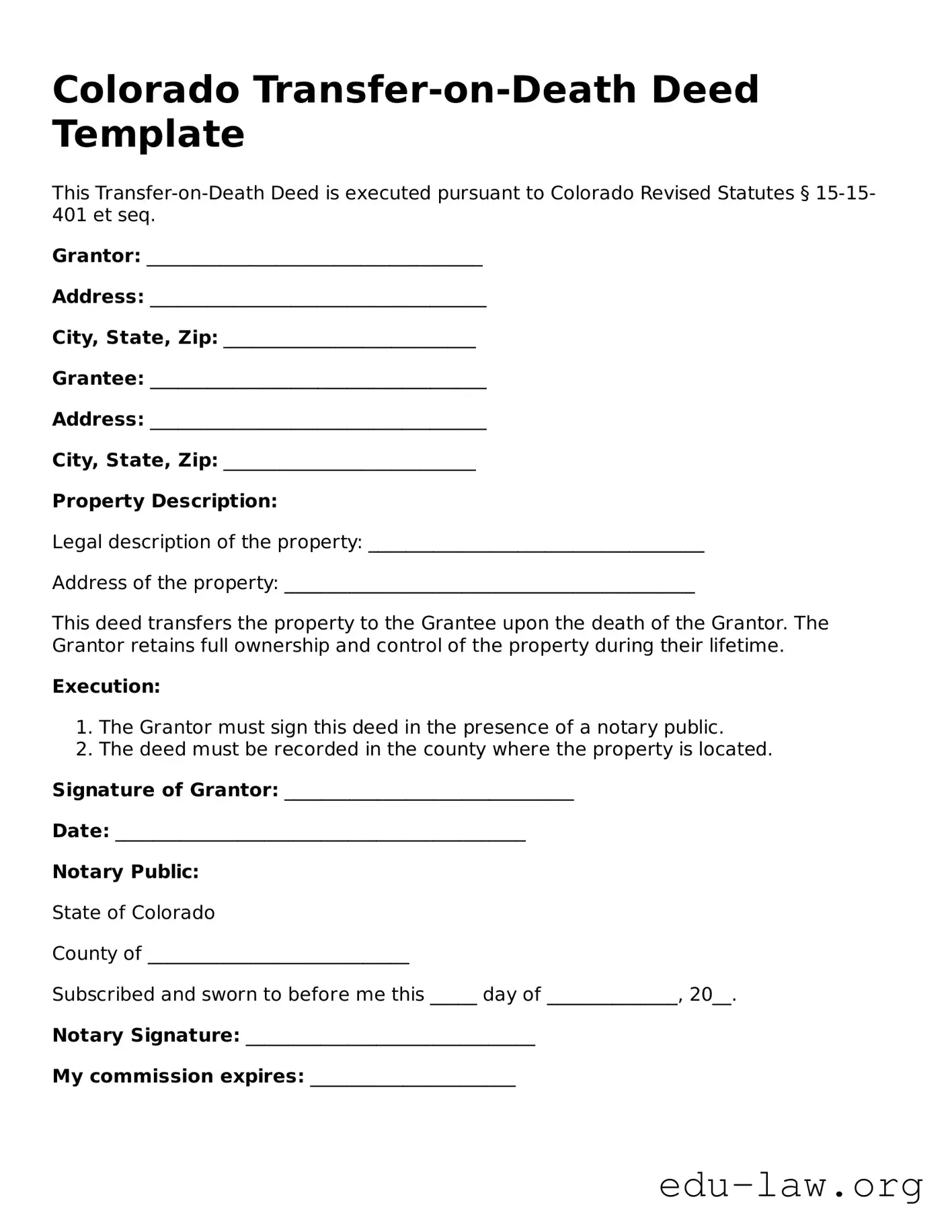
The Colorado Transfer-on-Death Deed (TOD) form offers a straightforward way for property owners to transfer their real estate to beneficiaries without the need for probate. This legal tool allows individuals to retain full control of their property during their lifetime while designating who will inherit it upon their death. The form requires specific information, including the property description and the names of the beneficiaries. Importantly, the TOD deed must be signed and recorded with the county clerk and recorder to be effective. This form not only simplifies the transfer process but also minimizes potential disputes among heirs. Understanding how to properly utilize the Transfer-on-Death Deed can provide peace of mind, ensuring that your wishes are honored and your loved ones are taken care of after you pass away.
Colorado Transfer-on-Death Deed Template
This Transfer-on-Death Deed is executed pursuant to Colorado Revised Statutes § 15-15-401 et seq.
Grantor: ____________________________________
Address: ____________________________________
City, State, Zip: ___________________________
Grantee: ____________________________________
Address: ____________________________________
City, State, Zip: ___________________________
Property Description:
Legal description of the property: ____________________________________
Address of the property: ____________________________________________
This deed transfers the property to the Grantee upon the death of the Grantor. The Grantor retains full ownership and control of the property during their lifetime.
Execution:
Signature of Grantor: _______________________________
Date: ____________________________________________
Notary Public:
State of Colorado
County of ____________________________
Subscribed and sworn to before me this _____ day of ______________, 20__.
Notary Signature: _______________________________
My commission expires: ______________________
| Fact Name | Details |
|---|---|
| Definition | A Transfer-on-Death (TOD) Deed allows property owners in Colorado to designate beneficiaries who will receive the property upon the owner's death, without going through probate. |
| Governing Law | The TOD Deed is governed by Colorado Revised Statutes, specifically Title 15, Article 15.5. |
| Eligibility | Any individual who owns real estate in Colorado can create a TOD Deed, provided they are of sound mind and at least 18 years old. |
| Revocation | A TOD Deed can be revoked at any time by the property owner. This can be done by executing a new deed or a formal revocation document. |
| Beneficiary Rights | Beneficiaries do not have rights to the property while the owner is alive. Their interest only vests upon the owner's death. |
| Filing Requirements | The TOD Deed must be signed by the property owner and recorded with the county clerk and recorder in the county where the property is located. |
| Tax Implications | Transferring property via a TOD Deed does not incur gift tax during the owner's lifetime, but it may have estate tax implications upon death. |
After completing the Colorado Transfer-on-Death Deed form, you will need to sign it in front of a notary public. Once notarized, the next step is to file the deed with the appropriate county clerk and recorder's office where the property is located. This ensures that the transfer becomes effective upon your death.
What is a Transfer-on-Death Deed in Colorado?
A Transfer-on-Death Deed (TOD Deed) is a legal document that allows a property owner in Colorado to designate one or more beneficiaries to receive their property upon their death. This deed does not transfer ownership during the owner's lifetime; rather, it ensures that the property passes directly to the named beneficiaries without going through probate. This can simplify the transfer process and may help avoid additional costs and delays associated with probate proceedings.
Who can create a Transfer-on-Death Deed?
Any individual who is the sole owner or a co-owner of real property in Colorado can create a Transfer-on-Death Deed. This includes homeowners and those who hold title to property. It is important to note that if there are multiple owners, all owners must agree to the terms outlined in the deed. Additionally, the property must be located in Colorado for the deed to be valid under state law.
How do I complete a Transfer-on-Death Deed?
To complete a Transfer-on-Death Deed, you will need to fill out the form with specific information, including the names of the beneficiaries, a legal description of the property, and your signature. It is crucial to ensure that the form is signed in front of a notary public to validate it. Once completed, the deed must be recorded with the county clerk and recorder’s office in the county where the property is located. This recording makes the deed effective and public.
Can I revoke a Transfer-on-Death Deed?
Yes, a Transfer-on-Death Deed can be revoked at any time before the property owner's death. To revoke the deed, the property owner must complete a revocation form and record it with the same county clerk and recorder’s office where the original deed was filed. It is advisable to inform the beneficiaries of the revocation to avoid any confusion in the future.
What happens if a beneficiary predeceases the property owner?
If a beneficiary named in the Transfer-on-Death Deed passes away before the property owner, the deed does not automatically transfer to the deceased beneficiary's heirs. Instead, that portion of the property will be divided among the remaining beneficiaries. It is wise to consider alternate beneficiaries in the deed to ensure a smooth transfer of ownership and to prevent complications in the future.
Incorrect Property Description: People often fail to provide a clear and accurate description of the property. This can lead to confusion and potential legal issues down the line.
Missing Signatures: The form requires signatures from all property owners. Omitting a signature can invalidate the deed, making it ineffective.
Not Notarizing the Document: A Transfer-on-Death Deed must be notarized to be legally binding. Failing to have it notarized can result in the deed being challenged.
Improperly Naming Beneficiaries: Listing beneficiaries without full names or using nicknames can create ambiguity. It is essential to use legal names to avoid disputes.
Filing the Deed Incorrectly: Some individuals do not file the deed with the appropriate county clerk’s office. This step is crucial for the deed to take effect upon the owner’s death.
Failing to Review State Laws: Not being aware of Colorado’s specific laws regarding Transfer-on-Death Deeds can lead to errors. Each state has its own regulations, and it's important to understand them.
Not Keeping Copies: After filling out and filing the deed, individuals often neglect to keep copies for their records. Having copies can be vital for future reference and for the beneficiaries.
The Colorado Transfer-on-Death Deed form allows property owners to designate beneficiaries who will receive the property upon their death, avoiding the probate process. However, several other forms and documents are often used in conjunction with this deed to ensure a smooth transfer of property and to address various legal aspects. Below is a list of related documents that may be necessary or beneficial.
Understanding these documents and their roles can help ensure that property transfers are executed smoothly and according to the owner's wishes. It is advisable to consult with a legal professional to navigate these forms effectively.
The Colorado Transfer-on-Death Deed (TODD) form shares similarities with a Living Trust. Both documents allow for the transfer of assets outside of probate, streamlining the process for beneficiaries. A Living Trust can hold various assets and provide detailed instructions on how they should be managed during the grantor's lifetime and distributed after death. Like the TODD, a Living Trust can be revoked or amended, giving the grantor flexibility as their circumstances change.
Another document comparable to the TODD is a Last Will and Testament. While a will dictates how assets are distributed after death, it must go through the probate process, which can be lengthy and costly. In contrast, the TODD allows property to pass directly to beneficiaries without probate, making it a more efficient option for transferring real estate. Both documents require careful consideration of beneficiaries and asset distribution, but the TODD simplifies the transfer of specific properties.
The Joint Tenancy with Right of Survivorship is also similar to the TODD. This arrangement allows two or more people to own property together, with the surviving owner automatically receiving the deceased owner’s share. Like the TODD, it bypasses probate, ensuring a smoother transition of ownership. However, unlike the TODD, joint tenancy automatically transfers ownership upon death, without the need for a separate document or process.
A Beneficiary Designation form is another document that aligns with the principles of the TODD. Commonly used for financial accounts and insurance policies, this form allows individuals to name beneficiaries who will receive the assets directly upon death. Just like the TODD, it avoids probate, ensuring a quicker transfer of assets. Both documents empower individuals to control the distribution of their property in a straightforward manner.
The Life Estate Deed is similar to the TODD in that it allows for the transfer of property while retaining certain rights during the grantor's lifetime. The grantor can live in the property or use it as they wish until death, at which point the property automatically transfers to the designated beneficiaries. This arrangement provides the grantor with security and control over the property while ensuring a smooth transition to heirs, much like the TODD.
The Family Limited Partnership (FLP) is another document that bears resemblance to the TODD. An FLP allows family members to pool their assets and manage them collectively while providing a mechanism for transferring ownership interests to heirs. This structure can help minimize estate taxes and avoid probate, similar to how the TODD facilitates the transfer of real estate. Both documents require careful planning to ensure that the family’s financial interests are protected.
A Revocable Living Trust also shares characteristics with the TODD. Both allow for the management and distribution of assets outside of probate. A Revocable Living Trust can cover a broader range of assets, including real estate, bank accounts, and investments. Like the TODD, it can be altered or revoked as circumstances change. This flexibility makes it a popular choice for individuals seeking to maintain control over their assets while planning for the future.
The Quitclaim Deed is another document that can be likened to the TODD. It allows an individual to transfer their interest in a property to another person without guaranteeing that the title is clear. While a quitclaim deed is often used to transfer property between family members or to clear up title issues, it does not provide the same level of protection or clarity as a TODD. The TODD ensures that the property will pass directly to the beneficiary upon death, while a quitclaim deed may not have the same assurances.
Lastly, the Power of Attorney (POA) can be considered similar to the TODD in that both documents allow for the management of assets. A POA grants someone the authority to make decisions on behalf of another person, which can include handling real estate transactions. While the TODD focuses on the transfer of property after death, the POA can be used during the grantor's lifetime. Both documents emphasize the importance of clear communication and planning in asset management.
When filling out the Colorado Transfer-on-Death Deed form, it is essential to adhere to certain guidelines to ensure the document is valid and effective. Below is a list of things you should and shouldn't do.
Understanding the Colorado Transfer-on-Death Deed form is essential for effective estate planning. However, several misconceptions can lead to confusion. Here are five common misunderstandings:
Clarifying these misconceptions can help individuals make informed decisions regarding their estate planning needs.
Understanding the Colorado Transfer-on-Death Deed form is essential for anyone looking to streamline the transfer of property upon death. Here are some key takeaways:
These points highlight the importance of understanding how the Transfer-on-Death Deed can simplify estate planning in Colorado.