When a loved one passes away, dealing with their estate can feel overwhelming, especially if the estate is small. In Colorado, the Small Estate Affidavit provides a streamlined way for heirs to claim property without the lengthy and often costly process of probate. This form is designed for estates valued at $66,000 or less, allowing heirs to transfer assets like bank accounts, vehicles, and personal property more efficiently. By completing the affidavit, individuals can affirm their right to inherit and simplify the distribution of the deceased's assets. It's important to understand the requirements for using this form, including who qualifies as an heir and what documentation is needed to support the claim. With the right information and guidance, navigating the process can be manageable, allowing families to focus on healing rather than getting bogged down in legal complexities.
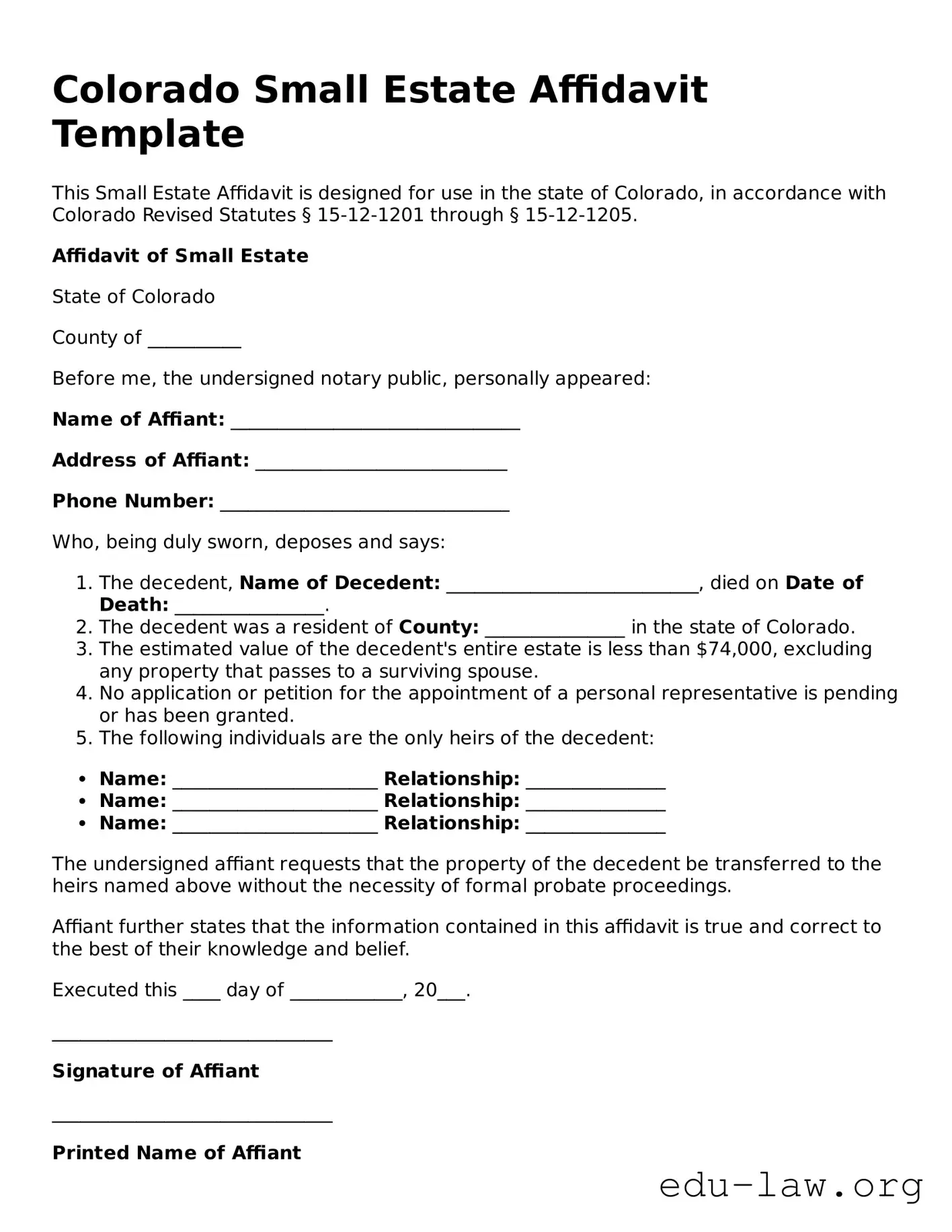
Colorado Small Estate Affidavit Template
This Small Estate Affidavit is designed for use in the state of Colorado, in accordance with Colorado Revised Statutes § 15-12-1201 through § 15-12-1205.
Affidavit of Small Estate
State of Colorado
County of __________
Before me, the undersigned notary public, personally appeared:
Name of Affiant: _______________________________
Address of Affiant: ___________________________
Phone Number: _______________________________
Who, being duly sworn, deposes and says:
The undersigned affiant requests that the property of the decedent be transferred to the heirs named above without the necessity of formal probate proceedings.
Affiant further states that the information contained in this affidavit is true and correct to the best of their knowledge and belief.
Executed this ____ day of ____________, 20___.
______________________________
Signature of Affiant
______________________________
Printed Name of Affiant
Notary Public:
______________________________
Signature of Notary
My commission expires: _______________
| Fact Name | Description |
|---|---|
| Purpose | The Colorado Small Estate Affidavit allows individuals to claim assets of a deceased person without going through formal probate. |
| Eligibility | This form is applicable when the total value of the estate is $66,000 or less, excluding certain assets. |
| Governing Law | The use of the Small Estate Affidavit is governed by Colorado Revised Statutes, Title 15, Article 12. |
| Filing Requirements | The affidavit must be signed by all heirs or beneficiaries entitled to the estate's assets. |
| Asset Types | Eligible assets include bank accounts, personal property, and vehicles, but not real estate. |
| Notarization | The affidavit must be notarized to ensure its validity and to confirm the identity of the signers. |
| Time Limit | There is no specific time limit to file the Small Estate Affidavit, but it is advisable to do so promptly after death. |
| Form Availability | The Colorado Small Estate Affidavit form can be obtained from county court websites or legal aid organizations. |
| Submission | The completed affidavit is typically presented to financial institutions or other asset holders to claim the assets. |
| Legal Advice | While the form is designed for self-use, consulting with an attorney is recommended for complex estates. |
Filling out the Colorado Small Estate Affidavit form is a straightforward process that allows individuals to claim assets of a deceased person without going through formal probate. Following these steps will help ensure that the affidavit is completed accurately and efficiently.
After completing the form and submitting it, you may need to follow up with the institutions holding the assets to ensure that the transfer is processed smoothly. Keep copies of all documents for your records.
What is a Small Estate Affidavit in Colorado?
A Small Estate Affidavit is a legal document that allows individuals to claim the assets of a deceased person without going through the formal probate process. In Colorado, this option is available when the total value of the estate is below a certain threshold, currently set at $74,000 for personal property and $1,000,000 for real property as of 2023.
Who can use a Small Estate Affidavit?
Any individual who is entitled to inherit from the deceased can use a Small Estate Affidavit. This typically includes heirs such as spouses, children, parents, or other relatives. However, it is important to ensure that the estate meets the value requirements for this process.
What assets can be claimed using a Small Estate Affidavit?
The Small Estate Affidavit can be used to claim personal property, such as bank accounts, vehicles, and personal belongings. Real estate can also be claimed, but only if the total value of the estate falls within the specified limits. It is essential to list all assets accurately in the affidavit.
How do I complete a Small Estate Affidavit?
To complete a Small Estate Affidavit, you must fill out the form with details about the deceased, the assets, and the heirs. You will also need to provide a statement confirming that the estate qualifies as a small estate. Once completed, the affidavit must be signed in front of a notary public.
Do I need to file the Small Estate Affidavit with the court?
No, you do not need to file the Small Estate Affidavit with the court. However, you may need to present it to financial institutions, banks, or other entities that hold the deceased's assets. They will use the affidavit to release the assets to you.
Are there any fees associated with using a Small Estate Affidavit?
There are generally no court fees for using a Small Estate Affidavit since it does not involve the probate court. However, you may incur costs for notarization and any necessary copies of the affidavit. Additionally, some financial institutions may have their own fees for processing the affidavit.
What happens if the estate exceeds the Small Estate limits?
If the estate's total value exceeds the limits for a Small Estate Affidavit, you will need to go through the formal probate process. This involves filing a petition with the probate court and may require legal assistance to navigate the complexities of probate law.
Can I use a Small Estate Affidavit if there is a will?
Yes, you can use a Small Estate Affidavit even if the deceased left a will. However, the will must not name an executor or require formal probate. If the will is valid and the estate is small enough, the affidavit can help expedite the transfer of assets to the heirs.
Incorrectly identifying the decedent. Ensure that the full name and date of death of the deceased are accurately provided. Missing or incorrect information can lead to delays.
Not listing all assets. All assets that fall under the small estate threshold must be included. Failing to mention any property can complicate the process.
Omitting debts and liabilities. It is important to disclose any outstanding debts of the decedent. This helps in providing a complete picture of the estate.
Not having the required signatures. Make sure that all necessary parties sign the affidavit. Missing signatures can invalidate the document.
Using outdated forms. Always use the most current version of the Small Estate Affidavit form. Outdated forms may not be accepted by the court.
Failing to notarize the affidavit. The affidavit must be notarized to be legally binding. Neglecting this step can result in the document being rejected.
Not following local filing procedures. Each county may have specific requirements for filing. Be sure to check local rules to ensure compliance.
Ignoring deadlines. Timeliness is crucial. Be aware of any deadlines related to the filing of the affidavit to avoid complications.
When handling the distribution of a deceased person's estate in Colorado, the Small Estate Affidavit is a valuable tool for simplifying the process. However, several other forms and documents may also be necessary to ensure the smooth transfer of assets. Below is a list of commonly used documents that often accompany the Colorado Small Estate Affidavit.
Collecting these documents can be crucial for ensuring that the estate is settled fairly and in accordance with the law. Each document plays a specific role in the process, helping to protect the rights of heirs and creditors alike.
The Colorado Small Estate Affidavit is similar to a Will, which outlines how a person's assets should be distributed after their death. While a Will requires formal probate proceedings, the Small Estate Affidavit allows for a simplified process when the estate's value falls below a certain threshold. This makes it easier for heirs to claim their inheritance without the lengthy and often costly probate process.
Another document that shares similarities is the Affidavit of Heirship. This affidavit is used to establish the rightful heirs of a deceased person, particularly when no Will exists. Like the Small Estate Affidavit, it simplifies the process of transferring assets by allowing heirs to present a sworn statement confirming their relationship to the deceased, thus avoiding probate delays.
The Transfer on Death Deed (TOD) is also comparable. This legal document allows property owners to designate beneficiaries who will automatically receive the property upon the owner's death. Similar to the Small Estate Affidavit, the TOD bypasses probate, providing a straightforward way to transfer assets directly to heirs without court intervention.
Living Trusts serve a similar purpose as well. A Living Trust allows individuals to place their assets into a trust during their lifetime, which can then be transferred to beneficiaries upon death without going through probate. This document provides a way to manage assets and streamline the transfer process, akin to the Small Estate Affidavit.
The Will Substitute is another related document. It is designed to transfer assets outside of probate, similar to how the Small Estate Affidavit functions. This substitute allows individuals to designate beneficiaries for specific assets, ensuring a quicker transfer process and reducing the burden on heirs.
Durable Power of Attorney is also relevant. While primarily used for making financial decisions on behalf of someone who is incapacitated, it can facilitate the management of an estate. If the principal passes away, the Durable Power of Attorney ceases, but it can simplify the handling of an estate while the individual is alive, much like the Small Estate Affidavit streamlines post-death asset distribution.
Joint Tenancy with Right of Survivorship is another document that shares characteristics with the Small Estate Affidavit. This arrangement allows two or more individuals to own property together, with the surviving owner automatically receiving the deceased owner's share. This transfer occurs outside of probate, similar to how the Small Estate Affidavit allows for the direct transfer of assets to heirs.
The Declaration of Trust is also akin to the Small Estate Affidavit. This document outlines how a trust operates and who the beneficiaries are. When a person passes away, the assets in the trust can be distributed according to the terms of the declaration, avoiding probate and providing a clear path for asset distribution, much like the Small Estate Affidavit.
Lastly, the Probate Waiver is a relevant document. It allows heirs to waive the right to probate proceedings, thereby simplifying the estate settlement process. This waiver can expedite the distribution of assets, similar to how the Small Estate Affidavit allows for a quicker transfer of assets without the need for formal probate.
When filling out the Colorado Small Estate Affidavit form, it's important to follow certain guidelines to ensure accuracy and compliance. Here are four things you should and shouldn't do:
The Colorado Small Estate Affidavit is a useful tool for settling the estates of individuals who have passed away. However, several misconceptions surround this form. Below is a list of common misunderstandings:
Understanding these misconceptions can help individuals navigate the process more effectively and ensure that they use the Small Estate Affidavit correctly.
Filling out and using the Colorado Small Estate Affidavit form can be a straightforward process for those managing small estates. Here are some key takeaways to keep in mind:
Understanding these points can facilitate a smoother experience when handling a small estate in Colorado.