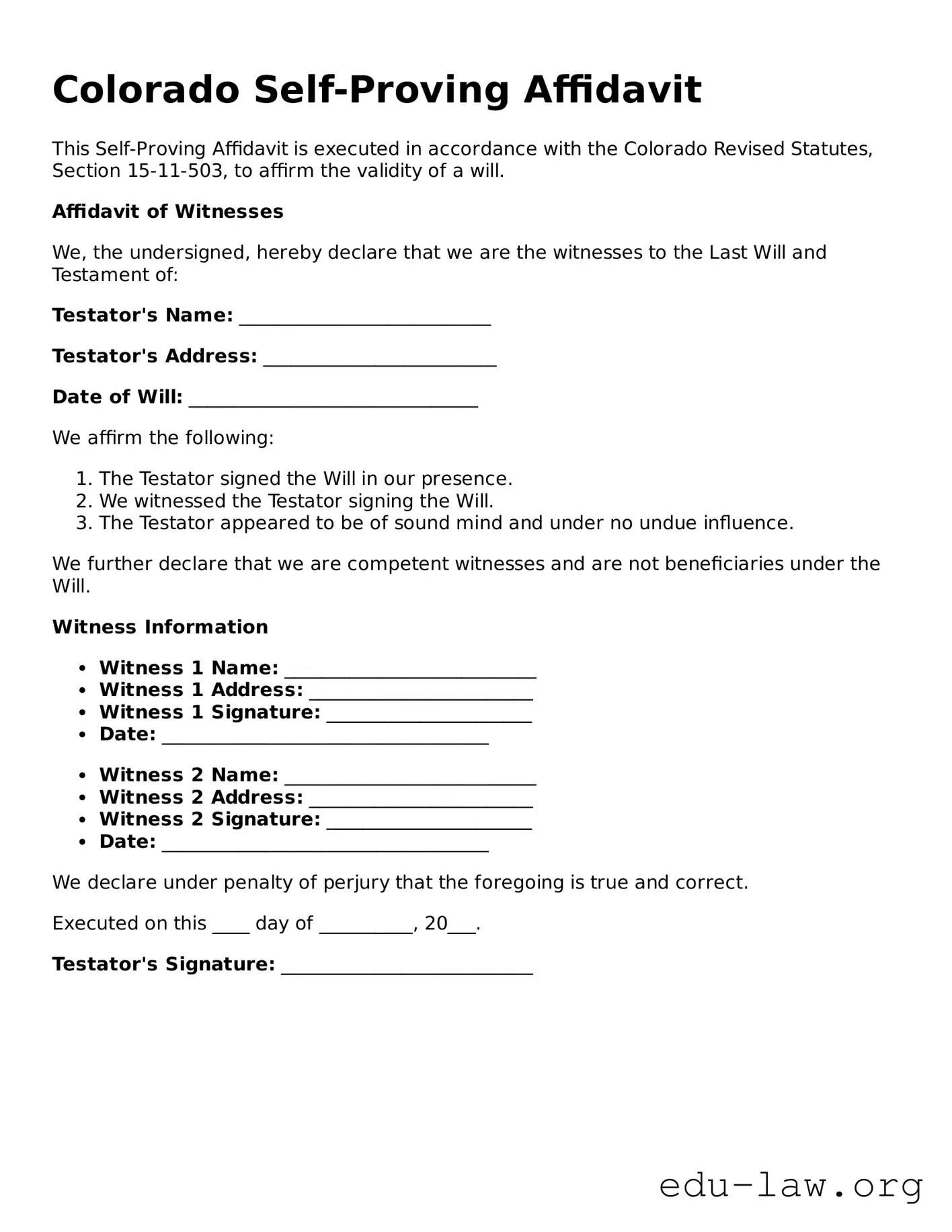
The Colorado Self-Proving Affidavit form plays a crucial role in the estate planning process, particularly in simplifying the probate procedure for individuals who have created a will. This form allows a testator—the person who makes the will—to affirm the validity of their will without requiring witnesses to testify in court after their death. By completing this affidavit, the testator, along with witnesses, can sign a document that confirms the will was executed properly, thereby streamlining the legal process for heirs and beneficiaries. The form typically includes essential information such as the names and addresses of the testator and witnesses, as well as statements affirming that the testator was of sound mind and not under duress when signing the will. Utilizing this form can significantly reduce complications during probate, making it a valuable tool for anyone looking to ensure their final wishes are honored efficiently and effectively.
Colorado Self-Proving Affidavit
This Self-Proving Affidavit is executed in accordance with the Colorado Revised Statutes, Section 15-11-503, to affirm the validity of a will.
Affidavit of Witnesses
We, the undersigned, hereby declare that we are the witnesses to the Last Will and Testament of:
Testator's Name: ___________________________
Testator's Address: _________________________
Date of Will: _______________________________
We affirm the following:
We further declare that we are competent witnesses and are not beneficiaries under the Will.
Witness Information
We declare under penalty of perjury that the foregoing is true and correct.
Executed on this ____ day of __________, 20___.
Testator's Signature: ___________________________
| Fact Name | Description |
|---|---|
| Purpose | The Colorado Self-Proving Affidavit is used to validate a will, allowing it to be accepted in probate without requiring witnesses to testify. |
| Governing Law | This form is governed by Colorado Revised Statutes, specifically C.R.S. § 15-11-503. |
| Signatories | The affidavit must be signed by the testator (the person making the will) and two witnesses. |
| Notarization | Although notarization is not required, it is recommended to enhance the document's credibility. |
| Format | The form should be in writing and can be attached to the will or created as a separate document. |
| Revocation | A self-proving affidavit can be revoked if the will is revoked, or if the testator changes their mind about the affidavit. |
| Legal Effect | Once executed, the self-proving affidavit allows the will to be probated without the need for the witnesses to appear in court. |
| Accessibility | The form can be accessed through various legal resources, including state government websites and legal aid organizations. |
Completing the Colorado Self-Proving Affidavit form is an important step in ensuring that your will is recognized and validated. After filling out this form, you will need to have it signed in the presence of a notary public, which adds an extra layer of authenticity to your document.
What is a Colorado Self-Proving Affidavit?
A Colorado Self-Proving Affidavit is a legal document that allows a will to be validated without requiring the witnesses to testify in court. This affidavit is typically signed by the testator (the person making the will) and the witnesses in the presence of a notary public, confirming that the will was executed properly and that the testator was of sound mind at the time of signing.
Why should I use a Self-Proving Affidavit?
Using a Self-Proving Affidavit can simplify the probate process. It eliminates the need for witnesses to appear in court to verify the will, which can save time and reduce potential disputes among heirs. By including this affidavit with your will, you provide a clear statement of its validity, making it easier for your executor to carry out your wishes.
How do I create a Self-Proving Affidavit in Colorado?
To create a Self-Proving Affidavit in Colorado, you need to ensure that the document is signed by you and your witnesses in front of a notary public. The affidavit should include specific language that confirms the authenticity of the will and the competency of the testator. It is advisable to consult with an attorney to ensure that the affidavit meets all legal requirements.
Is a Self-Proving Affidavit required in Colorado?
No, a Self-Proving Affidavit is not required in Colorado, but it is highly recommended. While a will can still be probated without it, having this affidavit can streamline the process and reduce complications. If a will does not include a Self-Proving Affidavit, witnesses may need to be called to testify, which can delay the probate proceedings.
Can I revoke a Self-Proving Affidavit?
Yes, you can revoke a Self-Proving Affidavit. If you decide to change your will or create a new one, the previous affidavit becomes void. It is important to properly execute a new will and, if necessary, a new Self-Proving Affidavit to reflect your current wishes. Always ensure that any changes are documented correctly to avoid confusion later.
What happens if my Self-Proving Affidavit is not properly executed?
If a Self-Proving Affidavit is not properly executed, it may not hold up in probate court. This could lead to complications, including the need for witnesses to testify about the will's validity. To avoid this scenario, it is crucial to follow all legal requirements when creating the affidavit, including proper notarization and signatures from all parties involved.
Can I use a Self-Proving Affidavit from another state in Colorado?
Generally, a Self-Proving Affidavit from another state may not be valid in Colorado unless it meets Colorado’s legal requirements. Each state has its own laws regarding wills and affidavits, so it is advisable to create a new Self-Proving Affidavit that complies with Colorado law to ensure its acceptance during probate.
Where can I find a Self-Proving Affidavit form for Colorado?
Self-Proving Affidavit forms can be found through various legal resources, including online legal service providers, law firms, and state government websites. It is recommended to use a form that is specifically designed for Colorado to ensure that it meets all necessary legal standards. Consulting with an attorney can also help you obtain a valid form tailored to your needs.
Not including all required signatures. The affidavit must be signed by the testator and witnesses. Missing any signature can invalidate the document.
Failing to provide accurate information. Ensure that names, dates, and other details are correct. Any inaccuracies can lead to complications in the future.
Using incorrect witness qualifications. Witnesses must meet specific criteria. If they do not, the affidavit may not hold up in court.
Not having the affidavit notarized. In Colorado, notarization is often required to validate the affidavit. Without it, the document may be challenged.
Overlooking state-specific requirements. Each state has its own rules for self-proving affidavits. Familiarize yourself with Colorado's regulations to avoid issues.
The Colorado Self-Proving Affidavit is a valuable document that helps streamline the probate process by allowing a will to be validated without the need for witnesses to testify in court. Along with this affidavit, there are several other forms and documents that are commonly utilized in estate planning and administration. Here is a list of related documents that may be beneficial to have on hand.
Having these documents prepared and organized can greatly facilitate the management of an estate, ensuring that wishes are honored and legal requirements are met. Each form plays a specific role in the estate planning process, and understanding their purpose can help individuals make informed decisions about their future and that of their loved ones.
The Colorado Self-Proving Affidavit is similar to the Affidavit of Execution. This document serves to verify that a will was executed in accordance with state laws. It typically includes statements from witnesses who can confirm that the testator signed the will in their presence. Like the Self-Proving Affidavit, the Affidavit of Execution aims to streamline the probate process by providing evidence of the will's validity without requiring witnesses to appear in court.
Another document that shares similarities is the Self-Attesting Will. This type of will includes a declaration at the end that the testator signed it in the presence of witnesses. The key similarity lies in the intent to simplify the probate process. Both documents help affirm the authenticity of the will and reduce the burden of proving its validity during probate proceedings.
The Affidavit of Witnesses is also comparable. This document allows witnesses to provide sworn statements about the execution of a will. It serves a similar purpose as the Self-Proving Affidavit by offering credible evidence that the will was executed properly. Both documents aim to eliminate potential disputes regarding the will's authenticity, thereby facilitating a smoother probate process.
Additionally, the Living Trust Certification is relevant. While a living trust is a different estate planning tool, the certification serves to verify the existence and terms of the trust. Like the Self-Proving Affidavit, it provides a means to confirm the intentions of the grantor without the need for extensive court involvement. Both documents contribute to clear and efficient estate management.
The Durable Power of Attorney can also be considered similar in function. This document allows an individual to appoint someone else to make decisions on their behalf. Although it primarily focuses on decision-making authority rather than testamentary intent, both documents require formal execution and can help avoid disputes regarding the individual's wishes. They serve to clarify intentions and reduce the need for court intervention.
The Medical Power of Attorney shares characteristics with the Self-Proving Affidavit as well. This document designates someone to make healthcare decisions for an individual in case they become incapacitated. Both documents require clear execution and can help ensure that a person's wishes are respected, thus minimizing potential conflicts among family members or caregivers.
Lastly, the Affidavit of Heirship is akin to the Self-Proving Affidavit in that it provides proof of a person's familial relationships after their death. This document is often used when a decedent did not leave behind a will. It helps establish who the rightful heirs are, similar to how the Self-Proving Affidavit helps confirm the validity of a will. Both documents serve to clarify the intentions of the deceased and facilitate the distribution of their estate.
When filling out the Colorado Self-Proving Affidavit form, it’s important to be thorough and accurate. Here’s a handy list of things to do and avoid to ensure the process goes smoothly.
By following these guidelines, you can navigate the Self-Proving Affidavit process with confidence. Remember, attention to detail is key!
There are several misconceptions surrounding the Colorado Self-Proving Affidavit form. Understanding these can help clarify its purpose and use. Below is a list of common misconceptions:
Clarifying these misconceptions can help individuals better understand the role of the Colorado Self-Proving Affidavit in estate planning.
Filling out and utilizing the Colorado Self-Proving Affidavit form can be a straightforward process, but it is essential to understand its significance. Here are some key takeaways to keep in mind: