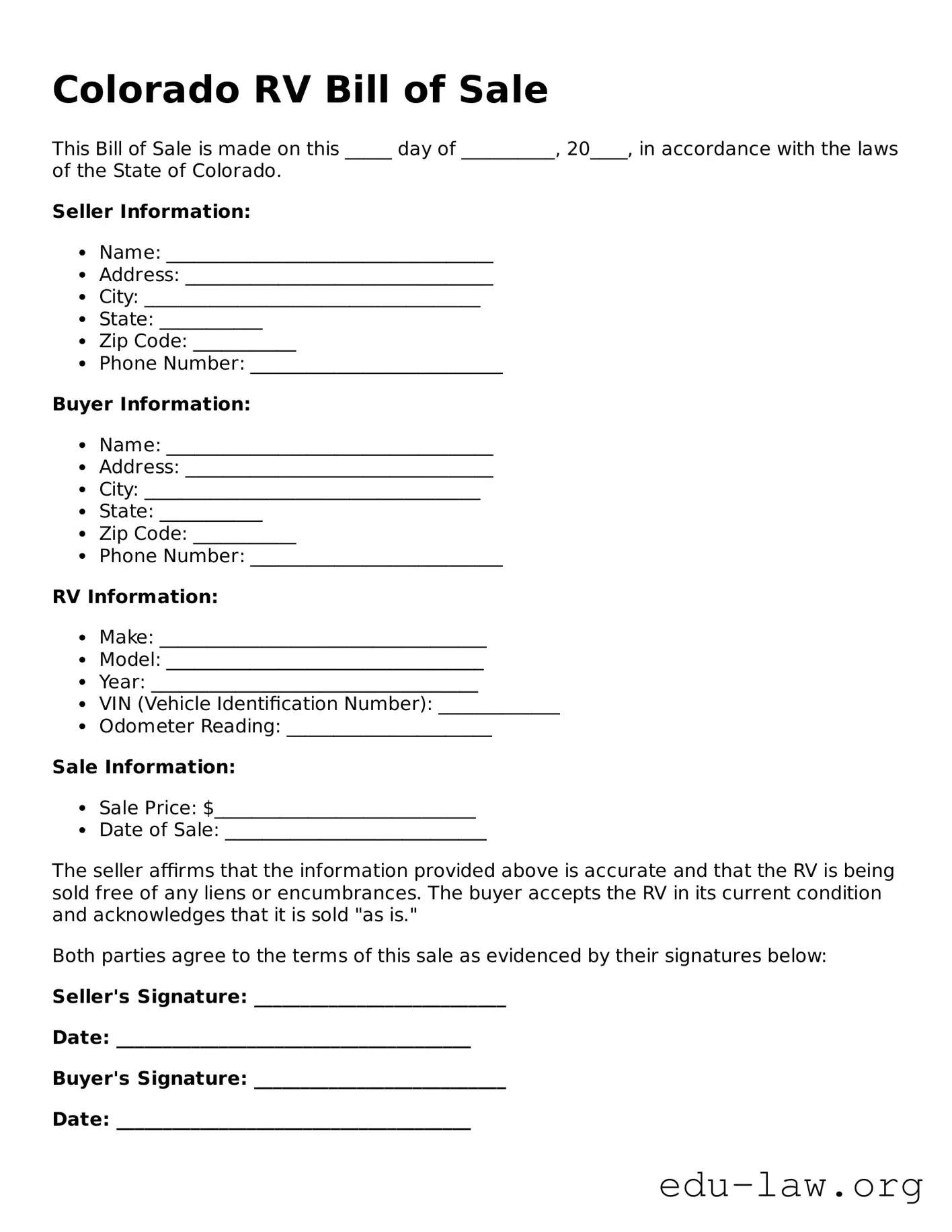
When purchasing or selling a recreational vehicle (RV) in Colorado, a Bill of Sale serves as an essential document to facilitate the transaction. This form not only provides proof of ownership but also details important information about the RV, such as its make, model, year, and Vehicle Identification Number (VIN). Both the buyer and seller must sign the document to validate the sale, ensuring that both parties agree to the terms outlined. Additionally, the Bill of Sale may include the sale price, date of the transaction, and any warranties or representations made by the seller. This document helps protect both parties by documenting the transfer of ownership and can be crucial in resolving any disputes that may arise later. Understanding the components of the Colorado RV Bill of Sale is vital for anyone involved in such transactions, as it lays the groundwork for a smooth and legally sound exchange.
Colorado RV Bill of Sale
This Bill of Sale is made on this _____ day of __________, 20____, in accordance with the laws of the State of Colorado.
Seller Information:
Buyer Information:
RV Information:
Sale Information:
The seller affirms that the information provided above is accurate and that the RV is being sold free of any liens or encumbrances. The buyer accepts the RV in its current condition and acknowledges that it is sold "as is."
Both parties agree to the terms of this sale as evidenced by their signatures below:
Seller's Signature: ___________________________
Date: ______________________________________
Buyer's Signature: ___________________________
Date: ______________________________________
| Fact Name | Description |
|---|---|
| Purpose | The Colorado RV Bill of Sale form is used to document the sale and transfer of ownership of a recreational vehicle in Colorado. |
| Requirements | The form requires the seller's and buyer's names, addresses, and signatures, along with the vehicle's details such as make, model, year, and VIN. |
| Governing Law | This form is governed by Colorado state law, specifically under the Colorado Revised Statutes regarding the sale of vehicles. |
| Notarization | Notarization is not required for the Colorado RV Bill of Sale, but it may be recommended for added security in the transaction. |
| Record Keeping | Both the buyer and seller should retain a copy of the completed form for their records, as it serves as proof of the transaction. |
Once you have the Colorado RV Bill of Sale form, you can begin filling it out. This document will help you complete the transaction of buying or selling a recreational vehicle in Colorado. Follow these steps to ensure all necessary information is included.
What is a Colorado RV Bill of Sale?
A Colorado RV Bill of Sale is a legal document that records the sale of a recreational vehicle (RV) between a seller and a buyer. This form serves as proof of the transaction, detailing essential information such as the names and addresses of both parties, the RV's make, model, year, and vehicle identification number (VIN). It is an important document for both the seller and buyer, ensuring a clear transfer of ownership.
Why do I need a Bill of Sale for my RV?
The Bill of Sale is crucial for several reasons. First, it protects both the seller and buyer by providing a written record of the transaction. This can be helpful in case of disputes or misunderstandings in the future. Second, it is often required when registering the RV with the Colorado Department of Revenue. Having this document can make the registration process smoother and ensure you comply with state regulations.
Is the Bill of Sale required to register my RV in Colorado?
Yes, in Colorado, a Bill of Sale is typically required when registering an RV. When you go to the Department of Motor Vehicles (DMV) to register your vehicle, you will need to present the Bill of Sale along with other documents, such as proof of insurance and identification. This helps verify the transfer of ownership and ensures that the registration reflects the current owner.
Can I create my own Bill of Sale for my RV?
Yes, you can create your own Bill of Sale for your RV. However, it is essential to include all necessary information to make it valid. This includes the names and addresses of both the buyer and seller, details about the RV, and the sale price. While templates are available online, ensure that your document complies with Colorado's requirements to avoid any issues during registration.
What should I do after completing the Bill of Sale?
After completing the Bill of Sale, both the seller and buyer should keep a signed copy for their records. The seller should also notify the DMV of the sale to protect themselves from any future liabilities associated with the RV. The buyer should take the signed Bill of Sale to the DMV when registering the RV to ensure a smooth transition of ownership.
Failing to include all necessary information about the RV. This includes the make, model, year, and Vehicle Identification Number (VIN).
Not providing accurate odometer readings. It is essential to record the correct mileage at the time of sale.
Omitting the seller's and buyer's contact information. Full names, addresses, and phone numbers should be clearly stated.
Forgetting to sign the document. Both the seller and buyer must provide their signatures to validate the transaction.
Not including the sale date. The date of the transaction is crucial for record-keeping purposes.
Using incorrect or outdated forms. Always ensure that the most current version of the Colorado RV Bill of Sale is being used.
Neglecting to check for any liens on the RV. A lien can affect ownership and should be disclosed in the sale.
Failing to keep a copy of the completed Bill of Sale. Both parties should retain a copy for their records.
When buying or selling an RV in Colorado, having the proper documentation is essential to ensure a smooth transaction. Along with the RV Bill of Sale, several other forms and documents may be required to complete the process. Here are five important documents often used in conjunction with the RV Bill of Sale:
Having these documents in order will facilitate a smoother transaction and help avoid potential disputes in the future. It's always advisable to check with local authorities for any additional requirements specific to your situation.
The Colorado Vehicle Bill of Sale is similar to the general Bill of Sale, which is used for various types of personal property transactions. This document serves as proof that a sale has taken place between a buyer and a seller. Just like the RV Bill of Sale, it includes essential details such as the names of both parties, a description of the item being sold, and the sale price. This helps protect both the buyer and seller by providing a record of the transaction.
Another document similar to the RV Bill of Sale is the Motorcycle Bill of Sale. This form is specifically designed for the sale of motorcycles. It captures similar information, including the buyer and seller’s details, the motorcycle's make, model, and VIN. Both documents ensure that ownership is transferred legally and that the transaction is documented for future reference.
The Boat Bill of Sale is yet another document akin to the RV Bill of Sale. It functions in much the same way, documenting the sale of a boat. This form includes details such as the boat's hull identification number, make, and model, along with the buyer and seller's information. Like the RV Bill of Sale, it serves as a legal record of the transaction, which can be important for registration and insurance purposes.
The Trailer Bill of Sale is also comparable to the RV Bill of Sale. It is used when selling a trailer, whether it's a utility trailer, camper, or any other type. This document captures the necessary details to ensure a smooth transfer of ownership, including the trailer's VIN and description. Both documents help to clarify the terms of the sale and provide proof of ownership.
In addition, the Car Bill of Sale shares similarities with the RV Bill of Sale. This document is specifically for the sale of cars and contains crucial information like the vehicle's make, model, year, and VIN. Both forms protect the interests of the buyer and seller by documenting the sale and providing evidence of ownership transfer.
The ATV Bill of Sale is another document that resembles the RV Bill of Sale. It is used for the sale of all-terrain vehicles and includes similar information, such as the ATV's make, model, and VIN. Both documents serve the same purpose: to provide a legal record of the sale and protect both parties involved in the transaction.
The Snowmobile Bill of Sale is similar as well, specifically for snowmobiles. It captures the details of the transaction, including the snowmobile's identification number and description. Like the RV Bill of Sale, it serves as proof of the sale and helps facilitate the transfer of ownership.
The Mobile Home Bill of Sale is another document that bears resemblance to the RV Bill of Sale. It is used for the sale of mobile homes and includes essential information like the home’s serial number and the names of the buyer and seller. Both documents ensure that the transaction is documented legally, protecting the rights of both parties.
Lastly, the Lease Agreement can be compared to the RV Bill of Sale in the context of rental transactions. While a Bill of Sale documents a sale, a Lease Agreement outlines the terms of renting a property or vehicle. Both documents are vital for defining the relationship between the parties involved, ensuring clarity and legal protection.
When filling out the Colorado RV Bill of Sale form, it’s essential to be thorough and accurate. Here’s a list of things you should and shouldn’t do to ensure a smooth transaction.
Following these guidelines can help facilitate a successful and legally binding sale. Always approach the process with care and attention to detail.
When dealing with the Colorado RV Bill of Sale form, several misconceptions can arise. Understanding these can help ensure a smoother transaction process. Here are six common misconceptions:
By clearing up these misconceptions, individuals can navigate the process of buying or selling an RV in Colorado with greater confidence.
When dealing with the Colorado RV Bill of Sale form, there are several important points to keep in mind. Understanding these can help ensure a smooth transaction.
By following these guidelines, you can ensure that the RV sale process is efficient and legally sound.