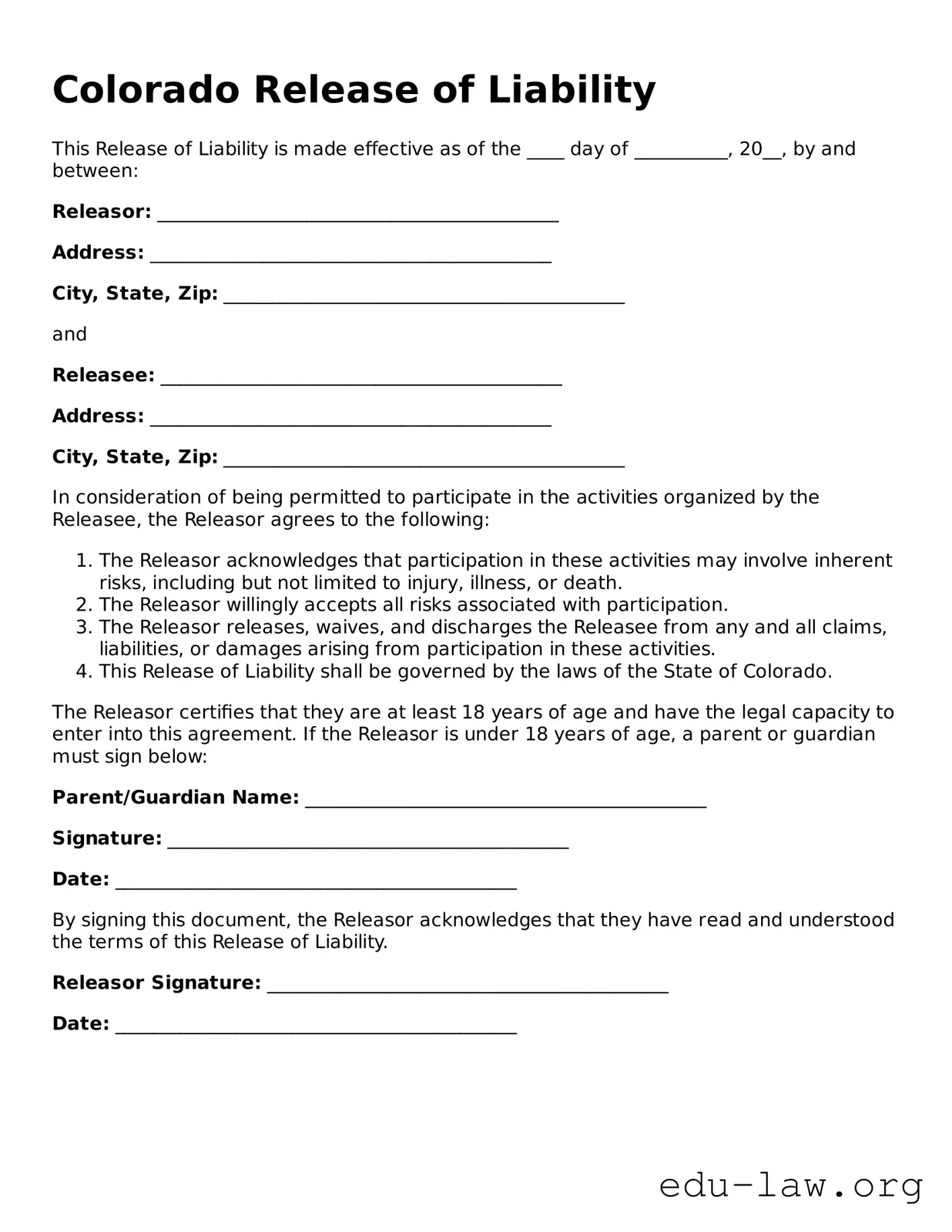
The Colorado Release of Liability form serves as a crucial document for individuals and organizations seeking to mitigate their risk when engaging in potentially hazardous activities. This form is designed to protect service providers, event organizers, and recreational facilities from legal claims arising from injuries or damages that participants may experience. By signing this document, participants acknowledge the inherent risks associated with the activity and agree to relinquish their right to sue for negligence or other claims that may arise during the course of participation. It typically outlines the specific activities covered, the responsibilities of both parties, and any limitations on liability. Additionally, the form often requires participants to affirm their understanding of the risks involved and may include provisions for minors, necessitating parental consent. As such, the Release of Liability form is not merely a protective measure; it serves as a clear communication tool that fosters transparency between providers and participants, ensuring that all parties are aware of their rights and responsibilities before engaging in potentially risky endeavors.
Colorado Release of Liability
This Release of Liability is made effective as of the ____ day of __________, 20__, by and between:
Releasor: ___________________________________________
Address: ___________________________________________
City, State, Zip: ___________________________________________
and
Releasee: ___________________________________________
Address: ___________________________________________
City, State, Zip: ___________________________________________
In consideration of being permitted to participate in the activities organized by the Releasee, the Releasor agrees to the following:
The Releasor certifies that they are at least 18 years of age and have the legal capacity to enter into this agreement. If the Releasor is under 18 years of age, a parent or guardian must sign below:
Parent/Guardian Name: ___________________________________________
Signature: ___________________________________________
Date: ___________________________________________
By signing this document, the Releasor acknowledges that they have read and understood the terms of this Release of Liability.
Releasor Signature: ___________________________________________
Date: ___________________________________________
| Fact Name | Description |
|---|---|
| Purpose | The Colorado Release of Liability form is designed to protect businesses and individuals from legal claims arising from injuries or damages that may occur during activities or events. |
| Governing Law | This form is governed by Colorado state law, particularly under the principles of tort law and liability waivers. |
| Voluntary Agreement | Participants must voluntarily sign the form, indicating their understanding and acceptance of the risks involved. |
| Scope of Release | The release typically covers various types of risks, including those related to physical injury, property damage, and even wrongful death. |
| Minors | For minors, a parent or guardian must sign the form, ensuring that the minor is also protected under the release. |
| Enforceability | While the form can provide protection, its enforceability may be challenged in court, especially if deemed unconscionable or if gross negligence is involved. |
| Importance of Clarity | Clear language is crucial in the form to ensure that participants fully understand what they are waiving, helping to prevent future disputes. |
After obtaining the Colorado Release of Liability form, you will need to complete it accurately to ensure it is valid. Follow the steps below to fill out the form correctly.
Once completed, ensure that you keep a copy for your records and submit the original as required.
What is a Colorado Release of Liability form?
The Colorado Release of Liability form is a legal document that individuals use to waive their right to sue for injuries or damages that may occur during a specific activity. This form is commonly utilized in recreational activities, sports, and events where there is a risk of injury.
Why is a Release of Liability important?
This form serves to protect organizations and individuals from legal claims. By signing the release, participants acknowledge the risks involved and agree not to hold the organizers liable for any injuries sustained during the activity.
Who should use a Release of Liability form?
Any individual or organization that conducts activities with inherent risks can benefit from using a Release of Liability form. This includes sports teams, event organizers, outdoor adventure companies, and recreational facilities.
What information is typically included in the form?
A Colorado Release of Liability form usually includes the participant's name, a description of the activity, acknowledgment of risks, and a statement releasing the organizers from liability. It may also require the participant's signature and date.
Is the Release of Liability form legally binding?
Yes, when properly executed, a Release of Liability form is generally considered legally binding. However, its enforceability can depend on various factors, such as clarity of language and the specific circumstances surrounding the activity.
Can minors sign a Release of Liability?
Minors cannot legally sign a Release of Liability form on their own. Instead, a parent or legal guardian must sign the form on behalf of the minor to ensure that the release is valid.
How can one ensure the Release of Liability is enforceable?
To enhance enforceability, the form should be clear and specific about the risks involved. It should also be signed voluntarily, without coercion, and participants should have the opportunity to ask questions before signing.
What are the potential limitations of a Release of Liability?
While a Release of Liability can limit legal claims, it may not protect against gross negligence or intentional misconduct. Courts may not enforce releases that are deemed unconscionable or overly broad.
Can a Release of Liability be revoked?
Once signed, a Release of Liability generally cannot be revoked. However, participants can choose not to participate in the activity if they change their mind after signing.
Where can one obtain a Colorado Release of Liability form?
Colorado Release of Liability forms can often be obtained from legal websites, recreational organizations, or by consulting with an attorney. It is essential to ensure that the form meets state requirements and is tailored to the specific activity.
Failing to read the form carefully. Many individuals overlook important details that could affect their rights.
Not providing complete information. Leaving out essential details, such as names or dates, can lead to complications later.
Using unclear language. Ambiguity in the wording can create misunderstandings regarding the intent of the release.
Not understanding the implications of signing. People often do not realize that signing a release may waive their right to sue.
Failing to date the form. A missing date can lead to questions about when the release was executed.
Not including witnesses or notarization when required. Some situations may necessitate additional verification to ensure the release is valid.
Signing without asking questions. If there are uncertainties, it is crucial to seek clarification before signing.
Assuming the form applies universally. Each release is specific to its context; assuming otherwise can lead to misunderstandings.
The Colorado Release of Liability form is often used in various situations to protect individuals and organizations from legal claims. However, it is frequently accompanied by other documents that serve complementary purposes. Here are four commonly used forms and documents that may be relevant.
Using these documents in conjunction with the Colorado Release of Liability form can provide a more comprehensive legal framework. Each form plays a vital role in clarifying responsibilities and protecting all parties involved.
The Colorado Release of Liability form shares similarities with the Waiver of Liability. Both documents serve to protect organizations and individuals from legal claims related to injuries or damages that may occur during activities. A Waiver of Liability typically requires participants to acknowledge the risks involved and agree not to hold the provider responsible for any injuries sustained. This mutual understanding helps to clarify responsibilities and expectations between parties.
Another document akin to the Colorado Release of Liability is the Indemnity Agreement. An Indemnity Agreement focuses on the transfer of risk from one party to another. In this case, one party agrees to compensate the other for any losses or damages that may arise from specific actions or events. Like the Release of Liability, it aims to minimize legal exposure and ensure that parties understand their obligations regarding potential claims.
The Participant Agreement is also similar in nature. This document outlines the terms and conditions under which an individual agrees to participate in an activity or event. It often includes clauses that limit liability, similar to the Colorado Release of Liability. By signing a Participant Agreement, individuals acknowledge the risks involved and agree to abide by the rules set forth by the organizing entity.
The Consent to Treat form is another related document. While it primarily addresses medical treatment, it often includes a liability waiver component. Participants grant permission for medical care in case of an emergency and acknowledge that they cannot hold the healthcare provider liable for any complications that may arise. This aspect mirrors the protective intent of the Release of Liability by managing expectations regarding health and safety.
The Hold Harmless Agreement is also comparable. This document protects one party from being held liable for any claims or damages resulting from the actions of another party. By signing a Hold Harmless Agreement, individuals or organizations agree to take responsibility for any legal repercussions that may arise, similar to the provisions found in the Colorado Release of Liability.
Lastly, the Acknowledgment of Risk form is closely related. This document is designed to inform participants about the inherent risks associated with specific activities. By signing, individuals acknowledge their understanding of these risks and agree not to hold the organization liable for any resulting injuries. This proactive approach to risk management aligns with the objectives of the Colorado Release of Liability, ensuring that all parties are aware of and accept the potential dangers involved.
When filling out the Colorado Release of Liability form, it is important to be careful and thorough. Below are some guidelines to follow, as well as common pitfalls to avoid.
Things You Should Do:
Things You Shouldn't Do:
Understanding the Colorado Release of Liability form is crucial for anyone involved in activities that carry risk. However, several misconceptions can lead to confusion. Here are seven common misconceptions:
Many people believe that signing this form means the organization is free from any liability. However, it does not protect against negligence or intentional harm.
Some think this form is only necessary for high-risk activities like skydiving or rock climbing. In reality, it can apply to a wide range of activities, including recreational events and community sports.
Parents or guardians can sign the form on behalf of minors. This is often necessary for youth activities to ensure safety and understanding of risks.
While notarization can add an extra layer of authenticity, it is not a requirement for the form to be legally binding in Colorado.
Individuals can still contest the form's validity in court, especially if they can prove that the terms were not clear or that they were misled.
The form typically outlines specific risks associated with an activity. It does not cover unforeseen events or risks that are not explicitly mentioned.
This form does not provide insurance coverage. It merely outlines the risks and limits liability for the organization. Participants should still consider obtaining their own insurance.
Being aware of these misconceptions can help individuals make informed decisions and understand their rights and responsibilities when participating in activities that require a Release of Liability form.
When filling out and using the Colorado Release of Liability form, there are several important points to keep in mind:
By following these key takeaways, individuals and organizations can effectively use the Colorado Release of Liability form to mitigate risks associated with various activities.