In the realm of real estate transactions, understanding the tools available for transferring property rights is essential. One such tool is the Colorado Quitclaim Deed, a straightforward yet powerful document that allows an individual, known as the grantor, to relinquish any claim they may have to a property, thereby transferring those rights to another party, referred to as the grantee. Unlike other types of deeds, a quitclaim deed does not guarantee that the grantor holds clear title to the property; instead, it simply conveys whatever interest the grantor may possess at the time of the transfer. This form is particularly useful in situations involving family transfers, divorce settlements, or clearing up title issues. While the process of executing a quitclaim deed is relatively simple, it is vital to ensure that all necessary information is accurately filled out, including the legal description of the property and the names of the parties involved. Additionally, the deed must be properly notarized and recorded with the county clerk and recorder to provide public notice of the change in ownership. Understanding these key aspects can help individuals navigate the complexities of property transfers with greater confidence.
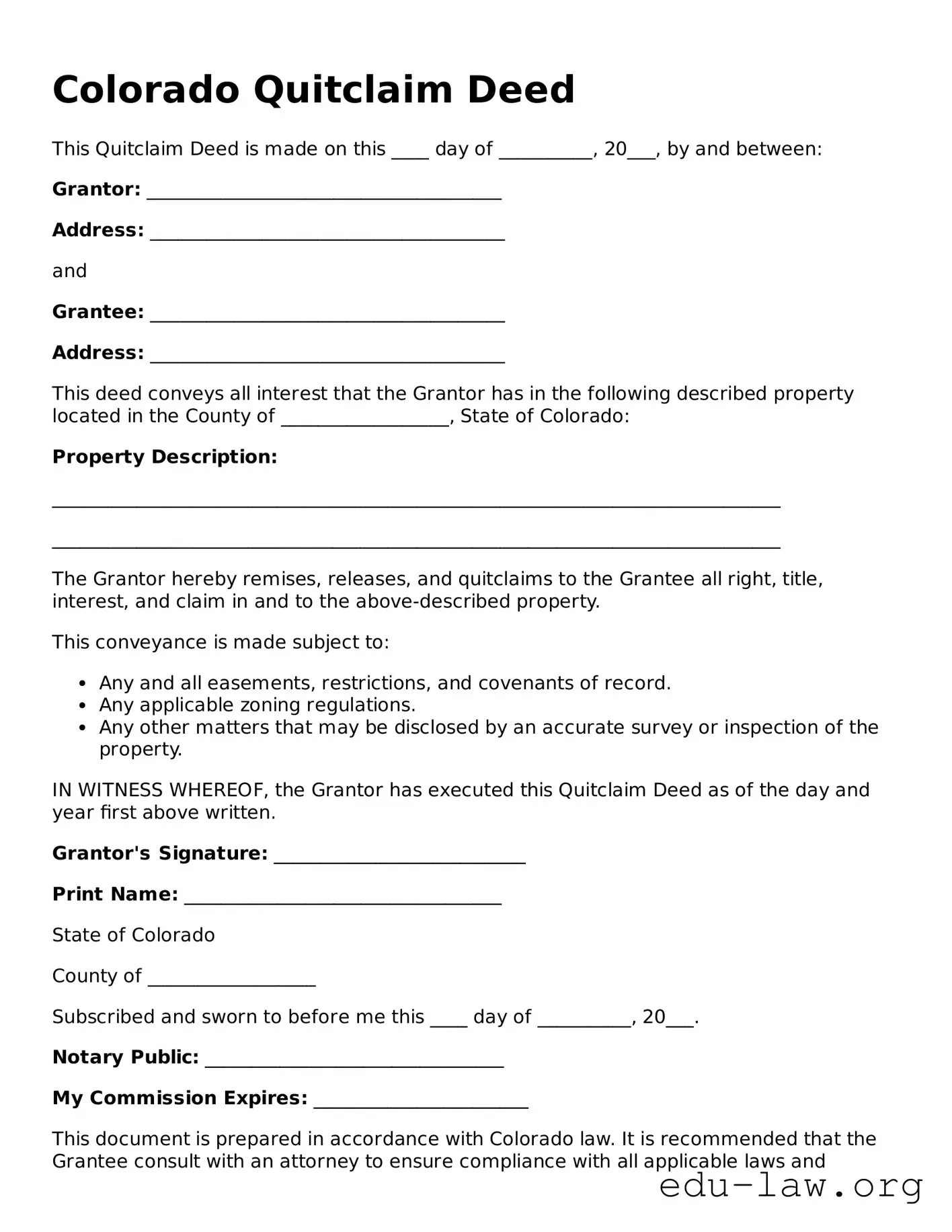
Colorado Quitclaim Deed
This Quitclaim Deed is made on this ____ day of __________, 20___, by and between:
Grantor: ______________________________________
Address: ______________________________________
and
Grantee: ______________________________________
Address: ______________________________________
This deed conveys all interest that the Grantor has in the following described property located in the County of __________________, State of Colorado:
Property Description:
______________________________________________________________________________
______________________________________________________________________________
The Grantor hereby remises, releases, and quitclaims to the Grantee all right, title, interest, and claim in and to the above-described property.
This conveyance is made subject to:
IN WITNESS WHEREOF, the Grantor has executed this Quitclaim Deed as of the day and year first above written.
Grantor's Signature: ___________________________
Print Name: __________________________________
State of Colorado
County of __________________
Subscribed and sworn to before me this ____ day of __________, 20___.
Notary Public: ________________________________
My Commission Expires: _______________________
This document is prepared in accordance with Colorado law. It is recommended that the Grantee consult with an attorney to ensure compliance with all applicable laws and regulations.
| Fact Name | Description |
|---|---|
| Definition | A quitclaim deed is a legal document used to transfer ownership of real estate from one party to another without any warranties. |
| Governing Law | The Colorado Quitclaim Deed is governed by Colorado Revised Statutes, Title 38, Article 30. |
| Use Cases | Commonly used in situations such as divorce settlements, transferring property between family members, or clearing up title issues. |
| Requirements | The deed must be signed by the grantor and notarized to be legally valid in Colorado. |
| Tax Implications | While a quitclaim deed itself does not trigger transfer taxes, it is advisable to check for any local regulations that may apply. |
| Recording | To provide public notice of the transfer, the quitclaim deed should be recorded with the county clerk and recorder in the county where the property is located. |
| Limitations | This type of deed does not guarantee that the grantor has clear title to the property; it merely transfers whatever interest the grantor may have. |
After you have gathered the necessary information, it's time to fill out the Colorado Quitclaim Deed form. This form is crucial for transferring property ownership and must be completed accurately to ensure a smooth process.
What is a Quitclaim Deed in Colorado?
A Quitclaim Deed is a legal document used to transfer ownership of real estate from one party to another without making any guarantees about the property title. In Colorado, this type of deed is often used between family members or in situations where the parties know each other well. It allows the grantor to relinquish any claim they may have to the property, but it does not ensure that the title is free of defects or encumbrances.
When should I use a Quitclaim Deed?
This form is commonly used in specific scenarios such as transferring property between family members, adding or removing a spouse from the title after marriage or divorce, or correcting a title issue. If you are unsure about the state of the title or if there are potential claims against the property, it may be wise to consult a professional.
How do I complete a Quitclaim Deed in Colorado?
To complete a Quitclaim Deed, you will need to include the names of the grantor (the person transferring the property) and the grantee (the person receiving the property), a legal description of the property, and the date of the transfer. It is essential to sign the document in front of a notary public. Once completed, the deed should be filed with the county clerk and recorder’s office in the county where the property is located.
Is a Quitclaim Deed the same as a Warranty Deed?
No, a Quitclaim Deed is not the same as a Warranty Deed. A Warranty Deed provides a guarantee that the grantor holds clear title to the property and has the right to transfer it. In contrast, a Quitclaim Deed offers no such assurances. This distinction is crucial, especially if there are concerns about the property's title.
Do I need an attorney to create a Quitclaim Deed?
Are there any fees associated with filing a Quitclaim Deed in Colorado?
Yes, there are fees associated with filing a Quitclaim Deed. These fees vary by county and may include a recording fee. It is advisable to check with the local county clerk and recorder’s office for the specific fee structure and any additional requirements that may apply.
Can a Quitclaim Deed be revoked?
Once a Quitclaim Deed is executed and recorded, it generally cannot be revoked unilaterally. However, if both parties agree, they can execute another deed to reverse the transaction. It is important to understand that the original deed cannot be undone without mutual consent.
Will a Quitclaim Deed affect my property taxes?
Transferring property through a Quitclaim Deed may impact property taxes, as the county assessor may reassess the property’s value based on the new ownership. It is advisable to contact the local assessor’s office to understand how this transfer may affect your property tax obligations.
What happens if there are existing liens on the property?
A Quitclaim Deed does not remove any existing liens or encumbrances on the property. If there are outstanding debts or claims against the property, these will remain in effect even after the transfer. It is crucial to conduct a title search before executing a Quitclaim Deed to understand any potential issues that may arise.
Failing to include all necessary parties. It is important to list both the grantor (the person transferring the property) and the grantee (the person receiving the property). Missing either party can lead to legal issues.
Not providing a complete legal description of the property. A vague or incomplete description can create confusion about what property is being transferred. Always ensure that the description is accurate and detailed.
Using incorrect names. Names must match the legal documents of the parties involved. Any discrepancies can invalidate the deed.
Overlooking the need for notarization. A quitclaim deed must be signed in front of a notary public to be legally binding. Failing to do this can render the document unenforceable.
Neglecting to record the deed. After signing and notarizing, the deed should be filed with the appropriate county office. Not recording it can lead to disputes about property ownership.
Not considering tax implications. Transferring property can have tax consequences. Consulting a tax professional can help avoid unexpected liabilities.
Ignoring local laws and regulations. Each jurisdiction may have specific requirements for quitclaim deeds. Researching local laws ensures compliance and protects against potential issues.
When completing a property transfer in Colorado, several forms and documents often accompany the Quitclaim Deed. Each document serves a specific purpose in ensuring the transaction is legal and properly recorded. Here’s a list of essential forms to consider:
Using the appropriate forms in conjunction with the Colorado Quitclaim Deed is crucial for a smooth property transfer. Each document plays a vital role in protecting the interests of all parties involved and ensuring compliance with state regulations.
A Warranty Deed is a legal document that transfers ownership of real property from one party to another. Unlike a Quitclaim Deed, a Warranty Deed guarantees that the grantor holds clear title to the property and has the right to sell it. This document offers protection to the buyer, as it assures them that there are no undisclosed liens or claims against the property. In essence, while a Quitclaim Deed transfers whatever interest the grantor has, a Warranty Deed provides a promise of ownership and a clean title.
A Bargain and Sale Deed is similar to a Quitclaim Deed in that it transfers property ownership without providing warranties against claims. However, this type of deed implies that the grantor has some interest in the property, even if that interest is not clearly defined. The buyer may assume some risk, as there is no guarantee that the title is free of issues. This deed is often used in transactions where the seller is not willing to provide full warranties, yet still wants to convey their interest in the property.
A Grant Deed is another document that shares similarities with a Quitclaim Deed. It conveys property ownership and includes certain implied warranties, such as the assurance that the property has not been sold to anyone else. Unlike a Quitclaim Deed, which offers no guarantees, a Grant Deed provides some level of protection to the buyer. It is commonly used in real estate transactions where the seller is confident in their title but does not want to take on the full responsibilities associated with a Warranty Deed.
An Executor’s Deed is used when a property is transferred from an estate to a beneficiary or heir after the death of the owner. This type of deed can resemble a Quitclaim Deed in that it typically does not provide warranties. It simply conveys the property interest that the deceased had at the time of their passing. The Executor’s Deed serves to finalize the estate settlement process, allowing heirs to take possession of the property without the need for extensive title searches.
A Trustee’s Deed is executed when property held in a trust is transferred to a beneficiary. Like a Quitclaim Deed, it may not offer any warranties regarding the title. The Trustee’s Deed conveys whatever interest the trustee has in the property, which can be particularly useful in estate planning. This document allows for a straightforward transfer of property while bypassing the complexities often associated with traditional sales.
A Deed in Lieu of Foreclosure is a document that allows a homeowner to transfer the property back to the lender to avoid foreclosure. This deed is similar to a Quitclaim Deed in that it transfers ownership without warranties. The homeowner relinquishes their interest in the property, and the lender accepts the deed as a means to settle the mortgage debt. This process can be less damaging to the homeowner’s credit compared to a formal foreclosure.
A Special Warranty Deed is a document that conveys property with limited warranties. The grantor only guarantees that they have not done anything to impair the title during their ownership. This differs from a Quitclaim Deed, which provides no warranties at all. A Special Warranty Deed can be beneficial in transactions where the seller wants to limit their liability while still offering some assurance to the buyer.
A Mineral Deed is a specific type of deed that transfers ownership of mineral rights associated with a property. While it serves a different purpose than a Quitclaim Deed, it shares the characteristic of transferring interests without warranties. The grantor may convey whatever rights they possess, which can include oil, gas, and other mineral resources. Buyers must be cautious, as they may inherit potential liabilities or claims against the mineral rights.
A Bill of Sale is not a deed but is often used in conjunction with property transactions. It transfers ownership of personal property rather than real estate. While a Quitclaim Deed deals with land and buildings, a Bill of Sale addresses items like vehicles, equipment, or furniture. Both documents facilitate the transfer of ownership, but they apply to different types of property and carry different legal implications.
When filling out the Colorado Quitclaim Deed form, it is essential to follow specific guidelines to ensure the document is valid and effective. Below are five things you should do and five things you should avoid.
Things You Should Do:
Things You Shouldn't Do:
When dealing with a Colorado Quitclaim Deed, several misconceptions may arise. Understanding these can help clarify the purpose and implications of this legal document. Below are six common misconceptions:
A Quitclaim Deed transfers ownership of property completely. This is not entirely accurate. While a Quitclaim Deed does transfer whatever interest the grantor has in the property, it does not guarantee that the grantor has any legal ownership or that the title is clear. It simply conveys the interest, if any, without warranties.
A Quitclaim Deed can be used to eliminate liens or debts on the property. This is a misconception. A Quitclaim Deed does not remove liens or debts associated with the property. If there are existing liens, they remain attached to the property even after the deed is executed.
Quitclaim Deeds are only for transferring property between family members. While they are commonly used in family transactions, Quitclaim Deeds can be used in various situations, including sales or transfers between unrelated parties. Their flexibility makes them useful in many contexts.
A Quitclaim Deed is the same as a Warranty Deed. This is incorrect. A Warranty Deed provides guarantees about the title and the grantor's ownership, while a Quitclaim Deed offers no such assurances. The differences in the level of protection can be significant.
You do not need to record a Quitclaim Deed. It is advisable to record the Quitclaim Deed with the county clerk and recorder. Recording the deed provides public notice of the transfer and helps establish a clear chain of title, which can be important for future transactions.
A Quitclaim Deed cannot be revoked once it is signed. This statement is misleading. While a Quitclaim Deed is generally considered final, it can be challenged in certain circumstances, such as if fraud is involved or if the grantor can prove they did not understand the transaction. Legal advice may be necessary in such cases.
When considering the Colorado Quitclaim Deed form, it is essential to understand its purpose and how to complete it correctly. Here are some key takeaways:
Understanding these points can help ensure a smoother process when using the Colorado Quitclaim Deed form.