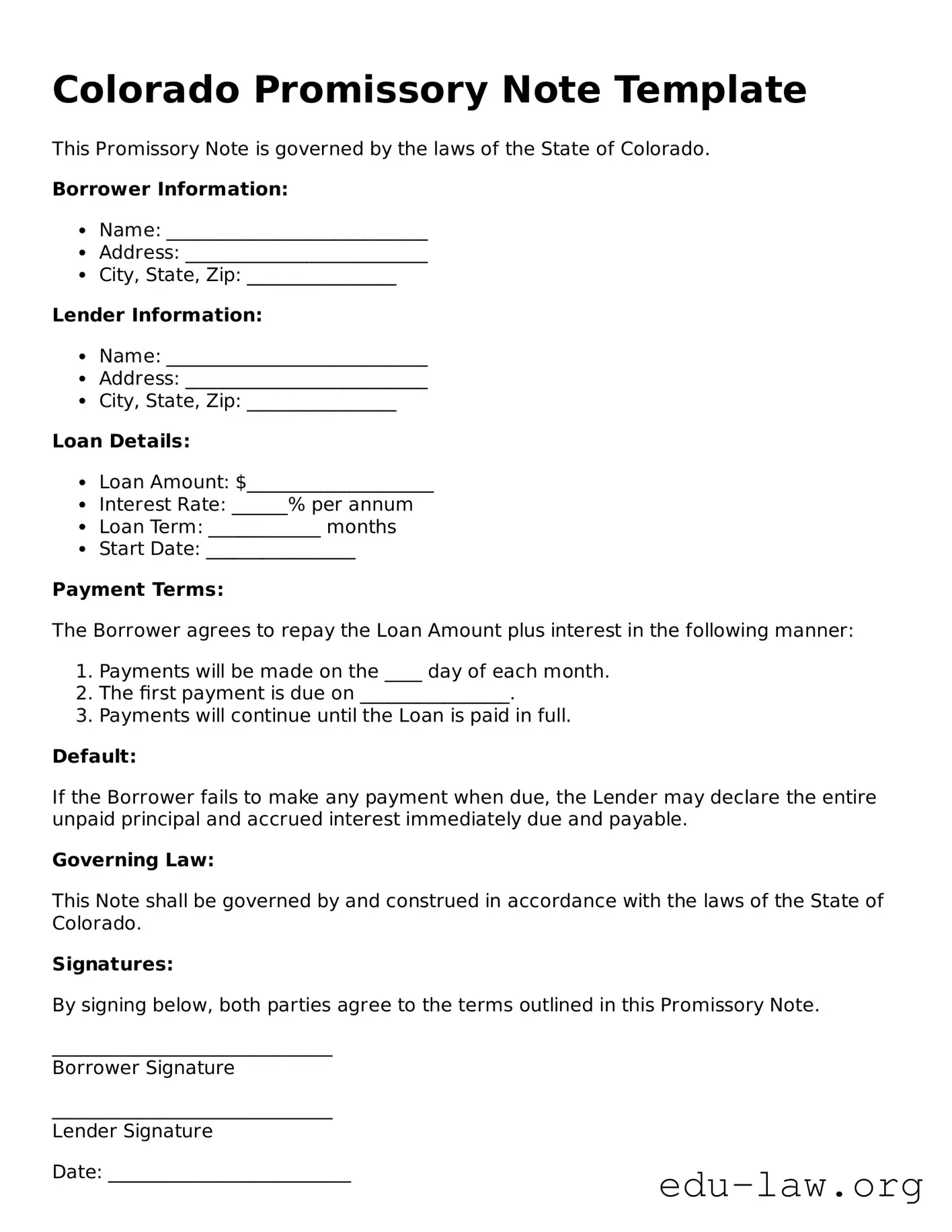
The Colorado Promissory Note form is an essential financial document that serves as a written promise to repay a specified amount of money under agreed-upon terms. This form outlines critical details such as the principal amount, interest rate, payment schedule, and any late fees that may apply. It is designed to protect both the lender and the borrower by clearly stating the obligations of each party. In Colorado, this note can be tailored to fit various lending situations, whether for personal loans, business transactions, or real estate purchases. Understanding the nuances of this form can help individuals navigate their financial agreements with confidence, ensuring clarity and accountability throughout the loan process. Additionally, the Colorado Promissory Note can include provisions for collateral, which provides extra security for the lender, further enhancing the trust between both parties involved in the transaction.
Colorado Promissory Note Template
This Promissory Note is governed by the laws of the State of Colorado.
Borrower Information:
Lender Information:
Loan Details:
Payment Terms:
The Borrower agrees to repay the Loan Amount plus interest in the following manner:
Default:
If the Borrower fails to make any payment when due, the Lender may declare the entire unpaid principal and accrued interest immediately due and payable.
Governing Law:
This Note shall be governed by and construed in accordance with the laws of the State of Colorado.
Signatures:
By signing below, both parties agree to the terms outlined in this Promissory Note.
______________________________
Borrower Signature
______________________________
Lender Signature
Date: __________________________
| Fact Name | Details |
|---|---|
| Definition | A Colorado Promissory Note is a written promise to pay a specific amount of money to a designated person or entity at a specified time or on demand. |
| Governing Law | The Colorado Promissory Note is governed by the Colorado Uniform Commercial Code (UCC), specifically Article 3. |
| Parties Involved | Typically, there are two parties: the borrower (maker) who promises to pay and the lender (payee) who receives the payment. |
| Interest Rate | The interest rate can be fixed or variable, and it should be clearly stated in the note to avoid confusion. |
| Default Terms | In case of default, the terms for late fees, penalties, and remedies should be outlined in the note. |
| Signatures Required | The document must be signed by the borrower to be legally binding, and a witness or notary may be required for added validity. |
After obtaining the Colorado Promissory Note form, you will need to fill it out carefully. This document requires specific information that outlines the terms of the loan. Make sure you have all necessary details ready before you start.
What is a Colorado Promissory Note?
A Colorado Promissory Note is a legal document in which one party (the borrower) promises to pay a specific amount of money to another party (the lender) under agreed-upon terms. This document outlines the loan amount, interest rate, repayment schedule, and any penalties for late payments. It serves as a written record of the debt and the borrower's obligation to repay it.
Who can use a Promissory Note in Colorado?
Any individual or business can use a Promissory Note in Colorado. Whether you are lending money to a friend, financing a business venture, or entering into a real estate transaction, a Promissory Note can provide clarity and security for both parties involved.
What are the key components of a Colorado Promissory Note?
A typical Colorado Promissory Note includes the following key components: the names and addresses of the borrower and lender, the principal amount, the interest rate, the repayment schedule, any late fees or penalties, and the signatures of both parties. It may also include provisions for default and the governing law.
Is a Promissory Note legally binding in Colorado?
Yes, a Promissory Note is legally binding in Colorado as long as it meets certain requirements. These include the intention to create a legal obligation, mutual consent, and the inclusion of essential terms. If properly executed, it can be enforced in court if the borrower fails to repay the loan.
Do I need a lawyer to create a Promissory Note in Colorado?
While it is not legally required to have a lawyer draft a Promissory Note, it is often advisable, especially for complex transactions. A legal professional can ensure that the document complies with Colorado laws and adequately protects your interests.
Can I modify a Promissory Note after it has been signed?
Yes, you can modify a Promissory Note after it has been signed, but both parties must agree to the changes. It is best to document any modifications in writing and have both parties sign the amended agreement to avoid confusion or disputes later on.
What happens if the borrower defaults on the Promissory Note?
If the borrower defaults, the lender has several options. They can pursue legal action to recover the owed amount, which may include filing a lawsuit. The terms of the Promissory Note will dictate the specific remedies available to the lender in case of default.
Can a Promissory Note be transferred to another party?
Yes, a Promissory Note can be transferred or assigned to another party unless the original agreement specifies otherwise. This means that the new party can step into the lender's shoes and collect payments from the borrower.
Are there any specific state laws governing Promissory Notes in Colorado?
Yes, Colorado has specific laws that govern Promissory Notes. These laws outline the requirements for enforceability, interest rates, and other terms. It is important to be aware of these regulations to ensure compliance and avoid legal issues.
Not including all necessary information. When filling out the Colorado Promissory Note form, it's crucial to provide complete details. This includes the names of both the borrower and the lender, the loan amount, and the interest rate. Missing any of this information can lead to confusion later.
Forgetting to specify the repayment terms. The repayment schedule should be clearly outlined. This includes the due dates for payments and the total duration of the loan. Without this, both parties may have different expectations about when payments are due.
Neglecting to sign the document. A Promissory Note is not legally binding without the signatures of both parties. Ensure that both the borrower and the lender sign the document before any money changes hands.
Overlooking the importance of witnesses or notarization. While not always required, having a witness or getting the document notarized can provide extra protection. This can help prevent disputes in the future by proving that both parties agreed to the terms.
A Colorado Promissory Note is a crucial document that outlines the terms of a loan between a borrower and a lender. When executing a Promissory Note, several other forms and documents may accompany it to ensure clarity and legal compliance. Below is a list of commonly used documents that often work in conjunction with the Promissory Note.
Each of these documents plays a vital role in the lending process, providing additional layers of protection and clarity for both the borrower and the lender. Properly preparing and understanding these forms can help prevent disputes and ensure a smoother transaction.
The Colorado Promissory Note form shares similarities with the Loan Agreement. Both documents outline the terms of a loan, including the amount borrowed, interest rate, and repayment schedule. A Loan Agreement may be more detailed, often including provisions for default and collateral, while a Promissory Note is typically a simpler acknowledgment of the debt.
Another document that resembles the Colorado Promissory Note is the Secured Promissory Note. This document not only details the promise to repay a loan but also specifies collateral backing the loan. In contrast to a standard Promissory Note, the Secured Promissory Note offers additional protection to the lender by outlining what assets can be claimed in case of default.
The Demand Note is also similar. It allows the lender to request repayment at any time. While a Promissory Note usually has a set repayment schedule, a Demand Note provides flexibility for the lender, making it a useful tool in certain financial situations.
A Personal Loan Agreement is another related document. It serves as a formal contract between individuals for a personal loan. Like the Promissory Note, it details the loan amount and repayment terms, but it often includes more extensive clauses regarding the responsibilities of both parties.
The Business Loan Agreement is similar as well. This document is used when a business borrows money. It includes terms about interest rates, repayment schedules, and may also outline the business’s financial obligations. While a Promissory Note can be used in business contexts, a Business Loan Agreement is more comprehensive and tailored for commercial transactions.
The Mortgage Note is another document that shares characteristics with the Colorado Promissory Note. A Mortgage Note is a specific type of Promissory Note used in real estate transactions. It includes the terms of the loan used to purchase property and is secured by the property itself, adding an extra layer of security for the lender.
The Installment Note is also comparable. This document outlines a loan that is repaid in installments over time. Like a Promissory Note, it specifies the amount borrowed and the interest rate, but it emphasizes the schedule of payments, making it clear how much is due and when.
The Subordination Agreement has some similarities as well. While it primarily addresses the priority of claims in the event of default, it often accompanies a Promissory Note when multiple loans are involved. This agreement ensures that one lender's claim is subordinate to another's, which can affect repayment terms and security interests.
The Conditional Promissory Note is another variant. This type of note includes specific conditions that must be met for the loan to be valid. Similar to a standard Promissory Note, it outlines the amount borrowed and repayment terms but adds a layer of complexity with conditions that must be fulfilled.
Lastly, the Installment Sale Agreement is akin to the Promissory Note in that it involves payments over time for a purchased item. However, this document typically involves the sale of goods or property, where the seller retains ownership until the buyer completes all payments. This agreement outlines the terms of the sale and payment schedule, similar to how a Promissory Note outlines the loan terms.
When filling out the Colorado Promissory Note form, it's important to approach the task with care. Here are some guidelines to help you navigate the process effectively.
Understanding the Colorado Promissory Note form can be challenging. Here are nine common misconceptions about this important financial document:
Being aware of these misconceptions can help individuals and businesses navigate their financial agreements more effectively.
When filling out and using the Colorado Promissory Note form, keep the following key takeaways in mind: