In the realm of marriage, financial clarity and protection are crucial for both parties. A Colorado Prenuptial Agreement serves as a proactive measure to address these concerns before tying the knot. This legal document outlines the distribution of assets and liabilities in the event of divorce or separation, ensuring that both partners understand their rights and obligations. It can cover various aspects, including property division, spousal support, and even debt management. By establishing clear terms, the agreement helps to minimize conflicts and misunderstandings during a potentially tumultuous time. Additionally, it provides a framework for discussing financial matters openly, fostering a sense of trust and transparency. As couples embark on their journey together, considering a prenuptial agreement can be a wise step toward securing their financial future.
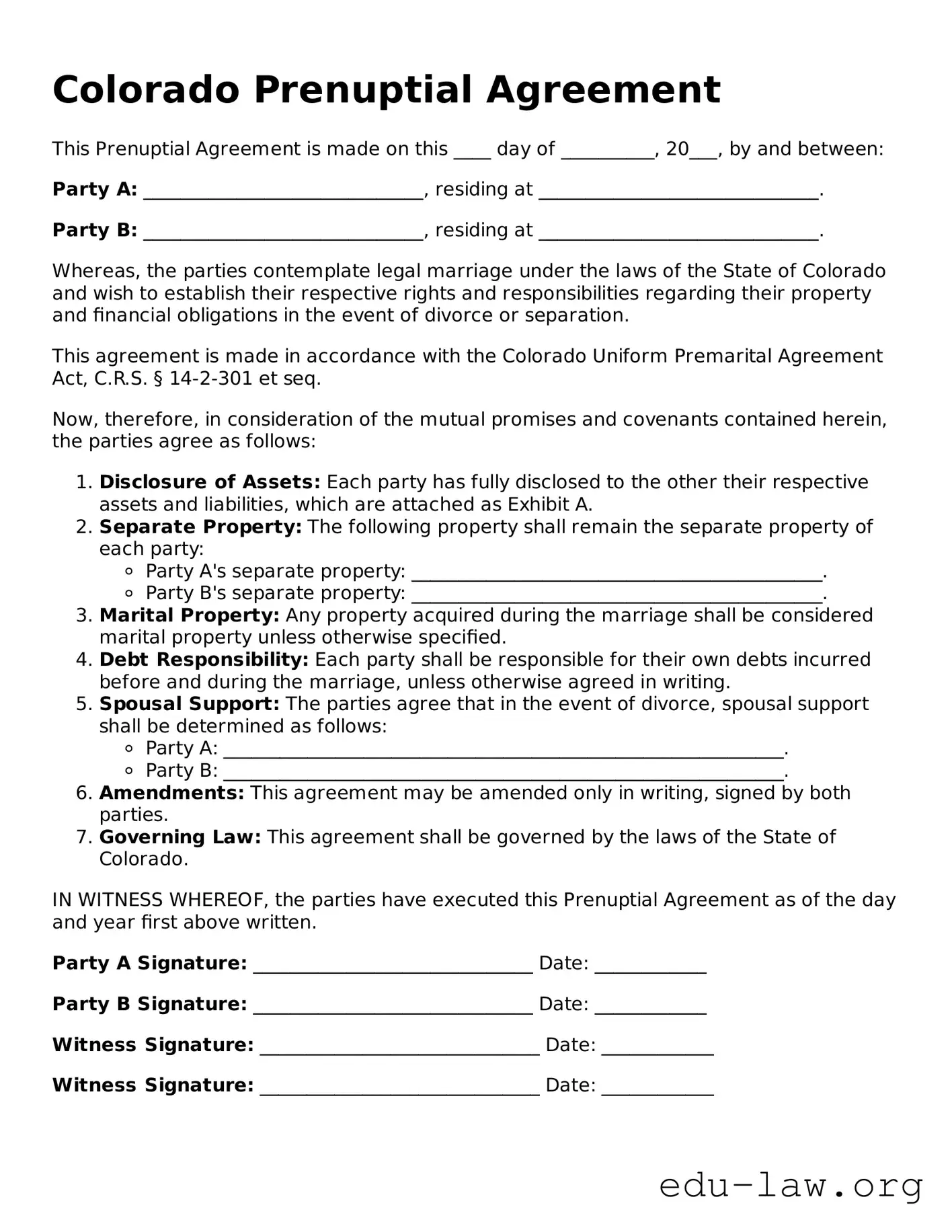
Colorado Prenuptial Agreement
This Prenuptial Agreement is made on this ____ day of __________, 20___, by and between:
Party A: ______________________________, residing at ______________________________.
Party B: ______________________________, residing at ______________________________.
Whereas, the parties contemplate legal marriage under the laws of the State of Colorado and wish to establish their respective rights and responsibilities regarding their property and financial obligations in the event of divorce or separation.
This agreement is made in accordance with the Colorado Uniform Premarital Agreement Act, C.R.S. § 14-2-301 et seq.
Now, therefore, in consideration of the mutual promises and covenants contained herein, the parties agree as follows:
IN WITNESS WHEREOF, the parties have executed this Prenuptial Agreement as of the day and year first above written.
Party A Signature: ______________________________ Date: ____________
Party B Signature: ______________________________ Date: ____________
Witness Signature: ______________________________ Date: ____________
Witness Signature: ______________________________ Date: ____________
| Fact Name | Details |
|---|---|
| Definition | A prenuptial agreement is a contract entered into by two individuals before marriage, outlining the distribution of assets and responsibilities in the event of divorce or separation. |
| Governing Law | In Colorado, prenuptial agreements are governed by the Colorado Uniform Premarital Agreement Act. |
| Enforceability | For a prenuptial agreement to be enforceable, it must be in writing and signed by both parties. |
| Full Disclosure | Both parties should fully disclose their assets and liabilities to ensure fairness and transparency. |
| Legal Representation | It is advisable for each party to seek independent legal advice before signing the agreement. |
| Modification | Prenuptial agreements can be modified or revoked at any time, provided both parties agree in writing. |
| Judicial Review | A court may review a prenuptial agreement for fairness and may refuse to enforce it if it is deemed unconscionable. |
| Timing | It is best to finalize the prenuptial agreement well in advance of the wedding to avoid any claims of coercion. |
| Common Misconceptions | Many people believe prenuptial agreements are only for the wealthy, but they can be beneficial for anyone wishing to clarify financial matters before marriage. |
Filling out the Colorado Prenuptial Agreement form is an important step in planning for your future together. This process ensures that both parties clearly understand their rights and responsibilities. Follow these steps to complete the form accurately.
What is a prenuptial agreement in Colorado?
A prenuptial agreement, often referred to as a prenup, is a legal document that a couple signs before getting married. It outlines how assets and debts will be divided in the event of divorce or separation. In Colorado, this agreement can also specify spousal support and other financial arrangements, providing clarity and protection for both parties involved.
Why should couples consider a prenuptial agreement?
Couples may choose to create a prenuptial agreement for various reasons. It can protect individual assets acquired before marriage, clarify financial responsibilities, and minimize conflicts during a divorce. Additionally, it can be especially beneficial for those entering a marriage with significant assets, debts, or children from previous relationships.
What must be included in a Colorado prenuptial agreement?
While the specifics can vary, a Colorado prenuptial agreement typically includes details about the couple’s assets, debts, and how they will be managed during the marriage. It may also address spousal support and the division of property in the event of a divorce. It's important that the agreement is fair and does not include any illegal provisions.
How does one create a prenuptial agreement in Colorado?
To create a prenuptial agreement in Colorado, both parties should first discuss their financial situations and expectations. It is advisable to consult with separate legal counsel to ensure that both parties fully understand the terms and implications. Once both parties agree on the terms, the agreement should be drafted, reviewed, and signed before the marriage takes place.
Is a prenuptial agreement legally binding in Colorado?
Yes, a prenuptial agreement can be legally binding in Colorado, provided it meets certain criteria. Both parties must enter into the agreement voluntarily, and it should be in writing and signed by both individuals. Additionally, the agreement should be fair and not created under duress or with fraudulent intent.
Can a prenuptial agreement be modified after marriage?
Yes, a prenuptial agreement can be modified or revoked after marriage. Both parties must agree to the changes, and it is advisable to document any modifications in writing. This ensures that any new terms are clear and enforceable in the event of a future dispute.
What happens if a prenuptial agreement is challenged in court?
If a prenuptial agreement is challenged in court, the judge will review the circumstances under which it was created. Factors such as whether both parties had legal representation, if there was full disclosure of assets, and whether the agreement was signed voluntarily will be considered. If the court finds that the agreement was not valid, it may be set aside.
Do both parties need a lawyer for a prenuptial agreement in Colorado?
While it is not legally required for both parties to have their own lawyers when creating a prenuptial agreement, it is highly recommended. Having separate legal representation helps ensure that both parties understand their rights and obligations. This can prevent misunderstandings and disputes in the future, making the agreement more likely to hold up in court.
Failing to fully disclose assets. It's crucial to provide a complete picture of your financial situation. Omitting any significant assets can lead to complications later.
Not understanding the implications of the agreement. Take time to comprehend how the prenup affects your rights and obligations. Ignorance can lead to disputes in the future.
Using vague language. Be specific about terms and conditions. Ambiguities can result in misinterpretation and legal challenges.
Neglecting to update the agreement. Life changes, such as acquiring new assets or having children, should prompt a review of the prenup.
Not involving legal counsel. Each party should seek independent legal advice. This ensures that both sides understand the agreement fully.
Forgetting to consider future income. Address how future earnings will be treated. This can prevent misunderstandings later on.
Ignoring state laws. Familiarize yourself with Colorado's specific requirements for prenuptial agreements. Compliance is essential for enforceability.
Rushing the process. Take your time to discuss and negotiate terms. A hastily prepared agreement can lead to regrets.
Not having the agreement notarized. A notarized document adds an extra layer of legitimacy and can help avoid disputes about authenticity.
Failing to communicate openly. Honest discussions about finances and expectations can strengthen the relationship and make the prenup process smoother.
A prenuptial agreement is an important document for couples planning to marry. It outlines the financial and property arrangements in the event of a divorce or separation. Alongside this agreement, several other forms and documents may be necessary to ensure a comprehensive understanding of each party's rights and obligations. Below is a list of related documents often used in conjunction with a Colorado prenuptial agreement.
Utilizing these documents alongside a prenuptial agreement can provide clarity and protection for both parties. Understanding the purpose of each document is crucial in fostering a transparent and secure partnership.
A cohabitation agreement is similar to a prenuptial agreement in that both documents outline the financial and personal arrangements between partners. While a prenuptial agreement is used before marriage, a cohabitation agreement is designed for couples who live together without being married. Both agreements can address property division, financial responsibilities, and other important issues, helping to clarify expectations and protect individual interests in the relationship.
A postnuptial agreement serves a similar purpose to a prenuptial agreement, but it is created after a couple is already married. Like a prenuptial agreement, a postnuptial agreement can specify how assets will be divided in the event of a divorce. This type of agreement can be particularly useful if a couple’s financial situation changes or if they wish to clarify certain aspects of their marriage after tying the knot.
A separation agreement is another document that shares similarities with a prenuptial agreement. This document is typically used when a couple decides to separate but is not yet ready for divorce. It outlines the terms of the separation, including how assets will be divided and what arrangements will be made for child custody and support. Like a prenuptial agreement, it aims to provide clarity and prevent disputes during a difficult time.
A marital settlement agreement is closely related to a prenuptial agreement as well. This document is created during the divorce process and outlines how the couple will divide their assets, debts, and responsibilities. While a prenuptial agreement is proactive, a marital settlement agreement is reactive, addressing issues that have arisen during the marriage. Both documents serve to protect the interests of each party and can simplify the divorce process.
An estate plan can also be compared to a prenuptial agreement in that both involve planning for the future. An estate plan outlines how a person’s assets will be distributed upon their death, while a prenuptial agreement specifies how assets will be handled during a marriage or divorce. Both documents are essential for protecting individual interests and ensuring that wishes are honored, whether in life or after passing.
Lastly, a business partnership agreement can resemble a prenuptial agreement in the way it addresses the division of assets and responsibilities. Just as a prenuptial agreement helps couples navigate financial matters in a relationship, a business partnership agreement outlines how partners will share profits, make decisions, and handle disputes. Both types of agreements aim to provide a clear framework for managing complex relationships, whether personal or professional.
When filling out the Colorado Prenuptial Agreement form, it is important to approach the process with care. Here are five things you should and shouldn't do:
Misconception 1: Prenuptial agreements are only for wealthy individuals.
This is not true. Prenuptial agreements can benefit anyone, regardless of income. They help clarify financial responsibilities and protect both parties' interests.
Misconception 2: Prenuptial agreements are only enforceable if they are signed in front of a lawyer.
Misconception 3: A prenuptial agreement can cover anything, including child custody.
This is incorrect. While prenuptial agreements can address property and financial matters, they cannot dictate child custody or support arrangements. Courts prioritize the child's best interests in these matters.
Misconception 4: Prenuptial agreements are only effective if signed long before the wedding.
While it is best to finalize a prenuptial agreement well in advance, they can still be valid if signed shortly before the wedding. However, last-minute agreements may raise questions about coercion or lack of understanding.
Misconception 5: Once signed, a prenuptial agreement cannot be changed.
This is false. Both parties can agree to modify or revoke a prenuptial agreement at any time, provided they do so in writing and follow the legal requirements for such changes.
When considering a prenuptial agreement in Colorado, it’s important to understand a few key aspects of the process. Here are four essential takeaways:
By keeping these points in mind, you can navigate the prenuptial agreement process with greater confidence and clarity.