When it comes to ensuring the well-being of your child, having the right legal tools at your disposal is essential. In Colorado, the Power of Attorney for a Child form serves as a vital resource for parents and guardians who wish to grant temporary authority to another adult, allowing them to make important decisions on behalf of their child. This form is particularly useful in various situations, such as when a parent is traveling, working long hours, or otherwise unable to be present for their child. It covers a range of responsibilities, including making medical decisions, enrolling the child in school, and managing day-to-day activities. By designating a trusted individual through this legal document, parents can ensure that their child’s needs are met, even in their absence. The form is straightforward, yet it carries significant implications for both the child and the appointed caregiver, making it crucial for parents to understand its components and the responsibilities it entails.
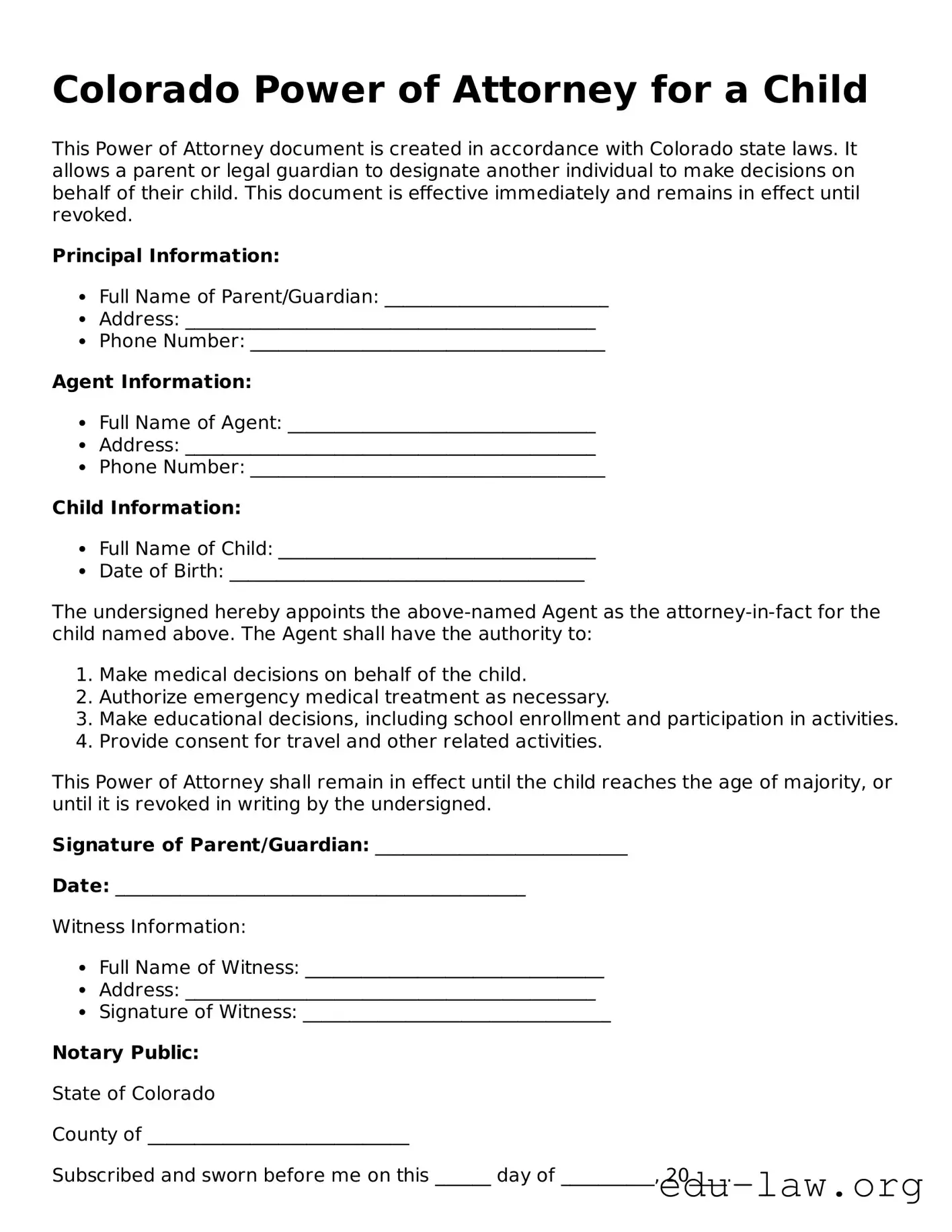
Colorado Power of Attorney for a Child
This Power of Attorney document is created in accordance with Colorado state laws. It allows a parent or legal guardian to designate another individual to make decisions on behalf of their child. This document is effective immediately and remains in effect until revoked.
Principal Information:
Agent Information:
Child Information:
The undersigned hereby appoints the above-named Agent as the attorney-in-fact for the child named above. The Agent shall have the authority to:
This Power of Attorney shall remain in effect until the child reaches the age of majority, or until it is revoked in writing by the undersigned.
Signature of Parent/Guardian: ___________________________
Date: ____________________________________________
Witness Information:
Notary Public:
State of Colorado
County of ____________________________
Subscribed and sworn before me on this ______ day of __________, 20____.
My commission expires: ____________________________
______________________________
Notary Public
| Fact Name | Description |
|---|---|
| Purpose | The Colorado Power of Attorney for a Child form allows a parent or legal guardian to designate another adult to make decisions for their child. |
| Governing Law | This form is governed by Colorado Revised Statutes, specifically Section 15-14-801. |
| Duration | The power of attorney can be effective for a specific period or until revoked by the parent or guardian. |
| Eligibility | Any adult can be designated as an agent, but they should be someone the parent trusts to act in the child's best interest. |
| Limitations | The agent does not have the authority to make decisions regarding the child's medical care unless explicitly stated. |
| Revocation | The parent or guardian can revoke the power of attorney at any time, provided they notify the agent. |
| Notarization | While notarization is not required, it is recommended to ensure the document's validity and to avoid disputes. |
Filling out the Colorado Power of Attorney for a Child form is a straightforward process. After completing the form, you will need to ensure it is signed and dated appropriately. This will allow you to designate someone to make decisions for your child in your absence.
What is a Power of Attorney for a Child in Colorado?
A Power of Attorney for a Child is a legal document that allows a parent or legal guardian to designate another adult to make decisions on behalf of their child. This can include decisions about medical care, education, and general welfare. It is especially useful in situations where the parent or guardian may be unavailable, such as during travel or extended absences.
Who can serve as an agent under this Power of Attorney?
Any adult can be appointed as an agent, provided they are trustworthy and capable of making decisions in the best interest of the child. This could be a relative, family friend, or neighbor. However, it’s important to choose someone who understands your values and the needs of your child.
How long does the Power of Attorney for a Child last?
The Power of Attorney for a Child can be set for a specific period or can remain in effect until revoked by the parent or guardian. Typically, it is wise to specify an end date or condition to avoid any confusion about its duration.
Do I need to have the Power of Attorney notarized?
Yes, in Colorado, it is recommended to have the Power of Attorney for a Child notarized. This adds an extra layer of legitimacy and can help prevent disputes about the document's validity. Notarization is a straightforward process that involves signing the document in front of a notary public.
Can I revoke the Power of Attorney once it is established?
Absolutely. As the parent or guardian, you have the right to revoke the Power of Attorney at any time. It is advisable to do this in writing and inform the agent and any relevant parties, such as schools or medical providers, to ensure everyone is aware of the change.
What decisions can the agent make on behalf of my child?
The agent can make a variety of decisions, including those related to medical care, education, and general welfare. However, the scope of authority can be limited or expanded based on your preferences. It’s important to clearly outline what decisions the agent can make in the document.
Is there a specific form I need to use for the Power of Attorney for a Child?
While there is no official state form required, it is recommended to use a form that complies with Colorado law. Many templates are available online, but it’s crucial to ensure that the form meets all legal requirements to be valid.
What happens if I don’t have a Power of Attorney for my child?
If you do not have a Power of Attorney and an emergency arises, it could complicate decision-making for your child’s care. Without this document, medical providers or schools may require additional legal steps to act on your behalf, which can delay important decisions.
Should I consult a lawyer when creating a Power of Attorney for my Child?
While it is not mandatory to consult a lawyer, it can be beneficial. A legal professional can help ensure that the document is properly drafted and tailored to your specific needs. They can also provide guidance on any state-specific requirements or considerations that may apply.
Not including all required information. It’s essential to fill in every section of the form completely. Missing information can lead to delays or complications.
Using outdated forms. Always ensure you have the most current version of the Power of Attorney for a Child form. Laws can change, and using an old form may invalidate your document.
Failing to sign and date the form. Without a signature and date, the document is not legally binding. Make sure to sign in the appropriate places.
Not having the form notarized. In Colorado, a Power of Attorney for a Child typically needs to be notarized. Skipping this step can render the document ineffective.
Choosing the wrong agent. Selecting someone who is not reliable or does not understand the responsibilities can create issues. Choose someone trustworthy and capable.
Ignoring the expiration date. Some Power of Attorney forms have specific expiration dates. Be aware of this to avoid any lapse in authority.
Not discussing the arrangement with the child. It’s important to communicate with the child about who will be taking care of them and what it means. This helps alleviate confusion and anxiety.
Overlooking state-specific requirements. Each state may have different rules regarding Power of Attorney forms. Familiarize yourself with Colorado's specific requirements to ensure compliance.
When creating a Power of Attorney for a Child in Colorado, it is often helpful to have additional forms and documents ready. These documents can assist in ensuring that the child's needs are met and that legal matters are handled appropriately. Below is a list of commonly used forms alongside the Power of Attorney for a Child.
Having these forms and documents in place can simplify the process of caring for a child when parents are unavailable. It is always a good idea to ensure that all necessary permissions and authorizations are clearly documented to avoid any potential issues.
The Colorado Power of Attorney for a Child form is similar to a General Power of Attorney. Both documents allow an individual to designate someone else to make decisions on their behalf. However, the General Power of Attorney covers a broader range of legal and financial matters, while the Power of Attorney for a Child specifically focuses on the care and welfare of a minor. This distinction is crucial for parents seeking to ensure their child's needs are met during their absence.
Another related document is the Medical Power of Attorney. This form grants authority to someone to make medical decisions for another person if they become incapacitated. While the Power of Attorney for a Child can include medical decisions, the Medical Power of Attorney is solely focused on health care matters. Parents may use both documents to ensure comprehensive care for their child in different situations.
The Temporary Guardianship Agreement is also similar. This document allows a parent to appoint someone as a temporary guardian for their child. Like the Power of Attorney for a Child, it is intended for short-term situations. However, a Temporary Guardianship Agreement often requires court approval, whereas the Power of Attorney for a Child does not, making it a more straightforward option for parents in need of immediate arrangements.
The Child Care Authorization form shares similarities as well. This document allows parents to authorize another individual to care for their child, covering aspects like school pick-up and drop-off. The Child Care Authorization is typically more informal and may not provide the same level of authority as the Power of Attorney for a Child, which is a more formal legal document.
The Consent to Travel form is relevant too. This document is often required when a child is traveling with someone other than their parents. It gives permission for the child to travel and can be similar in purpose to the Power of Attorney for a Child, which can also grant travel authority. However, the Consent to Travel is specifically for travel-related permissions.
The Adoption Consent form also bears resemblance. This document is used when a parent consents to the adoption of their child by another person. While the Power of Attorney for a Child allows for temporary decision-making authority, the Adoption Consent is a permanent transfer of parental rights. Both documents involve significant decisions about a child's future.
The School Authorization form is another related document. This form allows parents to authorize someone to make educational decisions for their child, including school enrollment and attendance. While the Power of Attorney for a Child can cover educational decisions, the School Authorization is specifically tailored for school-related matters, providing clarity in educational settings.
The Release of Information form is similar in that it allows a designated person to access a child's records. This document is often used in medical or educational contexts. The Power of Attorney for a Child may include the ability to release information, but the Release of Information form is more focused on granting access to specific records.
The Child Support Power of Attorney is also relevant. This document allows a parent to designate someone to handle child support matters on their behalf. While both documents involve the welfare of a child, the Child Support Power of Attorney is specifically focused on financial obligations, whereas the Power of Attorney for a Child encompasses broader caregiving responsibilities.
Lastly, the Durable Power of Attorney shares some similarities. This document remains effective even if the individual becomes incapacitated. While the Power of Attorney for a Child is typically not durable and is intended for specific situations, both documents allow for the delegation of authority and decision-making, ensuring that someone's wishes are respected during challenging times.
When filling out the Colorado Power of Attorney for a Child form, it is important to be mindful of certain practices to ensure the document is valid and effective. Below is a list of things you should and shouldn't do:
By following these guidelines, you can help ensure that the Power of Attorney for a Child form is properly executed and serves its intended purpose.
Understanding the Colorado Power of Attorney for a Child form is essential for parents and guardians. However, several misconceptions can lead to confusion. Here are seven common misconceptions:
Many believe this form is only necessary in urgent situations. In reality, it can be used for planned events, such as travel or temporary relocation.
This form can be filled out by parents or guardians without legal assistance. However, seeking legal advice can provide clarity on specific situations.
The Power of Attorney for a Child is not permanent. It can be revoked at any time by the parent or guardian who created it.
This form does not transfer parental rights. It allows another adult to make decisions on behalf of the child temporarily.
Multiple individuals can be named in the Power of Attorney, allowing for flexibility in decision-making.
While it is designed for use in Colorado, other states may recognize it. Always check local laws if traveling.
This form is specifically for children under the age of 18. It does not apply to adults or emancipated minors.
Clarifying these misconceptions can help ensure that parents and guardians use the Power of Attorney for a Child form effectively and appropriately.
When filling out and using the Colorado Power of Attorney for a Child form, consider these key takeaways: