When starting a business in Colorado, particularly a limited liability company (LLC), one of the most important documents you will encounter is the Colorado Operating Agreement form. This document serves as the backbone of your LLC, outlining the management structure, roles of members, and operational guidelines. It addresses key aspects such as the distribution of profits and losses, procedures for adding or removing members, and the decision-making processes within the company. Additionally, the agreement can specify how disputes among members will be resolved, ensuring a clear pathway to conflict resolution. While the state of Colorado does not legally require an operating agreement, having one in place is highly recommended, as it helps protect your personal assets and enhances the credibility of your business. By clearly defining the expectations and responsibilities of all members, this agreement fosters a cooperative environment, allowing your LLC to thrive.
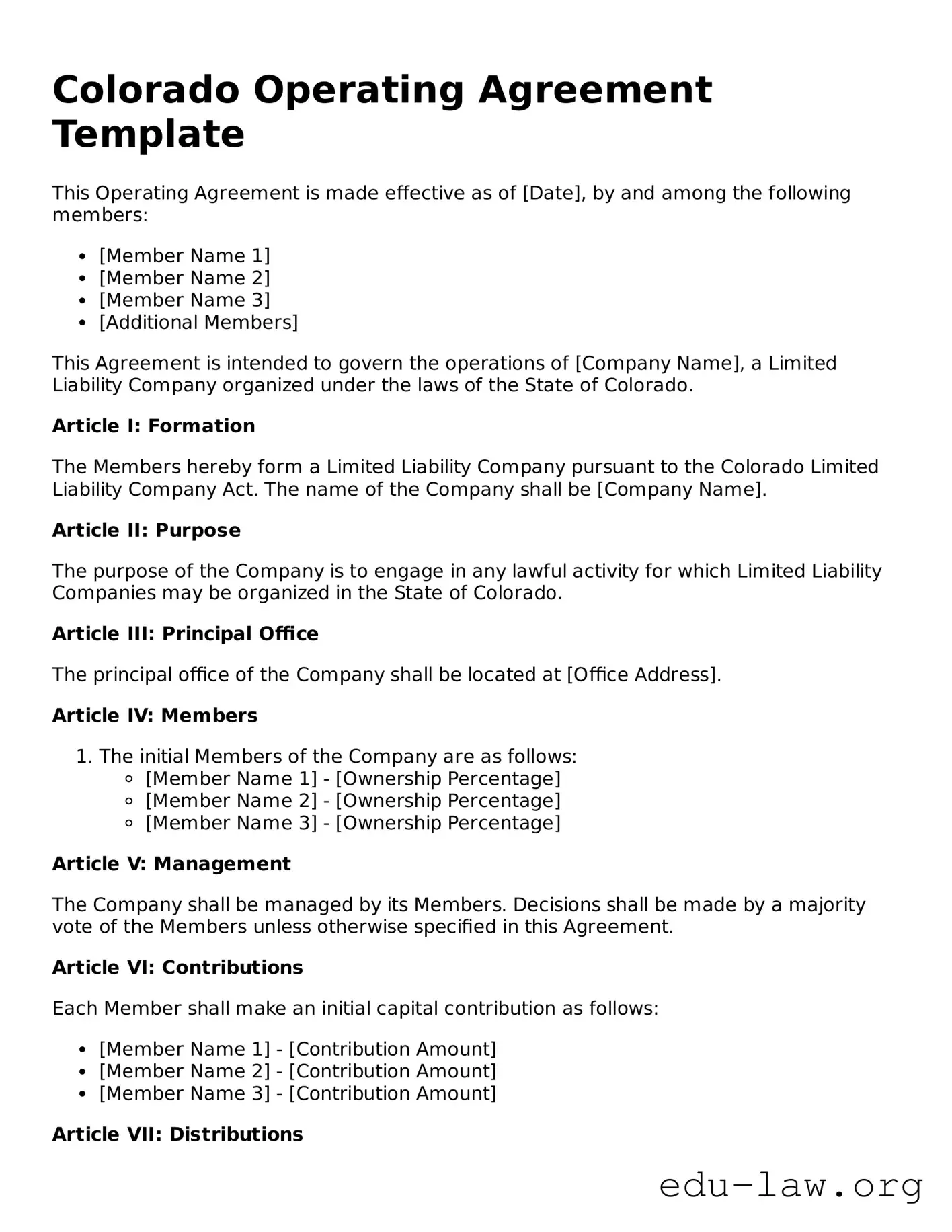
Colorado Operating Agreement Template
This Operating Agreement is made effective as of [Date], by and among the following members:
This Agreement is intended to govern the operations of [Company Name], a Limited Liability Company organized under the laws of the State of Colorado.
Article I: Formation
The Members hereby form a Limited Liability Company pursuant to the Colorado Limited Liability Company Act. The name of the Company shall be [Company Name].
Article II: Purpose
The purpose of the Company is to engage in any lawful activity for which Limited Liability Companies may be organized in the State of Colorado.
Article III: Principal Office
The principal office of the Company shall be located at [Office Address].
Article IV: Members
Article V: Management
The Company shall be managed by its Members. Decisions shall be made by a majority vote of the Members unless otherwise specified in this Agreement.
Article VI: Contributions
Each Member shall make an initial capital contribution as follows:
Article VII: Distributions
Distributions shall be made to the Members in proportion to their respective ownership interests in the Company.
Article VIII: Amendments
This Agreement may be amended only by a written agreement signed by all Members.
Article IX: Governing Law
This Agreement shall be governed by and construed in accordance with the laws of the State of Colorado.
IN WITNESS WHEREOF, the undersigned have executed this Operating Agreement as of the date first above written.
[Member Name 1] ________________________
[Member Name 2] ________________________
[Member Name 3] ________________________
[Additional Members] ________________________
| Fact Name | Description |
|---|---|
| Purpose | The Colorado Operating Agreement outlines the management structure and operating procedures for a limited liability company (LLC) in Colorado. |
| Governing Law | This agreement is governed by the Colorado Limited Liability Company Act, specifically Title 7, Article 80 of the Colorado Revised Statutes. |
| Members' Rights | The agreement defines the rights and responsibilities of the members, including profit distribution and decision-making processes. |
| Amendments | Members can amend the Operating Agreement, provided that the process for amendments is clearly outlined within the document. |
| Default Provisions | In the absence of an Operating Agreement, Colorado law provides default provisions that govern the LLC's operations. |
| Importance | A well-drafted Operating Agreement can help prevent disputes among members and provide clarity on operational matters. |
Completing the Colorado Operating Agreement form is an essential step for establishing the framework of your business. This document outlines the management structure, responsibilities, and operational procedures for your company. Follow the steps below to ensure accurate and thorough completion of the form.
Once the form is completed, review it for accuracy and ensure all members have a copy for their records. This agreement will serve as a vital reference as your business grows and evolves.
What is a Colorado Operating Agreement?
A Colorado Operating Agreement is a legal document that outlines the ownership and operating procedures of a Limited Liability Company (LLC) in Colorado. It serves as an internal guideline for the members of the LLC, detailing how the company will be managed, the rights and responsibilities of its members, and how profits and losses will be distributed.
Is an Operating Agreement required in Colorado?
While Colorado law does not mandate that LLCs have an Operating Agreement, it is highly recommended. Having this document can help prevent misunderstandings among members and provide clarity on various operational aspects. It also protects the LLC’s limited liability status by demonstrating that the business is a separate entity from its owners.
What should be included in a Colorado Operating Agreement?
A comprehensive Operating Agreement should include several key components. These typically cover the organization of the LLC, member contributions, management structure, decision-making processes, and procedures for adding or removing members. Additionally, it should outline how profits and losses are allocated and the process for dissolving the LLC if necessary.
Can I create my own Operating Agreement?
Yes, you can create your own Operating Agreement. Many templates are available online that can help guide you through the process. However, it's important to ensure that the agreement meets your specific needs and complies with Colorado laws. Consulting with a legal professional can provide additional assurance that your document is thorough and enforceable.
How do I amend an Operating Agreement in Colorado?
Amending an Operating Agreement in Colorado typically requires a vote among the members, as specified in the original agreement. The process for making amendments should be clearly outlined in the Operating Agreement itself. Once agreed upon, the amendments should be documented in writing and kept with the original agreement for record-keeping purposes.
What happens if there is no Operating Agreement?
If an LLC in Colorado does not have an Operating Agreement, it will be governed by the state's default laws regarding LLCs. This can lead to confusion and potential disputes among members, as the default rules may not align with the members' intentions. Without a clear agreement, decisions may be made based on majority rule, which could disadvantage minority members.
Can an Operating Agreement be modified after it is signed?
Yes, an Operating Agreement can be modified after it is signed, provided that the process for amendments is followed as outlined in the document. All members should agree to any changes, and it is advisable to document the modifications in writing to maintain clarity and avoid future disputes.
Failing to include all members: Ensure that every member of the LLC is listed in the agreement. Omitting a member can lead to disputes later.
Not specifying ownership percentages: Clearly define the ownership percentage for each member. This helps avoid confusion regarding profit sharing and decision-making authority.
Ignoring the management structure: Decide whether the LLC will be member-managed or manager-managed. This decision impacts how the business operates daily.
Overlooking voting rights: Outline the voting rights of each member. Specify how votes are counted and what decisions require a vote.
Neglecting to address profit distribution: Detail how profits and losses will be distributed among members. This should align with ownership percentages unless otherwise agreed.
Not including a dispute resolution process: Establish a method for resolving disputes among members. This can prevent conflicts from escalating.
Forgetting to update the agreement: As circumstances change, update the Operating Agreement. Regular revisions reflect the current status of the LLC.
Failing to sign and date the document: All members must sign and date the agreement. Without signatures, the document may not be legally binding.
When forming a limited liability company (LLC) in Colorado, the Operating Agreement is a crucial document. However, it is often accompanied by several other forms and documents that help establish the structure and operations of your business. Below is a list of commonly used documents that you may need to consider alongside your Colorado Operating Agreement.
Having these documents in place can streamline your LLC's formation and operation. It’s essential to ensure that all paperwork is accurate and complete to avoid potential issues down the line. Consider consulting with a legal professional to guide you through this process.
The Colorado Operating Agreement form is quite similar to the Limited Liability Company (LLC) Operating Agreement used in other states. Both documents serve the purpose of outlining the management structure and operational procedures of an LLC. They define the roles of members and managers, specify how profits and losses are distributed, and set forth guidelines for decision-making processes. Each state may have its own nuances, but the core principles remain consistent across the board.
Another document that shares similarities is the Partnership Agreement. This agreement governs the relationship between partners in a business partnership. Like the Operating Agreement, it outlines the roles, responsibilities, and financial arrangements among partners. Both documents aim to prevent disputes by providing clear guidelines and expectations for all parties involved.
The Corporate Bylaws document is also comparable, especially in how it governs the internal management of a corporation. While the Operating Agreement focuses on LLCs, Corporate Bylaws serve a similar purpose for corporations. They detail the roles of directors and officers, the process for holding meetings, and how decisions are made. Both documents ensure that the organization runs smoothly and adheres to established rules.
A Shareholder Agreement is another document that bears resemblance to the Operating Agreement. This agreement is typically used in corporations and outlines the rights and obligations of shareholders. Similar to an Operating Agreement, it addresses issues such as the transfer of shares, voting rights, and how profits are distributed. Both documents are essential for maintaining clarity and order within the organization.
The Joint Venture Agreement also aligns closely with the Operating Agreement. This document outlines the terms and conditions under which two or more parties collaborate on a specific project. Like an Operating Agreement, it defines the roles of each party, how profits and losses will be shared, and the decision-making process. Both agreements are crucial for ensuring that all parties have a clear understanding of their commitments and expectations.
The Membership Agreement is another document that serves a similar purpose. This agreement is typically used in membership-based organizations and outlines the rights and responsibilities of members. Like the Operating Agreement, it details how decisions are made and how profits or benefits are distributed among members. Both documents help to foster a sense of accountability and transparency within the organization.
The Nonprofit Bylaws are also akin to the Operating Agreement, especially for nonprofit organizations. These bylaws outline the governance structure, roles of board members, and procedures for meetings. While the focus is on nonprofit operations, both documents share the goal of ensuring that the organization functions effectively and adheres to its mission.
The Franchise Agreement can also be compared to the Operating Agreement in terms of outlining the relationship between franchisors and franchisees. This document specifies the rights and responsibilities of each party, including operational guidelines and financial arrangements. Similar to an Operating Agreement, it aims to create a clear framework for the business relationship, ensuring both parties understand their roles and obligations.
Lastly, the Terms of Service Agreement for online businesses shares similarities with the Operating Agreement. While it primarily governs the relationship between a service provider and its users, it also outlines the rights and responsibilities of both parties. Like the Operating Agreement, it aims to set clear expectations and prevent misunderstandings, ultimately fostering a better business relationship.
When filling out the Colorado Operating Agreement form, it's essential to approach the task thoughtfully. Here are some key dos and don'ts to keep in mind:
By following these guidelines, you can ensure that your Colorado Operating Agreement is filled out correctly and efficiently.
Understanding the Colorado Operating Agreement form is crucial for anyone involved in a business partnership or LLC in Colorado. However, several misconceptions can lead to confusion and potential pitfalls. Here are ten common misconceptions:
By dispelling these misconceptions, business owners can make informed decisions about their Operating Agreements and set a solid foundation for their enterprises. Taking the time to understand and create a comprehensive agreement can save time, money, and stress in the long run.
When filling out and using the Colorado Operating Agreement form, it is essential to keep several key points in mind. These points will help ensure that the agreement is comprehensive and meets legal requirements.
Attention to these details can prevent misunderstandings and promote a harmonious business environment.