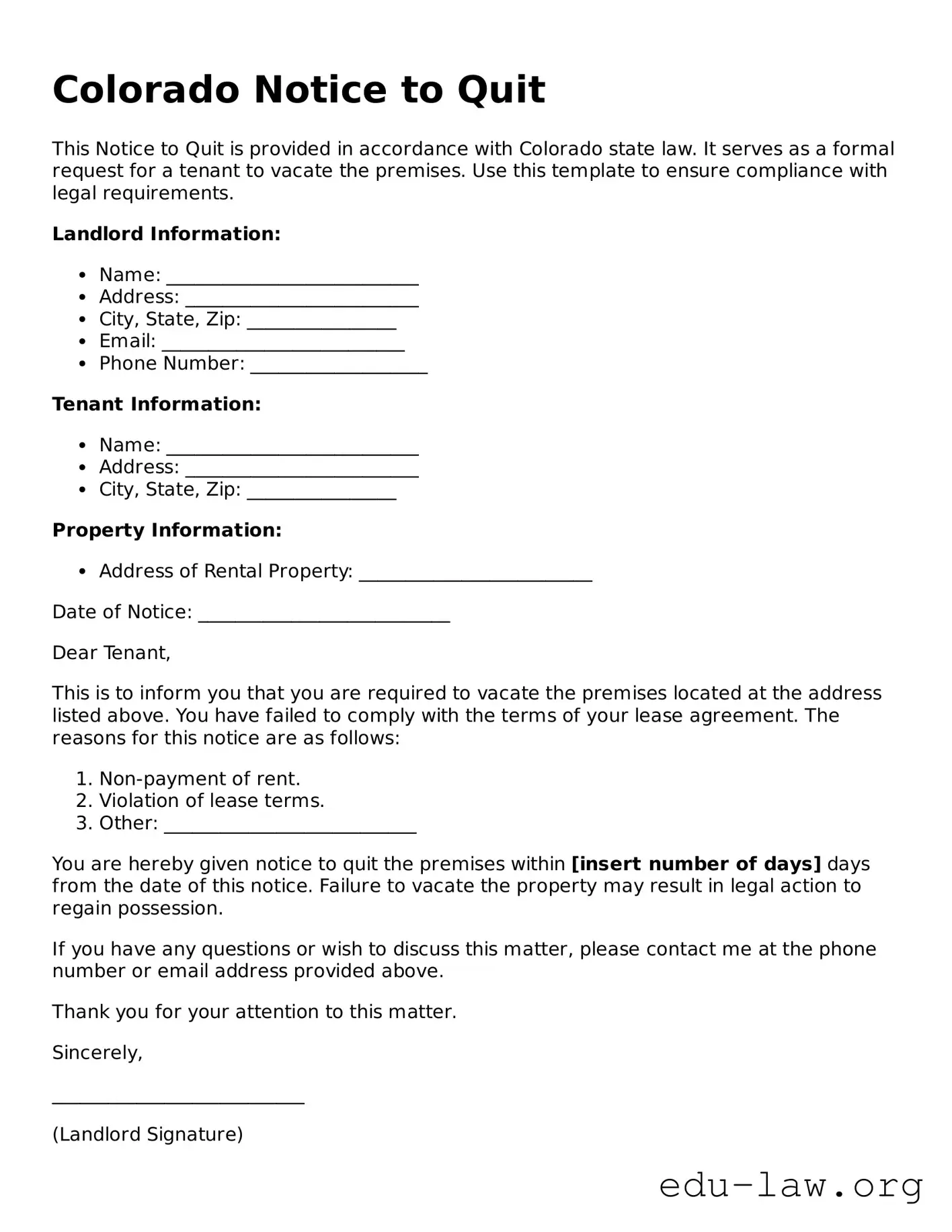
The Colorado Notice to Quit form serves as a crucial document in the landlord-tenant relationship, particularly when it comes to addressing issues of lease termination. This form is typically used by landlords to inform tenants that they must vacate the rental property, often due to non-payment of rent or other lease violations. It outlines specific details such as the reason for the eviction, the time frame in which the tenant must respond or leave, and any relevant state laws that govern the eviction process. By providing clear communication, the Notice to Quit helps to ensure that both parties understand their rights and responsibilities. Additionally, the form may vary depending on the circumstances, such as whether the tenant is being evicted for non-payment or for other breaches of the lease agreement. Understanding this form is essential for both landlords seeking to reclaim their property and tenants who may be facing eviction, as it lays the groundwork for the legal proceedings that may follow.
Colorado Notice to Quit
This Notice to Quit is provided in accordance with Colorado state law. It serves as a formal request for a tenant to vacate the premises. Use this template to ensure compliance with legal requirements.
Landlord Information:
Tenant Information:
Property Information:
Date of Notice: ___________________________
Dear Tenant,
This is to inform you that you are required to vacate the premises located at the address listed above. You have failed to comply with the terms of your lease agreement. The reasons for this notice are as follows:
You are hereby given notice to quit the premises within [insert number of days] days from the date of this notice. Failure to vacate the property may result in legal action to regain possession.
If you have any questions or wish to discuss this matter, please contact me at the phone number or email address provided above.
Thank you for your attention to this matter.
Sincerely,
___________________________
(Landlord Signature)
| Fact Name | Description |
|---|---|
| Purpose | The Colorado Notice to Quit form is used by landlords to inform tenants that they must vacate the rental property. |
| Governing Law | This form is governed by Colorado Revised Statutes, Title 13, Article 40. |
| Types of Notices | There are different types of notices, including those for non-payment of rent and lease violations. |
| Notice Period | The notice period varies depending on the reason for eviction, typically ranging from 3 to 10 days. |
| Delivery Methods | Landlords can deliver the notice by personal service, mail, or posting it on the property. |
| Tenant Rights | Tenants have the right to respond to the notice and can contest the eviction in court. |
| Form Requirements | The form must include specific information, such as the tenant's name, address, and the reason for eviction. |
| Legal Consequences | Failure to comply with the notice can lead to legal action and potential eviction proceedings. |
| Filing with Court | If the tenant does not vacate, the landlord may file an eviction lawsuit after the notice period expires. |
After obtaining the Colorado Notice to Quit form, it is essential to fill it out accurately to ensure it serves its intended purpose. Once completed, the form must be delivered to the tenant in accordance with state regulations.
Once the form is filled out and signed, it must be delivered to the tenant. This can be done in person, by certified mail, or through another method allowed by law. Ensure that you keep a record of how and when the notice was delivered.
What is a Colorado Notice to Quit form?
The Colorado Notice to Quit form is a legal document used by landlords to formally notify tenants that they must vacate the rental property. This notice is typically issued when a tenant has violated lease terms or has not paid rent. It serves as a first step in the eviction process, giving tenants a chance to remedy the situation or prepare to leave the property.
When should a landlord use the Notice to Quit?
A landlord should use the Notice to Quit when a tenant has failed to comply with the lease agreement. Common reasons include non-payment of rent, lease violations, or illegal activity on the premises. The notice provides the tenant with a specified period to either correct the issue or vacate the property.
How long does a tenant have to respond to a Notice to Quit?
The response time can vary based on the reason for the notice. For non-payment of rent, tenants typically have a grace period of 10 days to pay the owed rent or vacate. In cases of lease violations, tenants may have a shorter period, often around 5 days, to address the issue. It's important for tenants to read the notice carefully for specific deadlines.
Is the Notice to Quit the same as an eviction notice?
No, the Notice to Quit is not the same as an eviction notice. The Notice to Quit is a preliminary step that informs the tenant of the need to vacate the premises. An eviction notice, or summons, is issued only after the Notice to Quit has been ignored and the landlord has filed for eviction in court.
Can a tenant contest a Notice to Quit?
Yes, a tenant can contest a Notice to Quit. If a tenant believes the notice is unjust or based on incorrect information, they can respond to the landlord in writing. If the matter escalates to court, the tenant can present their case during the eviction proceedings.
What information must be included in a Notice to Quit?
A Notice to Quit should include specific information such as the tenant's name, the address of the rental property, the reason for the notice, and the date by which the tenant must vacate. It should also include the landlord's contact information and any relevant details about the lease agreement.
How is the Notice to Quit delivered to the tenant?
The Notice to Quit can be delivered in several ways. Common methods include personal delivery to the tenant, mailing the notice via certified mail, or posting the notice on the property. Each method has its own legal requirements, so landlords should choose the method that complies with state laws.
What happens if a tenant does not leave after receiving a Notice to Quit?
If a tenant does not vacate the property by the deadline specified in the Notice to Quit, the landlord may proceed with the eviction process. This involves filing an eviction lawsuit in the local court and obtaining a judgment to remove the tenant from the property legally.
Can a tenant be evicted without a Notice to Quit?
In Colorado, a tenant generally cannot be evicted without first receiving a Notice to Quit. The notice is a required step in the eviction process, providing tenants with an opportunity to remedy any lease violations or settle unpaid rent before further legal action is taken.
Where can I find a Colorado Notice to Quit form?
A Colorado Notice to Quit form can typically be found online through legal aid websites, local government resources, or by consulting with a legal document preparer. It's important to ensure that the form used complies with current Colorado laws and regulations.
Incorrect Tenant Information: One common mistake is failing to accurately fill in the tenant's name and address. This can lead to confusion and complications in the eviction process.
Missing Landlord Details: Landlords sometimes neglect to provide their own name and contact information. This information is crucial for the notice to be valid.
Improper Date: Some individuals forget to date the form. A missing date can make the notice ineffective, as it is essential for establishing timelines.
Failure to Specify the Reason for Eviction: Not clearly stating the reason for the notice can lead to legal challenges. It is important to provide a specific and valid reason.
Not Following Legal Requirements: Many people overlook the specific legal requirements outlined in Colorado law regarding the Notice to Quit. Ignoring these can invalidate the notice.
Improper Delivery Method: Some landlords do not deliver the notice in a manner that complies with state law. Hand delivery, certified mail, or posting may be required.
Neglecting to Keep a Copy: Failing to retain a copy of the Notice to Quit for personal records is a frequent oversight. This documentation may be needed for future legal proceedings.
Ignoring Tenant's Response: After delivering the notice, some landlords do not consider any response from the tenant. Engaging in communication can sometimes resolve the issue without further action.
When dealing with rental agreements and tenant issues in Colorado, the Notice to Quit form is just one piece of the puzzle. Several other documents may be necessary to ensure a smooth process. Here’s a list of commonly used forms that often accompany the Notice to Quit.
Understanding these documents can help landlords and tenants navigate the legal landscape more effectively. Each form plays a crucial role in ensuring that both parties are protected and informed throughout the process.
The Colorado Notice to Quit form shares similarities with the Eviction Notice. Both documents serve as formal notifications to tenants regarding their rental agreements. An Eviction Notice typically outlines the reasons for eviction, such as non-payment of rent or lease violations, while the Notice to Quit primarily informs tenants that they must vacate the property. Each document sets a timeline for compliance, ensuring that tenants understand their obligations and the consequences of failing to respond.
Another document similar to the Notice to Quit is the Lease Termination Letter. This letter is often used by landlords to end a lease agreement, whether it’s a month-to-month rental or a fixed-term lease. Like the Notice to Quit, it provides a clear timeline for the tenant to vacate the premises. However, the Lease Termination Letter may include additional information about the reasons for termination and any final steps needed for the move-out process.
The Demand for Rent is also comparable to the Notice to Quit. This document is issued when a tenant has failed to pay rent on time. While the Notice to Quit can be used for various reasons, the Demand for Rent specifically addresses payment issues. It urges the tenant to pay the overdue rent or face potential eviction. Both documents aim to prompt action from the tenant and clarify the landlord's expectations.
The Notice of Lease Violation is another document that bears resemblance to the Notice to Quit. This notice is issued when a tenant breaches the terms of their lease agreement. It details the specific violations, such as unauthorized pets or excessive noise. While the Notice to Quit requires the tenant to leave, the Notice of Lease Violation often gives the tenant a chance to correct their behavior before further actions are taken. Both documents emphasize the importance of adhering to lease terms.
Lastly, the Five-Day Notice to Pay Rent or Quit is similar to the Colorado Notice to Quit. This specific notice is used in some jurisdictions to inform tenants that they have five days to pay overdue rent or face eviction. It combines elements of both the Demand for Rent and the Notice to Quit. This document is straightforward, urging tenants to resolve their financial obligations quickly while also outlining the potential consequences of non-compliance.
When filling out the Colorado Notice to Quit form, it is essential to approach the task with care. Here are four important guidelines to follow:
Conversely, there are also actions to avoid when completing the form:
This is not entirely accurate. A Notice to Quit is a preliminary step that informs a tenant they must vacate the property. It does not, by itself, initiate eviction proceedings.
Landlords must have a valid legal reason, such as non-payment of rent or lease violations, to issue this notice. Arbitrary reasons are not permissible under the law.
Tenants retain the right to respond, negotiate, or contest the notice. They can also seek legal assistance to address the situation.
While personal delivery is one method, landlords can also send the notice via certified mail or post it on the property, depending on local laws.
Although it is recommended to use a formal template, a simple written notice can suffice as long as it contains the necessary information.
Landlords must adhere to the terms of the lease agreement and applicable laws. Notices cannot be issued arbitrarily or without cause.
When dealing with tenant issues in Colorado, the Notice to Quit form plays a crucial role. Here are some key takeaways to keep in mind when filling out and using this form:
By understanding these key points, landlords can navigate the eviction process more effectively and ensure compliance with Colorado laws.