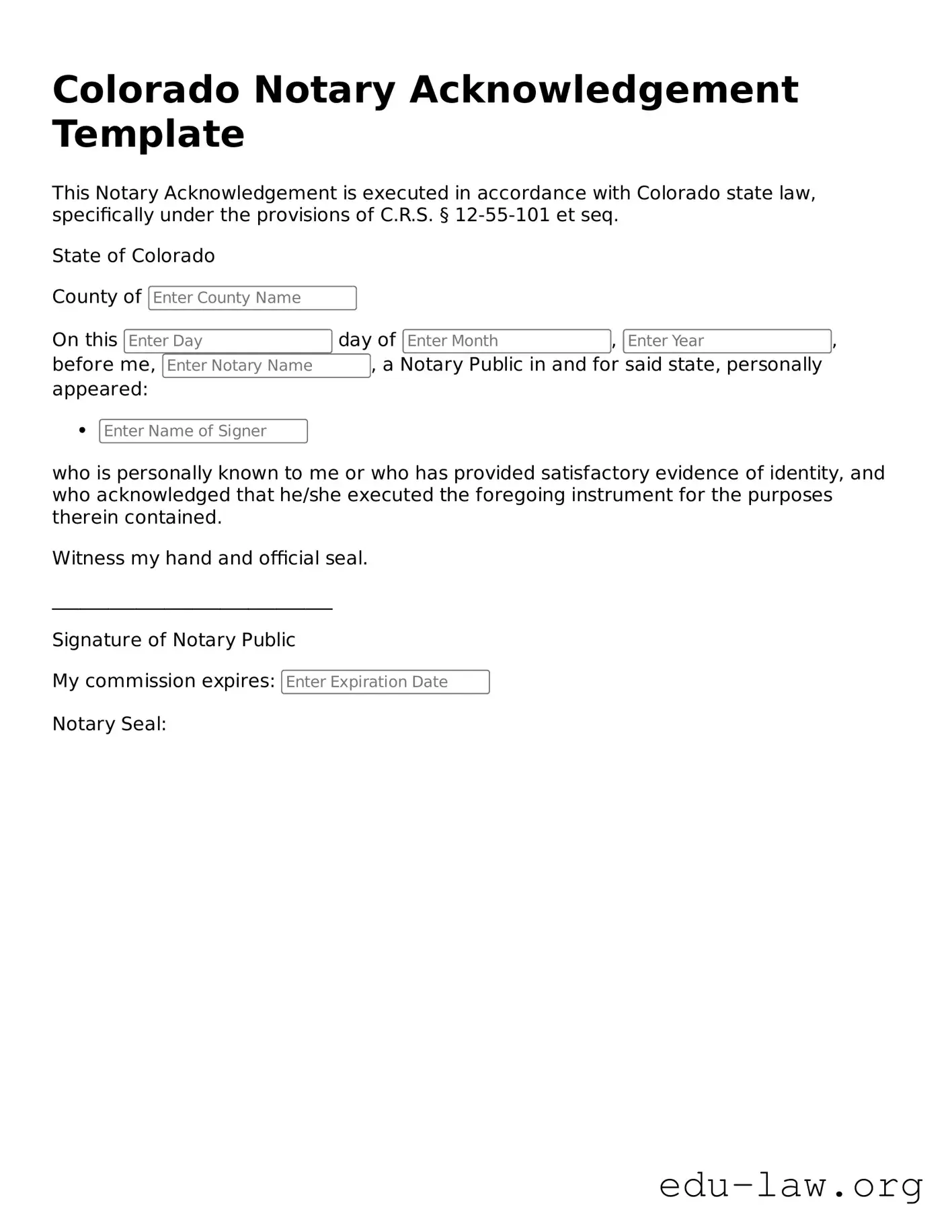
The Colorado Notary Acknowledgement form serves a crucial role in the notarization process, ensuring that documents are properly validated and recognized by the state. This form is typically utilized when a signer wishes to confirm their identity and their willingness to sign a document voluntarily. It requires specific details, including the name of the signer, the date of the acknowledgment, and the notary's official signature and seal. The form also includes a statement affirming that the signer appeared before the notary and acknowledged their signature. By providing a clear framework for these essential elements, the Colorado Notary Acknowledgement form helps to prevent fraud and ensures that legal documents carry the necessary authenticity. Understanding its components is vital for anyone involved in legal transactions, as it not only protects the parties involved but also upholds the integrity of the notarization process in Colorado.
Colorado Notary Acknowledgement Template
This Notary Acknowledgement is executed in accordance with Colorado state law, specifically under the provisions of C.R.S. § 12-55-101 et seq.
State of Colorado
County of
On this day of , , before me, , a Notary Public in and for said state, personally appeared:
who is personally known to me or who has provided satisfactory evidence of identity, and who acknowledged that he/she executed the foregoing instrument for the purposes therein contained.
Witness my hand and official seal.
______________________________
Signature of Notary Public
My commission expires:
Notary Seal:
| Fact Name | Details |
|---|---|
| Governing Law | The Colorado Notary Acknowledgment form is governed by Colorado Revised Statutes, Title 12, Article 55. |
| Purpose | This form is used to verify the identity of a signer and confirm that they willingly signed a document. |
| Signature Requirement | The signer must be present when the notary performs the acknowledgment. |
| Notary's Role | A notary public must complete the form, certifying that the signer is who they claim to be. |
| Identification | The signer must provide valid identification to the notary before the acknowledgment can take place. |
| Record Keeping | Notaries are required to keep a record of the acknowledgment in their official journal. |
| Fees | Colorado law allows notaries to charge a fee for their services, which is typically capped at $5 per acknowledgment. |
| Form Variations | While there is a standard form, variations may exist based on the type of document being acknowledged. |
After obtaining the Colorado Notary Acknowledgement form, it is essential to complete it accurately. This ensures that the document is valid and can be used as intended. Follow these steps carefully to fill out the form.
Once the form is filled out, review it for any errors or omissions. After confirming that everything is correct, the form can be submitted or used as needed.
What is a Colorado Notary Acknowledgement form?
The Colorado Notary Acknowledgement form is a legal document used to verify that a person has willingly signed a document in front of a notary public. This form serves as proof that the individual acknowledged their signature and the contents of the document, which can be crucial in various legal and financial transactions.
When do I need to use a Notary Acknowledgement form?
You typically need a Notary Acknowledgement form when you are signing important documents such as deeds, contracts, or affidavits. It is especially important in situations where the authenticity of the signature needs to be verified, like real estate transactions or court documents.
Who can serve as a notary public in Colorado?
In Colorado, a notary public can be any individual who is at least 18 years old, a resident of Colorado, and has completed the necessary training and passed the required exam. Additionally, they must apply for and receive a notary commission from the Secretary of State's office.
What information is required on the Notary Acknowledgement form?
The Notary Acknowledgement form typically requires the name of the person signing the document, the date of the acknowledgment, the notary's signature, and their seal. It may also include details about the document being signed, ensuring that all necessary information is accurately recorded.
Is a Notary Acknowledgement the same as a Notarization?
While a Notary Acknowledgement is a type of notarization, not all notarizations are acknowledgments. Acknowledgments confirm that the signer has appeared before the notary and acknowledged their signature. Other types of notarizations may involve administering oaths or affirmations, or certifying copies of documents.
Can I get a Notary Acknowledgement for a document that is not in English?
Yes, you can obtain a Notary Acknowledgement for a document that is not in English. However, it is advisable to have a certified translation available. The notary must understand the contents of the document they are notarizing, so providing a translation can help ensure that the process goes smoothly.
How much does it cost to get a document notarized in Colorado?
The cost of notarization in Colorado can vary. Notaries are allowed to charge a fee, which is typically around $5 per signature. However, prices may differ based on the notary's location and any additional services they offer, such as travel fees or specialized services.
Do I need to be present for the Notary Acknowledgement?
Yes, you must be present when the notary acknowledges your signature. This is a key aspect of the process, as the notary needs to confirm your identity and witness you signing the document. Remote notarization options may be available, but they follow specific rules and guidelines.
Incorrect Date: People often forget to fill in the date of the notarization. This date is crucial as it indicates when the document was acknowledged. Without it, the form may be considered incomplete.
Missing Signatures: Some individuals overlook the need for the signer’s signature. The notary must witness the signer’s signature, and if it’s missing, the acknowledgment is invalid.
Wrong Notary Information: Notaries sometimes fail to include their correct name, title, or commission number. This information must be accurate to ensure the acknowledgment is legitimate.
Improper Identification: It’s essential for the notary to verify the identity of the signer. If proper identification is not presented, the acknowledgment cannot be completed correctly.
When dealing with the Colorado Notary Acknowledgement form, it’s often helpful to be aware of other related documents that may come into play. These forms can complement the Notary Acknowledgement, ensuring that your legal processes run smoothly and effectively. Here’s a brief overview of four common forms that are frequently used alongside it.
Understanding these documents can help streamline your legal processes and ensure that everything is in order. Whether you're transferring property, granting authority, or simply formalizing an agreement, being aware of these forms can make your experience smoother and more efficient.
The Colorado Notary Acknowledgment form shares similarities with the Affidavit. Both documents serve as sworn statements, affirming the truthfulness of the information contained within. An individual typically signs an affidavit in the presence of a notary, who then verifies the identity of the signer. This process ensures that the information presented is credible and legally binding, much like the acknowledgment process in a notary form.
Another document akin to the Notary Acknowledgment is the Power of Attorney. This legal instrument allows one person to grant another the authority to act on their behalf. Like the notary acknowledgment, the Power of Attorney requires the principal's signature to be notarized, confirming that the principal understands the implications of the document and is signing voluntarily. Both documents require a notary to validate the identity of the signers, ensuring authenticity.
The Deed also shares characteristics with the Notary Acknowledgment form. A deed transfers ownership of property and must be signed in front of a notary to be legally effective. The notary's role is to confirm the identity of the parties involved and ensure that they are signing willingly. This parallels the acknowledgment process, where the notary certifies the signer's identity and intention.
Similar to the Notary Acknowledgment is the Certificate of Acknowledgment. This document is often used in real estate transactions to verify that a signature on a document is genuine. The certificate is completed by a notary public, who confirms that the signer appeared before them and acknowledged their signature. This serves the same purpose as the Notary Acknowledgment form, providing a layer of verification to the signing process.
The Jurat is another document that bears resemblance to the Notary Acknowledgment form. A jurat is a notarial act in which a notary certifies that a signer has sworn or affirmed the truth of the contents of a document. Like the acknowledgment, it requires the presence of the notary and the signer's identification. Both serve to ensure that the statements made are credible and legally binding.
The Will is similar in that it often requires notarization to ensure its validity. While not all wills must be notarized, those that are often include a self-proving affidavit, which is acknowledged by a notary. This process provides assurance that the testator was of sound mind and signed the will voluntarily, akin to the assurances provided by a Notary Acknowledgment form.
The Bill of Sale also shares similarities with the Notary Acknowledgment. This document transfers ownership of personal property and may require notarization to be enforceable. The notary verifies the identities of the parties involved, ensuring that the transaction is legitimate. This process mirrors the acknowledgment of signatures, providing a safeguard against fraud.
The Release of Liability form is another document that resembles the Notary Acknowledgment. This form is used to relinquish rights to make a claim against another party. Notarization may be required to validate the release, ensuring that the signer understands the consequences of their decision. The notary's role in confirming the identity of the signer parallels the acknowledgment process.
Lastly, the Settlement Agreement can be compared to the Notary Acknowledgment form. This document outlines the terms of a settlement between parties and often requires notarization to confirm that all parties have agreed to the terms willingly. The notary's verification of identities and intentions adds a layer of security, similar to the acknowledgment process in notarial acts.
When filling out the Colorado Notary Acknowledgement form, it is crucial to follow specific guidelines to ensure the document is valid. Here are seven important dos and don'ts to keep in mind:
By following these guidelines, you can help ensure that your notary acknowledgment is properly executed and legally binding. Pay attention to each detail to avoid complications later on.
Understanding the Colorado Notary Acknowledgement form is essential for anyone needing notarization services. However, several misconceptions can lead to confusion. Here are six common misunderstandings:
Being aware of these misconceptions can help individuals navigate the notary process more effectively. Always consult a professional if in doubt about the requirements for notarization.
When using the Colorado Notary Acknowledgement form, it's important to understand the key elements involved. Here are some essential takeaways to keep in mind: