In Colorado, non-compete agreements serve as important legal tools for employers seeking to protect their business interests while balancing the rights of employees. These agreements typically outline the restrictions placed on an employee regarding their ability to work for competitors or start a competing business after leaving their current employer. Key aspects of the Colorado Non-compete Agreement form include the duration of the restrictions, the geographical area in which they apply, and the specific activities that are prohibited. It is essential for both employers and employees to understand the implications of these agreements, as Colorado law imposes certain limitations on their enforceability. For instance, non-compete agreements are generally only enforceable for employees who earn a salary above a specific threshold. Additionally, the form must be clear and reasonable in its terms to be considered valid. By understanding the nuances of the Colorado Non-compete Agreement form, both parties can navigate their rights and obligations effectively, ensuring that the agreement serves its intended purpose without infringing on individual freedoms.
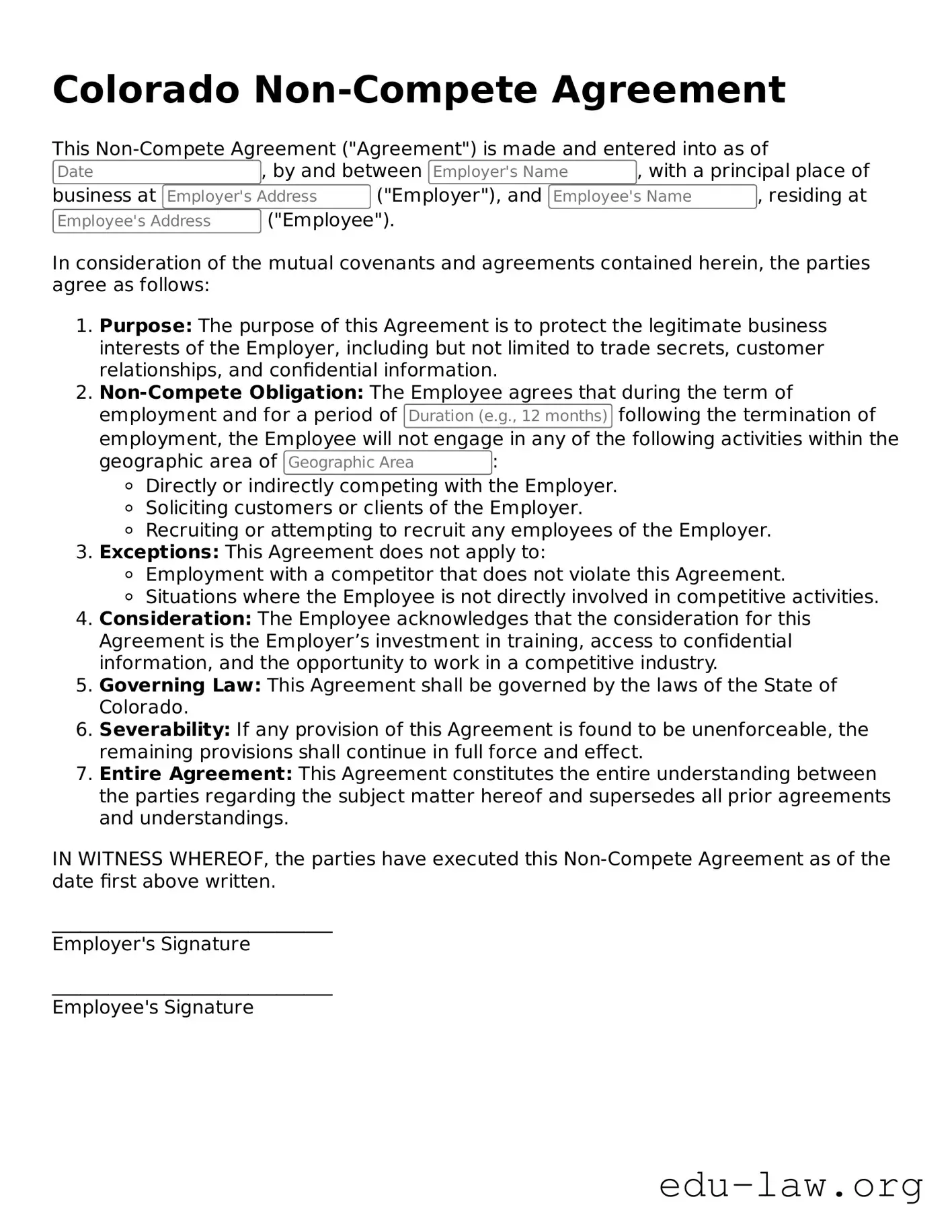
Colorado Non-Compete Agreement
This Non-Compete Agreement ("Agreement") is made and entered into as of , by and between , with a principal place of business at ("Employer"), and , residing at ("Employee").
In consideration of the mutual covenants and agreements contained herein, the parties agree as follows:
IN WITNESS WHEREOF, the parties have executed this Non-Compete Agreement as of the date first above written.
______________________________
Employer's Signature
______________________________
Employee's Signature
| Fact Name | Description |
|---|---|
| Governing Law | The Colorado Non-compete Agreement is governed by Colorado Revised Statutes, specifically § 8-2-113. |
| Enforceability | Non-compete agreements in Colorado are generally enforceable only under specific conditions. |
| Restrictions | These agreements can only restrict employees from working in a similar field for up to one year after leaving the company. |
| Geographic Limitations | Colorado law requires that non-compete agreements specify a reasonable geographic area where the restrictions apply. |
| Consideration Requirement | A valid non-compete agreement must provide adequate consideration, such as a job offer or promotion. |
| Exceptions | Certain professions, such as those in the medical field, have specific rules regarding non-compete agreements. |
| Employee Rights | Employees have the right to challenge overly restrictive non-compete agreements in court. |
| Non-solicitation Clauses | Colorado allows non-solicitation clauses, which can prevent former employees from poaching clients or employees. |
| Duration of Agreement | Agreements must clearly state the duration of the restrictions, which cannot exceed one year. |
| Legal Advice | It is advisable to seek legal counsel when drafting or signing a non-compete agreement to ensure compliance with state laws. |
Once you have the Colorado Non-compete Agreement form in hand, it's time to fill it out carefully. This document requires specific information to ensure it meets legal standards. Follow these steps to complete the form accurately.
After completing the form, make sure to keep a copy for your records. You may need to submit it to your employer or retain it for future reference. Double-check all entries for accuracy before finalizing the document.
What is a Colorado Non-compete Agreement?
A Colorado Non-compete Agreement is a legal document that restricts an employee from engaging in certain activities that may compete with their employer after leaving the company. In Colorado, these agreements are generally limited in scope and duration, ensuring that they do not unduly restrict an individual's ability to find work in their field. They are designed to protect legitimate business interests, such as trade secrets and customer relationships.
Are non-compete agreements enforceable in Colorado?
Yes, non-compete agreements can be enforceable in Colorado, but they must meet specific criteria. Colorado law limits the enforceability of these agreements primarily to situations involving the sale of a business or the protection of trade secrets. For employment-related non-compete agreements, they must be reasonable in duration, geographic area, and scope of activity. If they are deemed overly restrictive, a court may not enforce them.
How long can a non-compete agreement last in Colorado?
The duration of a non-compete agreement in Colorado should be reasonable. While there is no strict rule, most courts consider agreements lasting six months to two years as potentially acceptable. However, the specific context and circumstances surrounding the agreement play a significant role in determining what is deemed reasonable.
Can I negotiate the terms of a non-compete agreement?
Absolutely! It is common for employees to negotiate the terms of a non-compete agreement before signing. If you feel that certain aspects of the agreement are too restrictive or unfair, you have the right to discuss your concerns with your employer. This negotiation can lead to a more balanced agreement that protects both your interests and those of your employer.
What should I do if I believe my non-compete agreement is unfair?
If you believe your non-compete agreement is unfair, it is essential to seek legal advice. An attorney who specializes in employment law can help you understand your rights and options. They can assist in reviewing the agreement, determining its enforceability, and advising you on the best course of action, whether that involves negotiation or potential legal challenges.
Not Understanding the Terms: Many individuals rush through the form without fully grasping the implications of the non-compete agreement. It's essential to understand what you're agreeing to, including the duration and geographic scope of the restrictions.
Leaving Out Essential Details: Failing to include important information, such as the specific job title or role, can lead to confusion later. Ensure that all relevant details are clearly stated.
Inaccurate Dates: Incorrectly filling out the start and end dates of the agreement can create legal issues. Double-check these dates to avoid misunderstandings.
Neglecting to Review for Completeness: Skipping a final review of the entire document can result in overlooked sections. Take the time to ensure that every part of the form is filled out completely.
Ignoring State-Specific Laws: Each state has its own laws regarding non-compete agreements. Failing to consider Colorado's specific regulations can lead to unenforceable clauses.
Not Seeking Legal Advice: Some individuals assume they can handle the agreement on their own. However, consulting with a legal professional can provide clarity and ensure that your rights are protected.
Using Ambiguous Language: Vague terms can create confusion. It's important to use clear and specific language to avoid misinterpretations in the future.
Failing to Keep a Copy: After filling out the form, some forget to keep a copy for their records. Always retain a signed copy for your personal files.
Not Discussing with the Employer: Some individuals fill out the form without discussing it with their employer. Open communication can clarify expectations and prevent potential conflicts.
When entering into a Non-compete Agreement in Colorado, it’s often beneficial to consider additional documents that can support the agreement and clarify the relationship between the parties involved. Here are four commonly used forms and documents that may accompany a Non-compete Agreement:
Incorporating these documents alongside a Non-compete Agreement can help ensure that all aspects of the employment relationship are clearly defined and legally protected. It is advisable to consult with a legal professional to tailor these agreements to your specific situation.
The Colorado Non-compete Agreement form shares similarities with a Non-disclosure Agreement (NDA). Both documents aim to protect sensitive information. While the Non-compete Agreement restricts an employee from working with competitors after leaving a job, the NDA prevents the sharing of confidential information during and after employment. Employers often use both documents to safeguard their business interests, ensuring that proprietary information and trade secrets remain secure even when employees move on to other opportunities.
Another document akin to the Non-compete Agreement is the Non-solicitation Agreement. This agreement specifically prohibits an employee from soliciting clients or employees from their former employer. Like the Non-compete Agreement, it seeks to protect the business's relationships and workforce. Non-solicitation Agreements are often used in conjunction with Non-compete Agreements to create a comprehensive strategy for protecting a company's interests when an employee departs.
The Employment Agreement also bears resemblance to the Non-compete Agreement. An Employment Agreement outlines the terms and conditions of employment, including duties, compensation, and termination. Often, it includes clauses that detail non-compete obligations. Both documents serve to clarify expectations and protect the employer's interests, but the Employment Agreement encompasses a broader range of employment terms beyond just competition restrictions.
Finally, the Confidentiality Agreement is similar to the Non-compete Agreement in that it focuses on protecting sensitive information. This document ensures that employees do not disclose proprietary information they may encounter during their employment. While the Non-compete Agreement restricts future employment opportunities, the Confidentiality Agreement emphasizes the importance of keeping business secrets safe. Both agreements are essential tools for businesses to maintain their competitive edge and safeguard their intellectual property.
When filling out the Colorado Non-compete Agreement form, it is essential to approach the task with care. This document can significantly impact your professional future. Here are five important considerations to keep in mind:
By adhering to these guidelines, you can navigate the complexities of the Colorado Non-compete Agreement with greater confidence. It is always better to be informed and prepared.
Understanding the Colorado Non-compete Agreement form is essential for both employers and employees. However, several misconceptions can lead to confusion and misinterpretation. Here are four common misconceptions:
Clarifying these misconceptions can help both employers and employees navigate the complexities of non-compete agreements in Colorado more effectively.
When considering a Non-compete Agreement in Colorado, it’s essential to understand its nuances and implications. Here are key takeaways to keep in mind:
By understanding these key points, both employers and employees can navigate the complexities of non-compete agreements more effectively.