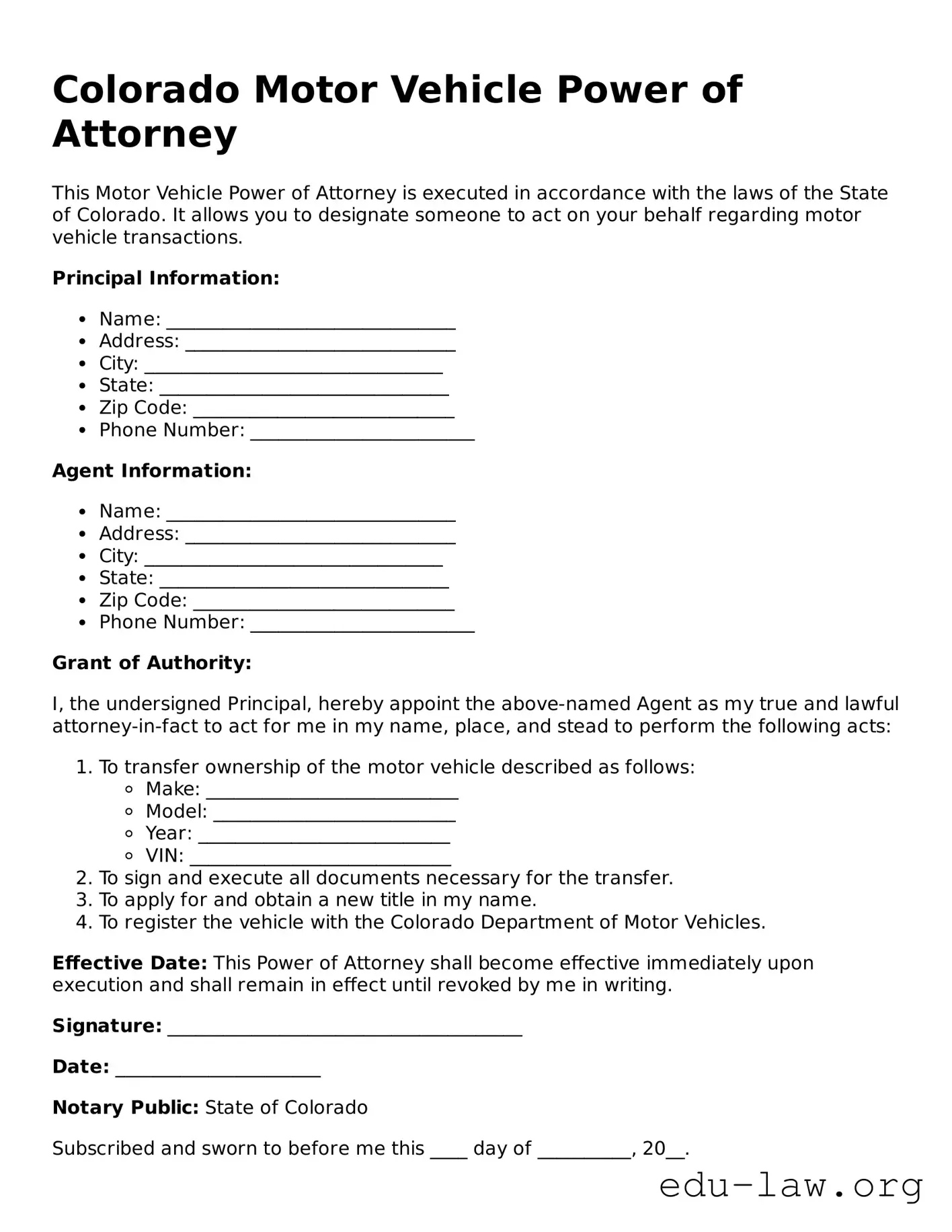
When it comes to managing your vehicle-related affairs in Colorado, the Motor Vehicle Power of Attorney form serves as a vital tool. This form allows you to appoint someone else to act on your behalf for various tasks related to your vehicle. Whether you need assistance with transferring ownership, registering a vehicle, or handling title issues, this document can simplify the process. It's particularly useful when you cannot be present to complete these tasks yourself. By designating a trusted individual, you ensure that your vehicle matters are taken care of efficiently and effectively. Understanding the key elements of this form, including how to fill it out and the responsibilities of the appointed agent, can make navigating vehicle transactions much smoother.
Colorado Motor Vehicle Power of Attorney
This Motor Vehicle Power of Attorney is executed in accordance with the laws of the State of Colorado. It allows you to designate someone to act on your behalf regarding motor vehicle transactions.
Principal Information:
Agent Information:
Grant of Authority:
I, the undersigned Principal, hereby appoint the above-named Agent as my true and lawful attorney-in-fact to act for me in my name, place, and stead to perform the following acts:
Effective Date: This Power of Attorney shall become effective immediately upon execution and shall remain in effect until revoked by me in writing.
Signature: ______________________________________
Date: ______________________
Notary Public: State of Colorado
Subscribed and sworn to before me this ____ day of __________, 20__.
My commission expires: _______________________
Notary Signature: _____________________________
| Fact Name | Description |
|---|---|
| Purpose | The Colorado Motor Vehicle Power of Attorney form allows an individual to authorize another person to act on their behalf in matters related to motor vehicle transactions. |
| Governing Law | This form is governed by the Colorado Revised Statutes, specifically § 15-14-501 et seq., which outlines the powers and responsibilities of agents under a power of attorney. |
| Eligibility | Any adult resident of Colorado can complete this form to designate an agent for motor vehicle matters. |
| Agent's Authority | The appointed agent can perform various tasks, including signing documents for vehicle registration, titling, and transferring ownership. |
| Revocation | The principal can revoke the power of attorney at any time as long as they are mentally competent. |
| Signature Requirement | The form must be signed by the principal and may require notarization to ensure its validity. |
| Use Cases | This form is commonly used when someone cannot be present to handle vehicle transactions, such as during relocation or illness. |
Filling out the Colorado Motor Vehicle Power of Attorney form is an important step if you need to authorize someone else to handle your vehicle-related matters. Once you have completed the form, you can submit it to the appropriate authorities or give it to the person you are designating as your agent.
Once you have filled out and signed the form, ensure that your agent understands their responsibilities. Keep the completed form in a safe place, and provide a copy to your agent so they can carry it when needed.
What is a Colorado Motor Vehicle Power of Attorney form?
The Colorado Motor Vehicle Power of Attorney form allows an individual to appoint someone else to act on their behalf in matters related to motor vehicles. This can include tasks such as transferring ownership, registering a vehicle, or obtaining a duplicate title. The person appointed is known as the agent, and they can perform specific actions as outlined in the form. This document is particularly useful when the owner cannot be present to complete these tasks themselves.
Who can be appointed as an agent in this form?
Any adult individual can be appointed as an agent using the Colorado Motor Vehicle Power of Attorney form. This could be a family member, friend, or even a professional, such as an attorney. It is important to choose someone trustworthy, as they will have the authority to make decisions regarding the motor vehicle in question. The agent must be willing to accept this responsibility and act in the best interest of the vehicle owner.
How do I complete the Colorado Motor Vehicle Power of Attorney form?
To complete the form, you need to provide specific information about both the vehicle owner and the agent. This includes names, addresses, and any relevant vehicle details, such as the Vehicle Identification Number (VIN). After filling out the necessary information, both parties should sign the document. It is advisable to have the signatures notarized to ensure the form is legally binding. Once completed, the form can be submitted to the appropriate motor vehicle authority as needed.
Is the Colorado Motor Vehicle Power of Attorney form permanent?
No, the Colorado Motor Vehicle Power of Attorney form is not permanent. It can be revoked at any time by the vehicle owner, as long as they are of sound mind. To revoke the authority granted, the owner should provide written notice to the agent and, if necessary, submit a revocation form to the motor vehicle authority. It is important for the vehicle owner to keep track of any changes in their wishes regarding the power of attorney.
Inadequate Identification of the Principal and Agent: One common mistake is failing to provide complete and accurate information for both the principal (the person granting authority) and the agent (the person receiving authority). This includes not including full names, addresses, or other identifying details. Without clear identification, the document may be considered invalid.
Not Specifying the Scope of Authority: Another frequent error is not clearly defining the powers being granted. The form should specify whether the agent has authority to handle all motor vehicle transactions or just specific ones, such as transferring ownership or registering a vehicle. Ambiguities can lead to misunderstandings and potential disputes.
Failure to Sign and Date: A critical step often overlooked is the need for both the principal and the agent to sign and date the form. Without signatures, the document lacks legal validity. It’s important to ensure that all required signatures are present before submitting the form.
Ignoring Notarization Requirements: In Colorado, notarization may be required for the Power of Attorney to be effective. Many individuals mistakenly assume that the form is valid without a notary’s acknowledgment. Neglecting this step can render the document unenforceable.
The Colorado Motor Vehicle Power of Attorney form allows an individual to designate another person to act on their behalf regarding motor vehicle transactions. This form is often accompanied by various other documents that facilitate the process of vehicle ownership transfer, registration, and other related activities. Below is a list of commonly used forms and documents that may be relevant in conjunction with the Motor Vehicle Power of Attorney.
Understanding these documents and their purposes can help streamline the process of vehicle ownership and ensure compliance with state regulations. Each form plays a critical role in facilitating transactions and protecting the rights of all parties involved.
The Colorado Motor Vehicle Power of Attorney form shares similarities with the General Power of Attorney document. Both forms allow an individual to designate another person to act on their behalf in various matters. However, the General Power of Attorney is broader in scope, covering financial and legal decisions beyond just motor vehicle transactions. This flexibility makes it suitable for a wide range of situations, while the Motor Vehicle Power of Attorney is specifically tailored to vehicle-related matters.
Another document that resembles the Colorado Motor Vehicle Power of Attorney is the Durable Power of Attorney. Like the Motor Vehicle Power of Attorney, the Durable Power of Attorney allows an individual to appoint an agent to manage their affairs. The key difference lies in its durability; it remains effective even if the principal becomes incapacitated. This feature is particularly important for individuals seeking to ensure their affairs are managed continuously, especially in health-related scenarios.
The Medical Power of Attorney is also similar, as it permits one person to make medical decisions for another. While the focus here is on health care rather than motor vehicles, both documents empower an agent to act in the best interest of the principal. This shared characteristic emphasizes the importance of trust and clarity in the agent-principal relationship, regardless of the specific domain of authority.
The Limited Power of Attorney is another related document. This form allows individuals to grant specific powers to an agent for a limited time or purpose. Similar to the Motor Vehicle Power of Attorney, it can be used for particular transactions, such as selling a vehicle. The distinction lies in its temporary nature; the Limited Power of Attorney is not intended for ongoing representation, making it suitable for specific, time-sensitive tasks.
Finally, the Real Estate Power of Attorney bears resemblance to the Colorado Motor Vehicle Power of Attorney in that both documents facilitate transactions involving property. The Real Estate Power of Attorney allows an agent to handle matters related to real estate transactions, such as buying or selling property. While the focus is different—real estate versus motor vehicles—the underlying principle of delegating authority to an agent remains the same, highlighting the importance of trusted representation in various legal contexts.
When filling out the Colorado Motor Vehicle Power of Attorney form, it’s important to follow certain guidelines to ensure everything is completed correctly. Here’s a helpful list of dos and don’ts to consider:
Following these guidelines can help ensure that your Power of Attorney form is processed smoothly and without delays.
The Colorado Motor Vehicle Power of Attorney (POA) form is a useful tool for individuals who need to delegate authority regarding their vehicle to another person. However, several misconceptions can lead to confusion about its use. Here are four common misconceptions:
This is not true. While the form is primarily designed for vehicle owners, it can also be used by individuals who have been given permission to act on behalf of the owner. For example, a parent can sign a POA for their child to manage their vehicle transactions.
Many believe that this form is only valid within Colorado's borders. In reality, while it is designed for use in Colorado, it can be recognized in other states, especially if it meets their requirements. However, it is always wise to check local laws to ensure compliance.
Some people think that notarization is mandatory for the Motor Vehicle POA to be effective. However, this is not the case in Colorado. The form can be valid without a notary, as long as it is properly completed and signed by the principal.
This misconception can lead to significant misunderstandings. The authority granted through a Motor Vehicle POA is not permanent; it can be revoked at any time by the principal. Additionally, the authority typically ends upon the principal's death.
Filling out and using the Colorado Motor Vehicle Power of Attorney form is a straightforward process, but it’s essential to understand its key aspects. Here are some important takeaways:
By following these guidelines, you can effectively use the Colorado Motor Vehicle Power of Attorney form to manage your vehicle-related affairs.