In the state of Colorado, a Medical Power of Attorney (MPOA) serves as a vital legal document that empowers individuals to designate a trusted person to make healthcare decisions on their behalf in the event they become unable to do so. This form is particularly significant for those who wish to ensure their medical preferences are honored during critical moments when they may not be able to communicate their wishes. The MPOA allows the appointed agent to consult with healthcare providers, access medical records, and make informed decisions regarding treatment options. It covers a range of healthcare decisions, from routine medical care to end-of-life treatment choices, ensuring that the individual's values and preferences guide the care they receive. By completing this form, individuals can have peace of mind knowing that their healthcare decisions will be managed by someone they trust, reflecting their personal beliefs and desires. Understanding the nuances of the Colorado Medical Power of Attorney form is essential for anyone looking to take proactive steps in managing their healthcare needs and ensuring that their voice is heard, even when they cannot speak for themselves.
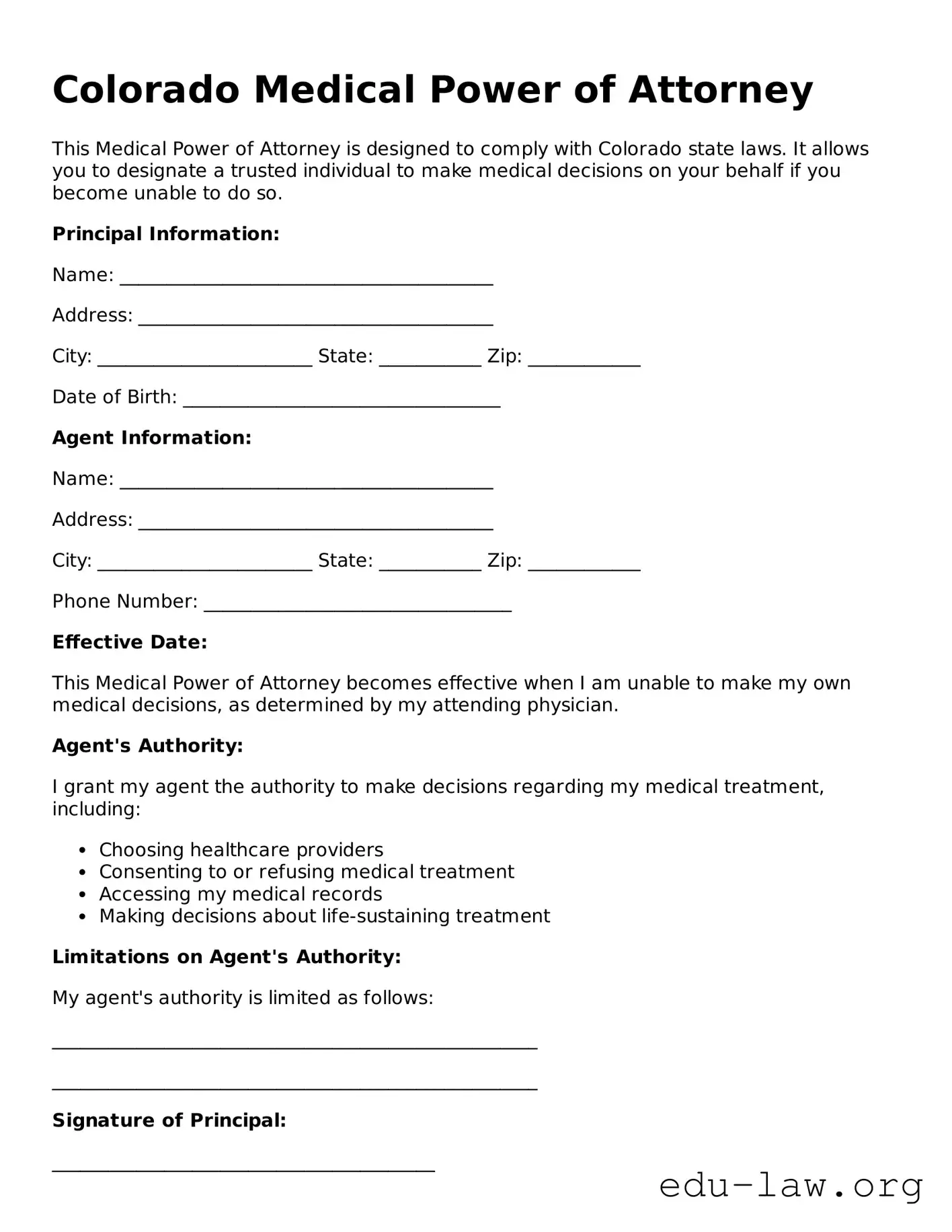
Colorado Medical Power of Attorney
This Medical Power of Attorney is designed to comply with Colorado state laws. It allows you to designate a trusted individual to make medical decisions on your behalf if you become unable to do so.
Principal Information:
Name: ________________________________________
Address: ______________________________________
City: _______________________ State: ___________ Zip: ____________
Date of Birth: __________________________________
Agent Information:
Name: ________________________________________
Address: ______________________________________
City: _______________________ State: ___________ Zip: ____________
Phone Number: _________________________________
Effective Date:
This Medical Power of Attorney becomes effective when I am unable to make my own medical decisions, as determined by my attending physician.
Agent's Authority:
I grant my agent the authority to make decisions regarding my medical treatment, including:
Limitations on Agent's Authority:
My agent's authority is limited as follows:
____________________________________________________
____________________________________________________
Signature of Principal:
_________________________________________
Date: __________________________________
Witnesses:
This document must be signed in the presence of two witnesses who are not related to the principal or the agent.
Witness 1 Name: _______________________________
Witness 1 Signature: __________________________
Date: ______________________________________
Witness 2 Name: _______________________________
Witness 2 Signature: __________________________
Date: ______________________________________
Notarization (optional):
State of Colorado
County of ____________________________
Subscribed and sworn before me on this ______ day of __________, 20__.
Notary Public: _______________________________
My commission expires: ______________________
| Fact Name | Description |
|---|---|
| Definition | The Colorado Medical Power of Attorney form allows an individual to designate another person to make medical decisions on their behalf if they become incapacitated. |
| Governing Law | This form is governed by the Colorado Revised Statutes, specifically Title 15, Article 18. |
| Eligibility | Any competent adult can complete a Medical Power of Attorney in Colorado. |
| Agent Selection | The principal has the right to choose any adult as their agent, except for certain individuals such as healthcare providers involved in the principal's care. |
| Durability | The authority granted in the Medical Power of Attorney remains effective even if the principal becomes incapacitated. |
| Revocation | The principal can revoke the Medical Power of Attorney at any time, provided they are still competent to do so. |
| Witness Requirement | The form must be signed in the presence of two witnesses or a notary public to be valid. |
| Limitations | The agent's authority is limited to making medical decisions and does not extend to financial or legal matters. |
| Notification | It is advisable for the principal to inform their healthcare providers and family members about the existence of the Medical Power of Attorney. |
| Form Availability | The Colorado Medical Power of Attorney form is available online through various legal resources and state websites. |
Filling out the Colorado Medical Power of Attorney form is an important step in ensuring your healthcare wishes are respected. This form allows you to appoint someone you trust to make medical decisions on your behalf if you are unable to do so. Follow these steps carefully to complete the form accurately.
What is a Colorado Medical Power of Attorney?
A Colorado Medical Power of Attorney is a legal document that allows an individual, known as the principal, to appoint another person, called an agent, to make medical decisions on their behalf if they become unable to do so. This ensures that the principal's healthcare preferences are respected even when they cannot communicate them directly.
Who can be appointed as an agent in a Medical Power of Attorney?
In Colorado, any competent adult can be appointed as an agent. This includes family members, friends, or trusted individuals. However, it is advisable to choose someone who understands your healthcare wishes and can make decisions in line with your values and preferences.
Does the Medical Power of Attorney need to be notarized?
Yes, in Colorado, the Medical Power of Attorney must be signed by the principal and witnessed by two individuals or notarized. The witnesses cannot be related to the principal or have any financial interest in the principal's estate. This requirement helps ensure the document is valid and reflects the principal's true intentions.
Can the Medical Power of Attorney be revoked?
Yes, the principal has the right to revoke the Medical Power of Attorney at any time, as long as they are competent. Revocation can be done through a written notice or by destroying the document. It is important to inform the appointed agent and any relevant healthcare providers of the revocation to avoid confusion.
What happens if I do not have a Medical Power of Attorney?
If you do not have a Medical Power of Attorney and become unable to make your own medical decisions, your family or healthcare providers may have to seek a court-appointed guardian or conservator. This process can be lengthy and may not reflect your personal wishes, making it essential to establish a Medical Power of Attorney in advance.
How can I ensure my Medical Power of Attorney reflects my wishes?
To ensure your Medical Power of Attorney accurately reflects your wishes, it is important to have open discussions with your appointed agent about your healthcare preferences. Additionally, consider including specific instructions regarding your desired medical treatments or interventions. Regularly reviewing and updating the document as needed will help maintain its relevance.
Not Choosing an Agent Carefully: Selecting someone who may not fully understand your wishes can lead to confusion. It’s essential to choose an individual who is trustworthy and willing to advocate for your healthcare preferences.
Failing to Discuss Your Wishes: Many people forget to have an open conversation with their chosen agent about their healthcare preferences. Without this discussion, the agent may not know what decisions to make on your behalf.
Not Signing the Form Properly: The Colorado Medical Power of Attorney form must be signed in front of a notary public or two witnesses. Missing this step can render the document invalid.
Neglecting to Update the Document: Life circumstances change. Failing to update your Medical Power of Attorney after significant life events, such as marriage or divorce, can lead to complications.
Using an Outdated Form: Laws and forms can change over time. Ensure you are using the most current version of the Medical Power of Attorney form to avoid any legal issues.
Not Including Specific Instructions: Leaving out specific instructions about your medical treatment can create confusion. Providing clear guidelines helps your agent make decisions that align with your values.
Overlooking Additional Documentation: Some individuals forget to include other important documents, such as a living will. Having all related documents together can streamline decision-making for your agent.
The Colorado Medical Power of Attorney form allows individuals to designate someone to make medical decisions on their behalf in the event they are unable to do so. This important document can be accompanied by several other forms that help clarify medical preferences and legal responsibilities. Below is a list of related documents that may be useful in conjunction with the Colorado Medical Power of Attorney.
Each of these documents serves a unique purpose in ensuring that an individual's healthcare wishes are honored and that their rights are protected. It is advisable to consider these forms carefully and discuss them with loved ones or legal professionals to ensure comprehensive planning for medical care.
The Colorado Medical Power of Attorney (MPOA) form shares similarities with the general Power of Attorney (POA) document. Both documents allow individuals to designate someone else to make decisions on their behalf. However, while a general POA can cover a wide range of decisions, including financial and legal matters, the MPOA is specifically focused on healthcare decisions. This specialized nature allows the MPOA to address medical situations directly, ensuring that the appointed agent can make informed choices about the individual's health care when they are unable to do so themselves.
Another document that resembles the MPOA is the Living Will. A Living Will outlines an individual's preferences regarding medical treatment in situations where they are terminally ill or incapacitated. Unlike the MPOA, which appoints an agent to make decisions, the Living Will explicitly states the individual's wishes. Both documents work together to provide clarity in medical situations, ensuring that healthcare providers understand the patient’s desires and that their rights are respected.
The Advance Healthcare Directive is another document similar to the MPOA. It combines elements of both the MPOA and the Living Will, allowing individuals to appoint a healthcare agent while also specifying their wishes regarding medical treatment. This comprehensive approach ensures that both the appointed agent and healthcare providers have clear guidance on the individual's preferences, making it easier to navigate complex medical decisions when the individual is unable to communicate.
Lastly, the Do Not Resuscitate (DNR) order is akin to the MPOA in that it addresses specific healthcare decisions. A DNR order is a legal document that instructs medical personnel not to perform cardiopulmonary resuscitation (CPR) if a patient’s heart stops or they stop breathing. While the MPOA allows an agent to make a wide range of healthcare decisions, the DNR focuses on a specific scenario. Both documents aim to ensure that an individual’s medical preferences are honored, but they serve different roles within the healthcare decision-making process.
When filling out the Colorado Medical Power of Attorney form, it’s important to approach the process with care. This document allows you to designate someone to make medical decisions on your behalf if you become unable to do so. Here are some essential dos and don'ts to consider:
Understanding the Colorado Medical Power of Attorney (MPOA) form is essential for making informed healthcare decisions. However, several misconceptions can lead to confusion. Here are eight common misconceptions about the Colorado MPOA form, along with clarifications:
This is not entirely true. While family members may be consulted, having a designated agent through a MPOA ensures that your specific wishes are honored and that someone is legally authorized to make decisions on your behalf.
Many people believe that a MPOA is only relevant when facing terminal illness. In reality, it can be used for any medical decision-making when you are unable to communicate your wishes, regardless of the situation.
While templates are available online, using a Colorado-specific MPOA form is crucial. Each state has its own requirements, and a form not tailored to Colorado may not be legally binding.
This is a common concern, but it’s important to note that you retain the right to revoke or amend the MPOA at any time, as long as you are competent to make those decisions.
People of all ages can benefit from having a MPOA. Accidents and unexpected health issues can arise at any time, making it wise for anyone to consider this legal document.
While both documents relate to healthcare decisions, they serve different purposes. A Living Will outlines your preferences for end-of-life care, whereas a MPOA designates someone to make decisions on your behalf.
Although consulting a lawyer can be beneficial, it is not a legal requirement in Colorado. Individuals can complete the form themselves, provided they follow the state’s guidelines.
This is a misconception. You can update or revoke your MPOA at any time, as long as you are mentally competent. Regularly reviewing your MPOA ensures it reflects your current wishes.
By addressing these misconceptions, individuals can better understand the importance of the Colorado Medical Power of Attorney and make informed decisions regarding their healthcare preferences.
When filling out and using the Colorado Medical Power of Attorney form, consider these key takeaways: