When couples in Colorado decide to live apart but wish to remain legally married, a Marital Separation Agreement can provide a structured approach to managing their separation. This important document outlines the rights and responsibilities of each spouse during the separation period. Key aspects typically addressed in the agreement include the division of property, allocation of debts, and arrangements for child custody and support, if applicable. Couples may also specify how they will handle shared expenses, such as mortgage payments or utilities, ensuring that both parties are clear on their financial obligations. By creating a comprehensive agreement, spouses can minimize conflicts and misunderstandings, paving the way for a smoother separation process. It's essential to recognize that while this agreement does not legally dissolve the marriage, it serves as a crucial tool for maintaining clarity and organization during a potentially tumultuous time.
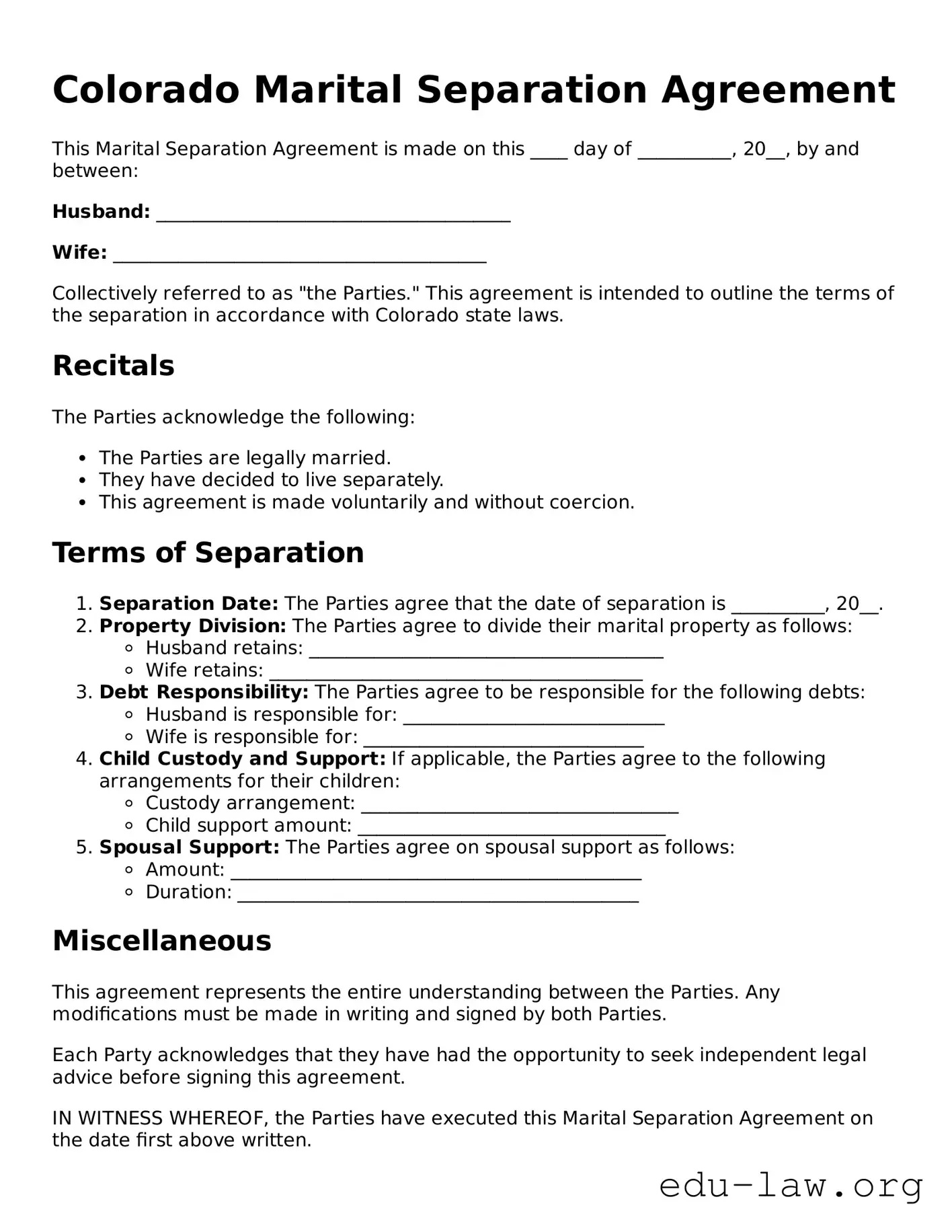
Colorado Marital Separation Agreement
This Marital Separation Agreement is made on this ____ day of __________, 20__, by and between:
Husband: ______________________________________
Wife: ________________________________________
Collectively referred to as "the Parties." This agreement is intended to outline the terms of the separation in accordance with Colorado state laws.
Recitals
The Parties acknowledge the following:
Terms of Separation
Miscellaneous
This agreement represents the entire understanding between the Parties. Any modifications must be made in writing and signed by both Parties.
Each Party acknowledges that they have had the opportunity to seek independent legal advice before signing this agreement.
IN WITNESS WHEREOF, the Parties have executed this Marital Separation Agreement on the date first above written.
Husband's Signature: ___________________________
Date: ________________________________________
Wife's Signature: _____________________________
Date: ________________________________________
| Fact Name | Description |
|---|---|
| Definition | A Colorado Marital Separation Agreement is a legal document that outlines the terms of separation between spouses. |
| Governing Law | The agreement is governed by Colorado state law, specifically under the Colorado Revised Statutes Title 14, Article 10. |
| Purpose | This document helps clarify issues such as property division, debt responsibility, and child custody arrangements. |
| Voluntary Nature | Both parties must voluntarily agree to the terms outlined in the agreement for it to be valid. |
| Not a Divorce | A Marital Separation Agreement does not legally end the marriage; it simply establishes the terms of separation. |
| Enforceability | Once signed, the agreement can be enforced in court, provided it meets legal standards. |
| Modification | Parties can modify the agreement if both spouses consent to the changes in writing. |
| Child Support | The agreement can include provisions for child support, which must comply with Colorado's child support guidelines. |
| Legal Advice | It is advisable for both parties to seek legal advice before signing the agreement to ensure their rights are protected. |
After you complete the Colorado Marital Separation Agreement form, you will be ready to proceed with the next steps in your separation process. This may include filing the agreement with the court or discussing it with your attorney. Follow these steps carefully to ensure that you fill out the form correctly.
What is a Colorado Marital Separation Agreement?
A Colorado Marital Separation Agreement is a legal document that outlines the terms and conditions agreed upon by spouses who choose to live separately while remaining legally married. This agreement typically addresses issues such as property division, debt responsibility, child custody, and support obligations.
Is a Marital Separation Agreement legally binding in Colorado?
Yes, once both parties sign the Marital Separation Agreement, it becomes legally binding. However, it is important to ensure that both parties fully understand the terms and have voluntarily agreed to them. Consulting with a legal professional is advisable to ensure that the agreement is enforceable.
Do I need an attorney to create a Marital Separation Agreement?
While it is not legally required to have an attorney to draft a Marital Separation Agreement, it is highly recommended. An attorney can help ensure that the agreement complies with Colorado law and adequately protects your rights and interests.
Can a Marital Separation Agreement be modified?
Yes, a Marital Separation Agreement can be modified if both parties agree to the changes. It is essential to document any modifications in writing and have both parties sign the revised agreement to ensure its validity.
What happens if one spouse does not follow the terms of the Marital Separation Agreement?
If one spouse fails to adhere to the terms of the agreement, the other spouse may seek legal recourse. This could involve filing a motion in court to enforce the agreement. Courts generally take these agreements seriously, especially if they were negotiated fairly.
How does a Marital Separation Agreement affect child custody and support?
The agreement should clearly outline the terms of child custody and support. It is crucial to prioritize the best interests of the children involved. Courts will review these terms to ensure they are reasonable and serve the children's welfare.
Can I use a Marital Separation Agreement to file for divorce later?
Yes, a Marital Separation Agreement can serve as a foundation for divorce proceedings. It can streamline the divorce process by already addressing many of the critical issues. However, it is essential to note that a separation does not automatically lead to divorce.
How long does it take to finalize a Marital Separation Agreement?
The time it takes to finalize a Marital Separation Agreement varies based on the complexity of the issues involved and the willingness of both parties to negotiate. If both spouses communicate openly and work together, the process can be completed relatively quickly.
What should be included in a Marital Separation Agreement?
A comprehensive Marital Separation Agreement should include provisions regarding property division, debt allocation, child custody arrangements, visitation schedules, and child and spousal support. Each aspect should be clearly defined to avoid future disputes.
Is a Marital Separation Agreement the same as a divorce?
No, a Marital Separation Agreement is not the same as a divorce. It allows spouses to live apart while remaining legally married. A divorce, on the other hand, legally ends the marriage. A separation can sometimes lead to divorce, but they are distinct legal processes.
Failing to provide complete information about both spouses. It is essential to include full names, addresses, and other identifying details.
Not clearly defining the terms of separation. Ambiguity can lead to misunderstandings later on. Specify the date of separation and any agreements regarding living arrangements.
Overlooking the division of assets and debts. Both parties should list all marital property and debts to ensure an equitable distribution.
Ignoring child custody and support arrangements. If children are involved, it is crucial to outline custody agreements and financial support obligations.
Neglecting to address spousal support. If applicable, the agreement should specify whether one spouse will pay support to the other and the amount.
Using vague language. Precise language helps avoid confusion. Each term should be clearly defined to prevent misinterpretation.
Failing to sign and date the agreement. Both parties must sign and date the document to make it legally binding.
Not consulting with a legal professional. Seeking advice can help ensure that the agreement complies with Colorado law and protects both parties' interests.
When navigating a marital separation in Colorado, several forms and documents may accompany the Colorado Marital Separation Agreement. Each document serves a specific purpose and can help ensure that both parties understand their rights and responsibilities. Below is a list of commonly used forms.
Each of these documents plays a crucial role in the separation process. Understanding their functions can help both parties navigate this challenging time with greater clarity and support.
The Colorado Marital Separation Agreement is similar to the Divorce Agreement. Both documents outline the terms under which a couple will separate, including the division of assets, child custody arrangements, and spousal support. However, while a Divorce Agreement finalizes the end of a marriage, a Marital Separation Agreement allows couples to live separately while remaining legally married. This can provide a temporary solution for couples who need time apart but are not ready to pursue divorce.
Another document comparable to the Colorado Marital Separation Agreement is the Child Custody Agreement. This agreement specifically focuses on the arrangements made for children during and after a separation or divorce. It details parenting time, decision-making responsibilities, and other critical aspects of co-parenting. While the Marital Separation Agreement may include child custody provisions, the Child Custody Agreement centers solely on the welfare of the children involved.
The Property Settlement Agreement shares similarities with the Marital Separation Agreement as it also addresses the division of property and debts between spouses. This document is often used during divorce proceedings but can be applied in a separation context as well. Both agreements aim to clarify each party's rights and responsibilities regarding shared assets, ensuring a fair division.
The Separation Agreement is another relevant document. This term is often used interchangeably with the Marital Separation Agreement. It serves the same purpose of outlining the terms of separation, including financial responsibilities and living arrangements. Both documents are crucial for couples seeking clarity and structure during a time of transition.
A Cohabitation Agreement may also be compared to the Marital Separation Agreement, particularly for couples who choose to live together without marrying. This document establishes the rights and responsibilities of each partner in the relationship. While the Marital Separation Agreement is for couples who are separating, the Cohabitation Agreement provides a framework for those who wish to live together without the legal ties of marriage.
The Prenuptial Agreement, although created before marriage, shares some common ground with the Marital Separation Agreement. Both documents address financial arrangements and asset division. A Prenuptial Agreement sets terms for how assets will be handled in the event of divorce, while the Marital Separation Agreement focuses on the current separation and may include similar provisions for asset management during that time.
Lastly, the Legal Separation Agreement is closely related to the Marital Separation Agreement. In fact, a Legal Separation Agreement is often used in situations where couples wish to separate but do not want to divorce. It covers similar topics, such as child custody, support, and property division. The key difference lies in the fact that a Legal Separation Agreement may have legal implications similar to divorce, while a Marital Separation Agreement can be more informal and temporary.
When filling out the Colorado Marital Separation Agreement form, it is important to follow certain guidelines to ensure accuracy and completeness. Below is a list of recommended practices and common pitfalls to avoid.
When it comes to the Colorado Marital Separation Agreement, many people hold misconceptions that can lead to confusion and misunderstandings. Here are four common myths surrounding this important document:
This is not true. A Marital Separation Agreement outlines the terms of separation, such as asset division and child custody, but it does not legally end the marriage. A divorce decree is necessary to finalize the dissolution of the marriage.
In reality, a Marital Separation Agreement can be modified if both parties agree to the changes. Life circumstances can change, and the agreement can be adjusted to reflect new realities.
This misconception can lead to significant issues. Both spouses must sign the Marital Separation Agreement for it to be legally binding. Mutual consent is key in this process.
This is incorrect. While many couples with children use this agreement to address custody and support issues, it is equally important for couples without children. It helps in dividing assets and debts, regardless of whether kids are involved.
Understanding these misconceptions can help individuals navigate the separation process more effectively and ensure that their rights and interests are protected.
When filling out and using the Colorado Marital Separation Agreement form, keep the following key points in mind: