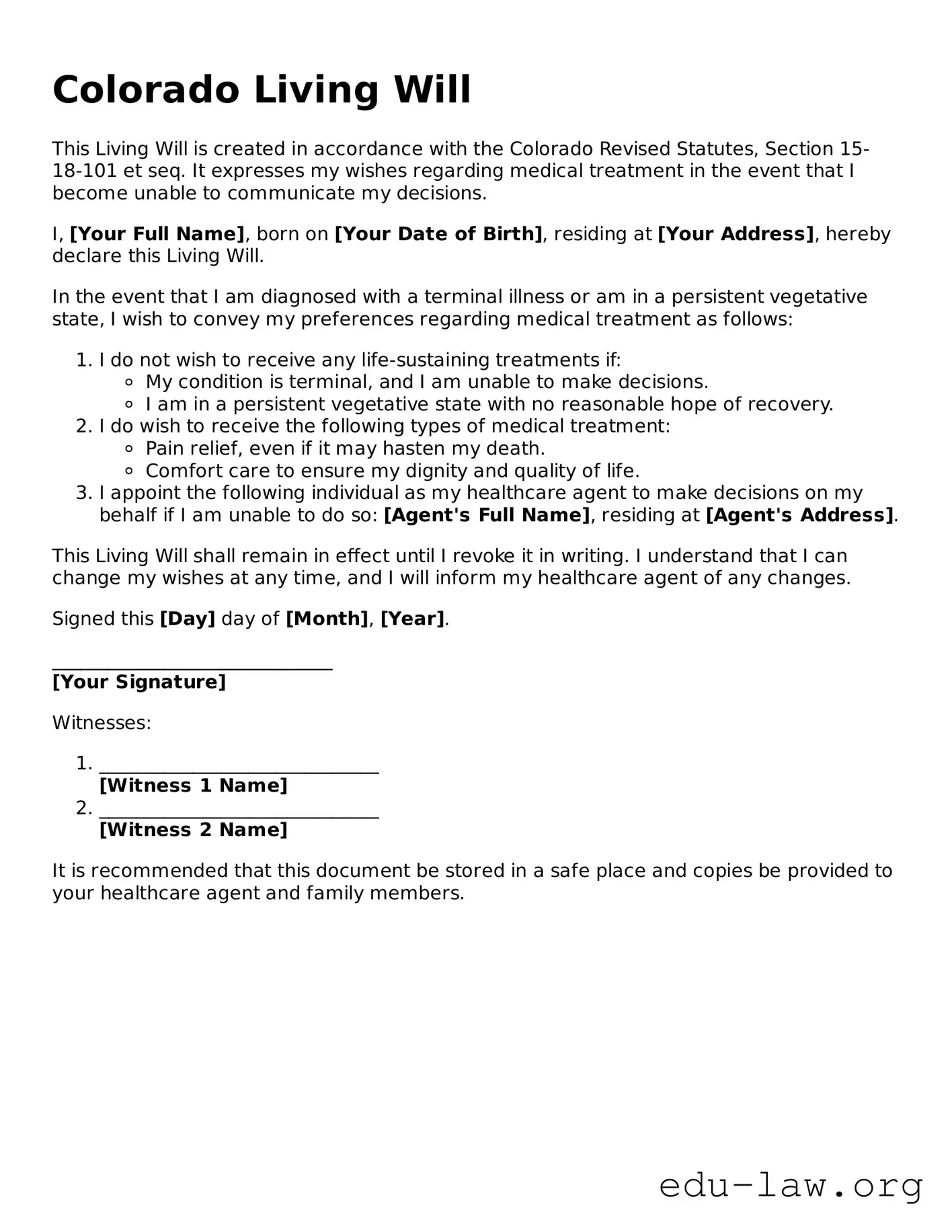
In Colorado, the Living Will form serves as a crucial document for individuals wishing to express their healthcare preferences in the event they become unable to communicate their wishes. This form allows people to outline their desires regarding life-sustaining treatments, ensuring that their choices are respected during critical medical situations. It typically addresses various aspects of medical care, including the use of artificial nutrition and hydration, resuscitation efforts, and other life-prolonging measures. By completing a Living Will, individuals can provide clear guidance to healthcare providers and loved ones, alleviating the burden of decision-making during emotionally challenging times. This document not only promotes personal autonomy but also fosters open conversations about end-of-life care among families and healthcare professionals.
Colorado Living Will
This Living Will is created in accordance with the Colorado Revised Statutes, Section 15-18-101 et seq. It expresses my wishes regarding medical treatment in the event that I become unable to communicate my decisions.
I, [Your Full Name], born on [Your Date of Birth], residing at [Your Address], hereby declare this Living Will.
In the event that I am diagnosed with a terminal illness or am in a persistent vegetative state, I wish to convey my preferences regarding medical treatment as follows:
This Living Will shall remain in effect until I revoke it in writing. I understand that I can change my wishes at any time, and I will inform my healthcare agent of any changes.
Signed this [Day] day of [Month], [Year].
______________________________
[Your Signature]
Witnesses:
It is recommended that this document be stored in a safe place and copies be provided to your healthcare agent and family members.
| Fact Name | Description |
|---|---|
| Governing Law | The Colorado Living Will is governed by Colorado Revised Statutes, Title 15, Article 18. |
| Purpose | This form allows individuals to express their wishes regarding medical treatment in case they become unable to communicate. |
| Eligibility | Any adult who is 18 years or older can complete a Living Will in Colorado. |
| Witness Requirement | The form must be signed in the presence of two adult witnesses or notarized. |
| Revocation | A Living Will can be revoked at any time by the individual, either verbally or in writing. |
| Healthcare Proxy | A Living Will does not appoint a healthcare proxy. A separate document is needed for that purpose. |
| Storage | It is advisable to keep the completed Living Will in a safe place and share copies with family and healthcare providers. |
Filling out the Colorado Living Will form is a straightforward process. After completing the form, you will need to ensure that it is signed and witnessed according to state requirements. This will help ensure that your wishes regarding medical treatment are respected in the event you cannot communicate them yourself.
What is a Colorado Living Will?
A Colorado Living Will is a legal document that allows individuals to express their wishes regarding medical treatment in the event they become unable to communicate their preferences. This document specifically addresses end-of-life care, outlining the types of medical interventions a person does or does not want if they are diagnosed with a terminal condition or are in a persistent vegetative state. By creating a Living Will, individuals can ensure their healthcare choices are respected, even when they cannot voice them themselves.
How do I create a Living Will in Colorado?
Creating a Living Will in Colorado involves a few straightforward steps. First, you need to obtain the official form, which can typically be found online or through healthcare providers. After that, you should carefully fill out the form, clearly stating your wishes regarding medical treatment. It is essential to sign the document in the presence of two witnesses or a notary public, as required by Colorado law. Once completed, it’s a good idea to share copies with your healthcare providers, family members, and anyone else who may be involved in your care.
Can I change or revoke my Living Will?
Yes, you can change or revoke your Living Will at any time, as long as you are mentally competent to do so. If you decide to make changes, it is important to complete a new Living Will form and ensure that it is signed and witnessed properly. Informing your healthcare providers and family members about the changes is crucial to ensure that your most current wishes are honored. Revoking a Living Will can be done simply by destroying the document or stating your intention to revoke it in writing.
What happens if I do not have a Living Will?
If you do not have a Living Will and become unable to communicate your healthcare preferences, medical decisions may be made by your family members or healthcare providers based on what they believe you would have wanted. This can sometimes lead to disagreements among family members or result in treatments that may not align with your values or wishes. Having a Living Will provides clarity and guidance, helping to avoid confusion and ensuring that your healthcare choices are honored during critical times.
Failing to clearly specify treatment preferences. Individuals often leave sections vague, which can lead to confusion about their wishes.
Not signing the document. A Living Will is only valid if it is signed by the individual. Omitting this step renders the document ineffective.
Forgetting to date the form. Without a date, it can be difficult to determine the most current wishes of the individual.
Neglecting to have witnesses. Colorado law requires that the Living Will be signed in the presence of two witnesses or notarized.
Using outdated forms. People sometimes fill out old versions of the Living Will, which may not comply with current laws.
Not discussing wishes with family. Failing to communicate intentions can lead to disputes or misunderstandings during critical moments.
Leaving out specific medical conditions. Without clear guidance on certain scenarios, healthcare providers may not know how to proceed.
Assuming everyone understands their wishes. Individuals often think that family members know their preferences without explicit communication.
Overlooking updates. People may forget to revise their Living Will after significant life changes, such as marriage or divorce.
A Colorado Living Will is an essential document for individuals wishing to outline their medical treatment preferences in case they become unable to communicate their wishes. However, there are several other important forms and documents that often accompany a Living Will. Each serves a unique purpose in ensuring that your healthcare decisions are respected and that your wishes are clearly communicated to your loved ones and medical professionals.
By having these documents in place alongside your Colorado Living Will, you can ensure that your healthcare wishes are honored and that your loved ones are equipped to make informed decisions on your behalf. Taking the time to prepare these forms can provide peace of mind for both you and your family.
The Colorado Living Will form shares similarities with the Advance Healthcare Directive. Both documents allow individuals to express their wishes regarding medical treatment in case they become unable to communicate. While the Living Will specifically focuses on end-of-life care, the Advance Healthcare Directive can cover a broader range of medical decisions, including appointing a healthcare proxy. This flexibility makes the Advance Healthcare Directive a comprehensive tool for managing one's healthcare preferences.
Another document akin to the Colorado Living Will is the Durable Power of Attorney for Healthcare. This legal document grants someone the authority to make healthcare decisions on behalf of another person. Like the Living Will, it ensures that an individual’s medical preferences are honored. However, while the Living Will outlines specific wishes, the Durable Power of Attorney allows the appointed agent to make decisions based on the individual's best interests, even if those decisions were not explicitly stated.
The Do Not Resuscitate (DNR) order is also similar to the Colorado Living Will. A DNR order specifically instructs healthcare providers not to perform CPR if a patient’s heart stops or they stop breathing. This document aligns with the Living Will in that both express a desire to avoid certain medical interventions at the end of life. However, the DNR is more focused on emergency situations, whereas the Living Will covers a broader range of healthcare decisions.
The Physician Orders for Life-Sustaining Treatment (POLST) form bears resemblance to the Colorado Living Will as well. The POLST translates a patient's wishes regarding life-sustaining treatment into actionable medical orders. Like the Living Will, it addresses preferences about resuscitation and other life-sustaining measures. However, the POLST is designed for patients with serious illnesses and is intended to be used by healthcare providers in emergency situations.
Another comparable document is the Healthcare Proxy. This document allows an individual to appoint someone to make healthcare decisions on their behalf. While the Colorado Living Will states specific wishes regarding medical treatment, the Healthcare Proxy gives the appointed person the discretion to make decisions based on the individual's values and preferences. This flexibility can be particularly important in situations where circumstances change and immediate decisions are needed.
Finally, the Mental Health Advance Directive is similar to the Colorado Living Will in that it allows individuals to outline their preferences regarding mental health treatment. This document specifically addresses mental health care, ensuring that a person’s wishes are respected during times of crisis. Like the Living Will, it empowers individuals to maintain control over their treatment options, even when they may not be able to communicate their desires directly.
When filling out the Colorado Living Will form, it is essential to approach the process with care. Here are five important dos and don'ts to consider:
Understanding the Colorado Living Will form is essential for making informed decisions about your healthcare preferences. However, several misconceptions often arise. Here are six common misunderstandings:
A Living Will specifically addresses your medical treatment preferences in the event you cannot communicate. In contrast, a Last Will and Testament deals with the distribution of your assets after your death.
This is not true. You can create a Living Will at any time, regardless of your current health status. It's a proactive step to ensure your wishes are known.
People of all ages can benefit from having a Living Will. Accidents and sudden illnesses can happen to anyone, making it crucial to have your preferences documented.
You can update or revoke your Living Will at any time, as long as you are mentally competent. Regularly reviewing your wishes is a good practice.
While each state has its own laws, many states recognize Living Wills from other jurisdictions. However, it's wise to check the specific requirements of the state where you reside.
While a Living Will provides guidance, it may not always be legally binding. It's important to communicate your wishes to family and healthcare providers to ensure they are understood and respected.
Clearing up these misconceptions can empower you to make informed decisions about your healthcare. Take the time to understand the importance of a Living Will and how it can safeguard your preferences.
When considering a Colorado Living Will, it is essential to understand its purpose and the steps involved in filling it out. Here are some key takeaways: