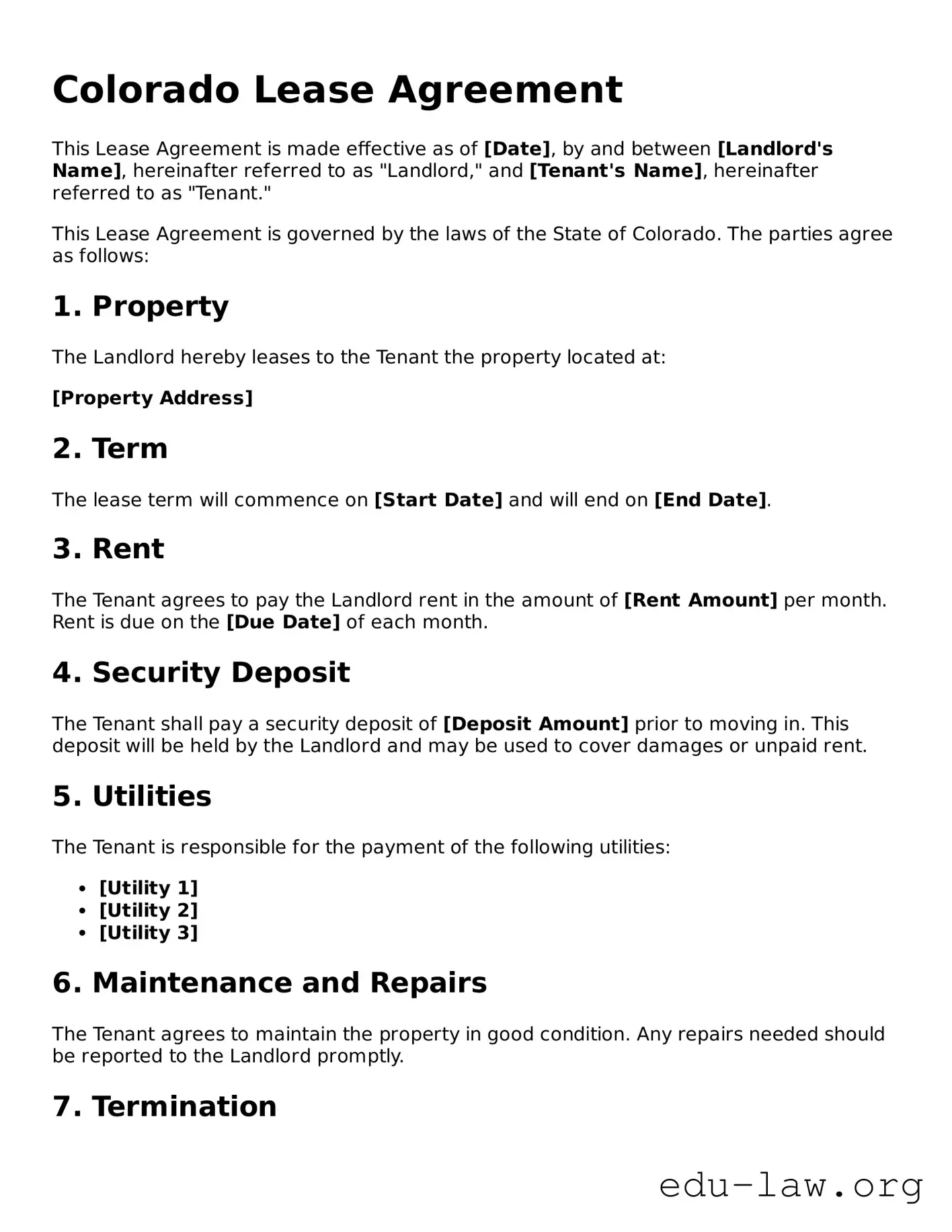
When renting a property in Colorado, having a clear and comprehensive lease agreement is essential for both landlords and tenants. This document outlines the terms and conditions of the rental arrangement, providing a roadmap for the relationship between both parties. Key aspects include the rental amount, payment due dates, and the duration of the lease. Additionally, it covers responsibilities for maintenance and repairs, rules regarding pets, and guidelines for terminating the lease. Security deposits are also addressed, detailing how much is required and the conditions for its return. By understanding the Colorado Lease Agreement form, both landlords and tenants can ensure a smoother rental experience, reducing misunderstandings and fostering a positive living environment.
Colorado Lease Agreement
This Lease Agreement is made effective as of [Date], by and between [Landlord's Name], hereinafter referred to as "Landlord," and [Tenant's Name], hereinafter referred to as "Tenant."
This Lease Agreement is governed by the laws of the State of Colorado. The parties agree as follows:
1. Property
The Landlord hereby leases to the Tenant the property located at:
[Property Address]
2. Term
The lease term will commence on [Start Date] and will end on [End Date].
3. Rent
The Tenant agrees to pay the Landlord rent in the amount of [Rent Amount] per month. Rent is due on the [Due Date] of each month.
4. Security Deposit
The Tenant shall pay a security deposit of [Deposit Amount] prior to moving in. This deposit will be held by the Landlord and may be used to cover damages or unpaid rent.
5. Utilities
The Tenant is responsible for the payment of the following utilities:
6. Maintenance and Repairs
The Tenant agrees to maintain the property in good condition. Any repairs needed should be reported to the Landlord promptly.
7. Termination
Either party may terminate this lease by providing written notice at least [Notice Period] days in advance.
8. Governing Law
This Lease Agreement shall be governed by the laws of the State of Colorado.
9. Signatures
By signing below, both parties agree to the terms of this Lease Agreement:
__________________________
Landlord's Signature
[Date]
__________________________
Tenant's Signature
[Date]
| Fact Name | Description |
|---|---|
| Governing Law | The Colorado Lease Agreement is governed by Colorado state law. |
| Parties Involved | The lease agreement is between the landlord and the tenant. |
| Lease Duration | The lease can be for a fixed term or month-to-month. |
| Security Deposit | Colorado law limits the amount a landlord can charge for a security deposit. |
| Maintenance Responsibilities | The lease should outline who is responsible for maintenance and repairs. |
| Rent Payment Terms | The lease must specify the rent amount and payment due date. |
| Notice Requirements | Both parties must provide written notice for lease termination or changes. |
| Dispute Resolution | The lease may include terms for resolving disputes between parties. |
Filling out the Colorado Lease Agreement form is an important step in establishing the terms of a rental arrangement. By completing this form accurately, both the landlord and tenant can ensure clarity and mutual understanding regarding their responsibilities and rights. Follow these steps to fill out the form correctly.
What is a Colorado Lease Agreement form?
A Colorado Lease Agreement form is a legal document that outlines the terms and conditions under which a landlord allows a tenant to occupy a rental property. This form specifies the rights and responsibilities of both parties, including rent amount, payment due dates, lease duration, and maintenance obligations.
What information is typically included in a Colorado Lease Agreement?
The lease agreement usually includes the names of the landlord and tenant, the rental property address, the lease term (length of the lease), rent amount, payment schedule, security deposit details, and any rules or restrictions regarding the property. It may also address maintenance responsibilities and procedures for handling disputes.
How long is a typical lease term in Colorado?
Lease terms in Colorado can vary widely. Common durations include month-to-month agreements, six-month leases, and one-year leases. The length of the lease should be clearly stated in the agreement, and both parties must agree to the specified duration.
Is a security deposit required in Colorado?
Yes, landlords in Colorado often require a security deposit. This deposit serves as protection for the landlord against potential damages or unpaid rent. Colorado law limits the amount a landlord can charge for a security deposit, typically to one month's rent. The lease should specify the deposit amount and the conditions for its return.
Can a landlord raise the rent during the lease term?
Generally, a landlord cannot raise the rent during a fixed-term lease unless the lease agreement explicitly allows for such increases. For month-to-month leases, landlords may increase the rent, but they must provide proper notice to the tenant, usually 30 days in advance.
What are the tenant's rights regarding repairs and maintenance?
In Colorado, tenants have the right to a habitable living environment. This means that landlords must make necessary repairs to ensure the property is safe and livable. If a landlord fails to address maintenance issues, tenants may have the right to withhold rent or take other legal actions, depending on the circumstances.
What happens if a tenant wants to terminate the lease early?
If a tenant wishes to terminate the lease before the agreed-upon end date, they must review the lease terms. Many agreements include clauses about early termination, which may require the tenant to provide written notice and possibly pay a fee. In some cases, tenants may negotiate with the landlord to reach a mutual agreement.
Are there specific laws that govern lease agreements in Colorado?
Yes, Colorado has specific laws that govern lease agreements, including the Colorado Uniform Residential Landlord and Tenant Act. This law outlines the rights and responsibilities of both landlords and tenants. It is essential for both parties to be aware of these laws to ensure compliance and protect their rights.
How can disputes between landlords and tenants be resolved?
Disputes can often be resolved through communication and negotiation. If informal discussions do not lead to a resolution, parties may consider mediation or arbitration. In some cases, legal action may be necessary. It is advisable for both landlords and tenants to document all communications and agreements related to the dispute.
Missing Signatures: One of the most common mistakes is forgetting to sign the lease agreement. Both the landlord and tenant must sign to make the contract legally binding.
Incorrect Dates: Failing to specify the correct start and end dates of the lease can lead to confusion. Ensure that all dates are accurate and clearly stated.
Neglecting to Include Rent Amount: It’s essential to state the monthly rent amount. Leaving this blank can lead to disputes later on.
Not Specifying Payment Details: Indicate how and when rent should be paid. For example, is it due on the first of the month? Will it be paid via check, bank transfer, or another method?
Ignoring Security Deposit Terms: Be sure to outline the amount of the security deposit and the conditions for its return. This prevents misunderstandings when the lease ends.
Overlooking Maintenance Responsibilities: Clearly define who is responsible for maintenance and repairs. This clarity can save both parties from potential conflicts.
Failing to Include Pet Policies: If pets are allowed or not, this should be explicitly stated. Not addressing this can lead to issues if a tenant brings a pet without permission.
Not Listing All Tenants: If multiple people will be living in the rental unit, all tenants should be listed in the agreement. This ensures everyone is accountable.
Forgetting to Include Terms for Lease Renewal: If you want to allow for lease renewal, include the terms and conditions. This can help avoid confusion when the lease term ends.
Neglecting Local Laws: Each state has its own rental laws. Failing to comply with Colorado's specific regulations can render parts of the lease unenforceable.
When entering into a lease agreement in Colorado, it is important to consider additional forms and documents that can help clarify the terms of the lease and protect the interests of both landlords and tenants. Below is a list of commonly used documents that complement the Colorado Lease Agreement.
Utilizing these documents alongside the Colorado Lease Agreement can help ensure a smooth rental experience for both landlords and tenants. Clear communication and documentation are key to avoiding misunderstandings and fostering a positive landlord-tenant relationship.
The Colorado Rental Application is similar to the Lease Agreement as it serves as a preliminary document in the rental process. This application collects essential information about potential tenants, including their rental history, employment status, and creditworthiness. While the Lease Agreement outlines the terms of the tenancy, the Rental Application helps landlords assess whether an applicant is a suitable fit for their property.
The Colorado Move-In Checklist also parallels the Lease Agreement. This document is used to document the condition of the rental unit before the tenant moves in. It helps both parties agree on the state of the property, which can prevent disputes over security deposits later on. While the Lease Agreement establishes the terms of the rental, the Move-In Checklist focuses on the physical condition of the property at the start of the tenancy.
The Colorado Security Deposit Receipt is another document related to the Lease Agreement. This receipt is issued to the tenant when they pay their security deposit. It details the amount received and the terms under which the deposit will be held. This document ensures transparency and accountability, just as the Lease Agreement outlines the responsibilities of both the landlord and tenant during the rental period.
The Colorado Notice to Quit shares similarities with the Lease Agreement as it addresses the termination of the rental relationship. This notice is issued when a tenant fails to comply with the terms of the lease, such as non-payment of rent. While the Lease Agreement lays out the terms of occupancy, the Notice to Quit provides a formal way to communicate the need for vacating the property due to violations of those terms.
The Colorado Rent Receipt is akin to the Lease Agreement in that it records payments made by the tenant. This document provides proof of payment and can be used for record-keeping purposes. Just as the Lease Agreement specifies the rent amount and due dates, the Rent Receipt confirms that the tenant has fulfilled their financial obligations under the lease.
Lastly, the Colorado Lease Renewal Agreement is similar to the original Lease Agreement. This document is used when both parties agree to extend the terms of the existing lease for another period. It reiterates the original terms while allowing for any modifications that may be necessary. While the initial Lease Agreement establishes the rental terms, the Lease Renewal Agreement ensures continuity and clarity for both the landlord and tenant.
When filling out the Colorado Lease Agreement form, attention to detail is crucial. Here are some important dos and don’ts to guide you through the process.
By following these guidelines, you can help ensure a smoother leasing process and foster a positive relationship between landlord and tenant.
Understanding lease agreements is crucial for both landlords and tenants. However, several misconceptions often arise regarding the Colorado Lease Agreement form. Here are seven common misunderstandings:
Many people believe that lease agreements are interchangeable. In reality, each lease can be tailored to specific needs, laws, and circumstances of the property and the parties involved.
Some tenants and landlords think that a verbal agreement is enough to establish a lease. However, having a written lease provides clarity and legal protection for both parties.
There is a misconception that security deposits are always non-refundable. In Colorado, landlords must return the deposit, minus any deductions for damages, within a specific timeframe.
Many believe that once a lease is presented, the terms are set in stone. In fact, most lease terms are negotiable, and both parties can discuss and agree on modifications.
Some tenants think they must handle all repairs. In Colorado, landlords are generally responsible for maintaining the property in a habitable condition, while tenants handle minor repairs.
It is a common belief that tenants can break a lease without repercussions. However, breaking a lease can lead to financial penalties and legal action, depending on the lease terms.
Some landlords assume they can enter a rental property whenever they want. In Colorado, landlords must provide reasonable notice before entering, except in emergencies.
By understanding these misconceptions, both landlords and tenants can navigate the leasing process more effectively and protect their rights.
When filling out and using the Colorado Lease Agreement form, several important points should be considered to ensure compliance and clarity. Here are key takeaways:
By keeping these key points in mind, both landlords and tenants can create a clear and effective lease agreement that protects their rights and responsibilities.