Creating a Last Will and Testament is an essential step in ensuring that your wishes regarding asset distribution and guardianship are honored after your passing. In Colorado, this legal document outlines how your property will be allocated, who will manage your estate, and who will care for any minor children. The form includes key sections such as the appointment of an executor, identification of beneficiaries, and specific bequests. Additionally, it allows for the inclusion of funeral arrangements and any other personal wishes you may want to convey. Understanding the structure and requirements of the Colorado Last Will and Testament form is crucial for making informed decisions that reflect your values and desires. By properly executing this document, you can provide clarity and peace of mind for your loved ones during a challenging time.
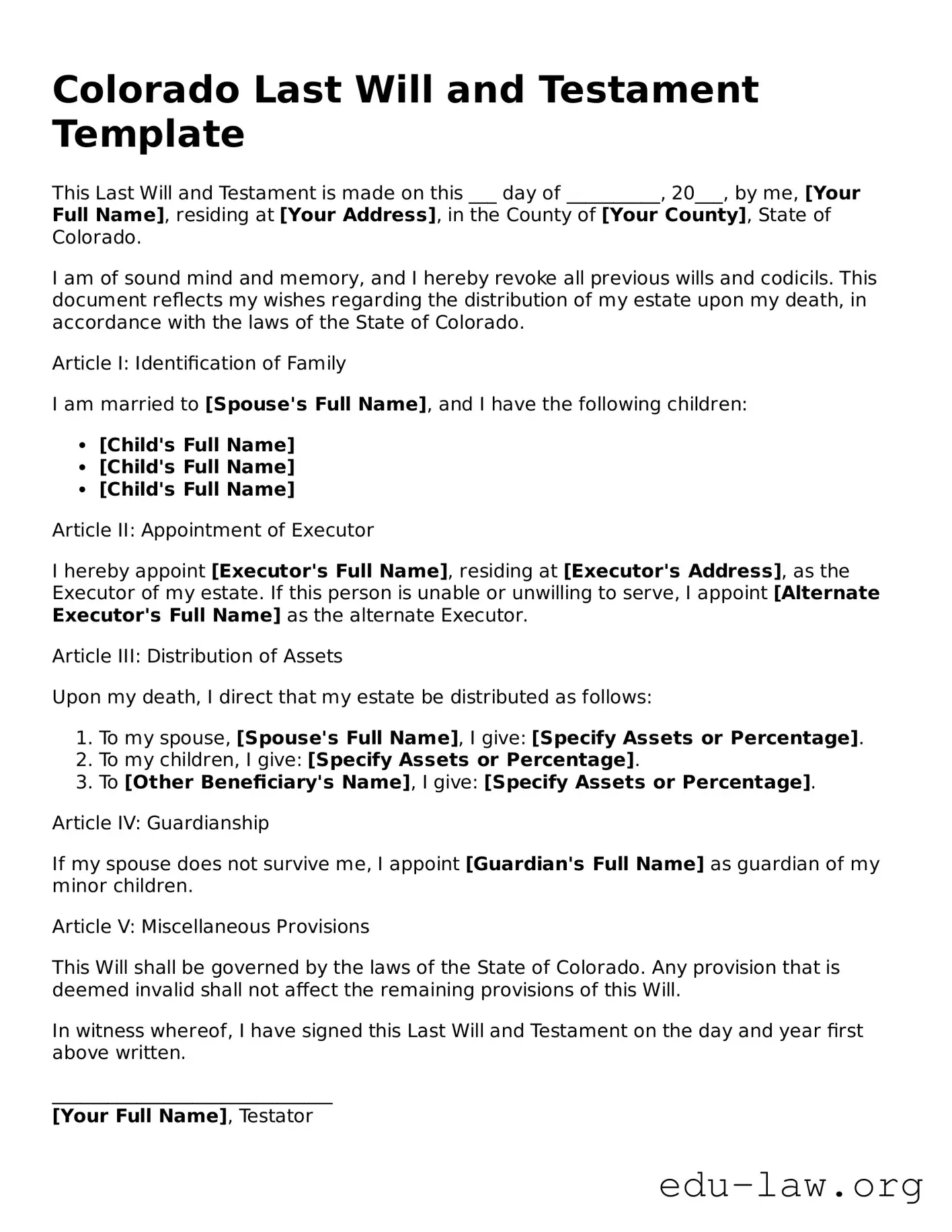
Colorado Last Will and Testament Template
This Last Will and Testament is made on this ___ day of __________, 20___, by me, [Your Full Name], residing at [Your Address], in the County of [Your County], State of Colorado.
I am of sound mind and memory, and I hereby revoke all previous wills and codicils. This document reflects my wishes regarding the distribution of my estate upon my death, in accordance with the laws of the State of Colorado.
Article I: Identification of Family
I am married to [Spouse's Full Name], and I have the following children:
Article II: Appointment of Executor
I hereby appoint [Executor's Full Name], residing at [Executor's Address], as the Executor of my estate. If this person is unable or unwilling to serve, I appoint [Alternate Executor's Full Name] as the alternate Executor.
Article III: Distribution of Assets
Upon my death, I direct that my estate be distributed as follows:
Article IV: Guardianship
If my spouse does not survive me, I appoint [Guardian's Full Name] as guardian of my minor children.
Article V: Miscellaneous Provisions
This Will shall be governed by the laws of the State of Colorado. Any provision that is deemed invalid shall not affect the remaining provisions of this Will.
In witness whereof, I have signed this Last Will and Testament on the day and year first above written.
______________________________
[Your Full Name], Testator
We, the undersigned witnesses, hereby declare that the above-named Testator signed this Last Will and Testament in our presence, and we affirm that we are not beneficiaries under this Will.
______________________________
[Witness 1's Full Name]
Address: [Witness 1's Address]
______________________________
[Witness 2's Full Name]
Address: [Witness 2's Address]
| Fact Name | Description |
|---|---|
| Legal Requirement | In Colorado, a Last Will and Testament must be in writing and signed by the testator. |
| Witnesses | The will must be signed in the presence of at least two witnesses who are at least 18 years old. |
| Testamentary Capacity | The testator must be at least 18 years old and of sound mind to create a valid will. |
| Revocation | A will can be revoked by the testator at any time before their death, either by creating a new will or by destroying the old one. |
| Governing Law | The Colorado Revised Statutes, Title 15, Article 11, govern the creation and execution of wills in Colorado. |
| Holographic Wills | Colorado recognizes holographic wills, which are handwritten and do not require witnesses, provided they are signed by the testator. |
After obtaining the Colorado Last Will and Testament form, it is essential to fill it out accurately to ensure your wishes are clearly stated. Follow these steps carefully to complete the form. Remember, clarity and precision are vital.
What is a Last Will and Testament in Colorado?
A Last Will and Testament is a legal document that outlines how a person wishes their assets and property to be distributed after their death. In Colorado, this document also allows you to name guardians for minor children and appoint an executor to manage your estate. Having a will is crucial for ensuring that your wishes are honored and can help prevent disputes among family members after you pass away.
Who can create a Last Will and Testament in Colorado?
In Colorado, any person who is at least 18 years old and of sound mind can create a Last Will and Testament. This means that you should be able to understand the nature of your actions and the consequences of creating a will. If you meet these criteria, you have the legal capacity to draft your will, whether you choose to do it yourself or seek assistance from an attorney.
What are the requirements for a valid Last Will and Testament in Colorado?
To be considered valid in Colorado, a Last Will and Testament must be in writing and signed by the person creating the will, known as the testator. Additionally, it must be witnessed by at least two individuals who are not beneficiaries of the will. These witnesses must be present at the same time when the testator signs the document. It’s important to follow these requirements closely to ensure that your will is enforceable in court.
Can I change or revoke my Last Will and Testament in Colorado?
Yes, you can change or revoke your Last Will and Testament at any time while you are still alive and of sound mind. To make changes, you can create a new will that explicitly revokes the previous one, or you can add a codicil, which is an amendment to your existing will. Always ensure that any changes are properly executed according to Colorado law to avoid confusion or disputes later on.
Failing to sign the will in the presence of witnesses. In Colorado, two witnesses must observe the signing of the will to ensure its validity.
Not dating the will. A date is crucial as it establishes when the will was created, which can be important if there are multiple versions.
Overlooking the need for a self-proving affidavit. This can simplify the probate process by affirming the validity of the will without requiring witnesses to testify later.
Using vague language when describing assets. Clear and specific descriptions help avoid confusion and disputes among heirs.
Neglecting to update the will after major life changes. Events like marriage, divorce, or the birth of children should prompt a review and possible revision of the will.
Forgetting to include alternate beneficiaries. In case the primary beneficiary cannot inherit, having alternates ensures that your wishes are honored.
When preparing a Last Will and Testament in Colorado, several other documents may be useful to ensure that all aspects of estate planning are covered. Each document serves a unique purpose and can help clarify the wishes of the individual making the will.
Having these documents in place can provide clarity and peace of mind. They help ensure that an individual's wishes are respected and that their loved ones are taken care of in difficult times.
A living will is a document that outlines a person's preferences regarding medical treatment in the event they become incapacitated. Like a Last Will and Testament, it serves to express individual wishes, but it focuses specifically on healthcare decisions rather than the distribution of assets. Both documents are crucial for ensuring that a person's desires are respected, but they address different aspects of personal autonomy.
A power of attorney grants someone the authority to make decisions on behalf of another person. This document, like a Last Will and Testament, is about control over one's affairs. However, while a will dictates the distribution of property after death, a power of attorney is effective during a person's lifetime and can cover financial, legal, or health-related decisions, depending on the scope outlined in the document.
An advance healthcare directive combines elements of both a living will and a power of attorney for healthcare. This document allows individuals to specify their medical treatment preferences and appoint someone to make healthcare decisions if they cannot do so themselves. Similar to a Last Will and Testament, it ensures that personal wishes are honored but focuses solely on medical care rather than asset distribution.
A trust is a legal arrangement where one party holds property for the benefit of another. Trusts can be used to manage assets during a person’s lifetime and after death. Like a Last Will and Testament, a trust provides a way to dictate how assets are handled, but it can also help avoid probate, which is a lengthy process that a will typically must go through.
An affidavit is a written statement confirmed by oath or affirmation. While it may not directly relate to the distribution of assets like a Last Will and Testament, it can serve as a supporting document in various legal proceedings, including probate. Affidavits can help clarify intentions or provide evidence regarding a person's wishes or circumstances at the time of creating a will.
A codicil is a document that modifies an existing will. This is similar to a Last Will and Testament as it pertains to the same individual’s estate planning. A codicil allows changes to be made without the need to create an entirely new will, making it a convenient way to update preferences or address changes in circumstances while maintaining the original document's integrity.
A declaration of trust is a document that outlines the terms of a trust and specifies how assets will be managed and distributed. While a Last Will and Testament details what happens to assets after death, a declaration of trust governs the management of those assets during a person’s lifetime and can provide more immediate control and flexibility in asset distribution.
A guardianship designation allows individuals to appoint a guardian for their minor children or dependents. This document shares similarities with a Last Will and Testament in that both express wishes regarding care and responsibility for loved ones. However, while a will addresses the distribution of assets, a guardianship designation focuses on the welfare and upbringing of children in the event of the parent’s passing.
When filling out the Colorado Last Will and Testament form, consider the following guidelines to ensure accuracy and compliance.
Understanding the Colorado Last Will and Testament form is crucial for anyone looking to ensure their wishes are honored after they pass. However, several misconceptions can lead to confusion. Here are four common misunderstandings:
This is incorrect. In Colorado, a will must be signed by the person creating it (the testator) in order to be considered valid. Without a signature, the document does not hold legal weight.
While Colorado does allow for handwritten wills, known as holographic wills, they must meet specific criteria. The entire document must be in the testator's handwriting and signed. Otherwise, it may not be recognized.
This is a dangerous assumption. Life changes, such as marriage, divorce, or the birth of children, can impact your wishes. Regularly reviewing and updating your will ensures it reflects your current intentions.
This is misleading. While the will does become active after death, it must first go through the probate process. This legal procedure can take time and may involve court oversight, depending on the circumstances.
Creating a Last Will and Testament in Colorado is an important step in ensuring your wishes are honored after your passing. Here are some key takeaways to consider when filling out and using this form:
By following these guidelines, you can create a Last Will and Testament that reflects your intentions and provides peace of mind for you and your loved ones.