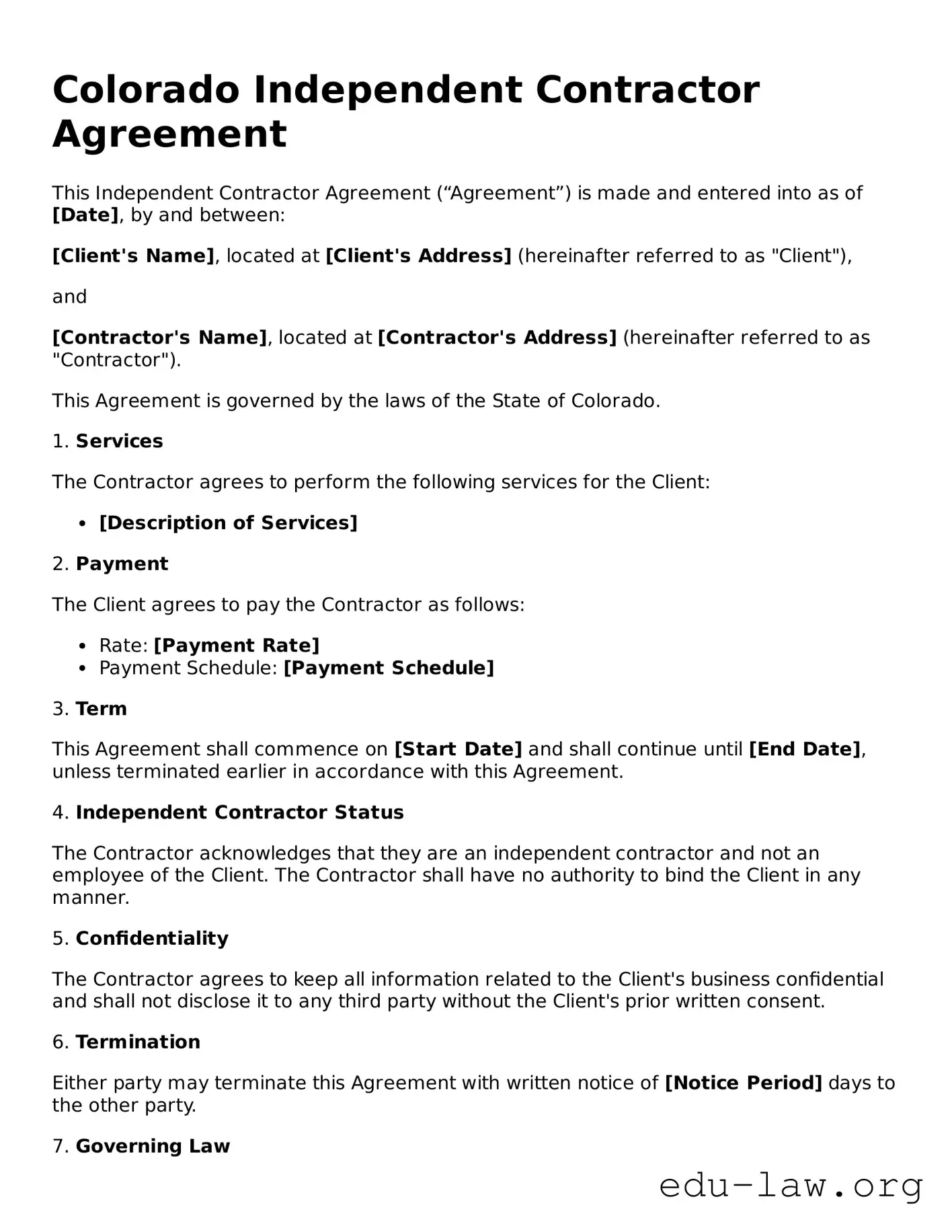
The Colorado Independent Contractor Agreement form serves as a crucial document for establishing the terms and conditions between a hiring party and an independent contractor. This agreement outlines the scope of work, payment terms, and the rights and responsibilities of both parties involved. It clearly defines the nature of the relationship, ensuring that both the contractor and the hiring entity understand their obligations. Key components include the description of services to be provided, deadlines for project completion, and compensation details. Additionally, it addresses confidentiality, intellectual property rights, and dispute resolution procedures. By utilizing this form, both parties can foster a transparent working relationship, minimizing misunderstandings and protecting their interests throughout the duration of the contract.
Colorado Independent Contractor Agreement
This Independent Contractor Agreement (“Agreement”) is made and entered into as of [Date], by and between:
[Client's Name], located at [Client's Address] (hereinafter referred to as "Client"),
and
[Contractor's Name], located at [Contractor's Address] (hereinafter referred to as "Contractor").
This Agreement is governed by the laws of the State of Colorado.
1. Services
The Contractor agrees to perform the following services for the Client:
2. Payment
The Client agrees to pay the Contractor as follows:
3. Term
This Agreement shall commence on [Start Date] and shall continue until [End Date], unless terminated earlier in accordance with this Agreement.
4. Independent Contractor Status
The Contractor acknowledges that they are an independent contractor and not an employee of the Client. The Contractor shall have no authority to bind the Client in any manner.
5. Confidentiality
The Contractor agrees to keep all information related to the Client's business confidential and shall not disclose it to any third party without the Client's prior written consent.
6. Termination
Either party may terminate this Agreement with written notice of [Notice Period] days to the other party.
7. Governing Law
This Agreement shall be governed by and construed in accordance with the laws of the State of Colorado.
IN WITNESS WHEREOF, the parties hereto have executed this Independent Contractor Agreement as of the date first above written.
Client Signature: ________________________ Date: _______________
Contractor Signature: _____________________ Date: _______________
| Fact Name | Description |
|---|---|
| Purpose | The Colorado Independent Contractor Agreement is used to outline the terms of engagement between a business and an independent contractor. |
| Governing Law | This agreement is governed by the laws of the State of Colorado. |
| Key Components | Essential elements include scope of work, payment terms, and duration of the contract. |
| Tax Responsibilities | Independent contractors are responsible for their own taxes, unlike employees who have taxes withheld by their employers. |
| Liability | Typically, independent contractors are not covered by the employer's liability insurance, placing responsibility on the contractor. |
| Termination Clause | The agreement should include conditions under which either party can terminate the contract, ensuring clarity and legal protection. |
Filling out the Colorado Independent Contractor Agreement form requires careful attention to detail. By following the steps outlined below, you can ensure that the form is completed accurately and comprehensively. This will help facilitate a clear understanding between the contractor and the hiring party.
After completing these steps, review the form for accuracy and completeness before submitting it. It is advisable to keep a copy for your records, as this can be useful for future reference or in case of disputes.
What is a Colorado Independent Contractor Agreement?
A Colorado Independent Contractor Agreement is a legal document that outlines the relationship between a business and an independent contractor. This agreement specifies the terms of work, payment details, and the responsibilities of both parties. It helps clarify expectations and protects both the contractor and the business by establishing clear guidelines for the work to be performed.
Why is it important to have an Independent Contractor Agreement?
Having an Independent Contractor Agreement is crucial for several reasons. First, it helps prevent misunderstandings by clearly defining the scope of work and payment terms. Second, it provides legal protection for both parties in case of disputes. Without a formal agreement, it may be challenging to resolve conflicts or enforce payment obligations. Additionally, it helps ensure compliance with state laws regarding independent contractors.
What should be included in the agreement?
Essential elements of a Colorado Independent Contractor Agreement include the names of the parties involved, a detailed description of the services to be provided, payment terms, deadlines, and confidentiality clauses if necessary. It’s also wise to include provisions regarding termination of the agreement and any applicable state laws. These details help create a comprehensive understanding of the working relationship.
Can an Independent Contractor Agreement be modified?
Yes, an Independent Contractor Agreement can be modified, but both parties must agree to the changes. It’s best to document any modifications in writing to avoid confusion later on. This ensures that everyone is on the same page and helps maintain a positive working relationship. Always communicate openly about any changes to the agreement to foster trust and transparency.
Inaccurate Personal Information: Many individuals fail to provide complete and accurate personal details. This includes names, addresses, and contact information. A simple typo can lead to significant issues down the line.
Misclassification of Employment Status: Some people mistakenly identify themselves as independent contractors when they actually meet the criteria for being an employee. This misclassification can have legal and financial repercussions.
Missing or Vague Scope of Work: It’s essential to clearly define the tasks and responsibilities involved. Leaving this section vague can lead to misunderstandings and disputes later.
Failure to Include Payment Terms: Not specifying how and when payment will be made can create confusion. Clear payment terms help both parties understand their financial obligations.
Ignoring Tax Implications: Many individuals overlook the tax responsibilities that come with being an independent contractor. Understanding these obligations is crucial to avoid unexpected liabilities.
Not Reviewing for Compliance: The agreement must comply with Colorado laws. Failing to ensure that all provisions meet legal standards can lead to enforceability issues.
Neglecting to Sign and Date: It may seem trivial, but not signing and dating the agreement can render it invalid. Both parties should ensure that this step is completed to formalize the agreement.
When working with independent contractors in Colorado, several other documents can complement the Independent Contractor Agreement. These forms help clarify roles, responsibilities, and expectations between parties. Here’s a brief overview of some commonly used documents:
Using these documents alongside the Independent Contractor Agreement can help create a clear and professional working relationship. They provide structure and protection for both the contractor and the business, ensuring everyone understands their roles and responsibilities.
The Colorado Independent Contractor Agreement is similar to the Employment Agreement, which outlines the terms of employment between an employer and employee. While both documents define the relationship, the Employment Agreement typically includes benefits, job responsibilities, and other employer obligations, whereas the Independent Contractor Agreement focuses on the services provided and the compensation structure without the employer-employee relationship.
Another related document is the Non-Disclosure Agreement (NDA). This agreement protects confidential information shared between parties. While the Independent Contractor Agreement may include confidentiality clauses, an NDA specifically emphasizes the obligation to keep sensitive information private, often extending beyond the duration of the contract.
The Service Agreement is also comparable. This document details the terms under which services are provided, similar to the Independent Contractor Agreement. However, a Service Agreement may be broader, encompassing various types of services and not necessarily limited to independent contractors, making it applicable to a wider range of professional relationships.
The Consulting Agreement shares similarities as well. It is specifically tailored for consultants who provide expert advice or services. Like the Independent Contractor Agreement, it defines the scope of work, payment terms, and other essential elements. The key difference lies in the nature of the work, with consulting often implying a higher level of expertise.
The Partnership Agreement is another document that bears resemblance. It outlines the relationship between business partners, detailing their roles, responsibilities, and profit-sharing arrangements. While the Independent Contractor Agreement focuses on a service relationship, a Partnership Agreement establishes a more integrated business relationship between parties.
The License Agreement is also noteworthy. This document allows one party to use another party's intellectual property under specific conditions. While the Independent Contractor Agreement may involve the creation of work products, a License Agreement specifically governs the use of those products, distinguishing ownership and rights to use.
The Joint Venture Agreement is similar in that it defines a collaborative effort between two or more parties for a specific project. Both agreements outline responsibilities and expectations, but a Joint Venture Agreement often involves a more significant investment and shared risks, whereas the Independent Contractor Agreement is typically more transactional.
The Non-Compete Agreement is another relevant document. It restricts one party from engaging in similar business activities that could compete with another party for a specified time and within a certain area. While the Independent Contractor Agreement may include non-compete clauses, this document is specifically focused on protecting business interests from competition.
Lastly, the Work-for-Hire Agreement is akin to the Independent Contractor Agreement in that it defines the ownership of work produced. In a Work-for-Hire Agreement, the creator relinquishes rights to the work upon completion, ensuring that the hiring party retains full ownership. This is often a crucial aspect of independent contracting, especially in creative fields.
When filling out the Colorado Independent Contractor Agreement form, it is important to be thorough and accurate. Here are six essential dos and don'ts to keep in mind:
Following these guidelines will help ensure that the agreement is completed correctly and serves its intended purpose effectively.
When it comes to the Colorado Independent Contractor Agreement form, there are several misconceptions that can lead to confusion. Here are four common myths:
Many people think that this agreement is only relevant for freelancers. In reality, it applies to anyone working as an independent contractor, regardless of their profession or industry.
Some believe that because the agreement is a standard form, it lacks legal weight. However, when properly filled out and signed, it is a legally binding document that outlines the terms of the working relationship.
It is a common belief that independent contractors can operate without formal agreements. However, having a signed agreement protects both parties and clarifies expectations, duties, and payment terms.
Some assume that the Independent Contractor Agreement is uniform across the U.S. Each state has its own laws and requirements, so it’s important to use the correct form specific to Colorado.
When filling out and using the Colorado Independent Contractor Agreement form, there are several important points to keep in mind. Here are five key takeaways:
By following these key points, you can effectively use the Colorado Independent Contractor Agreement form to establish a clear and professional working relationship.