In Colorado, families choosing to homeschool their children must submit a Homeschool Letter of Intent to their local school district. This form serves as an official notification of the family's decision to provide home-based education. It outlines essential details, such as the names and ages of the children being homeschooled, as well as the educational curriculum that will be used. Parents are also required to affirm their commitment to meet the state's educational requirements. The process is designed to ensure that homeschooled students receive a quality education while allowing families the flexibility to tailor learning to their children's individual needs. Understanding the specifics of this form is crucial for parents to navigate the homeschooling landscape successfully and comply with state regulations.
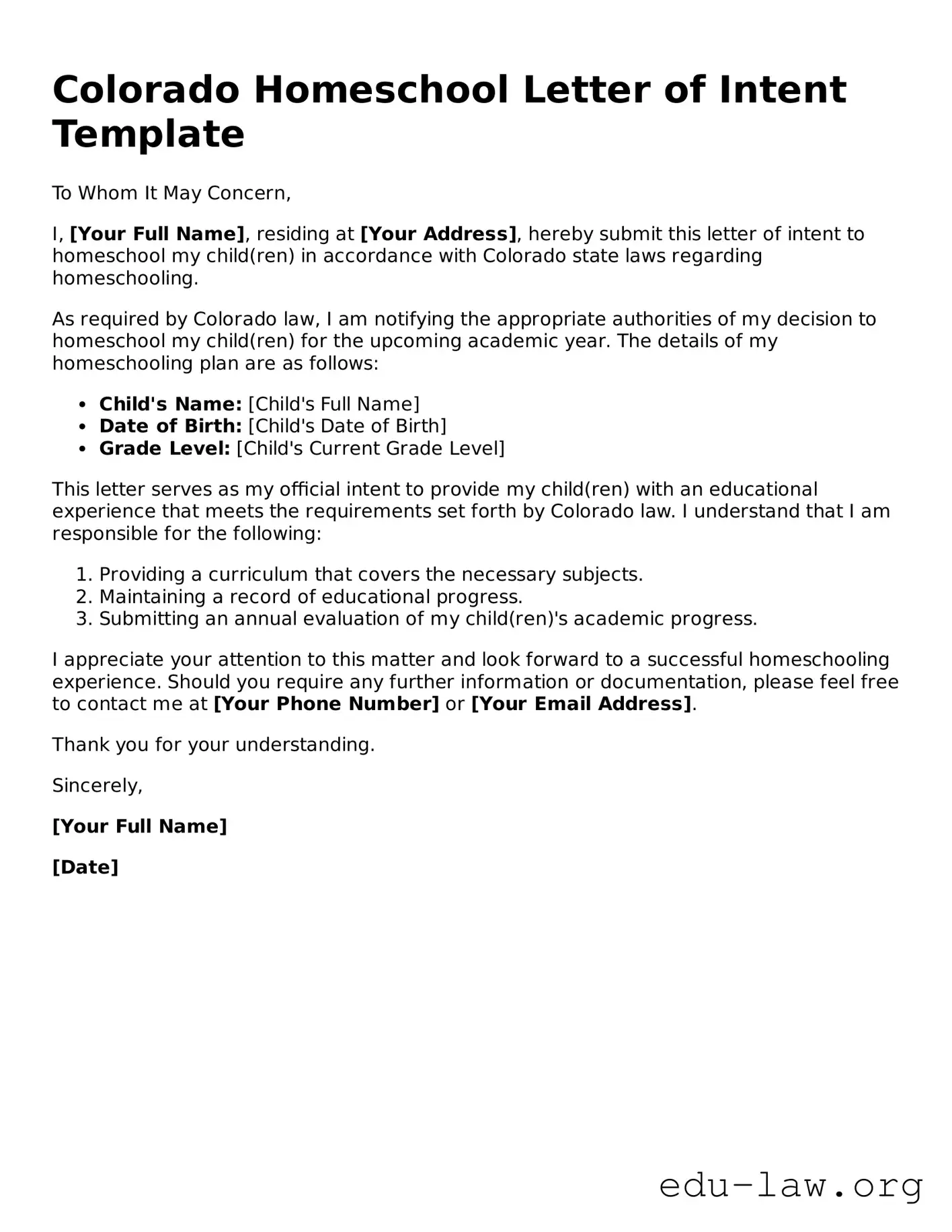
Colorado Homeschool Letter of Intent Template
To Whom It May Concern,
I, [Your Full Name], residing at [Your Address], hereby submit this letter of intent to homeschool my child(ren) in accordance with Colorado state laws regarding homeschooling.
As required by Colorado law, I am notifying the appropriate authorities of my decision to homeschool my child(ren) for the upcoming academic year. The details of my homeschooling plan are as follows:
This letter serves as my official intent to provide my child(ren) with an educational experience that meets the requirements set forth by Colorado law. I understand that I am responsible for the following:
I appreciate your attention to this matter and look forward to a successful homeschooling experience. Should you require any further information or documentation, please feel free to contact me at [Your Phone Number] or [Your Email Address].
Thank you for your understanding.
Sincerely,
[Your Full Name]
[Date]
| Fact Name | Description |
|---|---|
| Purpose | The Colorado Homeschool Letter of Intent form is used to notify the state of your intent to homeschool your child. |
| Governing Law | The form is governed by Colorado Revised Statutes § 22-33-104.5. |
| Submission Deadline | The form must be submitted within 14 days of starting your homeschool program. |
| Information Required | It requires basic information such as the child's name, age, and address. |
| Annual Requirement | The Letter of Intent must be submitted annually for each child being homeschooled. |
| Notification Method | You can submit the form via mail or electronically, depending on your school district's policies. |
| Record Keeping | Parents must keep a copy of the submitted Letter of Intent for their records. |
| Additional Documentation | No additional documentation is required with the initial submission of the form. |
| Contact Information | For questions, parents should contact their local school district for guidance. |
After completing the Colorado Homeschool Letter of Intent form, you will need to submit it to your local school district. Make sure to keep a copy for your records. This form is a crucial step in establishing your homeschooling program.
What is the Colorado Homeschool Letter of Intent?
The Colorado Homeschool Letter of Intent is a formal document that parents or guardians submit to notify their school district of their decision to homeschool their child. This letter serves as an official declaration of intent to provide education outside the traditional school system.
Who needs to submit the Letter of Intent?
Any parent or guardian who chooses to homeschool their child in Colorado must submit the Letter of Intent. This requirement applies to children aged 6 to 16, as they fall within the compulsory education age range in the state.
When should the Letter of Intent be submitted?
The Letter of Intent should be submitted to the local school district at least 14 days before the start of the homeschooling program. It is advisable to submit the letter as early as possible to ensure compliance with state regulations.
What information is required in the Letter of Intent?
The Letter of Intent must include the name and address of the child, the name of the parent or guardian, and a statement expressing the intent to homeschool. Additionally, it may be beneficial to provide information about the educational plan, although this is not strictly required at the time of submission.
Is there a specific format for the Letter of Intent?
While there is no mandated format for the Letter of Intent, it is recommended to keep the letter clear and concise. A simple, straightforward letter that includes all necessary information will suffice. Some parents choose to use templates available online to ensure they cover all required elements.
What happens after submitting the Letter of Intent?
Once the Letter of Intent is submitted, the school district will acknowledge receipt. Parents are then responsible for developing and implementing an educational plan for their child. It is essential to maintain records of educational progress, as the district may request documentation to ensure compliance with homeschooling laws.
Are there any consequences for not submitting the Letter of Intent?
Failure to submit the Letter of Intent can result in legal consequences, as homeschooling without proper notification is not permitted in Colorado. Parents may face penalties, including the potential requirement to enroll their child in a public or private school. It is crucial to adhere to the state's regulations to avoid any complications.
Not providing complete information about the student. It's essential to include the full name, date of birth, and address. Omitting any of these details can lead to delays or issues with your homeschooling status.
Failing to sign and date the form. A signature is not just a formality; it confirms that you are officially submitting your intent to homeschool. Without it, the form is considered incomplete.
Incorrectly identifying the educational year. Be sure to specify the correct school year for which you are submitting the intent. This helps in maintaining accurate records.
Not checking for spelling errors. Simple typos can create confusion. Take a moment to review the form for any mistakes before submitting it.
Neglecting to include all required attachments. Some states may require additional documents, such as proof of residency or educational plans. Make sure you have everything needed to support your intent.
Submitting the form late. Each district has its own deadlines for submitting the Letter of Intent. Missing these deadlines can result in complications with your homeschooling process.
Ignoring district-specific requirements. While the basic form may be standard, some districts have unique rules or additional forms to fill out. Always check your local regulations.
Using outdated forms. Ensure you are using the most current version of the Letter of Intent. Forms can change, and using an old version may lead to rejection.
Not keeping a copy for personal records. Always make a copy of the submitted form for your own records. This can be helpful in case of any future inquiries or issues.
When families decide to homeschool in Colorado, they often need to complete several forms and documents in addition to the Homeschool Letter of Intent. These documents help ensure compliance with state regulations and provide necessary information about the educational plan. Below is a list of commonly used forms and documents in conjunction with the Homeschool Letter of Intent.
These documents collectively support the homeschooling process and help families adhere to Colorado's educational requirements. Maintaining accurate and organized records is essential for a successful homeschooling experience.
The Colorado Homeschool Letter of Intent form shares similarities with the Affidavit of Homeschooling, which is often used in various states to formally declare a family's intention to homeschool their children. Both documents require parents to provide basic information about their children and their educational plans. The Affidavit typically includes details such as the child’s name, age, and the educational curriculum to be used. Like the Letter of Intent, this document serves as a formal notification to the state’s education department, ensuring compliance with homeschooling laws.
Another document that resembles the Colorado Homeschool Letter of Intent is the Notice of Intent to Homeschool. This notice is commonly required in many states and acts as an official declaration to local school authorities. Parents must submit this notice to inform the school district of their decision to homeschool. Similar to the Letter of Intent, it includes essential information about the child and the educational approach that will be taken. Both documents aim to keep local education authorities informed while protecting the rights of homeschooling families.
The Individualized Education Program (IEP) also bears some resemblance to the Colorado Homeschool Letter of Intent, particularly when it comes to outlining educational goals for a child. While an IEP is specifically designed for students with disabilities and is developed by a team of educators and parents, it shares the common goal of ensuring that a child receives a tailored educational experience. Both documents require parents to think critically about their child’s needs and the resources that will be employed to meet those needs, fostering a personalized approach to education.
Lastly, the Enrollment Form for Private School is another document that aligns with the Colorado Homeschool Letter of Intent. While it is used for families enrolling their children in private institutions, both forms serve a similar purpose in terms of informing educational authorities about a child’s educational setting. The Enrollment Form typically requires parents to provide information about their child, the school, and the educational plan. Like the Letter of Intent, it facilitates communication between parents and educational authorities, ensuring that the child’s educational path is recognized and supported.
When filling out the Colorado Homeschool Letter of Intent form, it is important to follow specific guidelines to ensure a smooth process. Here are four things you should do and should not do:
Many people have misunderstandings about the Colorado Homeschool Letter of Intent form. Here are five common misconceptions:
This is not true. Families from all backgrounds and circumstances can choose to homeschool. It is a flexible option that can work for many different lifestyles.
In reality, the form simply notifies the school district of your intent to homeschool. You have the freedom to choose how you educate your child, including the curriculum and teaching methods.
This is a common belief, but it is not a requirement. Parents or guardians can educate their children without formal teaching credentials in Colorado.
While there are deadlines for submitting the form, it can typically be done at various times throughout the year. Check with your local school district for specific guidelines.
This is a misconception. If you decide that homeschooling is not the right fit, you can return to public or private school at any time.
Understanding these points can help clarify the process and alleviate concerns about homeschooling in Colorado.
When filling out and using the Colorado Homeschool Letter of Intent form, there are several important points to consider. Here are four key takeaways: