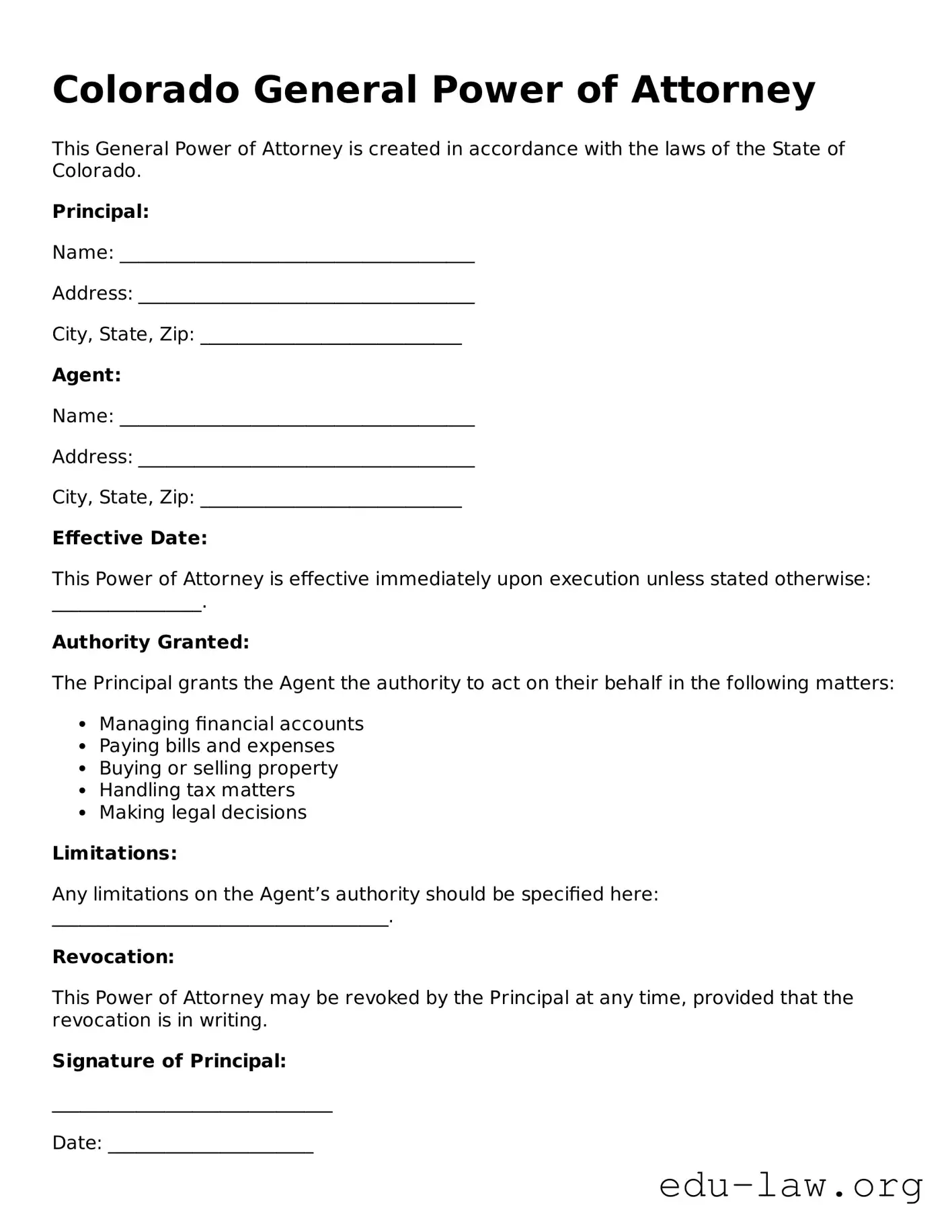
The Colorado General Power of Attorney form is a vital legal document that allows individuals to designate someone they trust to handle their financial and legal affairs. This form empowers an agent to make decisions on behalf of the principal, covering a wide range of responsibilities, from managing bank accounts to signing contracts. It is particularly useful in situations where the principal may be unable to act due to illness, absence, or incapacity. The form outlines the specific powers granted to the agent, ensuring clarity in the relationship and responsibilities. Importantly, it also allows the principal to specify any limitations on the agent's authority, providing an added layer of control. Understanding the nuances of this form is essential for anyone considering appointing an agent, as it can significantly impact financial and legal outcomes. With the right knowledge, individuals can ensure that their interests are well-represented and protected, even when they cannot be present to make decisions themselves.
Colorado General Power of Attorney
This General Power of Attorney is created in accordance with the laws of the State of Colorado.
Principal:
Name: ______________________________________
Address: ____________________________________
City, State, Zip: ____________________________
Agent:
Name: ______________________________________
Address: ____________________________________
City, State, Zip: ____________________________
Effective Date:
This Power of Attorney is effective immediately upon execution unless stated otherwise: ________________.
Authority Granted:
The Principal grants the Agent the authority to act on their behalf in the following matters:
Limitations:
Any limitations on the Agent’s authority should be specified here: ____________________________________.
Revocation:
This Power of Attorney may be revoked by the Principal at any time, provided that the revocation is in writing.
Signature of Principal:
______________________________
Date: ______________________
Witnesses:
Witness 1 Name: ___________________________
Witness 1 Signature: ________________________
Date: ______________________
Witness 2 Name: ___________________________
Witness 2 Signature: ________________________
Date: ______________________
Notary Public:
State of Colorado
County of ___________________________
Subscribed and sworn before me this ______ day of ____________, 20___.
Notary Public Signature: ________________________
My commission expires: ________________________
| Fact Name | Description |
|---|---|
| Definition | A Colorado General Power of Attorney form allows an individual (the principal) to appoint someone else (the agent) to manage their financial affairs. |
| Governing Law | This form is governed by the Colorado Revised Statutes, specifically Title 15, Article 14. |
| Durability | The general power of attorney can be made durable, meaning it remains effective even if the principal becomes incapacitated. |
| Agent's Authority | The agent can handle various financial matters, including banking, real estate transactions, and tax matters. |
| Revocation | The principal can revoke the power of attorney at any time, provided they are mentally competent. |
| Witnesses and Notarization | In Colorado, the form must be signed in the presence of a notary public to be valid. |
Filling out the Colorado General Power of Attorney form is a straightforward process. Once you complete the form, you can designate someone to make decisions on your behalf regarding financial matters. This can be particularly useful if you are unable to manage your affairs due to illness, absence, or other reasons.
What is a General Power of Attorney in Colorado?
A General Power of Attorney (GPOA) in Colorado is a legal document that allows one person, known as the principal, to grant another person, referred to as the agent or attorney-in-fact, the authority to act on their behalf. This authority can cover a wide range of financial and legal matters, such as managing bank accounts, signing contracts, and handling real estate transactions. The GPOA remains effective until the principal revokes it or passes away, making it a powerful tool for managing affairs, especially in cases where the principal may be unable to do so themselves.
How do I create a General Power of Attorney in Colorado?
Creating a General Power of Attorney in Colorado involves a few key steps. First, you need to obtain the appropriate form, which can often be found online or through legal resources. Next, you must fill out the form, clearly specifying the powers you wish to grant to your agent. It’s essential to choose someone you trust, as they will have significant control over your affairs. After completing the form, you must sign it in the presence of a notary public. This step is crucial, as notarization adds a layer of authenticity and helps prevent disputes about the document's validity.
Can I revoke a General Power of Attorney in Colorado?
Yes, you can revoke a General Power of Attorney in Colorado at any time, as long as you are mentally competent. To do so, you should create a written revocation document that clearly states your intention to revoke the previous GPOA. It’s advisable to notify your agent and any institutions or individuals that may have relied on the original document. This helps prevent confusion and ensures that your current wishes are respected. Additionally, it’s a good practice to destroy any copies of the original GPOA to avoid any potential misuse.
What happens if I become incapacitated and have a General Power of Attorney in place?
If you become incapacitated and have a General Power of Attorney in place, your designated agent can step in to manage your affairs as specified in the document. This can include making financial decisions, handling healthcare matters, and ensuring that your day-to-day needs are met. It’s important to note that the agent’s authority is limited to what you outlined in the GPOA. Therefore, having a well-drafted document is essential to ensure that your wishes are followed during your incapacity.
Not clearly identifying the principal. It’s essential to include the full legal name of the person granting the power of attorney. Without this, the document may be deemed invalid.
Failing to specify the powers granted. A general power of attorney should clearly outline what decisions the agent can make. Vague language can lead to confusion.
Not signing the document in front of a notary. In Colorado, a power of attorney must be notarized to be legally binding. Skipping this step can invalidate the document.
Overlooking the agent’s responsibilities. It’s important to understand that the agent has a fiduciary duty to act in the principal’s best interest. Not discussing this can lead to misunderstandings.
Using outdated forms. Laws change, and so do the requirements for legal documents. Always ensure you are using the most current version of the power of attorney form.
Neglecting to include a successor agent. If the primary agent is unable or unwilling to act, having a backup can prevent complications.
Not reviewing the document thoroughly. Before signing, it’s crucial to read the entire form carefully. Mistakes or omissions can lead to significant issues down the line.
When creating a Colorado General Power of Attorney, it's essential to consider other documents that can complement this important legal tool. Each of these forms serves a unique purpose and can help ensure that your wishes are respected and your affairs are managed effectively. Here’s a list of related documents you might find useful.
By considering these documents alongside your Colorado General Power of Attorney, you can create a comprehensive plan that addresses your financial and healthcare needs. Taking these steps now can save your loved ones from confusion and stress in the future.
The Colorado General Power of Attorney form is similar to the Durable Power of Attorney. Both documents allow an individual to appoint someone else to make decisions on their behalf. However, the Durable Power of Attorney remains effective even if the principal becomes incapacitated, while the General Power of Attorney may become void under such circumstances. This distinction is crucial for individuals seeking to ensure their affairs are managed during periods of incapacity.
Another document comparable to the Colorado General Power of Attorney is the Medical Power of Attorney. This form specifically grants authority to a designated person to make medical decisions for the principal. While the General Power of Attorney can encompass a wide range of financial and legal matters, the Medical Power of Attorney focuses solely on healthcare-related decisions. Individuals often use both documents together to ensure comprehensive coverage of their needs.
The Springing Power of Attorney also shares similarities with the General Power of Attorney. This type of document becomes effective only upon a specific event, usually the incapacitation of the principal. While the General Power of Attorney is effective immediately upon signing, the Springing Power of Attorney provides a way for individuals to maintain control over their affairs until a triggering event occurs.
A Revocable Living Trust is another document that bears resemblance to the Colorado General Power of Attorney. Both allow for the management of assets and can help avoid probate. However, a Revocable Living Trust typically involves transferring ownership of assets into the trust, while a General Power of Attorney grants authority to manage assets without changing ownership. This difference can impact how individuals plan for their estate and manage their financial affairs.
The Financial Power of Attorney is also akin to the General Power of Attorney. This document specifically authorizes someone to handle financial matters, such as banking and investments, on behalf of the principal. While the General Power of Attorney can cover a broader scope of responsibilities, the Financial Power of Attorney narrows the focus to financial transactions, making it a preferred choice for those who want to limit the authority granted.
Lastly, the Limited Power of Attorney is similar in that it allows an individual to designate someone to act on their behalf. However, this document restricts the scope of authority to specific tasks or time frames. In contrast, the Colorado General Power of Attorney typically grants broader powers. Individuals may choose a Limited Power of Attorney for specific transactions, such as selling property or handling a particular financial matter, while reserving the General Power of Attorney for more extensive authority.
When filling out the Colorado General Power of Attorney form, it is crucial to follow specific guidelines to ensure the document is valid and effective. Below is a list of actions to take and avoid during this process.
Things You Should Do:
Things You Shouldn't Do:
Many people have misunderstandings about the Colorado General Power of Attorney form. Here are four common misconceptions:
This is not true. A General Power of Attorney can be effective immediately upon signing, allowing your chosen agent to act on your behalf right away. It does not require you to be incapacitated.
While your agent does have significant authority, their powers are limited to what you specify in the document. You can outline what they can and cannot do, providing you with control over your financial matters.
Actually, a General Power of Attorney typically ends if you become incapacitated unless you have created a durable power of attorney. A durable power of attorney remains effective even if you are no longer able to make decisions.
This misconception is false. You can revoke a General Power of Attorney at any time as long as you are mentally competent. Simply notify your agent and follow the proper procedures to ensure it is officially revoked.
When considering the Colorado General Power of Attorney form, it is important to understand its implications and requirements. Here are key takeaways to keep in mind:
Understanding these points can help ensure that the Colorado General Power of Attorney form is used effectively and responsibly.