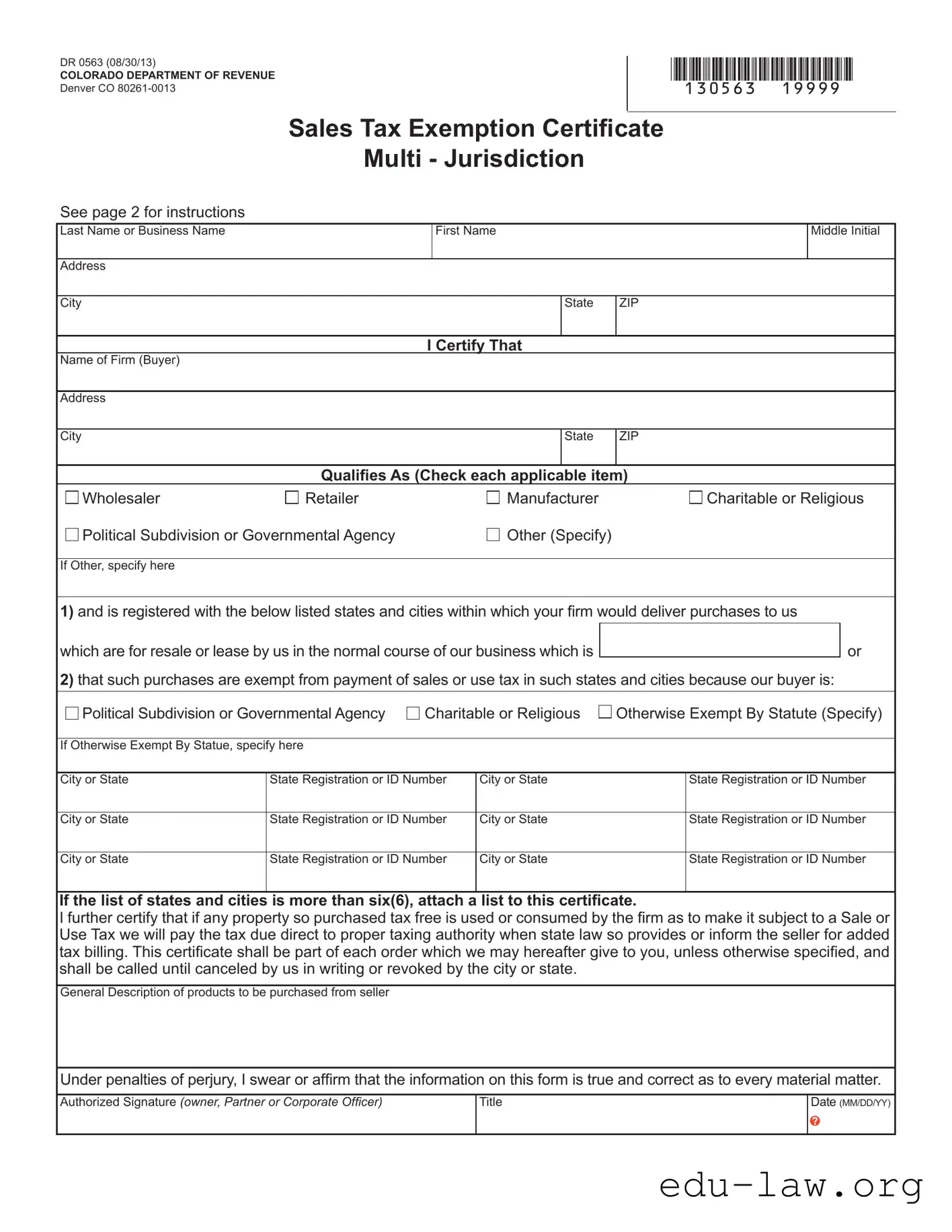
The Colorado Exemption form, officially known as DR 0563, serves as a crucial tool for businesses seeking to navigate sales tax obligations in the state. This multi-jurisdictional sales tax exemption certificate allows buyers, including wholesalers, retailers, manufacturers, and charitable organizations, to certify their eligibility for tax exemption on purchases intended for resale or lease. To complete the form, businesses must provide their name, address, and registration details, along with a declaration of their qualifications. The form requires buyers to check applicable exemption categories and list the states and cities where they are registered. Importantly, it also emphasizes the buyer's responsibility to pay sales or use tax if the purchased property is used in a manner that triggers tax liability. This certificate is essential for sellers as well, as they must maintain a valid exemption certificate on file to avoid collecting sales tax unnecessarily. Misuse of the form can lead to serious consequences, underscoring the importance of accurate completion and adherence to state regulations. By understanding the Colorado Exemption form, businesses can ensure compliance and optimize their tax strategies.
DR 0563 (08/30/13)
COLORADO DEPARTMENT OF REVENUE
Denver CO
*130563==19999*
Sales Tax Exemption Certiicate
Multi - Jurisdiction
See page 2 for instructions
Last Name or Business Name |
First Name |
|
|
|
Address |
|
|
|
|
|
|
|
|
|
City |
|
State |
|
ZIP |
|
|
|||
|
|
|
|
|
Middle Initial
I Certify That
Name of Firm (Buyer)
Address
City |
State |
ZIP |
Qualiies As (Check each applicable item)
Wholesaler |
Retailer |
Manufacturer |
Charitable or Religious |
Political Subdivision or Governmental Agency |
Other (Specify) |
|
|
If Other, specify here
1)and is registered with the below listed states and cities within which your irm would deliver purchases to us
which are for resale or lease by us in the normal course of our business which is |
|
or |
2)that such purchases are exempt from payment of sales or use tax in such states and cities because our buyer is:
Political Subdivision or Governmental Agency
Charitable or Religious |
Otherwise Exempt By Statute (Specify) |
If Otherwise Exempt By Statue, specify here
City or State |
State Registration or ID Number |
City or State |
State Registration or ID Number |
|
|
|
|
City or State |
State Registration or ID Number |
City or State |
State Registration or ID Number |
|
|
|
|
City or State |
State Registration or ID Number |
City or State |
State Registration or ID Number |
If the list of states and cities is more than six(6), attach a list to this certiicate.
I further certify that if any property so purchased tax free is used or consumed by the irm as to make it subject to a Sale or
Use Tax we will pay the tax due direct to proper taxing authority when state law so provides or inform the seller for added tax billing. This certiicate shall be part of each order which we may hereafter give to you, unless otherwise speciied, and shall be called until canceled by us in writing or revoked by the city or state.
General Description of products to be purchased from seller
Under penalties of perjury, I swear or afirm that the information on this form is true and correct as to every material matter.
Authorized Signature (owner, Partner or Corporate Oficer)
Title
Date (MM/DD/YY)
To Our Customers:
In order to comply with the majority of state and local sales
tax law requirements, it is necessary that we have in our iles a properly executed exemption certiicate from all of our customers who claim sales tax exemption. If we do not have this certiicate, we are obligated to collect the tax for the state in which the property is delivered. If you are entitled to sales tax exemption, please complete the certiicate and send it to us at your earliest convenience. If you purchase tax free for
a reason for which this form does not provide, please send us your special certiicate or statement.
*Lessor: A form DR0440, “Permit to Collect Sales Tax
on the Rental or Lease Basis” must be completed and submitted to the Department of Revenue for approval.
Caution To Seller: In order for the certiicate to be
accepted in good faith by the seller, the seller must exercise care that the property being sold is of a type normally sold wholesale, resold, leased, rented , or utilized as an
ingredient or component part of a product manufactured by the buyer in the usual course of his business. A seller failing
to exercise due care could be held liable for the sales tax due in some states or cities.
Misuse of this certiicate by the seller, lessor, buyer, les- see, or the representative thereof may be punished by ine, imprisonment or loss of right to issue certiicates in some states or cities.
| Fact Name | Description |
|---|---|
| Form Identification | The Colorado Sales Tax Exemption Certificate is identified as DR 0563, and it is used for multi-jurisdictional sales tax exemption purposes. |
| Governing Law | This form is governed by Colorado sales tax law, specifically under the Colorado Revised Statutes (C.R.S.) § 39-26-114, which outlines the requirements for sales tax exemptions. |
| Purpose of the Form | This certificate allows qualifying buyers, such as wholesalers or charitable organizations, to purchase goods without paying sales tax, provided they meet specific criteria. |
| Seller's Responsibility | Sellers must ensure that the goods sold are typically sold at wholesale and that the exemption certificate is valid. Failure to do so may result in liability for unpaid sales tax. |
Filling out the Colorado Exemption form is a straightforward process that ensures you can claim sales tax exemption for your purchases. Once completed, this form should be submitted to the seller to confirm your eligibility for exemption. Below are the steps to accurately fill out the form.
After completing these steps, ensure that the form is accurate and submit it to the seller promptly. This will help you avoid unnecessary tax charges and streamline your purchasing process.
What is the purpose of the Colorado Exemption form?
The Colorado Exemption form, also known as the Sales Tax Exemption Certificate, is used by businesses to claim exemption from sales tax on certain purchases. When a buyer qualifies for a sales tax exemption—such as being a wholesaler, retailer, manufacturer, or a charitable organization—they can use this form to certify their status. This helps ensure that sales tax is not collected on purchases that are exempt under state law.
Who needs to fill out the Colorado Exemption form?
Any business or organization that qualifies for a sales tax exemption in Colorado should complete this form. This includes wholesalers, retailers, manufacturers, charitable organizations, governmental agencies, and others specified in the form. If a business intends to make tax-exempt purchases, it is essential that they provide a properly executed exemption certificate to the seller to avoid sales tax charges.
How do I complete the Colorado Exemption form?
To fill out the Colorado Exemption form, start by providing your name or business name, address, and contact information. Next, indicate the type of organization you represent by checking the appropriate boxes. If your organization is exempt for reasons not listed, specify those reasons in the designated area. Additionally, list the states and cities where your firm is registered and where purchases will be delivered. Finally, an authorized representative must sign and date the form to certify that the information provided is true and correct.
What happens if I do not provide a Colorado Exemption form?
If a seller does not have a completed Colorado Exemption form on file, they are required to collect sales tax on the transaction. This means that buyers who are eligible for tax exemption may end up paying sales tax unnecessarily. It is important for buyers to submit the form as soon as possible to avoid this situation and ensure compliance with state tax laws.
Can the Colorado Exemption form be revoked or canceled?
Yes, the Colorado Exemption form can be revoked or canceled at any time by the buyer. To do so, the buyer must provide written notice to the seller. It is also important to note that if the seller has reason to believe the exemption is being misused, they may be required to take action, which could include collecting sales tax. Therefore, maintaining accurate records and communicating any changes is essential for both buyers and sellers.
Failing to provide accurate contact information. Ensure that the last name or business name, address, city, state, and ZIP code are filled out correctly.
Not checking all applicable categories. The form requires buyers to check each applicable item, such as wholesaler, retailer, or charitable organization. Missing this step can lead to denial of the exemption.
Omitting the state registration or ID numbers. Buyers must include registration or ID numbers for all states and cities where purchases will be made. Failing to do so can invalidate the exemption.
Neglecting to specify if the exemption falls under "Other." If a buyer checks this option, they must provide a clear explanation. Lack of clarity can result in confusion and potential tax liabilities.
Not signing the form. An authorized signature is essential. Without it, the form lacks validity and cannot be processed.
Submitting incomplete information. All sections of the form should be filled out completely. Incomplete forms can delay processing and lead to tax collection.
Failing to attach additional documentation. If the list of states and cities exceeds six, buyers must attach a separate list. This oversight can result in rejection of the exemption.
Ignoring the penalties of perjury. Buyers must understand that providing false information can lead to severe consequences, including fines and imprisonment.
When dealing with sales tax exemptions in Colorado, it is important to be aware of additional forms and documents that may accompany the Colorado Exemption form. Each of these documents serves a specific purpose and can help streamline the process of claiming exemptions. Below is a list of commonly used forms that you may encounter.
Understanding these forms and their purposes can help ensure that you navigate the sales tax exemption process smoothly. Each document plays a vital role in maintaining compliance with Colorado’s tax regulations and protecting your business interests.
The Colorado Exemption form is similar to the Resale Certificate used in various states, which allows businesses to purchase goods without paying sales tax if those goods are intended for resale. This document typically requires the buyer to provide their business information and a description of the items being purchased. Just like the Colorado form, the Resale Certificate helps businesses avoid double taxation, ensuring that sales tax is only collected when the final consumer purchases the item. The process and requirements may vary slightly by state, but the fundamental purpose remains the same: to facilitate tax-exempt purchases for resale purposes.
Another document that shares similarities is the Certificate of Exemption. This form is often utilized by nonprofit organizations, allowing them to purchase goods and services without incurring sales tax. Like the Colorado Exemption form, it requires the organization to certify its tax-exempt status. Both forms help ensure compliance with tax laws while supporting the financial operations of charitable entities. The Certificate of Exemption often serves as a safeguard for sellers, protecting them from liability in the event of an audit.
The 501(c)(3) Tax-Exempt Status Letter is also comparable to the Colorado Exemption form. Nonprofits use this letter to prove their tax-exempt status to vendors, allowing them to make tax-free purchases. Similar to the Colorado form, this letter must be presented to suppliers to avoid sales tax on qualifying purchases. Both documents reinforce the importance of maintaining proper records and documentation to support tax-exempt transactions, ensuring that organizations can operate effectively without unnecessary tax burdens.
In addition, the Direct Pay Permit is another document that functions similarly. This permit allows businesses to make tax-exempt purchases on certain goods and services, as they will remit the sales tax directly to the state. Much like the Colorado Exemption form, it requires the business to provide specific details about its operations and the nature of the purchases. The Direct Pay Permit streamlines the tax process for businesses, ensuring that they comply with state tax regulations while minimizing the upfront tax costs associated with purchases.
Lastly, the Vendor's Exemption Certificate is akin to the Colorado Exemption form. This document is often used by vendors who are purchasing goods for resale or to use in their business operations. It allows them to avoid paying sales tax at the point of sale, similar to the Colorado form's intent. Both forms require the buyer to affirm their eligibility for exemption and provide necessary details about their business activities. This helps sellers verify the legitimacy of the exemption claim and protects them from potential tax liabilities.
When filling out the Colorado Exemption form, there are important dos and don'ts to keep in mind. Adhering to these guidelines can help ensure that your exemption request is processed smoothly.
Understanding the Colorado Exemption form can be tricky, and many misconceptions can lead to confusion. Here are eight common misunderstandings about this important document:
By understanding these misconceptions, businesses can better navigate the complexities of sales tax exemptions in Colorado. Proper use of the exemption form is essential for compliance and can help avoid unnecessary tax liabilities.
Here are key takeaways about filling out and using the Colorado Exemption form:
By following these guidelines, you can ensure proper use of the Colorado Exemption form and avoid potential tax liabilities.