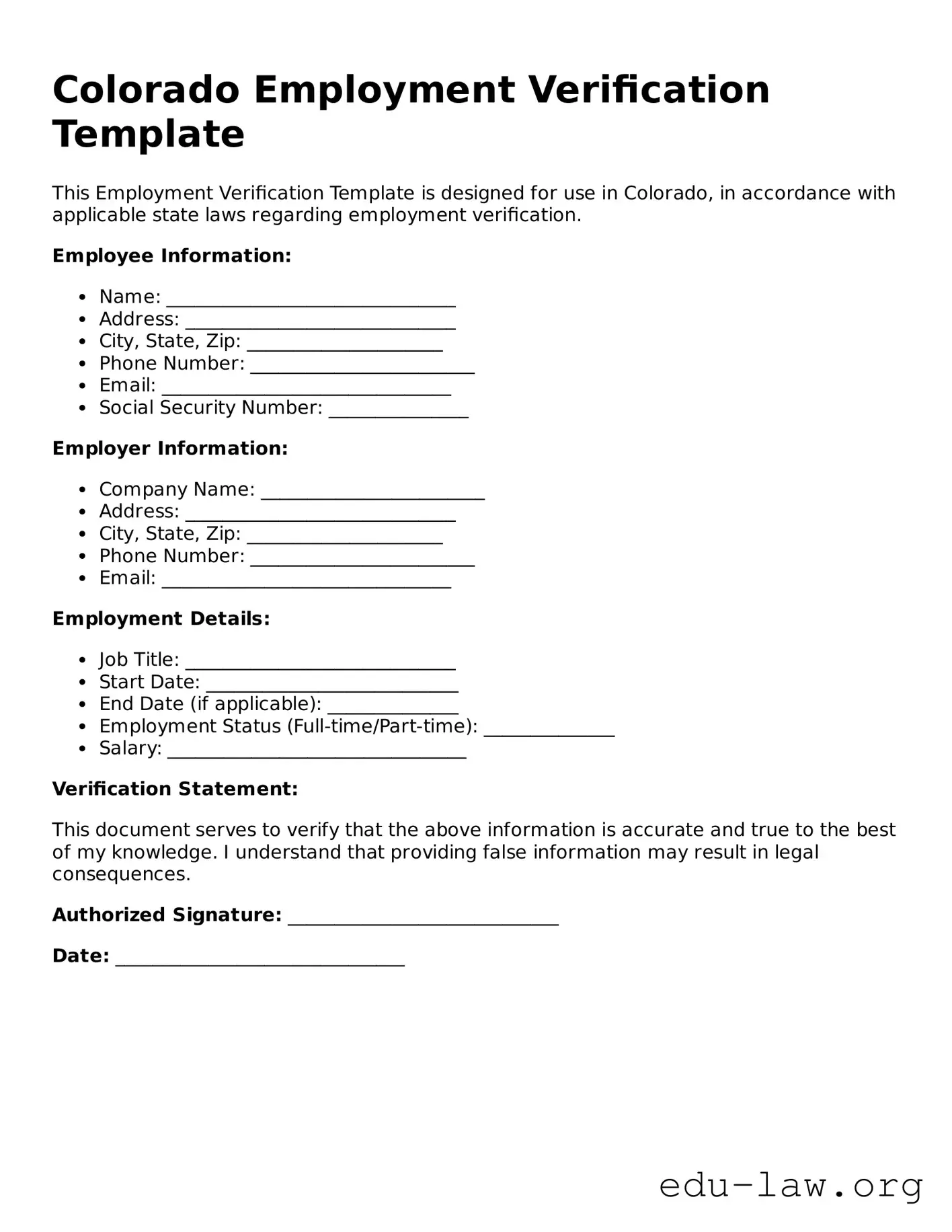
In Colorado, the Employment Verification form plays a crucial role in the hiring process, serving as a means for employers to confirm the employment status of their prospective employees. This form is particularly important for ensuring compliance with state laws and regulations regarding employment eligibility. It typically requires the employee to provide essential personal information, including their name, social security number, and details about their current or previous employment. Employers utilize this information to verify the accuracy of the employee’s claims and to assess their qualifications for the position. Additionally, the form may include sections for the employer to document their findings and any relevant comments regarding the employment verification process. Understanding the significance of this form can help both employers and employees navigate the complexities of employment verification in a manner that is efficient and compliant with legal standards.
Colorado Employment Verification Template
This Employment Verification Template is designed for use in Colorado, in accordance with applicable state laws regarding employment verification.
Employee Information:
Employer Information:
Employment Details:
Verification Statement:
This document serves to verify that the above information is accurate and true to the best of my knowledge. I understand that providing false information may result in legal consequences.
Authorized Signature: _____________________________
Date: _______________________________
| Fact Name | Details |
|---|---|
| Purpose | The Colorado Employment Verification form is used to verify an employee's eligibility to work in the state. |
| Governing Law | This form is governed by Colorado Revised Statutes, specifically C.R.S. § 8-2-122. |
| Employer Requirement | Employers in Colorado must complete this form for all new hires to comply with state law. |
| Submission | The form must be submitted to the Colorado Department of Labor and Employment. |
| Retention Period | Employers are required to keep the completed form for a minimum of three years. |
| Employee Information | The form collects essential details such as the employee's name, address, and Social Security number. |
| Verification Process | Employers must verify the employee's identity and eligibility using acceptable documents. |
| Penalties | Failure to complete the form can result in fines and penalties for the employer. |
| Online Access | The form is available online, making it easy for employers to download and complete. |
| Updates | The form is subject to updates, so employers should check for the latest version regularly. |
Completing the Colorado Employment Verification form is an important step in ensuring that your employment details are accurately documented. After filling out the form, it will be submitted to the appropriate agency or employer for processing.
What is the Colorado Employment Verification form?
The Colorado Employment Verification form is a document used by employers to verify the employment status of their employees. It typically includes details such as the employee's job title, dates of employment, and salary information. This form is often required by financial institutions, government agencies, or other entities that need to confirm an individual's employment for various purposes.
Who needs to fill out the Employment Verification form?
Employers are responsible for completing the Employment Verification form. They must provide accurate and truthful information about the employee's work history. Employees may need to request this form from their employer when applying for loans, housing, or other services that require proof of employment.
How do I request an Employment Verification form?
To request the Employment Verification form, an employee should contact their human resources department or direct supervisor. A written request may be necessary, especially if the employer has a formal process for handling such requests. It is advisable to provide any relevant details to expedite the process.
What information is typically included in the form?
The form generally includes the employee's name, job title, dates of employment, salary or hourly wage, and the employer's contact information. Some forms may also ask for additional details, such as the employee's work performance or eligibility for rehire.
Is there a fee for obtaining the Employment Verification form?
Typically, there is no fee for obtaining the Employment Verification form itself. However, some employers may charge a nominal fee for processing requests or for providing additional documentation. It is best to clarify with the employer if any costs are associated with the request.
How long does it take to receive the completed form?
The time it takes to receive the completed Employment Verification form can vary. Factors such as the employer's policies and workload can affect processing times. Generally, employees should allow at least a few business days for their request to be fulfilled.
Can the Employment Verification form be used for multiple purposes?
Yes, the Employment Verification form can be used for various purposes, including applying for loans, renting an apartment, or verifying employment for background checks. It is important to ensure that the information provided is accurate and up-to-date for each use.
What should I do if my employer refuses to complete the form?
If an employer refuses to complete the Employment Verification form, the employee should first inquire about the reason for the refusal. If it is due to a misunderstanding, clarifying the request may resolve the issue. If the refusal is unwarranted, the employee may consider discussing the situation with a higher-level manager or seeking legal advice if necessary.
Are there any legal requirements for the Employment Verification form?
While there are no specific legal requirements for the form itself, employers must ensure that the information provided is accurate and complies with applicable employment laws. Misrepresentation or failure to provide requested information can lead to legal consequences for the employer.
Incomplete Information: One of the most common mistakes is failing to provide all required details. This includes missing out on crucial information such as the employee’s full name, job title, or employment dates. Each field must be filled out accurately to avoid delays.
Incorrect Dates: Entering the wrong employment dates can lead to confusion. Whether it’s the start date or the end date, accuracy is essential. Double-checking these dates can save time and prevent potential issues.
Signature Issues: Forgetting to sign the form or using an incorrect signature can invalidate the document. Ensure that the form is signed in the appropriate place and that the signature matches the name provided.
Failure to Submit on Time: Timing is crucial when it comes to employment verification. Submitting the form late can lead to complications, especially if it’s tied to a specific deadline. Keeping track of submission dates is vital.
When completing the Colorado Employment Verification form, several other documents may be required to support the verification process. These documents provide additional context and information regarding an employee's work history and status. Below is a list of commonly used forms and documents that often accompany the Employment Verification form.
Gathering these documents can expedite the verification process and ensure that all necessary information is available for review. It is essential to keep these records organized and readily accessible for any employment-related inquiries.
The I-9 form, or Employment Eligibility Verification form, is a key document used by employers in the United States. Like the Colorado Employment Verification form, it serves to confirm an employee's identity and eligibility to work in the country. Employers must complete the I-9 for each new hire, requiring employees to present specific forms of identification. This ensures that the workforce is composed of individuals who are legally allowed to work in the U.S., just as the Colorado form aims to validate employment status within the state.
The W-4 form, known as the Employee’s Withholding Certificate, is another important document. While it primarily addresses tax withholding, it shares a similar purpose in that it is completed by employees to provide essential information to their employers. This form allows employers to determine the correct amount of federal income tax to withhold from an employee's paycheck. Both the W-4 and the Colorado Employment Verification form are crucial for ensuring compliance with legal requirements and facilitating proper record-keeping for both parties.
The 1099 form is used for independent contractors and freelancers, making it somewhat different from the Colorado Employment Verification form, which is focused on employees. However, both documents require accurate information about the individual’s work status. The 1099 form reports income paid to non-employees, while the Colorado form verifies employment status. Both documents are essential for tax reporting and compliance, highlighting the importance of accurate documentation in the workforce.
The pay stub is another document that is relevant in the employment context. While the Colorado Employment Verification form confirms employment status, the pay stub provides a record of earnings and deductions for employees. Pay stubs typically include details such as hours worked, wages, and taxes withheld. Both documents play a role in ensuring transparency and accountability between employers and employees, contributing to a clear understanding of employment conditions.
The offer letter is a document that outlines the terms of employment for a new hire. Similar to the Colorado Employment Verification form, it serves as an official record of employment. The offer letter typically includes details about job responsibilities, salary, and benefits. Both documents are foundational to the employment relationship, establishing clear expectations and providing a basis for further verification of employment status.
Lastly, the employment contract is a formal agreement between an employer and an employee. Like the Colorado Employment Verification form, it outlines the terms of employment, including job duties, compensation, and duration of employment. Employment contracts often include clauses regarding confidentiality and non-compete agreements. Both the contract and the verification form are essential for defining the employment relationship, ensuring that both parties understand their rights and obligations.
When filling out the Colorado Employment Verification form, it's important to approach the task with care. This form is essential for verifying an individual's employment status, and accuracy is key. Here are some guidelines to help you navigate the process effectively.
Understanding the Colorado Employment Verification form is essential for both employers and employees. However, several misconceptions can lead to confusion. Here are four common misconceptions:
By addressing these misconceptions, both employers and employees can navigate the Employment Verification process more effectively.
When filling out and using the Colorado Employment Verification form, there are several important points to keep in mind. Here are five key takeaways: