In the state of Colorado, the Durable Power of Attorney (DPOA) form serves as a crucial legal document, empowering individuals to designate a trusted person to manage their financial and medical decisions in the event they become unable to do so themselves. This form allows for a seamless transition of authority, ensuring that one’s wishes are respected and upheld during times of incapacity. A well-drafted DPOA can cover a wide range of decisions, from managing bank accounts and real estate transactions to making healthcare choices, thereby providing peace of mind to both the principal and their loved ones. It is important to note that the DPOA remains effective even if the principal becomes incapacitated, distinguishing it from other types of powers of attorney that may become void under such circumstances. Furthermore, Colorado law requires that the document be signed in the presence of a notary public, adding an extra layer of validity and protection. Understanding the nuances of this form is essential for anyone considering its use, as it can significantly influence the management of one’s affairs during critical times.
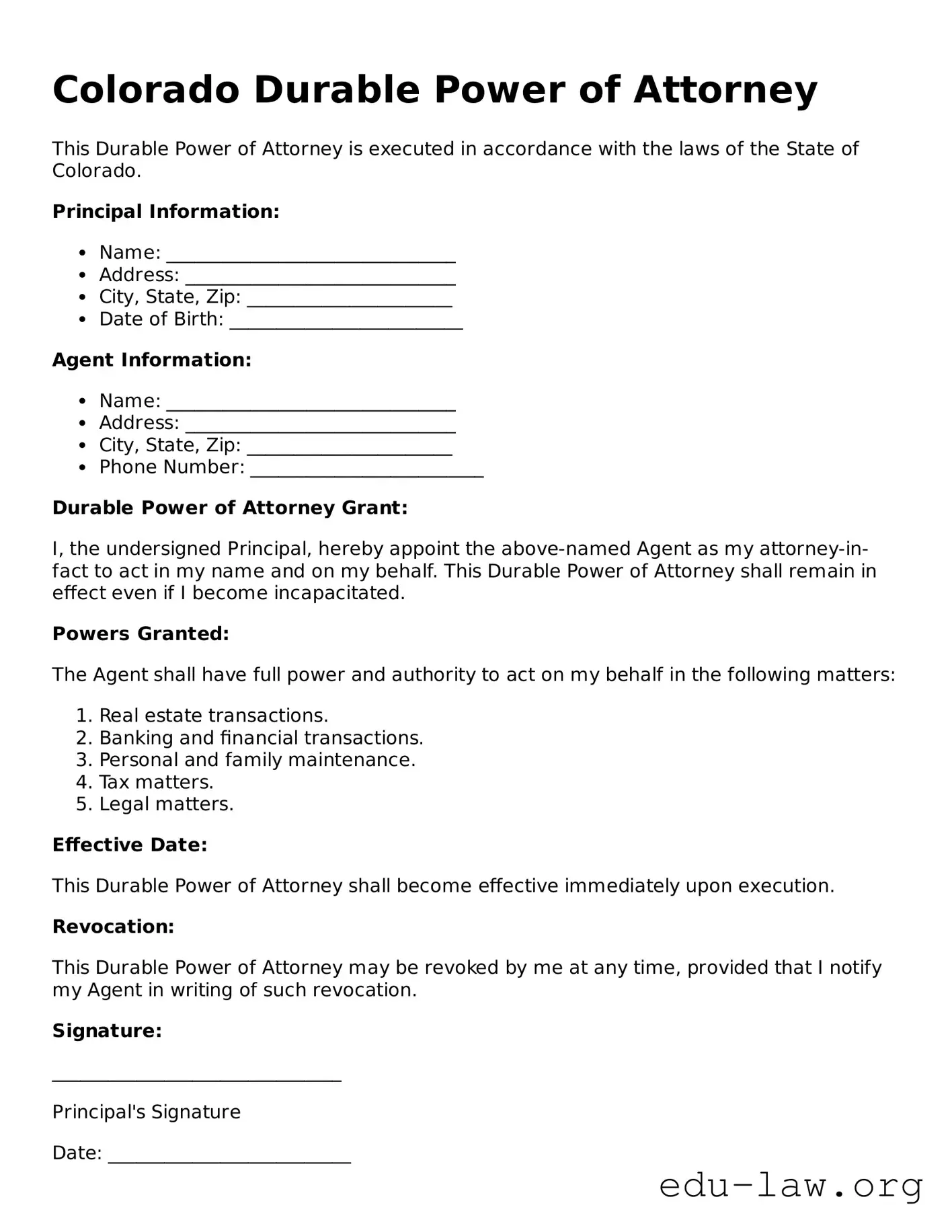
Colorado Durable Power of Attorney
This Durable Power of Attorney is executed in accordance with the laws of the State of Colorado.
Principal Information:
Agent Information:
Durable Power of Attorney Grant:
I, the undersigned Principal, hereby appoint the above-named Agent as my attorney-in-fact to act in my name and on my behalf. This Durable Power of Attorney shall remain in effect even if I become incapacitated.
Powers Granted:
The Agent shall have full power and authority to act on my behalf in the following matters:
Effective Date:
This Durable Power of Attorney shall become effective immediately upon execution.
Revocation:
This Durable Power of Attorney may be revoked by me at any time, provided that I notify my Agent in writing of such revocation.
Signature:
_______________________________
Principal's Signature
Date: __________________________
Witnesses:
By signing below, the witnesses affirm that the Principal appeared to be of sound mind and under no undue influence at the time of signing this document.
This document is intended to comply with Colorado Revised Statutes § 15-14-501 et seq.
| Fact Name | Description |
|---|---|
| Definition | A Colorado Durable Power of Attorney allows an individual to appoint someone else to make financial and legal decisions on their behalf, even if they become incapacitated. |
| Governing Law | The Colorado Durable Power of Attorney is governed by the Colorado Revised Statutes, specifically Title 15, Article 14. |
| Durability | This form remains effective even if the principal becomes incapacitated, ensuring that their affairs can continue to be managed. |
| Agent's Authority | The agent can be granted broad or limited powers, depending on the principal's preferences outlined in the document. |
| Revocation | The principal can revoke the Durable Power of Attorney at any time, as long as they are competent to do so. |
Filling out the Colorado Durable Power of Attorney form is an important step in ensuring that your financial and legal matters are managed according to your wishes, especially in the event that you are unable to make decisions for yourself. It is essential to approach this process with care and attention to detail. Once the form is completed, it will need to be signed and possibly notarized, depending on your specific circumstances.
What is a Durable Power of Attorney in Colorado?
A Durable Power of Attorney (DPOA) in Colorado is a legal document that allows an individual, known as the principal, to appoint another person, called the agent, to make decisions on their behalf. This authority remains effective even if the principal becomes incapacitated. The DPOA can cover financial matters, medical decisions, or both, depending on the principal's wishes.
How does one create a Durable Power of Attorney in Colorado?
To create a Durable Power of Attorney in Colorado, the principal must complete a DPOA form that complies with state laws. The form should be signed by the principal in the presence of a notary public. It is advisable to discuss the document with an attorney to ensure that it meets specific needs and requirements.
What powers can be granted to the agent under a Durable Power of Attorney?
The principal can grant a wide range of powers to the agent, including managing bank accounts, paying bills, filing taxes, and handling real estate transactions. The principal can also specify limitations on the agent's authority, ensuring that the agent acts within defined boundaries.
Can a Durable Power of Attorney be revoked?
Yes, a Durable Power of Attorney can be revoked at any time by the principal, as long as they are mentally competent. To revoke the DPOA, the principal should provide written notice to the agent and any third parties who may have relied on the document. It is recommended to create a new DPOA if the principal wishes to appoint a different agent.
What happens if the principal becomes incapacitated?
If the principal becomes incapacitated, the Durable Power of Attorney remains in effect. The agent can then act on behalf of the principal, making decisions regarding their finances and healthcare as specified in the document. This ensures that the principal's wishes are respected even when they are unable to communicate them.
Are there any limitations to the authority granted in a Durable Power of Attorney?
Yes, the authority granted in a Durable Power of Attorney can be limited. The principal can specify particular actions that the agent is not allowed to take. For example, the principal may choose to restrict the agent from making gifts or selling certain properties. Clear limitations should be outlined in the document to avoid any confusion.
Is it necessary to have a lawyer to create a Durable Power of Attorney in Colorado?
While it is not legally required to have a lawyer to create a Durable Power of Attorney in Colorado, consulting with an attorney is highly recommended. An attorney can provide guidance on the implications of the document, help tailor it to specific needs, and ensure compliance with state laws. This can prevent potential issues in the future.
Not naming an alternate agent: Many individuals fail to designate a backup agent. If the primary agent is unavailable or unwilling to act, this oversight can create complications.
Leaving sections blank: Incomplete forms can lead to confusion and misinterpretation. Each section should be filled out thoroughly to ensure clarity of intent.
Using outdated forms: Laws change over time. Utilizing an outdated version of the Durable Power of Attorney form may result in invalidation of the document.
Failing to sign and date: A common mistake is neglecting to sign and date the document. Without proper signatures, the form holds no legal weight.
Not discussing the decision with the agent: Appointing someone without consulting them first can lead to misunderstandings. Communication ensures that the agent understands their responsibilities and is willing to accept them.
Ignoring witness and notarization requirements: Colorado law may require witnesses or notarization for the document to be valid. Skipping this step can invalidate the power of attorney.
Not reviewing the document regularly: Life circumstances change. Failing to review and update the Durable Power of Attorney can result in outdated decisions that no longer reflect your wishes.
When preparing a Colorado Durable Power of Attorney, it is often beneficial to consider additional documents that can complement its effectiveness. These documents help ensure that your wishes are respected and provide clarity in various situations. Below are some commonly used forms that may accompany the Durable Power of Attorney.
Considering these additional documents can provide peace of mind. They work together with the Durable Power of Attorney to create a comprehensive plan that addresses both your healthcare and financial needs. Always consult with a qualified professional to ensure that your documents meet your specific requirements.
The Colorado Medical Power of Attorney is similar to the Durable Power of Attorney in that both documents allow an individual to designate another person to make decisions on their behalf. However, the Medical Power of Attorney specifically focuses on healthcare decisions, such as medical treatments and procedures. This document is crucial for ensuring that your medical preferences are honored if you become unable to communicate them yourself.
The Financial Power of Attorney also shares similarities with the Durable Power of Attorney. While the Durable Power of Attorney can cover a broad range of financial matters, the Financial Power of Attorney is specifically tailored to handle financial transactions. This includes managing bank accounts, paying bills, and handling investments. It is essential for individuals who want to ensure their financial affairs are managed according to their wishes when they cannot do so themselves.
The Living Will is another document that relates closely to the Durable Power of Attorney. A Living Will outlines your preferences regarding medical treatment in end-of-life situations. Unlike the Durable Power of Attorney, which appoints someone to make decisions for you, the Living Will communicates your wishes directly. This document is vital for ensuring that your desires about life-sustaining treatments are respected.
The Revocable Trust is similar in purpose to the Durable Power of Attorney, as both are tools for managing your assets. A Revocable Trust allows you to place your assets into a trust during your lifetime, which can then be managed by a trustee. This document can help avoid probate and provide for your beneficiaries after your death. Unlike the Durable Power of Attorney, a Revocable Trust does not appoint someone to make decisions on your behalf while you are alive but rather manages your assets according to your instructions.
The Advance Directive combines elements of both the Medical Power of Attorney and the Living Will. This document provides guidance on medical decisions and designates an agent to make those decisions if you are unable to do so. The Advance Directive is essential for ensuring that both your medical preferences and the person responsible for making those choices are clearly defined.
The Guardianship document is similar in that it appoints someone to make decisions for another person, typically regarding a minor or an incapacitated adult. While the Durable Power of Attorney is often used for financial and healthcare decisions, a Guardianship is a legal arrangement that grants an individual the authority to make decisions about a person's overall welfare. This can include living arrangements, education, and healthcare, making it a more comprehensive form of decision-making.
The Conservatorship is akin to the Durable Power of Attorney in that it involves the management of an individual's financial affairs. A Conservatorship is often established by a court when a person is deemed unable to manage their finances. Unlike the Durable Power of Attorney, which can be created voluntarily, a Conservatorship is a legal process that requires court approval and oversight.
The HIPAA Authorization is another related document. While the Durable Power of Attorney can grant authority over medical decisions, the HIPAA Authorization specifically allows designated individuals to access your medical records. This is crucial for ensuring that your appointed agent can make informed decisions regarding your healthcare. Without this authorization, your agent may face barriers in obtaining necessary medical information.
Finally, the Declaration of Guardian is similar in that it allows individuals to express their wishes regarding who should act as their guardian in the event of incapacity. This document is particularly important for parents who want to ensure their children are cared for by specific individuals. While the Durable Power of Attorney focuses on financial and healthcare decisions, the Declaration of Guardian emphasizes personal and family matters.
When filling out the Colorado Durable Power of Attorney form, it is important to follow certain guidelines to ensure the document is valid and meets your needs. Below is a list of things to do and not do.
Many people have misunderstandings about the Colorado Durable Power of Attorney form. Here are six common misconceptions:
Some believe that a Durable Power of Attorney only activates when the principal is unable to make decisions. However, it can be effective immediately upon signing, unless specified otherwise in the document.
While many use this form for financial matters, it can also grant authority over medical decisions, depending on how the document is drafted.
This is incorrect. The principal retains the right to revoke or change the Durable Power of Attorney at any time, as long as they are competent to do so.
In Colorado, a Durable Power of Attorney does not require witnesses to be valid. However, notarization is typically recommended to ensure the document is recognized by financial institutions.
While agents have a fiduciary duty to act in the principal's best interest, the specific duties and limitations can vary based on the language in the document.
This is a misconception. Each state has its own laws and requirements regarding Durable Power of Attorney forms, and the Colorado form has specific provisions that may differ from those in other states.
Filling out and using the Colorado Durable Power of Attorney form is an important process for individuals who want to designate someone to make financial or medical decisions on their behalf. Here are some key takeaways to consider: