The Colorado Do Not Resuscitate (DNR) Order form is a crucial document that empowers individuals to express their wishes regarding medical treatment in emergency situations. This form is designed for patients who wish to forgo cardiopulmonary resuscitation (CPR) and other life-sustaining measures in the event of a cardiac arrest or respiratory failure. It is essential for ensuring that a person's end-of-life preferences are respected, especially when they may be unable to communicate those wishes. The DNR Order must be completed and signed by a qualified medical professional, such as a physician, and it requires the patient or their legal representative to provide informed consent. In Colorado, this form is recognized by healthcare providers and emergency responders, ensuring that the patient's decisions are honored in critical moments. Understanding the implications of a DNR Order is vital for patients and their families, as it can significantly impact the course of medical care during emergencies.
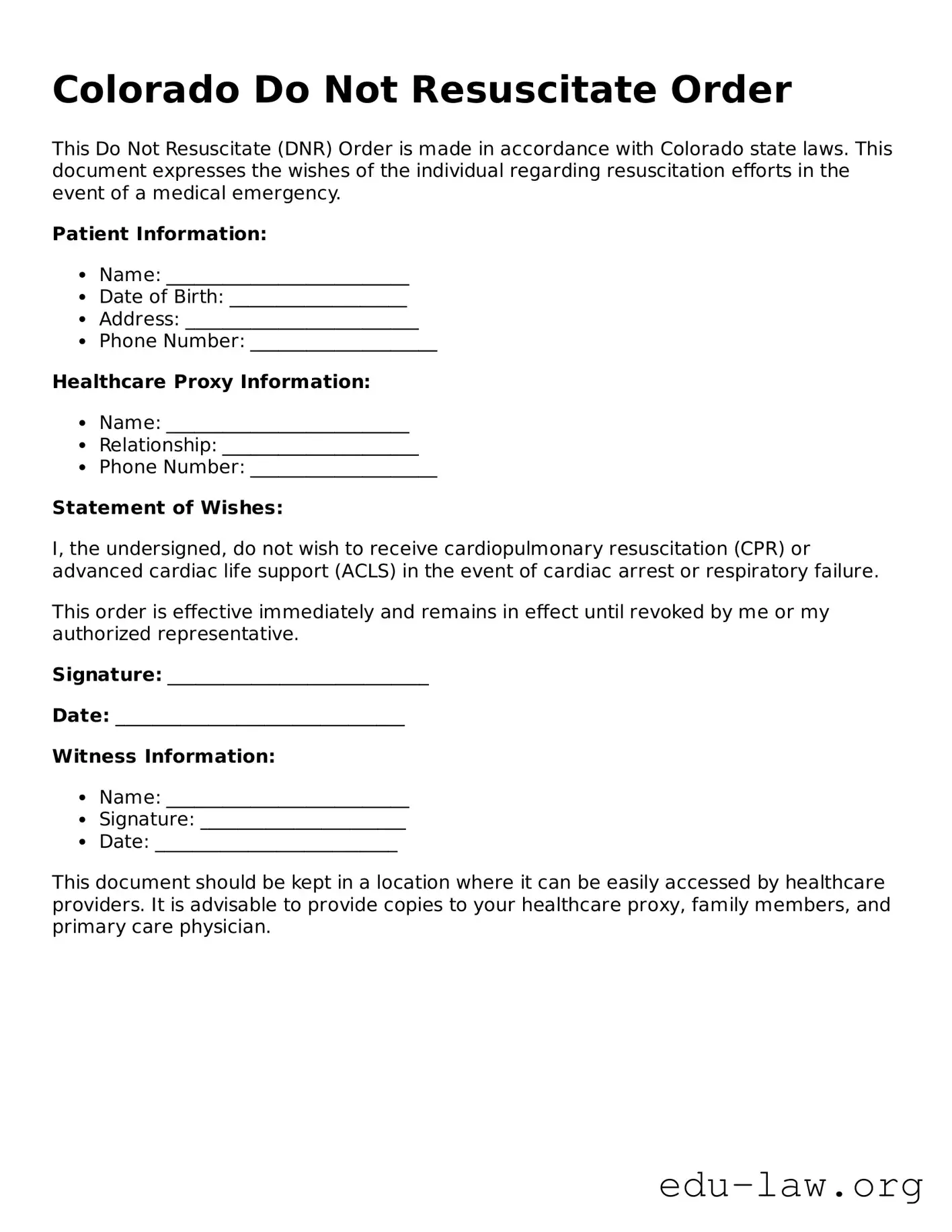
Colorado Do Not Resuscitate Order
This Do Not Resuscitate (DNR) Order is made in accordance with Colorado state laws. This document expresses the wishes of the individual regarding resuscitation efforts in the event of a medical emergency.
Patient Information:
Healthcare Proxy Information:
Statement of Wishes:
I, the undersigned, do not wish to receive cardiopulmonary resuscitation (CPR) or advanced cardiac life support (ACLS) in the event of cardiac arrest or respiratory failure.
This order is effective immediately and remains in effect until revoked by me or my authorized representative.
Signature: ____________________________
Date: _______________________________
Witness Information:
This document should be kept in a location where it can be easily accessed by healthcare providers. It is advisable to provide copies to your healthcare proxy, family members, and primary care physician.
| Fact Name | Description |
|---|---|
| Definition | A Colorado Do Not Resuscitate (DNR) Order is a legal document that indicates a person's wish not to receive cardiopulmonary resuscitation (CPR) in the event of cardiac arrest. |
| Governing Law | The Colorado DNR Order is governed by Colorado Revised Statutes, specifically Title 25, Article 48. |
| Eligibility | Any adult can complete a DNR order, but it must be signed by a physician and the patient or their legal representative. |
| Form Availability | The DNR order form is available online through the Colorado Department of Public Health and Environment's website. |
| Signature Requirements | The form requires signatures from both the patient and a physician to be valid. |
| Revocation | A DNR order can be revoked at any time by the patient or their legal representative, verbally or in writing. |
| Emergency Medical Services | Emergency medical personnel are required to honor a valid DNR order in the field. |
| Hospital Protocol | Hospitals must have policies in place to recognize and implement DNR orders upon admission. |
| Patient Rights | Patients have the right to make decisions about their medical care, including whether to have a DNR order. |
Filling out the Colorado Do Not Resuscitate Order (DNR) form is an important step for individuals who wish to express their healthcare preferences. This document allows you to communicate your wishes regarding resuscitation in a clear and legally recognized manner. Following the steps below will ensure that the form is completed accurately.
Once the form is filled out and distributed, it is essential to keep it accessible. Discuss your wishes with family and healthcare providers to ensure everyone understands your preferences.
What is a Colorado Do Not Resuscitate Order (DNR) form?
A Colorado Do Not Resuscitate Order (DNR) form is a legal document that allows an individual to express their wishes regarding resuscitation efforts in the event of a medical emergency. Specifically, it instructs healthcare providers not to perform cardiopulmonary resuscitation (CPR) or other life-saving measures if the individual’s heart stops beating or if they stop breathing. This form is typically used by individuals with serious health conditions who wish to avoid aggressive medical interventions at the end of life.
Who can complete a DNR form in Colorado?
In Colorado, any adult who is capable of making their own medical decisions can complete a DNR form. This includes individuals who are 18 years or older and are of sound mind. Additionally, a DNR can be completed by a legal guardian or a person holding durable power of attorney for healthcare if the individual is unable to make decisions for themselves. It is important that the person completing the form fully understands the implications of their decision.
How do I obtain and fill out a DNR form in Colorado?
The Colorado DNR form can be obtained from various sources, including hospitals, healthcare providers, and online resources. Once you have the form, it is essential to fill it out accurately. The form typically requires personal information, including the individual’s name, date of birth, and signature. It may also need to be signed by a physician to ensure it is legally valid. After completing the form, it should be kept in an easily accessible location, and copies should be shared with healthcare providers and family members.
What should I do if I change my mind about my DNR order?
If you decide to change your mind about your DNR order, you can revoke it at any time. To do this, you should destroy the original DNR form and inform your healthcare providers and family members of your decision. It may also be helpful to complete a new DNR form indicating your updated wishes. Clear communication with your healthcare team is crucial to ensure that your current preferences are understood and respected.
Not Understanding the Form's Purpose: Some individuals fill out the Colorado Do Not Resuscitate Order form without fully grasping its intent. This form is meant to communicate a person's wishes regarding resuscitation efforts in case of a medical emergency. Misunderstanding can lead to unintended consequences.
Inaccurate Personal Information: Failing to provide correct personal details can create confusion. It is crucial to include accurate names, dates of birth, and contact information. Mistakes here can delay or complicate the implementation of the order.
Missing Signatures: The form requires specific signatures to be valid. Often, individuals forget to sign the document themselves or neglect to obtain the necessary signatures from witnesses or healthcare providers. This oversight can render the form ineffective.
Not Discussing the Decision with Family: Many people fill out the form without discussing their wishes with family members. This can lead to confusion and conflict during a medical crisis. Open conversations about end-of-life preferences are essential for ensuring that everyone is on the same page.
In addition to the Colorado Do Not Resuscitate (DNR) Order form, several other documents can support healthcare decisions and ensure that an individual's wishes are respected. These forms help convey preferences regarding medical treatment and end-of-life care. Below is a list of commonly used documents that work alongside the DNR form.
These documents collectively empower individuals to articulate their healthcare preferences and ensure that their wishes are honored, especially in critical situations. Utilizing these forms alongside the Colorado DNR Order can provide clarity and peace of mind for both patients and their families.
The Colorado Do Not Resuscitate (DNR) Order form shares similarities with the Advance Directive, a legal document that allows individuals to outline their preferences for medical treatment in case they become unable to communicate their wishes. Both documents serve to guide healthcare providers in making decisions that align with a patient's values and desires. While the DNR specifically addresses resuscitation efforts, the Advance Directive can cover a broader range of medical interventions, providing a more comprehensive view of a person's healthcare preferences.
Another document akin to the DNR is the Physician Orders for Life-Sustaining Treatment (POLST). The POLST form is designed for individuals with serious illnesses or those nearing the end of life. Like the DNR, it communicates a patient's wishes regarding resuscitation and other life-sustaining treatments. However, the POLST goes further by detailing specific medical interventions a patient may or may not want, making it a more detailed and actionable document in emergency situations.
The Living Will is another important document that parallels the DNR. A Living Will allows individuals to specify their wishes regarding medical treatment in situations where they are terminally ill or permanently unconscious. While the DNR focuses specifically on resuscitation, the Living Will encompasses a broader spectrum of medical decisions, including the use of artificial nutrition and hydration, making it a critical component of end-of-life planning.
Health Care Power of Attorney (HCPOA) also shares similarities with the DNR. This document appoints a trusted individual to make healthcare decisions on behalf of someone who is incapacitated. While the DNR provides specific instructions about resuscitation, the HCPOA allows the appointed agent to interpret and act upon the individual's wishes in a variety of medical situations. Together, these documents ensure that a person's healthcare preferences are honored, even when they cannot voice them directly.
The Medical Order for Life-Sustaining Treatment (MOLST) is another document that functions similarly to the DNR. Like the POLST, the MOLST is designed for patients with serious health conditions. It provides clear medical orders regarding the patient's preferences for resuscitation and other life-sustaining treatments. Both the MOLST and DNR aim to ensure that medical personnel understand and respect the patient's wishes during critical moments.
Lastly, the Do Not Intubate (DNI) order is closely related to the DNR. A DNI order specifically instructs healthcare providers not to insert a breathing tube in the event of respiratory failure. While the DNR focuses on the broader context of resuscitation efforts, the DNI hones in on one specific aspect of life support. Both documents reflect a patient's preferences regarding aggressive medical interventions, highlighting the importance of aligning medical care with individual values.
When filling out the Colorado Do Not Resuscitate (DNR) Order form, it's crucial to approach the task with care. Here are some important dos and don'ts to consider:
Understanding the Colorado Do Not Resuscitate (DNR) Order can be challenging. Here are eight common misconceptions about the DNR form that you should know:
This is not true. A DNR only indicates that you do not want CPR or advanced cardiac life support if your heart stops. You will still receive other forms of medical treatment.
Only individuals with the capacity to make their own medical decisions can complete a DNR. This usually means you must be an adult or an emancipated minor.
These are different documents. A living will outlines your wishes for medical treatment in various situations, while a DNR specifically addresses resuscitation efforts.
This is a misconception. Hospitals will continue to provide necessary medical care, but they will not perform CPR if you have a DNR in place.
You can revoke or change your DNR at any time. It’s important to communicate any changes to your healthcare providers.
You do not need a lawyer to fill out a DNR form. However, consulting with a healthcare professional can help ensure your wishes are clearly understood.
This is a misconception. A DNR can be appropriate for anyone who wishes to avoid resuscitation, regardless of their overall health status.
Your family can still be involved in medical decisions. A DNR reflects your wishes, but family input is often considered in other aspects of care.
Being informed about the Colorado DNR Order is crucial. Understanding these misconceptions can help you make better decisions regarding your healthcare preferences.
When considering a Do Not Resuscitate (DNR) Order in Colorado, it is important to understand the implications and proper procedures involved. Here are some key takeaways to keep in mind:
Understanding these key points can help ensure that your wishes are respected in a medical emergency. Taking the time to fill out and distribute the DNR Order form properly can provide peace of mind for you and your loved ones.