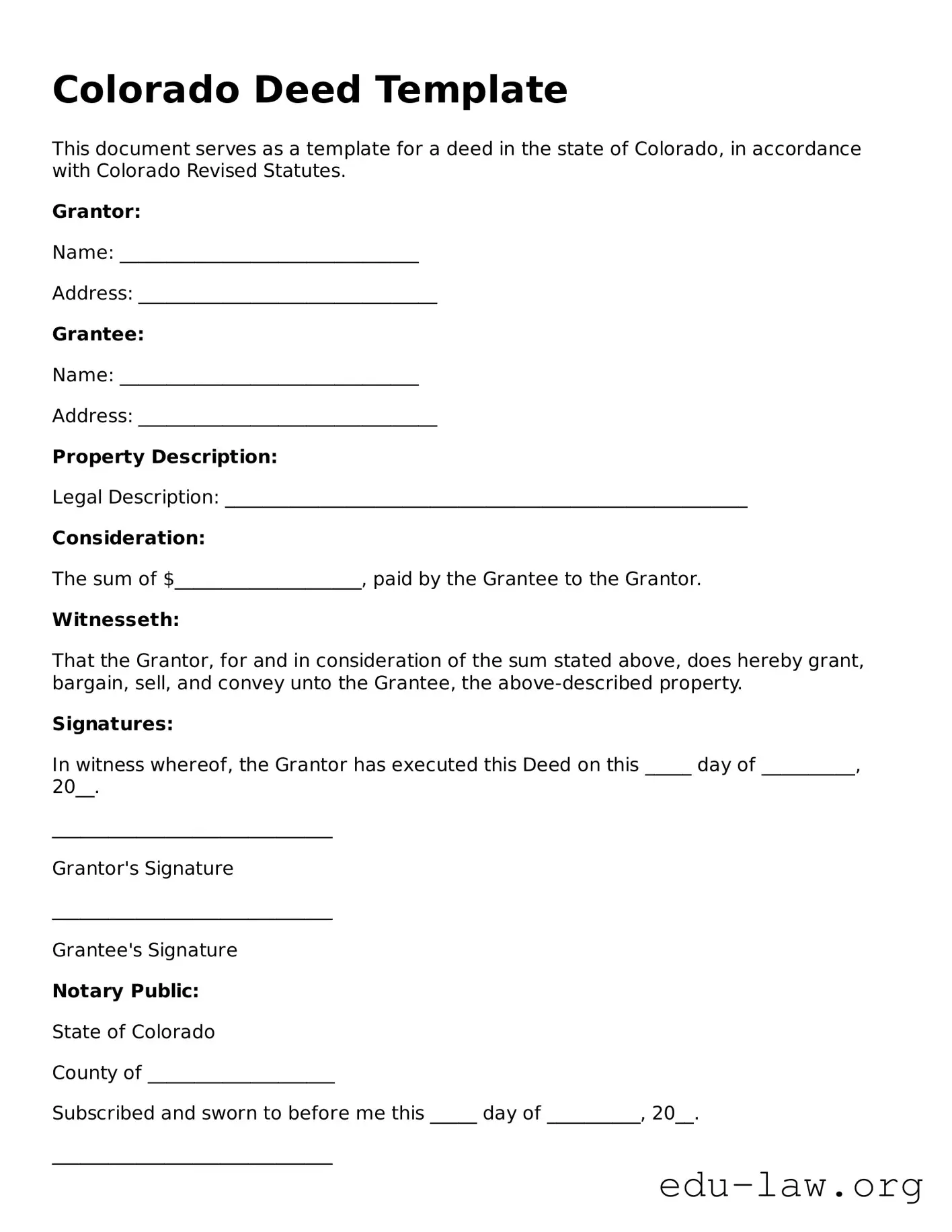
The Colorado Deed form is an essential legal document that facilitates the transfer of property ownership in the state of Colorado. This form captures critical information about the parties involved in the transaction, including the grantor (the person transferring the property) and the grantee (the person receiving the property). It outlines the property description, ensuring clarity about what is being transferred. Additionally, the form may include details about any existing liens or encumbrances, which are important for the grantee to understand. The Colorado Deed form is typically signed in the presence of a notary, providing an extra layer of authenticity and protection for both parties. Understanding the nuances of this form is vital for anyone involved in a real estate transaction, as it helps ensure a smooth transfer and protects the interests of all parties involved.
Colorado Deed Template
This document serves as a template for a deed in the state of Colorado, in accordance with Colorado Revised Statutes.
Grantor:
Name: ________________________________
Address: ________________________________
Grantee:
Name: ________________________________
Address: ________________________________
Property Description:
Legal Description: ________________________________________________________
Consideration:
The sum of $____________________, paid by the Grantee to the Grantor.
Witnesseth:
That the Grantor, for and in consideration of the sum stated above, does hereby grant, bargain, sell, and convey unto the Grantee, the above-described property.
Signatures:
In witness whereof, the Grantor has executed this Deed on this _____ day of __________, 20__.
______________________________
Grantor's Signature
______________________________
Grantee's Signature
Notary Public:
State of Colorado
County of ____________________
Subscribed and sworn to before me this _____ day of __________, 20__.
______________________________
Notary Public
My commission expires: ________________
| Fact Name | Description |
|---|---|
| Governing Law | The Colorado Deed form is governed by the Colorado Revised Statutes, specifically Title 38, which deals with property law. |
| Types of Deeds | Colorado recognizes various types of deeds, including warranty deeds, quitclaim deeds, and special warranty deeds. |
| Signature Requirements | For a deed to be valid in Colorado, it must be signed by the grantor and acknowledged by a notary public. |
| Recording | Deeds must be recorded in the county where the property is located to provide public notice of ownership. |
| Consideration | While a deed can be executed without consideration, it is generally advisable to include a nominal amount to validate the transfer. |
| Legal Description | A complete legal description of the property must be included in the deed to ensure clarity and prevent disputes. |
After completing the Colorado Deed form, you will need to file it with the appropriate county clerk and recorder's office. This process ensures that the transfer of property ownership is officially recognized and recorded.
What is a Colorado Deed form?
A Colorado Deed form is a legal document used to transfer ownership of real property from one party to another in the state of Colorado. It serves as proof of the transfer and outlines the rights and responsibilities associated with the property. Common types of deeds include warranty deeds, quitclaim deeds, and special warranty deeds.
What information is required on a Colorado Deed form?
A Colorado Deed form must include specific information such as the names of the grantor (seller) and grantee (buyer), a legal description of the property, the date of the transfer, and any conditions or restrictions related to the property. Additionally, the deed should be signed by the grantor and may need to be notarized to be valid.
How do I obtain a Colorado Deed form?
Do I need a lawyer to complete a Colorado Deed form?
While it is not legally required to have a lawyer complete a Colorado Deed form, it is highly recommended. A legal professional can ensure that the deed is filled out correctly, complies with state laws, and protects your interests during the property transfer.
What is the difference between a warranty deed and a quitclaim deed?
A warranty deed provides a guarantee that the grantor holds clear title to the property and has the right to sell it. It offers protection to the grantee against any claims on the property. In contrast, a quitclaim deed transfers whatever interest the grantor has in the property without any guarantees. This means the grantee may not receive clear title.
Is there a fee to file a Colorado Deed form?
Yes, there is typically a fee to file a Colorado Deed form with the county clerk and recorder's office. The fee varies by county, so it is advisable to check with the local office for the exact amount. Additionally, there may be other costs associated with the transfer, such as recording fees or taxes.
How do I record a Colorado Deed form?
To record a Colorado Deed form, you must take the completed and signed deed to the county clerk and recorder's office in the county where the property is located. The office will review the document, collect any applicable fees, and then officially record the deed in the public records.
What happens if a Colorado Deed form is not recorded?
If a Colorado Deed form is not recorded, the transfer of property ownership may not be recognized by third parties. This can lead to disputes over ownership and potential legal issues. Recording the deed provides public notice of the transfer and protects the rights of the grantee.
Can I change a Colorado Deed form after it has been signed?
Once a Colorado Deed form has been signed and recorded, it cannot be changed. If modifications are necessary, a new deed must be created to reflect the changes. It is essential to consult a legal professional to ensure that any new deed is properly executed and recorded.
Incorrect Grantee Information: Many individuals mistakenly enter the wrong name or misspell the name of the person receiving the property. This can lead to significant legal complications.
Failure to Include a Legal Description: A complete and accurate legal description of the property is crucial. Omitting this information can render the deed ineffective.
Not Signing the Deed: A deed must be signed by the grantor. Forgetting to sign can invalidate the document, leaving the transfer incomplete.
Improper Notarization: Deeds must be notarized to be legally binding. Using an unlicensed notary or failing to have the deed notarized can cause issues.
Incorrect Date: Failing to date the deed or entering the wrong date can create confusion regarding when the property transfer occurred.
Ignoring State-Specific Requirements: Each state has unique rules regarding deeds. Not adhering to Colorado’s specific requirements can lead to rejection of the document.
Inaccurate Tax Information: Some people forget to include tax identification numbers or fail to check for outstanding taxes, which can complicate the transfer process.
Not Recording the Deed: After completing the deed, it’s vital to record it with the county clerk. Failing to do so can result in disputes over ownership.
Neglecting to Seek Legal Advice: Many individuals attempt to complete the deed without consulting a legal professional. This can lead to errors that might have been avoided with proper guidance.
When transferring property in Colorado, several additional forms and documents often accompany the Colorado Deed form. These documents help clarify the transaction, provide necessary disclosures, or fulfill legal requirements. Below is a list of commonly used forms.
Understanding these documents is crucial for anyone involved in a property transaction in Colorado. Each plays a specific role in ensuring the process is transparent and legally sound.
The Colorado Deed form shares similarities with a Warranty Deed. A Warranty Deed provides a guarantee from the seller to the buyer that the property title is clear of any liens or encumbrances. This document offers the highest level of protection to the buyer, as it assures them that they will not face any legal claims against the property after the sale. Like the Colorado Deed, a Warranty Deed must be signed by the grantor and usually requires notarization to be legally binding.
Another document akin to the Colorado Deed is the Quitclaim Deed. This type of deed transfers whatever interest the grantor has in the property without any warranties. While it does not guarantee that the title is free from defects, it is often used between family members or in situations where the parties know each other well. Both the Quitclaim Deed and the Colorado Deed require the same basic information, such as the names of the parties involved and a description of the property.
The Special Warranty Deed is also similar to the Colorado Deed. This document provides a limited warranty, ensuring that the grantor has not encumbered the property during their ownership. Unlike a full Warranty Deed, which covers the entire history of the property, the Special Warranty Deed only protects against claims that arose during the grantor's ownership. Both deeds require a clear description of the property and the signatures of the involved parties.
A Bargain and Sale Deed is another document that bears resemblance to the Colorado Deed. This deed implies that the grantor has the title to the property and the right to sell it, but it does not provide any warranties against encumbrances. It is often used in real estate transactions where the buyer is willing to accept some risk. Like the Colorado Deed, a Bargain and Sale Deed must be executed in writing and typically requires notarization.
The Grant Deed is similar to the Colorado Deed in that it conveys ownership of real property from one party to another. A Grant Deed guarantees that the property has not been sold to anyone else and that it is free of any undisclosed encumbrances. While the Colorado Deed may not always provide such guarantees, both documents require the grantor's signature and a clear property description.
A Deed of Trust is another document that shares characteristics with the Colorado Deed. While it primarily serves as a security instrument for a loan, it involves the transfer of property rights. In a Deed of Trust, the borrower conveys the property to a trustee, who holds it as security for the loan. Both documents require clear identification of the parties involved and a detailed property description, although their purposes differ significantly.
The Affidavit of Title is also related to the Colorado Deed. This document is often used in conjunction with a property transfer to affirm the seller's ownership and confirm that the title is clear. While it does not transfer property, it provides essential information that can accompany a deed, ensuring that the buyer is fully informed. Both documents require accurate information about the property and the parties involved.
Lastly, the Bill of Sale is similar in that it can accompany a property transfer, particularly when personal property is involved. While the Colorado Deed focuses on real estate, a Bill of Sale serves to transfer ownership of personal items. Both documents require the identification of the parties and a description of the items being transferred, ensuring that the transaction is clear and legally binding.
When filling out the Colorado Deed form, it is important to approach the task with care. Here are some essential dos and don'ts to keep in mind:
By following these guidelines, you can help ensure a smooth process when completing the Colorado Deed form.
When it comes to the Colorado Deed form, there are several misconceptions that can lead to confusion. Understanding these can help ensure that the process of transferring property is smooth and clear. Here are seven common misconceptions:
Many people think that all deed forms serve the same purpose. In reality, there are different types of deeds, such as warranty deeds and quitclaim deeds, each serving specific functions and offering different levels of protection.
Some believe that simply having a deed is enough to transfer ownership of a property. However, the deed must be properly executed, delivered, and recorded to be legally effective.
While legal professionals can certainly assist, individuals can also prepare their own deeds, provided they follow the correct procedures and requirements outlined by Colorado law.
Another misconception is that notarization is unnecessary. In Colorado, a deed must be signed in front of a notary public to be valid.
Some people think that after a deed is recorded, it cannot be altered. In fact, if there is an error or a change needed, a new deed can be created to correct the issue.
Many assume that once a deed is executed, it cannot be undone. However, under certain circumstances, deeds can be revoked or set aside through legal processes.
Lastly, some believe that changing the deed has no impact on property taxes. In reality, transferring ownership can trigger reassessment of property taxes, depending on the circumstances.
Understanding these misconceptions can help ensure that property transactions in Colorado are handled correctly and efficiently. Always consider seeking guidance if you have questions about the process.
When filling out and using the Colorado Deed form, keep these key takeaways in mind:
These steps help ensure a smooth property transfer process in Colorado.