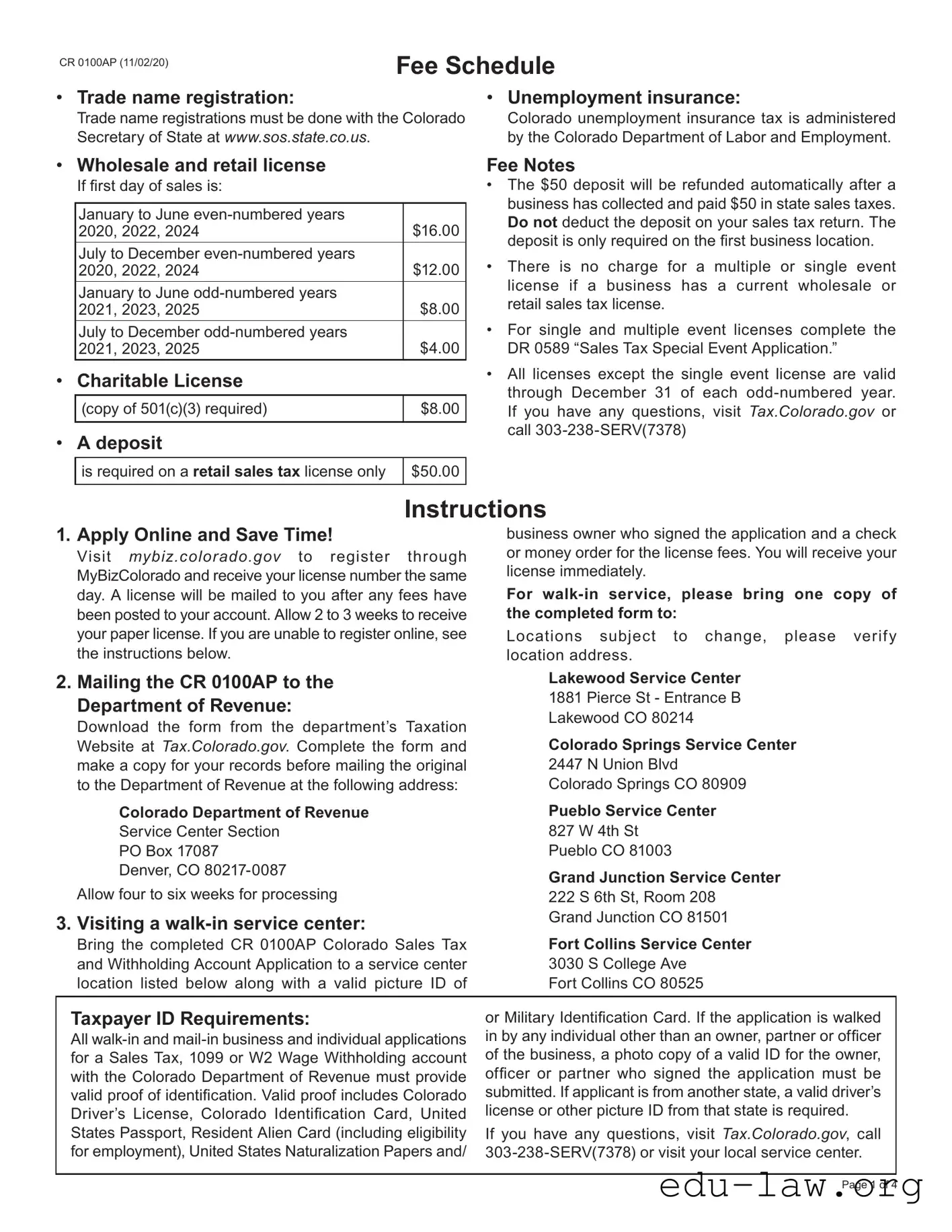
The Colorado CR 100 form, also known as the Colorado Sales Tax and Withholding Account Application, plays a crucial role for businesses operating in the state. This form is essential for those looking to establish a sales tax account, a W-2 withholding account, or a 1099 withholding account. It serves multiple purposes, including registering a new business, changing ownership, or adding an additional location to an existing account. By completing the CR 100, business owners can apply for various licenses, such as a state sales tax license or a charitable license, while also providing necessary details about their business structure and operations. The form includes sections that require information about the business name, address, type of organization, and specific products or services offered. Additionally, it outlines the fee structure associated with different licenses and permits, including important notes about deposits and renewals. Understanding the requirements and processes outlined in the CR 100 form is vital for compliance with Colorado's tax regulations, ensuring that businesses can operate smoothly and legally. Whether applying online or through a service center, completing this form accurately is the first step toward meeting your business's tax obligations in Colorado.

CR 0100AP (11/02/20) |
Fee Schedule |
|
|
• Trade name registration: |
• Unemployment insurance: |
Trade name registrations must be done with the Colorado Secretary of State at www.sos.state.co.us.
Colorado unemployment insurance tax is administered by the Colorado Department of Labor and Employment.
•Wholesale and retail license
If first day of sales is:
|
January to June |
$16.00 |
|
2020, 2022, 2024 |
|
|
July to December |
$12.00 |
|
2020, 2022, 2024 |
|
|
January to June |
$8.00 |
|
2021, 2023, 2025 |
|
|
July to December |
$4.00 |
|
2021, 2023, 2025 |
|
• |
Charitable License |
|
|
(copy of 501(c)(3) required) |
$8.00 |
|
|
|
• |
A deposit |
|
|
is required on a retail sales tax license only |
$50.00 |
Fee Notes
•The $50 deposit will be refunded automatically after a business has collected and paid $50 in state sales taxes. Do not deduct the deposit on your sales tax return. The deposit is only required on the first business location.
•There is no charge for a multiple or single event license if a business has a current wholesale or retail sales tax license.
•For single and multiple event licenses complete the DR 0589 “Sales Tax Special Event Application.”
•All licenses except the single event license are valid through December 31 of each
Instructions
1. Apply Online and Save Time!
Visit mybiz.colorado.gov to register through MyBizColorado and receive your license number the same day. A license will be mailed to you after any fees have been posted to your account. Allow 2 to 3 weeks to receive your paper license. If you are unable to register online, see the instructions below.
2. Mailing the CR 0100AP to the Department of Revenue:
Download the form from the department’s Taxation Website at Tax.Colorado.gov. Complete the form and make a copy for your records before mailing the original to the Department of Revenue at the following address:
Colorado Department of Revenue
Service Center Section
PO Box 17087
Denver, CO
Allow four to six weeks for processing
3. Visiting a
Bring the completed CR 0100AP Colorado Sales Tax and Withholding Account Application to a service center location listed below along with a valid picture ID of
business owner who signed the application and a check or money order for the license fees. You will receive your license immediately.
For
Locations subject to change, please verify location address.
Lakewood Service Center
1881 Pierce St - Entrance B
Lakewood CO 80214
Colorado Springs Service Center
2447 N Union Blvd
Colorado Springs CO 80909
Pueblo Service Center 827 W 4th St
Pueblo CO 81003
Grand Junction Service Center 222 S 6th St, Room 208 Grand Junction CO 81501
Fort Collins Service Center
3030 S College Ave
Fort Collins CO 80525
Taxpayer ID Requirements: |
or Military Identification Card. If the application is walked |
All |
in by any individual other than an owner, partner or officer |
for a Sales Tax, 1099 or W2 Wage Withholding account |
of the business, a photo copy of a valid ID for the owner, |
with the Colorado Department of Revenue must provide |
officer or partner who signed the application must be |
valid proof of identification. Valid proof includes Colorado |
submitted. If applicant is from another state, a valid driver’s |
Driver’s License, Colorado Identification Card, United |
license or other picture ID from that state is required. |
States Passport, Resident Alien Card (including eligibility |
If you have any questions, visit Tax.Colorado.gov, call |
for employment), United States Naturalization Papers and/ |
Page 1 of 4
Colorado Sales Tax and Withholding Account Application
CR 0100AP
General Information
The CR 0100AP is used to open a sales tax,
•To apply for a state sales tax license, complete sections A, B, C, E, F and G.
•To apply for a withholding account, complete sections A, B, D, E, F and G. If you require both licenses, complete all sections.
•To electronically open an account, go to MyBiz Colorado at mybiz.Colorado.gov
Refer to the following definitions.
•
•1099 Withholding. Payers who withhold tax on Colorado income reported on 1099 forms. (example: contract labor)
•Oil and Gas Withholding. Every producer of crude oil, natural gas or oil shale shall withhold one percent from the amount owed to any person owning a working interest, a royalty interest, a production payment or any interest in carbon dioxide or oil and gas production in Colorado. No withholding is required from payments made to Colorado or the U.S. Government (see Department of Revenue publication FYI Withholding 4).
•Trade Names are registered with the Colorado Secretary of State. A trade name is not required to obtain a tax account.
•State Sales Tax License. A state sales tax license is required for any person that sells tangible personal property regardless of whether selling retail or wholesale. A license is not required for persons engaged exclusively in the business of selling commodities or services which are exempt from taxation.
•State and Local Sales. Colorado has a 2.9 percent sales tax. Additionally, many cities and counties impose their own local sales tax on purchases and transactions within their boundaries. There are also special district taxes that apply in certain boundaries.
For a complete listing of all applicable tax rates and exemption information, please see “Colorado Sales/Use Tax Rates” DR 1002 on our website at Tax.Colorado.gov. The DR 1002 is revised in January and July each year.
You may also visit Colorado.gov/RevenueOnline to find tax rates by city, county and business account number through Revenue Online.
Due to the complexities surrounding the laws on the collection and remittance of sales/use tax in Colorado, it is recommended that you attend a live class or take an online tax class offered by the department after opening
your business and/or obtaining a sales tax license. Visit Colorado.gov/pacific/tax/education for class schedule and registration.
Section A
Box 1. Reasons for filing this application.
•Original Application. A new
•Change of ownership. An existing business that changes its legal structure. Does not include changes of stockholders of corporations and members in limited liability companies. If you purchase an existing business and have a new FEIN, you must apply for a new license and complete a DR 0100A.
•Additional Location. The business already has a Colorado account number but is adding a new business location.
•Do you have a Department of Revenue Account Number? If your business or organization currently has a Colorado Account Number (CAN), enter it here. A sales tax deposit is required on a business’ first retail sales tax location only as long as each additional location uses the same account number.
Box 2. Type of Organization. Check the box that indicates the legal structure for your business/organization.
Note: Married couples must register as a general partnership if both spouses are owners of the business. General partnerships require a FEIN.
Section B
Line 1a. Taxpayer Name. The name should be
entered as follows:
•Individual (sole proprietorship). Last name, first name and middle name or initial.
•General Partnership, Association or Joint Venture.
The last name, first name and middle initial of two principal partners. If there are additional partners, attach a separate sheet.
•Corporation, Limited Partnership, Limited Liability Company (LLC), Limited Liability Partnership (LLP) or Limited Liability Limited Partnership (LLLP). The legal name of the business must match exactly as filed with the Colorado Secretary of State and IRS.
• Government. Enter the legal name of the government agency.
•Nonprofit. Enter the name of the nonprofit organization. If applying for a charitable license, a copy of 501(c)(3) is required.
Line 1b. Social Security Number (SSN). Enter the Social Security number of the owner if this is an application for an individual (Sole Proprietor). If the Sole Proprietor has an FEIN number, complete Line 1d.
Page 2 of 4

Line 1c. Business Name. If operating as any other type of organization other than Individual/Sole Proprietor, enter business name here as registered with Colorado Secretary of State and IRS.
Line 1d. Federal Employer Identification Number (FEIN). An FEIN is required to open a new account with the Colorado Department of Revenue. FEINs are issued by the Internal Revenue Service, IRS.gov. Individuals (Sole Proprietors) can use their social security numbers. All other entities must have a FEIN number.
Line 2a. Trade Name/Doing Business As. If the taxpayer will be doing business under any name other than the name on Line 1, the “trade name” should be entered here. Trade names must be registered with the Colorado Secretary of State.
Line 2b. Proof of Identification/Taxpayer ID Requirements: All applicants for a sales tax or withholding account with the Colorado Department of Revenue must provide valid proof of identification at the time of application. Valid proof includes a legible copy of a Colorado Driver’s License, Colorado Identification Card, United States Passport, Resident Alien Card (indicating eligibility for employment), United States Naturaliza- tion Papers and/or Military Identification Card. If the application is being walked in by any individual other than an owner, partner or officer of the business, a photo copy of a valid ID for the owner, officer or partner who signed the application must be submitted. If the applicant is from another state, a valid driver’s license or other picture ID from that state is required. Do not enter a social security number here.
Line 3a. Principal Address. This is the address of the orga- nization’s/entity’s principle place of business in Colorado. If you are located outside the state and do not have a physical location in Colorado, your main address in a different state is acceptable. Do Not use a post office box.
•If a business will have multiple fixed locations, a separate application must be filed for each location.
•If you are a mobile vendor (example: food truck or tool sales) indicate MOBILE. You are required to give the address, warehouse or office of the location you park and store the vehicle.
Line 3b. County. Enter the county in which your principal place of business is located. If you are not sure which county, refer to the DR 1002 available on the department’s Web site at Tax.Colorado.gov under “Forms & Instructions”
Line 3c. City. Enter the city in which your principal place of business is located.
Line 3d. Phone Number. Enter the telephone number for your business.
Line
Line 4c. Telephone. Enter the telephone number for the mailing address. If you would like to receive text notifications for due date reminders and the like, check the mobile text box ‘Yes’. If you would not like text notifications, select ‘No’.
Line 4d. Mailing Address. Enter the street address, city, state and zip code where the business or organization will receive mail from the department.
Line 5. Email Address. Please enter the email address you would like on file. Indicate on the application if you would like email correspondence from the state. The emails could be account specific or updates to sales tax collection.
Line 6a and 6b. If you acquired the business, please provide the prior business name, address, date of acquisition and the prior owner’s first and last name.
Line 7. List Specific products and/or Services you provide and explain in detail on Line 8. Check the applicable boxes in section 7 on the form:
Do you sell alcohol? |
Yes |
No |
Do you sell tobacco products? |
Yes |
No |
Do you sell prepaid wireless? |
Yes |
No |
Do you sell medical marijuana? |
Yes |
No |
Do you sell recreational marijuana? |
Yes |
No |
Do you sell EXCLUSIVELY through the |
Yes |
No |
marketplace? |
|
|
Do you rent motor vehicles for 30 days |
Yes |
No |
or less? |
|
|
Do you rent out items for 30 days or less? |
Yes |
No |
Do you rent out rooms for 30 days or less? |
Yes |
No |
Is your business in a special taxing |
Yes |
No |
district? |
|
|
Are you a Market Place Facilitator? |
Yes |
No |
If yes - As a Market Place Facilitator, do |
Yes |
No |
you also sell products? |
|
|
Write a brief description of products, services and/ or function of the business/organization on line 8. The information you provide will help us determine the appropriate North American Industry Classification System (NAICS) code for your business. It will also help us get tax information and updates to you, depending on your business type.
Lines 8a through 8d. Owner/Partner/Corp. Officer. All organizations, including sole proprietors, must complete these lines. Type/print the name, title, FEIN (Federal Employer Identification Number), social security number, and home address of each individual, partner, corporate officer or member. If there are more than two owners, attach a separate sheet and provide the same information for additional owners. For a partnership between corporations or limited liability companies, list each legal name, address, and FEIN separately.
Page 3 of 4
Section C — Sales Tax
Line 1. Type of sales which applies to your business.
•Wholesaler. A business that sells to retail merchants, jobbers, dealers, or other wholesalers for the purpose of resale. This license cannot be used to purchase items for personal use.
•Retail Sales. A retailer is a business that sells products to final purchasers and is required to collect the appropriate sales taxes. A retailer may also sell wholesale, but is not required to have a separate wholesale license. RTD/CD and local taxes must also be collected, if applicable.
•Charitable. If your organization has been designated as “charitable 501(c)(3),” the organization will be exempt from paying the $50 deposit for a retail sales tax license. Your license fee is $8. Please attach a copy of the IRS 501(c)(3) letter.
•Note on Special Events. Must apply for this separate license on form DR 0589, Sales Tax Special Event Application. This license is required if you sell at special events. There is no additional fee for businesses that already have a sales tax license.
Line 2a. Filing Frequency. Select the filing frequency based on the amount of anticipated sales tax collection.
Line 2b. First Day of Sale. You may wish to start your license prior to the first day of sales in order to make purchases for producing products to sell.
Section E - Fees
Do not enter Period Covered From and To (Dept. Use Only)
•Sales Tax Deposit. A deposit is required on a retail license. Charitable organizations are exempt. The deposit is refunded automatically after a business collects and remits $50 in state sales taxes. Do not deduct the deposit from your sales tax return. The deposit is only required on a business’s first location if each additional location uses the same account number. (See instructions for Section A, Box 1.)
•Sales Tax License. Standard Colorado Sales tax License is $16 for a
•Wholesale License is $16 for a
•Charitable License. The fee is $8.
•Note: The withholding license has no fee for registration and no renewal is required.
Section D — Withholding
Line 1. Type of Withholding account. Indicate which type of withholding account: W2, 1099, or Oil/Gas withholding. A 1099 withholding account is only needed when you withhold from 1099 payments.
Gaming Establishments
Complete the Sales Tax/Withholding Account Application (CR 0100AP) to apply for a 1099 or
Line 2. Filing frequency. If you will have employees, estimate how much wage withholding you expect to pay for all your employees in one year. Your required filing frequency will be based on your estimated annual wage withholding. Businesses with annual wage withholding of $50,000 or more must file and remit withholding taxes by Electronic Funds Transfer (EFT). For more information, print the publication “Colorado Department of Revenue Electronic Funds Transferred (EFT) Program For Tax Payments” (DR 5782) from our website at Tax.Colorado.gov. Frequency for Oil/Gas is monthly. See FYI Withholding 4 for schedule.
Line 4b. First Day of Payroll. List the month and year you anticipate payroll to begin. Normally, start dates begin with a quarter, e.g., 1/20, 4/20, 7/20, or 10/20, but you can start your payroll anytime.
Section F — Points of Compliance
•Licensed retailers are required to renew their licenses every two years
•Licensed retailers are required to file monthly, quarterly, or annual returns based on the sales tax collected.
•Licensed retailers are required to file returns for each tax period even if they had no sales and collected no tax.
•Licensed retailers understand their license is only used to purchase items they resell.
•Licensed retailers understand sales tax rates are subject to change twice a year (January & July).
•Licensed retailers can close their account or change their address utilizing the DR 1102.
Section G — Signature
•A signature must be on this document or it will not be processed.
•Please include the title of the person signing and the date signed.
Allow four to six weeks to receive a license by mail when completing and sending in a CR 0100AP form. If you apply for a license through mybiz.Colorado.gov you will receive your license number the same day. Allow two to three weeks to receive your paper license. If you apply for your license at a service center you will receive your account number and license immediately. This concludes the application.
Page 4 of 4

CR 0100AP (11/02/20)
COLORADO DEPARTMENT OF REVENUE
Service Center Section
PO Box 17087
Denver CO
Colorado Sales Tax and
Withholding Account Application
|
|
|
|
Reason for Filing This Application |
|
||
A |
|
1. |
|
|
|
|
|
|
Original Application |
|
Change of Ownership |
Additional Location |
|||
|
|
|
|
|
|
|
|
|
|
Do you have a Colorado Account Number? |
|
If Yes, the Account Number |
|
||
|
|
Yes |
No |
|
|
|
|
2. Indicate |
Type of Organization. If you are not an individual, you |
must have a FEIN number. |
|
||||
|
Individual/Sole Proprietor |
Limited Liability Company (LLC) |
Corporation/S Corp |
Government |
|||
|
General Partnership |
Limited Liability Partnership (LLP) |
Association |
Joint Venture |
|||
|
Limited Partnership |
Limited Liability Limited Partnership (LLLP) |
Estate/Trust |
Nonprofit (Charitable) |
|||
|
|
|
|
|
|
|
Business Information |
|
|
|
|
|
|||||
B |
1a. Last Name (If registering as SSN) |
|
|
|
First Name |
|
|
|
|
|
1b. SSN (Required) |
|
|
||||
|
|
1c. Business Name (If registering as FEIN) |
|
|
|
|
|
|
|
|
1d. FEIN (Required) |
|
|
||||
|
|
|
|
|
|
|
|
|
|
|
|
||||||
2a. Trade |
Name / Doing Business As (If applicable and for informational purposes only) |
|
|
|
|
|
|||||||||||
|
|
|
|
|
|
|
|
|
|
|
|
|
|
|
|
|
|
2b. |
Proof of Identification |
|
|
|
|
|
|
|
|
|
|
|
|
|
|
||
|
State DL/ID |
|
|
Passport |
|
|
|
Other |
|
|
|
|
|
||||
|
|
|
|
|
|
|
|
|
|
|
|
|
|
|
|
|
|
Physical Place of Business |
|
|
|
|
|
|
|
|
|
|
|
|
|
||||
3a. |
Principal Address |
|
|
|
|
City |
|
|
|
|
|
State |
Zip |
|
|
||
|
|
|
|
|
|
|
|
|
|
|
|
|
|
|
|
|
|
3b. |
County |
|
|
|
|
3c. If business is within city limits, what city? |
|
3d. Phone |
Number |
|
|
||||||
|
|
|
|
|
|
|
|
|
|
|
|
|
|||||
Mailing Address (If different than the physical address) |
|
|
|
|
|
|
|
|
|
||||||||
4a. |
Last Name |
|
|
|
|
|
First Name |
|
|
|
|
|
|||||
|
|
|
|
|
|
|
|
|
|
|
|
|
|
|
|
||
4b. |
Business Name |
|
|
|
|
|
4c. Phone Number |
|
Mobile Text (Data Rates May Apply) |
||||||||
|
|
|
|
|
|
|
|
|
|
|
|
|
|
Yes |
No |
|
|
4d. |
Mailing Address |
|
|
|
|
City |
|
|
|
|
|
State |
Zip |
|
|
||
|
|
|
|
|
|
|
|
|
|
|
|
|
|
|
|
|
|
5. Email Address |
|
|
|
|
|
|
|
|
|
|
|
|
|
|
|||
|
|
|
|
|
|
|
|
|
|
|
|
|
|
|
|
|
|
Email Opt In For |
|
|
|
|
|
|
|
|
|
|
|
|
|
|
|||
|
Return Filing |
Tax Updates |
Revenue Online Instructions |
Tax Rate Changes (2x/Year) |
|
Marketplace Information |
|||||||||||
If you acquired or purchased the business, complete the following: |
|
|
|
|
|
||||||||||||
6a. |
Business Name and Prior Owner’s First and Last Name |
|
|
|
|
|
|
6b. Date of Acquisition (MM/YYYY) |
|||||||||
|
|
|
|
|
|
|
|
|
|
|
|
|
|
|
|||
6c. Address (Street, City, State, Zip) |
|
|
|
|
|
|
|
|
6d. Prior Owner’s FEIN |
|
|
||||||
|
|
|
|
|
|
|
|
|
|
|
|
|
|
|
|
||
7. Complete the questions below |
|
|
|
|
|
|
|
|
|
|
|
|
|
||||
Do you sell alcohol? |
|
Yes |
No |
|
Do you rent motor vehicles for 30 days or less? |
Yes |
No |
||||||||||
Do you sell tobacco products? |
Yes |
No |
|
Do you rent out items for 30 days or less? |
|
|
Yes |
No |
|||||||||
Do you sell Prepaid Wireless? |
Yes |
No |
|
Do you rent out rooms for 30 days or less? |
|
|
Yes |
No |
|||||||||
Do you sell Medical Marijuana? |
Yes |
No |
|
Do you sell EXCLUSIVELY through the marketplace? |
Yes |
No |
|||||||||||
Do you sell Recreational Marijuana? |
Yes |
No |
|
Are you a Marketplace Facilitator? |
|
|
Yes |
No |
|||||||||
Is your business in a Special taxing district? |
Yes |
No |
|
As a Marketplace Facilitator, do you also sell products? |
Yes |
No |
|||||||||||
8. List specific products and/or services you provide and explain in detail (Required)
(Form continued on page 2)
9a. |
Owner/Partner/Corp Officer Last Name |
|
|
Owner/Partner/Corp Officer First Name |
||
|
|
|
|
|
|
|
Job Title |
|
|
|
9b. Phone Number |
||
|
|
|
|
|
|
|
9c. Address (Street, City, State, Zip) |
|
|
|
9d. SSN |
||
|
|
|
|
|
||
10a. Owner/Partner/Corp Officer Last Name |
|
Owner/Partner/Corp Officer First Name |
||||
|
|
|
|
|
|
|
Job Title |
|
|
|
10b. Phone Number |
||
|
|
|
|
|
|
|
10c. Address (Street, City, State, Zip) |
|
|
|
10d. SSN |
||
|
|
|
|
|||
Additional Owner/Partner/Corp Officers on a separate paper |
|
|
|
|||
C |
|
Sales Tax Account (Fees Apply) |
||||
1. Indicate Type of Sale: |
|
|
|
|
||
|
|
Wholesaler |
|
Charitable |
||
2a. |
Filing |
Frequency: If SALES TAX collected is: |
|
|
|
|
|
Wholesale Only - Annually |
Under $300/month - Quarterly |
Seasonal, write in the months in business |
|||
|
$15/month or less - Annually |
$300/month or more - Monthly |
|
|
|
|
|
|
|
|
|
|
|
2b. |
License Start Date Required (MM/YYYY) |
|
CO Account Number - Site (Dept Use Only) |
|||
Withholding Tax Account (No Fees Apply)
1.Indicate which you are applying for:
2.Filing Frequency: If W2 wage withholding tax amount is
|
W2 Withholding |
|
$1 - $6,999/Year - Quarterly |
$7,000 - $49,999/Year - Monthly |
||||||
|
|
|
|
|||||||
|
1099 Withholding |
3. Filing Frequency: If 1099 withholding tax amount is |
|
|
||||||
D |
|
$1 - $6,999/Year - Quarterly |
$7,000 - $49,999/Year - Monthly |
|||||||
|
|
|
||||||||
|
Monthly |
|
|
|
|
|
|
|||
|
|
|
|
|
|
|
|
|
|
|
|
|
|
|
|
|
|
|
|
||
|
Oil/Gas Withholding |
4a. Payroll Company, if applicable |
|
|
|
|
||||
|
|
|
|
|
|
|
|
|
||
|
|
|
|
|
|
|
|
|
||
|
4b. First Day of Payroll Required (MM/YYYY) |
4c. Payroll Company Phone Number |
|
|
||||||
|
|
|
|
|
|
|
|
|
|
|
|
Period Covered |
|
|
|
FEES (see fees on page 1 of instructions) |
|
||||
|
(Dept Use Only) |
|
|
|
|
|||||
|
From |
To |
|
|
|
|
|
|
|
|
|
MM/YY |
|
|
|
State Sales Tax Deposit |
(355) |
$ |
|
||
|
|
|
|
|
|
|||||
|
MM/YY |
MM/YY |
|
|
Sales Tax License |
|
(999) |
|
|
|
E |
|
|
|
|
|
$ |
|
|||
MM/YY |
MM/YY |
|
|
Wholesale License |
|
(999) |
$ |
|
||
|
|
|
|
|
|
|
|
|
|
|
|
MM/YY |
MM/YY |
|
|
Charitable License |
|
(999) |
|
|
|
|
|
|
|
|
|
$ |
|
|||
|
Mail to and Make Checks Payable to: |
|
|
|
|
|
||||
|
Colorado Department of Revenue |
|
|
|
|
|
|
|||
|
PO Box 17087 |
|
|
|
|
|
|
|
|
|
|
Denver, CO |
|
|
|
Amount Owed |
$ |
|
|||
The State may convert your check to a one time electronic banking transaction. Your bank account may be debited as early as the same day received by the State. If converted, your check will not be returned. If your check is rejected due to insufficient or uncollected funds, the Department of Revenue may collect the payment amount directly from your bank account electronically.
|
|
Points of Compliance |
|||
F |
• Renew sales tax license on |
|
• Sales tax license is only used for wholesale purchase for resale |
||
• Returns filing frequency is based on tax amount |
|
• Sales tax rates may change twice per year |
|||
|
• Required to file, even if zero sales tax due |
|
• Business account closure or address changes by filing DR 1102 |
||
|
|
||||
|
I declare under penalty of perjury in the second degree that the statements made in this application are true and complete to the |
||||
G |
best of my knowledge. |
|
|
|
|
Signature of Owner, Partner, or Corporate Officer |
|
Job Title |
|
Date (MM/DD/YYYY) |
|
|
|
|
|
|
|
|
|
|
|
(See fee and additional information on page 1 of instructions) |
|
| Fact Name | Details |
|---|---|
| Form Purpose | The CR 100 form is used to apply for a sales tax, W-2 withholding, 1099 withholding, or oil/gas withholding account in Colorado. |
| Governing Law | This form is governed by Colorado state tax laws and regulations, specifically those administered by the Colorado Department of Revenue. |
| Online Application | Applicants can register online at mybiz.colorado.gov to receive their license number on the same day. |
| Fee Schedule | Fees vary by license type, with retail licenses costing $16 for two years, and charitable licenses costing $8. |
| Deposit Requirement | A $50 deposit is required for the first retail sales tax license location, refundable after collecting $50 in state sales taxes. |
| Processing Time | Mail-in applications may take four to six weeks for processing, while walk-in applications provide immediate licenses. |
| Identification Requirements | Applicants must provide valid proof of identification, such as a Colorado driver's license or passport, when submitting the form. |
| Renewal Frequency | Licenses must be renewed every two years, specifically at the beginning of each even-numbered year. |
| Tax Filing Obligations | Licensed retailers are required to file returns for each tax period, even if no sales were made during that time. |
Completing the Colorado CR 100 form is a straightforward process that involves providing essential information about your business. After filling out the form, you will need to submit it to the appropriate department to obtain your sales tax and withholding account. Ensure that all required sections are completed accurately to avoid delays in processing.
After completing these steps, you can submit the form by mail, online, or in person at a service center. Each method has its own processing time, so choose the one that best fits your needs. Allow four to six weeks for mail submissions, or receive your license immediately if you visit a service center in person.
What is the purpose of the Colorado CR 100 form?
The Colorado CR 100 form, officially known as the Colorado Sales Tax and Withholding Account Application, serves several important functions for businesses operating in Colorado. Primarily, it is used to establish a sales tax account, a W-2 withholding account, or a 1099 withholding account. Additionally, businesses can use this form to add a new location to an existing account. Completing this form is essential for any entity that sells tangible personal property or provides taxable services in the state. By registering, businesses ensure compliance with Colorado tax laws and facilitate the collection and remittance of sales taxes.
How do I apply for a sales tax license using the CR 100 form?
To apply for a sales tax license using the CR 100 form, you must first complete the relevant sections of the form. Specifically, you will need to fill out sections A, B, C, E, F, and G. After completing the form, you have three options for submission. You can apply online through MyBizColorado, which allows you to receive your license number on the same day. Alternatively, you can mail the completed form to the Colorado Department of Revenue or visit a local service center. If you choose to visit a service center, bring a valid photo ID and payment for the required fees. This method will grant you an immediate license upon approval.
What are the fees associated with the CR 100 form?
The fees associated with the CR 100 form vary depending on the type of license you are applying for. For example, a standard sales tax license costs $16 for a two-year period, while a wholesale license also costs $16. Charitable organizations can obtain a license for a reduced fee of $8, provided they submit a copy of their 501(c)(3) documentation. Additionally, a $50 deposit is required for retail sales tax licenses, which is refunded once the business collects and remits $50 in state sales taxes. It is important to note that these fees are subject to change, and businesses should refer to the latest fee schedule when applying.
How long does it take to process the CR 100 form?
The processing time for the CR 100 form can vary based on the method of application. If you apply online through MyBizColorado, you will receive your license number the same day. However, if you choose to mail the form, you should allow four to six weeks for processing. For those who visit a walk-in service center, the license will be issued immediately upon approval of the application. It is advisable to plan accordingly based on your business needs and the method of application you select.
Failing to provide the correct legal name of the business. It is essential that the name matches exactly as filed with the Colorado Secretary of State and the IRS. Any discrepancies can lead to delays or rejections.
Omitting the Federal Employer Identification Number (FEIN) when required. Sole proprietors can use their Social Security Number, but all other entities must have a FEIN to open an account.
Not indicating the type of organization accurately. Selecting the wrong category can result in issues with licensing and compliance.
Neglecting to provide a valid proof of identification. All applicants must submit valid identification, which can include a driver’s license or passport. Failure to do so will lead to application denial.
Using a post office box for the principal address. The form requires a physical location in Colorado, and using a P.O. Box is not acceptable.
Forgetting to sign the application. A missing signature will halt processing, causing unnecessary delays.
Not checking the appropriate boxes regarding the types of products or services offered. This information is crucial for determining tax obligations and compliance requirements.
Failing to include an email address for correspondence. Providing an email helps ensure that the state can communicate important updates or requirements.
Not understanding the filing frequency for sales tax based on anticipated collections. Selecting the wrong frequency can lead to issues with timely tax payments.
Overlooking the need for a separate application for additional business locations. Each location requires its own application, even if they share the same account number.
The Colorado CR 100 form is an important document for businesses looking to open a sales tax, withholding, or oil/gas account in the state. However, it often works in conjunction with several other forms and documents that help streamline the registration process. Below is a list of six common forms and documents that are frequently used alongside the CR 100.
Understanding these forms and documents can significantly ease the process of establishing a business in Colorado. Each plays a vital role in ensuring compliance with state laws and regulations, helping businesses operate smoothly and effectively.
The Colorado CR 100 form is similar to the IRS Form SS-4, which is used to apply for an Employer Identification Number (EIN). Both documents serve as applications that help businesses establish their identity for tax purposes. Just as the CR 100 form requires information about the business type and ownership structure, the SS-4 form asks for details about the entity, including its legal name and address. Both forms are essential for compliance with state and federal regulations, ensuring that businesses can operate legally and fulfill their tax obligations.
Another document comparable to the CR 100 is the Colorado Sales Tax License Application (DR 100). This application is specifically designed for businesses that need to collect sales tax on their sales of tangible personal property. Like the CR 100, it requires information about the business structure and the type of products sold. Both forms are critical for businesses operating in Colorado, as they ensure compliance with state tax laws and enable businesses to collect and remit sales tax properly.
The Colorado Business Registration Form (CR 001) also shares similarities with the CR 100. This form is used for registering a new business in Colorado and requires basic information about the business, such as its name, address, and structure. Both forms are foundational documents that help establish a business’s legal standing in the state. They serve as starting points for businesses to fulfill their regulatory obligations and access various licenses and permits.
Additionally, the Colorado Charitable Organization Registration Form (DR 100) is similar to the CR 100 in that it is used by nonprofit organizations to register with the state. Both forms require detailed information about the organization, including its purpose and leadership. They are essential for ensuring compliance with state regulations, particularly for organizations that seek to operate tax-exempt or solicit donations.
The Colorado Trade Name Registration form also resembles the CR 100. This document is used to register a business’s trade name with the Secretary of State, ensuring that the name is legally recognized. Like the CR 100, it requires information about the business and its owners. Both forms play a vital role in protecting a business’s identity and ensuring that it operates under a legally recognized name.
The Colorado LLC Articles of Organization (form LLC-1) is another document that has similarities with the CR 100. This form is used to create a Limited Liability Company in Colorado and requires information about the business structure, owners, and registered agent. Both forms are foundational for establishing a business entity in Colorado, providing the necessary information for legal recognition and compliance with state laws.
The Colorado Corporation Articles of Incorporation (form CC-1) is also akin to the CR 100. This form is used to officially create a corporation in Colorado and requires details about the corporation’s structure, purpose, and officers. Both forms are essential for businesses looking to establish a formal legal entity, ensuring that they meet state requirements for operation and taxation.
Furthermore, the Colorado Business Personal Property Declaration (form DR 1102) shares characteristics with the CR 100. This form is used to report personal property owned by a business for tax purposes. Both documents require accurate reporting of business-related information and are crucial for compliance with state tax laws. They help ensure that businesses fulfill their tax obligations based on their assets and operations.
The Colorado Sales Tax Special Event Application (DR 0589) is another similar document. This application is required for businesses that wish to sell goods at special events. Like the CR 100, it requires details about the business and the nature of the sales. Both forms are necessary for compliance with sales tax regulations and enable businesses to operate legally during temporary events.
Lastly, the Colorado Employer’s Quarterly Wage Report (form UI-3) is comparable to the CR 100 in that it deals with tax obligations related to employment. This report is used to report wages paid to employees and calculate unemployment insurance contributions. Both forms are essential for businesses that employ workers, ensuring compliance with state employment laws and tax requirements.
When filling out the Colorado CR 100 form, there are important guidelines to follow to ensure a smooth application process. Below is a list of things you should and shouldn't do.
Following these guidelines will help you navigate the application process more effectively. If you have questions, resources are available to assist you.
Understanding the Colorado CR 100 form is crucial for compliance and successful business operations. Here are eight common misconceptions:
Addressing these misconceptions promptly can help ensure compliance and avoid potential issues with your business operations in Colorado.
Here are some key takeaways about filling out and using the Colorado CR 100 form: